Fixing Attribution in Enhanced Ecommerce
Dissecting Product List Attribution Mechanics in Analytics Funnels
Standard ecommerce tracking models often collapse under complex multi-touch customer journeys. Legacy implementations routinely fail to distinguish between internal site navigation touchpoints and external traffic acquisitions. When Google introduced Enhanced Ecommerce, it created dedicated mechanisms to evaluate product interactions across distinct stages: impressions, clicks, product detail views, cart additions, checkout steps, and purchase transactions. However, attribution within these reports behaves fundamentally differently than standard channel attribution, relying on ephemeral hit-level contexts and session-scoped list parameters rather than persistent customer records.
In standard configurations, product list attribution depends on the actionField.list parameter passed during click or impression events. When a visitor navigates through an on-site catalog, clicks a product card, and proceeds to purchase, Google Analytics attributes that revenue back to the specific internal list (e.g., 'Related Products' or 'Search Results Grid'). If the user initiates a separate navigation cycle, opens multiple tabs, or experiences a session timeout before completing the transaction, the product list attribution breaks down completely. The attributed source defaults to direct or reassigns credit incorrectly to the most recent page path, masking the true ROI of internal discovery surfaces.
Data Layer Architecture and Session-Stitched Attribution Engines
Preserving data fidelity requires an architectural shift away from unvalidated client-side events toward a persistent, server-validated event pipeline. Modern browser privacy updates, such as Apple's Intelligent Tracking Prevention (ITP) and Firefox's Total Cookie Protection, reduce document.cookie lifetimes to under seven days and purge local storage on unvisited subdomains. Consequently, multi-session attribution models lose their connective identifier. Relying on default client-side analytics scripts results in attribution blind spots of up to 30% on organic and paid product discovery funnels.
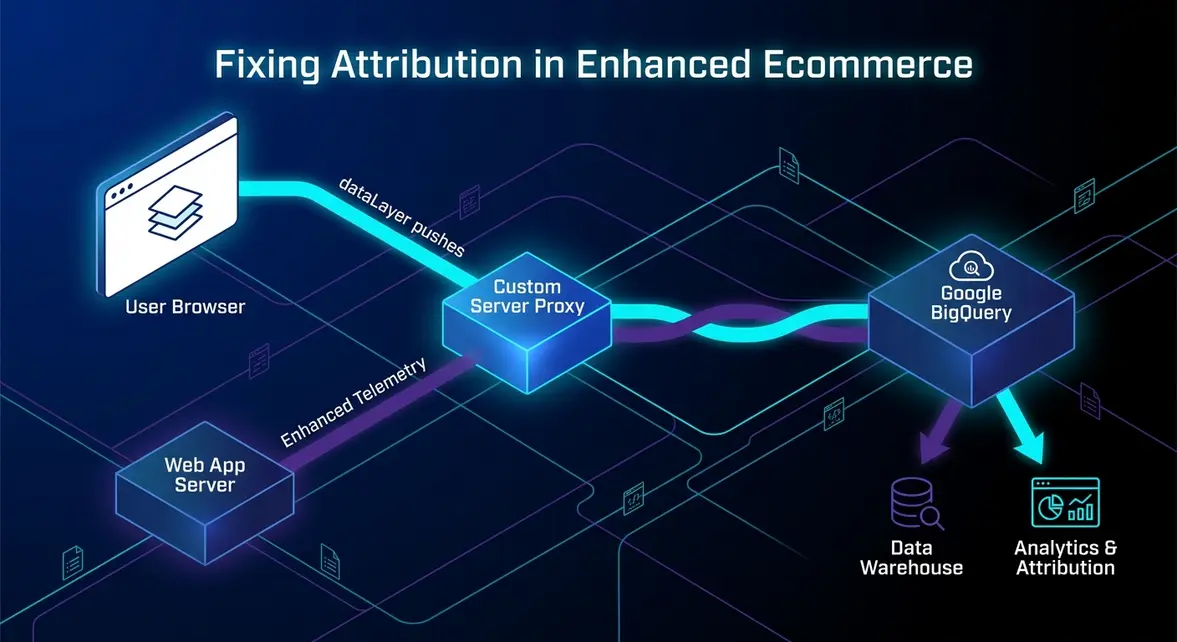
To solve this structural limitation, engineering teams must decouple tracking logic from transient browser memory and implement edge-routed data collection. By deploying a Server-Side Google Tag Manager (SS-GTM) container behind a first-party subdomain (e.g., telemetry.domain.com), teams set HTTP-only, secure cookies that persist beyond browser storage wipeouts. This architecture guarantees that the initial item_list_id and item_list_name metadata remains tied to the visitor's unified identity across sessions.
- First-Party Edge Proxying: Routes telemetry via Cloud Run or AWS ECS to bypass ad-blockers and retain cookie lifetime integrity.
- Item-Scoped Parameter Persistence: Preserves original list attribution by caching the list identifier alongside the user ID in server-side session stores (e.g., Redis).
- Deterministic Identity Stitching: Reconciles pre-login product discovery actions with post-authentication database records within a centralized data warehouse.
Marketing Ops Implementation: Deploying Deterministic Item-List Attribution
To accurately capture product list interactions without attribution drift, the client application must dispatch a standardized payload through the data layer. In modern Next.js or React single-page architectures, this requires pushing an explicit select_item event immediately prior to the navigation event, while simultaneously updating application state with the active list context.
Implement the following data layer push whenever a user interacts with a product listing or internal merchandising banner:
javascript window.dataLayer = window.dataLayer || []; window.dataLayer.push({ event: 'select_item', ecommerce: { item_list_id: 'featured_enterprise_solutions', item_list_name: 'Featured Enterprise Solutions Grid', items: [{ item_id: 'sku_enterprise_annual', item_name: 'Enterprise Tier Subscription', index: 1, item_category: 'B2B Software', price: 2400.00, quantity: 1 }] } }); Downstream, raw data ingested via Google Analytics 4 BigQuery Export must be transformed using window functions to properly allocate revenue back to the initial discovery touchpoint. When running analytical queries inside Google BigQuery, extract the initial list context using the following SQL model:
```sql WITH item_interactions AS ( SELECT user_pseudo_id, event_timestamp, event_name, item.item_id, item.item_list_id, item.item_list_name FROMproject_id.analytics_XXXXX.events_*,
UNNEST(items) AS item
WHERE
event_name IN ('select_item', 'purchase')
),
stitched_attribution AS (
SELECT
user_pseudo_id,
item_id,
event_name,
event_timestamp,
FIRST_VALUE(item_list_name IGNORE NULLS) OVER (
PARTITION BY user_pseudo_id, item_id
ORDER BY event_timestamp ASC
ROWS BETWEEN UNBOUNDED PRECEDING AND CURRENT ROW
) AS attributed_list_name
FROM
item_interactions
)
SELECT
attributed_list_name,
COUNT(DISTINCT user_pseudo_id) AS converting_users
FROM
stitched_attribution
WHERE
event_name = 'purchase'
GROUP BY
attributed_list_name;
---

*System Telemetry Source:* [Original Engineering Report](https://www.simoahava.com/analytics/attribution-enhanced-ecommerce-reports/)
Related Growth Blueprints
All Blueprints →Need this architecture deployed in your pipeline?
Skip the synchronous sales cycle and endless discovery calls. Submit your core acquisition or conversion bottleneck for a deep-dive asynchronous growth diagnostic.