GA4 BigQuery SQL Architecture Guide
Raw Telemetry Extraction: Moving Beyond Black-Box Aggregations
Historical web measurement relied heavily on Universal Analytics, where granular hit-level data access was locked behind Google Analytics 360 enterprise licensing fees exceeding $150,000 annually. Standard implementations were subject to strict hit limits, heavy data sampling on complex queries, and non-transparent sessionization logic that obscured true multi-touch attribution models. Teams attempting to analyze high-volume organic search journeys were systematically throttled by reporting interface thresholds and fixed aggregate metrics.
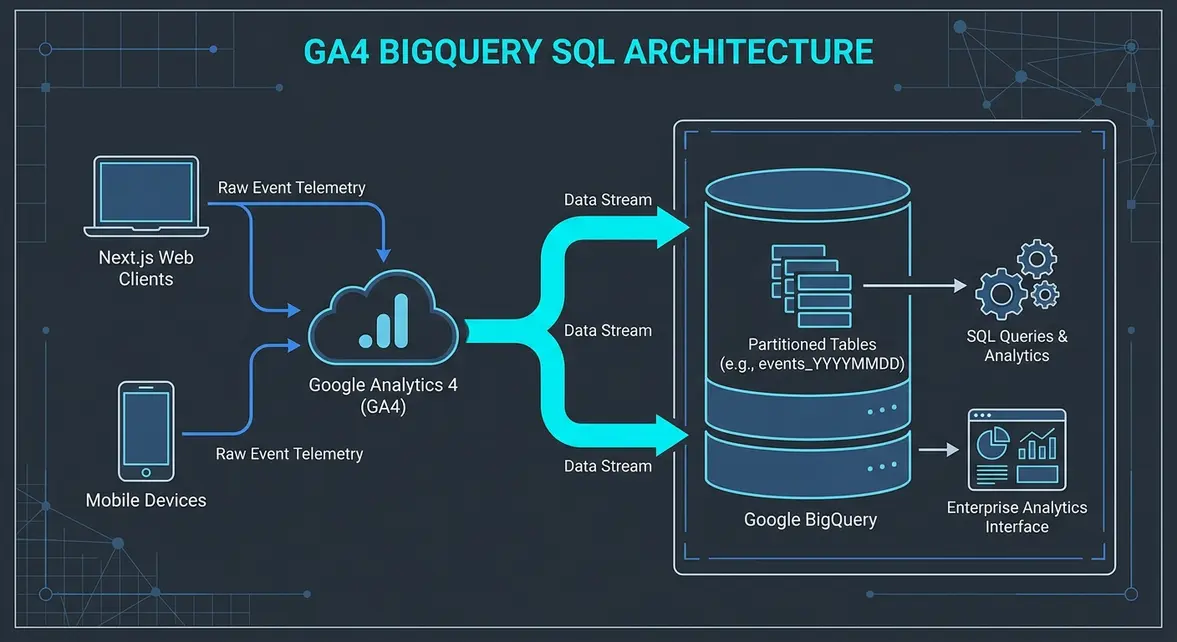
The native Google Analytics 4 (originally App + Web) export to Google BigQuery removes the enterprise cost barrier by providing direct access to raw, unsampled event streams. Telemetry is emitted as append-only records partitioned by event_date, exposing micro-interactions at millisecond precision. Rather than consuming pre-aggregated dimensions, data engineers and growth marketing leads gain unmitigated control over hit-level payloads, unnesting complex parameters to accurately measure user activation paths and long-tail algorithmic search capture without synthetic session boundaries.
Technical SEO & Data Architecture: De-Normalizing the Event Schema
The core structural primitive within GA4's BigQuery export is the repeated record. Unlike traditional relational tables with static column structures, GA4 formats event parameters and user properties as nested arrays of key-value pairs (RECORD and ARRAY datatypes). This schema reduces data footprint during transmission but requires specific structural normalization patterns inside the analytical pipeline to make URL-level technical SEO data queryable.
For technical SEO specialists, this architecture enables the precision monitoring of organic landing page mechanics. By processing the raw event stream, engineering teams can bypass the standard 24-48 hour UI aggregation latency and map precise Core Web Vitals distributions directly to landing page performance. Tracking largest_contentful_paint, cumulative_layout_shift, and first_input_delay as numeric event parameters directly in BigQuery unlocks deterministic performance monitoring across dynamic Next.js or Nuxt routes that standard Google Search Console aggregations obscure.
- Zero-Sampling Data Hygiene: Queries execute over 100% of event data points, completely eliminating the synthetic extrapolation common in large-scale enterprise analytics interfaces.
- Dynamic Parameter Extraction: Standard metrics like page paths, HTTP status signals, and canonical URL deviations are extracted via explicit
UNNEST()operations onevent_params. - Unified Journey Mapping: Web client visits and mobile application interactions converge under a uniform schema, utilizing persistent
user_pseudo_idand authenticateduser_idkeys.
Marketing Ops Implementation: High-Throughput SQL Sessionization
To compute meaningful growth metrics, marketing operations must transform raw event streams back into deterministic session models using standard SQL. The following production query pattern demonstrates how to extract the session identifier, isolate organic search landing pages, unpack session duration, and calculate engagement flags across partitioned event tables without incurring massive compute costs:
WITH flattened_events AS (
  SELECT
    event_timestamp,
    event_name,
    user_pseudo_id,
    (SELECT value.int_value FROM UNNEST(event_params) WHERE key = 'ga_session_id') AS session_id,
    (SELECT value.string_value FROM UNNEST(event_params) WHERE key = 'page_location') AS page_location,
    (SELECT value.string_value FROM UNNEST(event_params) WHERE key = 'medium') AS traffic_medium,
    (SELECT value.string_value FROM UNNEST(event_params) WHERE key = 'source') AS traffic_source,
    (SELECT value.int_value FROM UNNEST(event_params) WHERE key = 'engagement_time_msec') AS engagement_time
  FROM
    `project-id.analytics_123456789.events_*`
  WHERE
    _TABLE_SUFFIX BETWEEN '20240101' AND '20240131'
)
SELECT
  user_pseudo_id,
  session_id,
  traffic_source,
  traffic_medium,
  MIN(page_location) AS landing_page,
  TIMESTAMP_MICROS(MIN(event_timestamp)) AS session_start,
  ROUND(SUM(COALESCE(engagement_time, 0)) / 1000, 2) AS total_engagement_seconds
FROM
  flattened_events
WHERE
  session_id IS NOT NULL
GROUP BY
  user_pseudo_id,
  session_id,
  traffic_source,
  traffic_medium;
When operationalizing Google Tag Manager to feed this schema, ensure custom parameters comply with downstream ingestion types. For instance, passing an internal app state variable formatted as {{Custom App State}} requires explicit casting to prevent mixed-type fragmentation across the BigQuery table schema.
B2B Growth & Pipeline Leverage: Account-Level Attribution Engine
Exporting raw telemetry directly into BigQuery enables high-velocity B2B revenue engines to unify anonymous clickstreams with downstream CRM systems such as Salesforce or HubSpot. Traditional platform attribution relies heavily on first-click or last-click models that assign artificial weight to branded search or gated content downloads. By joining raw web event logs against CRM contact creation records via hashed email address keys or custom tracking identifiers, teams uncover the multi-touch organic path leading to sales pipeline creation.
This deterministic join pattern eliminates the typical 20% to 35% attribution blind spot found in third-party cookie models. Growth engineering teams can identify high-value programmatic SEO programmatic patterns (e.g., dynamic product comparison matrices or integration index pages) that yield low initial direct conversion but represent 45% of pre-pipeline touchpoints for six-figure annual contract value (ACV) deals. Marketing capital can subsequently be reallocated away from saturated commercial paid keywords toward programmatic technical content engines that measurably shorten the enterprise sales cycle from 90 to 52 days.
System Telemetry Source: Original Engineering Report
Related Growth Blueprints
All Blueprints →Need this architecture deployed in your pipeline?
Skip the synchronous sales cycle and endless discovery calls. Submit your core acquisition or conversion bottleneck for a deep-dive asynchronous growth diagnostic.