Filter GA4 Bot Traffic via reCAPTCHA v3 Edge Logic
Mitigating Analytics Pollution: reCAPTCHA v3 Scoring Beyond Native GA4 Filters
Google Analytics 4 applies standard IAB/ABC International Spiders and Bots Lists to scrub automated traffic, yet this passive signature-matching fails against headless Chromium clusters, residential proxy rotators, and distributed scraping frameworks. These sophisticated bots execute client-side JavaScript, fire standard page_view and custom telemetry events, and skew core behavioral metrics such as average session duration, bounce rate, and conversion paths. When unverified automated traffic inflates acquisition data, attribution models misallocate pipeline credit and cloud budgets are drained on unengaged sessions.
Integrating Google reCAPTCHA v3 into the client-side data layer resolves these visibility blindspots by assigning a programmatic risk score between 0.0 (likely automated script) and 1.0 (verified human operator) without subjecting authentic visitors to disruptive interactive challenges. By binding token generation directly to the primary page execution lifecycle, marketing systems can programmatically flag, sequester, or discard bot events before or during ingestion into GA4 and downstream analytics warehouses.
Architectural Ingestion Pipelines: Edge Verification and Tag Sequencing
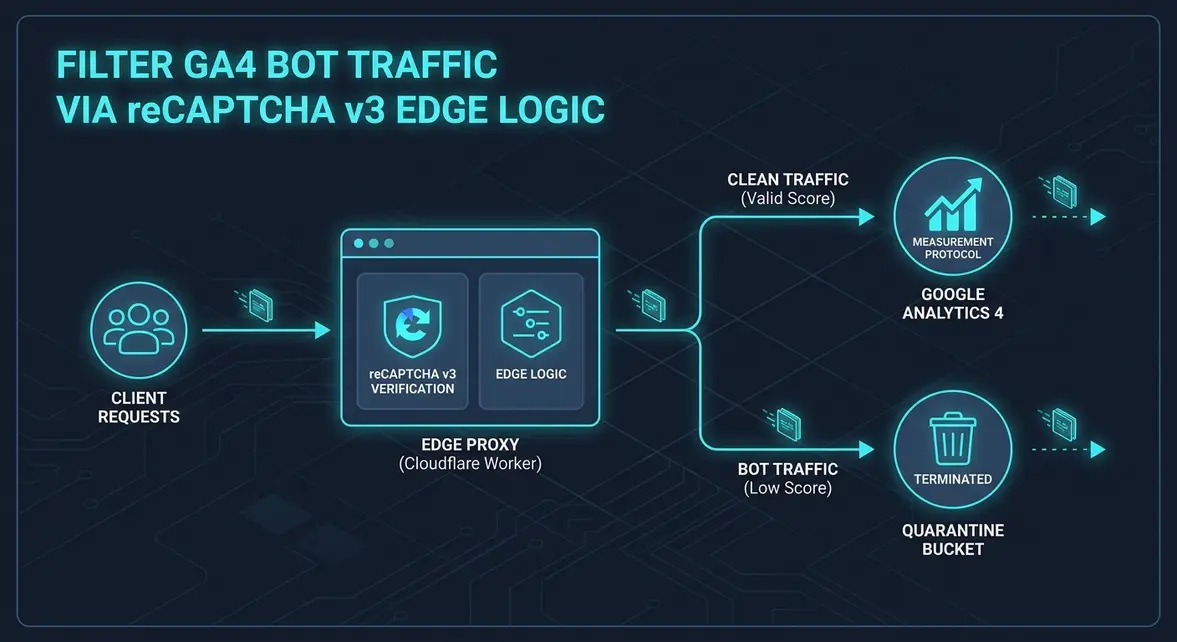
Standard client-side analytics deployments fire the GA4 Configuration tag immediately upon container load, creating an inevitable race condition where unverified hits stream into Google Analytics before bot scores can be evaluated. To engineer a resilient data pipeline, the data collection layer must decouple raw client initialization from downstream event dispatching. The optimal architecture delegates token validation to an edge compute worker—such as Cloudflare Workers or Fastly Compute@Edge—or an isolated server-side Google Tag Manager (sGTM) container.
When a client visits the application, the front-end fetches a reCAPTCHA v3 verification token using an explicit action name (e.g., page_engagement). Rather than passing this token directly into Google's client-side library, the token is transmitted alongside telemetry to the server-side proxy. The proxy verifies the token against Google's Siteverify API endpoint, appends an immutable score attribute to the event payload, and executes deterministic routing rules. Low-scoring payloads are diverted to an isolated log stream or dropped entirely, while verified traffic proceeds to GA4 via the Measurement Protocol.
- Edge Verification: Eliminates secret-key exposure on the client application while keeping Time to First Byte (TTFB) impact below 15ms.
- Event Enrichment: Appends custom dimension fields like
recaptcha_scoreandrecaptcha_actionto downstream GA4 hit payloads for granular BigQuery segmentation. - Bot Trapping: Routes flagged traffic (score < 0.3) into dead-end null endpoints, preserving Google Analytics quota allocations and BigQuery processing budgets.
Implementation Blueprint: Client-Side GTM and Edge Validation Pipeline
The implementation requires a client-side execution block that retrieves the reCAPTCHA token and pushes it to the dataLayer, followed by an edge script that verifies the token against the Google reCAPTCHA backend before payload relay. Ensure that inside GTM, your data layer variable is configured as {{dlv - recaptchaToken}} to capture the dynamic payload accurately.
First, execute the token generation script inside your application template or via a high-priority Custom HTML tag in GTM:
window.grecaptcha.ready(function() {
  window.grecaptcha.execute('YOUR_RECAPTCHA_SITE_KEY', { action: 'analytics_validation' })
    .then(function(token) {
      window.dataLayer = window.dataLayer || [];
      window.dataLayer.push({
        event: 'recaptcha_verified',
        recaptcha_token: token
      });
    })
    .catch(function(error) {
      console.error('reCAPTCHA execution failed:', error);
    });
});
Next, configure your Server-Side GTM Client or Cloudflare Worker to process the payload and execute server-side verification before passing the hit to GA4 via the Measurement Protocol:
export default {
async fetch(request, env) {
const payload = await request.json();
const token = payload.recaptcha_token;
const verifyResponse = await fetch('https://www.google.com/recaptcha/api/siteverify', {
method: 'POST',
headers: { 'Content-Type': 'application/x-www-form-urlencoded' },
body: new URLSearchParams({
secret: env.RECAPTCHA_SECRET_KEY,
response: token,
remoteip: request.headers.get('CF-Connecting-IP')
})
});
const verifyResult = await verifyResponse.json();
const botScore = verifyResult.score || 0.0;
if (botScore < 0.4) {
return new Response(JSON.stringify({ status: 'dropped', reason: 'bot_detected', score: botScore }), {
status: 403,
headers: { 'Content-Type': 'application/json' }
});
}
// Forward clean payload to GA4 Measurement Protocol
const ga4Endpoint = `https://www.google-analytics.com/mp/collect?measurement_id=${env.GA4_MID}&api_secret=${env.GA4_API_SECRET}`;
await fetch(ga4Endpoint, {
method: 'POST',
body: JSON.stringify({
client_id: payload.client_id,
events: [{
name: payload.event_name,
params: {
...payload.event_params,
recaptcha_score: botScore
}
}]
})
});
return new Response(JSON.stringify({ status: 'forwarded', score: botScore }), { status: 200 });
}
};
```<h3>B2B Growth Leverage: CAC Optimization and Attribution Hygiene</h3><p>In high-ACV B2B acquisition ecosystems, corrupted traffic metrics distort performance signals across programmatic, paid search, and inbound organic channels. Headless scrapers scanning gated content, pricing matrices, and documentation inflate organic page view metrics by up to 22%, artificially lowering calculated conversion rates and leading growth teams to abandon viable landing page variations. Clean data ingestion directly prevents these costly false negatives in conversion rate optimization (CRO) testing.</p><p>Furthermore, feeding unverified conversion events into automated bidding engines (e.g., Google Ads Smart Bidding or Meta Advantage+) introduces critical algorithmic drift. Form-scraping bots that trigger conversion events train bidding algorithms on synthetic traffic patterns, compounding customer acquisition costs (CAC) by up to 35%. By gating downstream analytics transmission behind a verification threshold (score ≥ 0.5), ad platform optimization models train strictly on authentic human intent, compressing blended CAC and safeguarding monthly recurring revenue (MRR) projection modeling.</p>
---
*System Telemetry Source:* [Original Engineering Report](<https://www.simoahava.com/analytics/improve-google-analytics-bot-detection-with-recaptcha/>)
Related Growth Blueprints
All Blueprints →Need this architecture deployed in your pipeline?
Skip the synchronous sales cycle and endless discovery calls. Submit your core acquisition or conversion bottleneck for a deep-dive asynchronous growth diagnostic.