GA4 Custom Parameter Modeling & Event Architecture
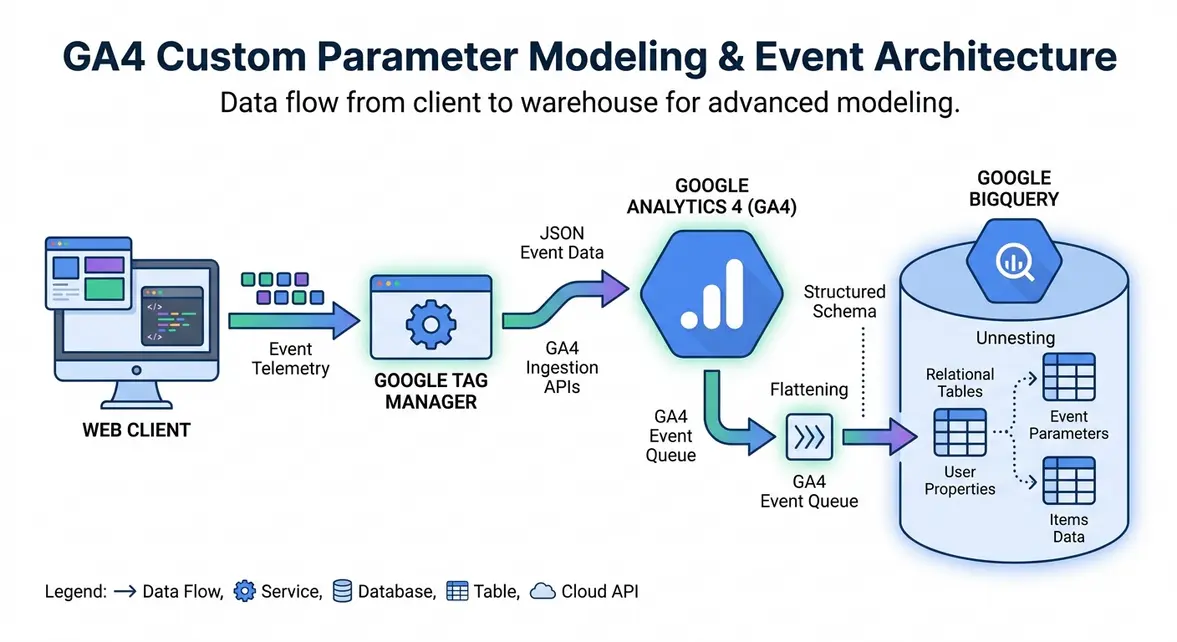
Deconstructing Universal Analytics Rigid Schemas for Event-Driven Ingestion
The legacy Google Universal Analytics (UA) architecture forced event tracking into a rigid, four-dimensional taxonomy: Category, Action, Label, and Value. This hierarchical constraint frequently led growth engineers to serialize distinct metadata attributes into pipe-delimited strings within the Label field, creating acute data-parsing bottlenecks in downstream analytics platforms. The Google Analytics 4 (originally App + Web) paradigm replaces hit-level hierarchies with a unified, event-driven schema where every user action is an independent entity enriched by arbitrary key-value pairs termed event parameters.
While this decoupling delivers programmatic flexibility, it introduces a dual-layer reporting architecture. Dispatching a key-value parameter via the Google tag (gtag.js) or a Google Tag Manager client-side container does not automatically surface that variable in the native GA4 UI reporting explorer. To render these parameters in standard exploration interfaces, data engineers must register custom dimension definitions that link runtime parameter keys to internal schema slots. Conversely, unindexed parameters bypass the standard UI aggregation pipeline but remain persistently queryable in raw streaming BigQuery exports, eliminating UA-era hit-type fragmentation.
Technical SEO, Indexing Signals, and Analytics Data Architecture
Deploying granular event parameters directly impacts technical SEO and digital experience telemetry. Rather than maintaining disparate tracking systems for search telemetry and product analytics, technical teams can pipe Core Web Vitals metrics, crawl/rendering contexts, and indexation flags through a single analytics client payload. For Single Page Applications (Next.js, Remix, Nuxt), this architecture enables programmatic dispatch of route changes alongside DOM mutation metadata, avoiding the high payload overhead of firing full UA pageviews on virtual navigations.
Understanding parameter constraints and storage mechanics is essential when structuring an enterprise acquisition pipeline:
- High-Cardinality Management: Standard properties enforce a limit of 50 event-scoped custom dimensions and 25 user-scoped dimensions. Registering dynamic identifiers (e.g., raw UUIDs or high-entropy timestamps) as standard UI dimensions triggers automated (other) thresholding rollups. Raw high-cardinality values must be queried directly from BigQuery rather than mapped to the GA4 UI.
- Unnesting Complex Payloads: GA4 parameters are exported to Google BigQuery as a repeated record:
event_paramscontainingkey,value.string_value,value.int_value,value.float_value, andvalue.double_value. SQL parsing requires explicit cross-joins and unnesting operations to reconstruct relational tables. - Sub-Resource Latency Isolation: Parameter payloads must be handled asynchronously via non-blocking browser APIs (e.g., Navigator.sendBeacon) to ensure metrics collection does not contend with the main thread during Largest Contentful Paint (LCP) and Interaction to Next Paint (INP) rendering cycles.
Marketing Ops Implementation: Client Dispatch to BigQuery Extraction
To capture and query custom parameters, engineering must implement a clean runtime dispatch protocol, register the parameter schema, and extract the unaggregated data downstream. Below is the precise implementation pattern for tracking high-intent organic engagement and querying the schema in BigQuery.
First, push a standardized event payload to the GTM dataLayer using typed parameters on key SEO landing pages:
javascript window.dataLayer = window.dataLayer || []; window.dataLayer.push({ event: 'editorial_engagement', content_metadata: { cluster: 'technical-seo', word_count: 2450, reading_depth_percentage: 75, content_id: 'seo_arch_1092' } }); Within Google Tag Manager, configure a Data Layer Variable referencing content_metadata.cluster. If mapping parameters in dynamic variables, ensure variable tokens such as {{DLV - Content Cluster}} map directly to the custom parameter name inside your GA4 Event Tag.
Once dispatched, the parameter must be extracted via Google BigQuery to circumvent UI sampling and explore exact correlation across enterprise acquisition paths:
sql SELECT event_date, event_timestamp, event_name, (SELECT value.string_value FROM UNNEST(event_params) WHERE key = 'cluster') AS content_cluster, (SELECT value.int_value FROM UNNEST(event_params) WHERE key = 'reading_depth_percentage') AS depth_pct, user_pseudo_id FROM `project_id.analytics_123456789.events_*` WHERE event_name = 'editorial_engagement' AND _TABLE_SUFFIX BETWEEN '20240101' AND '20240131' LIMIT 1000; B2B Growth & MRR Leverage: Pipeline Attribution Modeling
Standard last-click attribution frequently attributes B2B pipeline creation to generic direct or branded search conversions, hiding the specific technical articles that drove initial product evaluation. By parameterizing top-of-funnel content consumption—capturing attributes like content_cluster, code_snippet_copied, and api_spec_downloaded—growth teams can join anonymous client telemetry with downstream CRM contact records in BigQuery following a demo form submission.
Correlating custom content parameters with CRM opportunity stages isolates the exact organic content clusters yielding pipeline velocity. For example, enterprise infrastructure companies utilizing this schema can determine that prospects consuming content marked with cluster: 'kubernetes-architecture' produce an average contract value (ACV) 3.4x higher than standard product overview traffic, while simultaneously trimming customer acquisition cost (CAC) by 18% through the deprecation of non-converting editorial initiatives.
System Telemetry Source: Original Engineering Report
Related Growth Blueprints
All Blueprints →Need this architecture deployed in your pipeline?
Skip the synchronous sales cycle and endless discovery calls. Submit your core acquisition or conversion bottleneck for a deep-dive asynchronous growth diagnostic.