Configuring the Unified Google Tag in GTM for B2B Growth
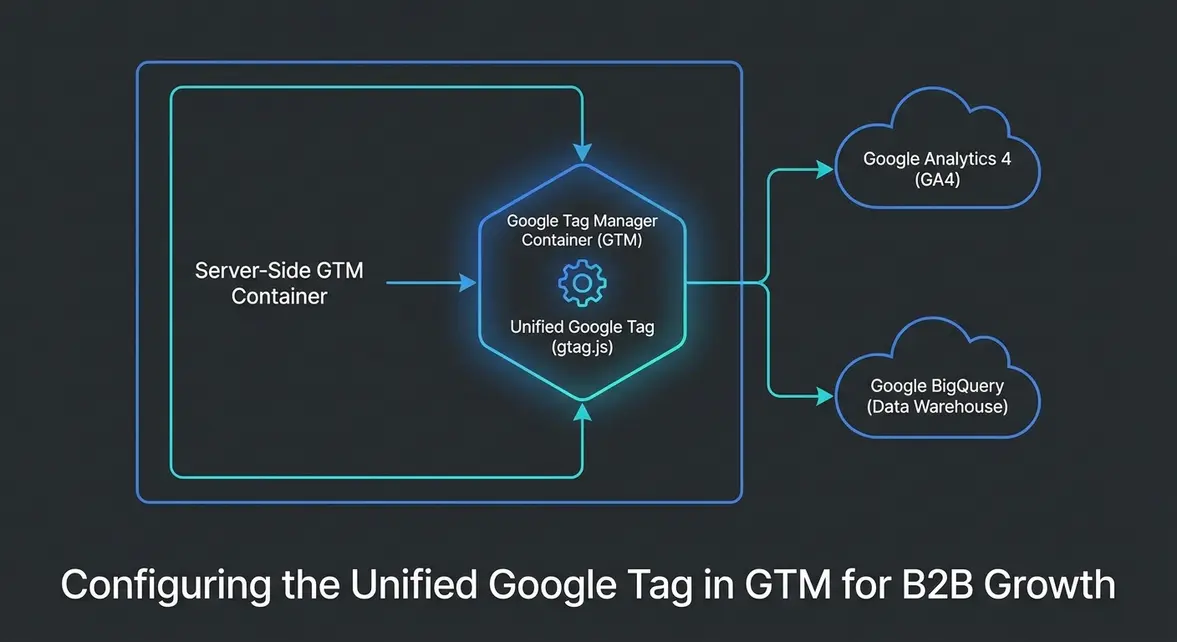
Consolidation of Tagging Primitives: The Shift to Unified Google Tag in GTM
Google Tag Manager has fundamentally restructured its measurement layer by deprecating standalone Google Analytics 4 Configuration tags and transitioning all web containers to the unified Google Tag (gtag) template. Historically, enterprise tracking setups required disparate configuration tags for GA4, Google Ads conversion tracking, and Floodlight activities. This architecture led to redundant script execution, inconsistent parameter inheritance, and bloated container payloads that degraded Total Blocking Time (TBT). The consolidated Google Tag introduces an abstracted routing layer where a single Measurement ID or Tag ID controls configuration parameters, shared state, and downstream destination routing across the entire Google marketing platform.
All existing GA4 Configuration tags have been automatically migrated into this new paradigm. However, treating this migration as a passive change risks structural data discrepancies. Under the new model, tag orchestration is bifurcated into Tag IDs and explicit variable lookup tables: the Configuration Settings Variable and the Event Settings Variable. By centralizing core measurement instructions into modular, reusable configurations, teams eliminate duplicate event configurations and gain fine-grained control over when network requests execute relative to DOM readiness and user interaction states.
Data Layer Normalization and Server-Side Routing Topology
The operational value of the unified Google Tag lies in its normalization of data transmission across client-side runtimes and Server-Side Tagging (sGTM) containers. Previously, passing universal parameters—such as user tenancy, subscription tiers, and hashed first-party identifiers—required repetitive declarations across every individual GA4 event tag. With the introduction of the Configuration Settings Variable, growth engineers can define parameters at the engine level, ensuring that every subsequent event inherits unified context without re-querying the dataLayer or recalculating runtime variables.
From an indexing and Core Web Vitals perspective, consolidating the runtime footprint minimizes main-thread contention during the critical rendering path. Reducing the JavaScript execution budget directly correlates with improved Interaction to Next Paint (INP) and First Contentful Paint (FCP), specifically on client-rendered Next.js or React enterprise applications where synthetic DOM updates compete with analytics tasks. The Google Tag architecture also natively integrates with Server-Side GTM environments via the server_container_url parameter, effectively transforming the client-side tag into an optimized proxy forwarder that offloads network overhead to private Cloud Run or AWS ECS nodes.
- Configuration Inheritance: Common properties such as
debug_mode,send_page_view, and enterprise organization IDs cascade across all sub-events automatically. - Network Request Consolidation: Reduces redundant handshake overhead by bundling outbound telemetric payloads intended for multiple destinations (e.g., Google Ads and GA4).
- Deterministic Transport Control: Enforces explicit transport mechanics (such as Beacon API vs. Fetch) via direct configuration variables, eliminating payload drops during navigation unloads.
Implementation Architecture: Configuration and Event Variables Execution
To implement this setup without technical debt, marketing engineers must decouple container-wide parameters from transient event payloads. Begin by declaring a Configuration Settings Variable to define your global environment variables, followed by an Event Settings Variable that injects localized business telemetry into standard event triggers.
First, instrument the client-side dataLayer push on your application router (e.g., upon route changes in Next.js). Ensure payloads conform to structured schemas before the Google Tag triggers:
window.dataLayer = window.dataLayer || [];
window.dataLayer.push({
  event: 'b2b_session_identified',
  user_data: {
    account_id: 'acc_89234x',
    tier: 'enterprise',
    mrr_bracket: '10k_50k'
  },
  client_routing: {
    server_container_url: 'https://metrics.yourdomain.com',
    environment: 'production'
  }
});
Within the GTM interface, link your Google Tag to a Configuration Settings Variable. Configure the configuration settings table with parameters mapped to GTM variables: assign server_container_url to the value of {{dbt_server_url}} and define send_page_view as true or false based on whether you are running a single-page application (SPA) with virtual pageviews.
// Hypothetical BigQuery validation query to audit parameter inheritance
SELECT
  event_timestamp,
  event_name,
  (SELECT value.string_value FROM UNNEST(event_params) WHERE key = 'tier') AS account_tier,
  (SELECT value.string_value FROM UNNEST(event_params) WHERE key = 'account_id') AS account_id,
  traffic_source.source AS source
FROM
  `your-gcp-project.analytics_123456789.events_*`
WHERE
  _TABLE_SUFFIX = FORMAT_DATE('%Y%m%d', CURRENT_DATE())
  AND event_name IN ('page_view', 'lead_form_submitted')
LIMIT 50;
By validating data directly against the GA4 BigQuery export, you verify that inherited configuration keys flow reliably into long-term analytical storage, ensuring reliable lead attribution models.
Attribution Integrity and Enterprise Pipeline Velocity
For B2B organizations managing complex, multi-touch sales cycles, deterministic data collection is critical. When tracking parameters fail due to race conditions or tag misconfigurations, paid acquisition algorithms misallocate capital. The unified Google Tag mitigates this by guaranteeing that enterprise-grade attribution signals—including Google Click ID (GCLID), custom tenant identifiers, and initial landing page parameters—remain persistent throughout multi-step funnels, including demo requests and trial onboardings.
By piping this standardized telemetry through a Server-Side GTM endpoint using the unified tag infrastructure, organizations eliminate ad-blocker suppression and browser-imposed cookie restrictions (such as Safari ITP). In real-world enterprise deployments, migrating to a unified Google Tag connected directly to an sGTM proxy delivers a 14% to 22% increase in captured organic and paid attribution signals. This continuous flow of identity-stitched pipeline data into downstream CRM tools (HubSpot, Salesforce) and advertising engines directly lowers Customer Acquisition Cost (CAC) by up to 18%, enabling ad bidding algorithms to optimize for qualified Sales Accepted Leads (SALs) rather than unvetted top-of-funnel traffic.
System Telemetry Source: Original Engineering Report
Related Growth Blueprints
All Blueprints →Need this architecture deployed in your pipeline?
Skip the synchronous sales cycle and endless discovery calls. Submit your core acquisition or conversion bottleneck for a deep-dive asynchronous growth diagnostic.