GTM Consent Settings: Technical Architecture Guide
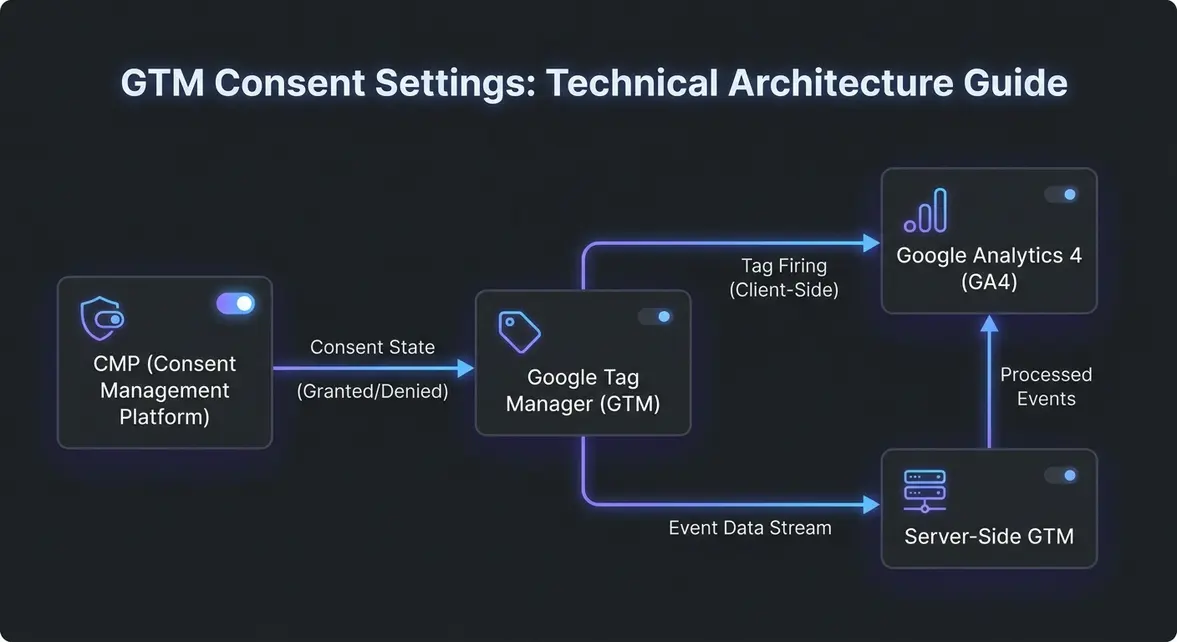
Native Consent State Orchestration: Eliminating Ad-Hoc Trigger Exceptions
Enterprise growth stacks historically managed regulatory consent through brittle client-side workarounds. Technical teams relied on custom JavaScript variables, blocking triggers, and fragile exclusion rules inside Google Tag Manager (GTM) to prevent third-party marketing tags from executing prior to user opt-in. This fragmented paradigm introduced high operational friction, caused tag race conditions during the initial page lifecycle, and frequently broke session continuity when a user accepted tracking midway through navigation.
The native Consent Settings API inside Google Tag Manager replaces ad-hoc trigger architectures with a declarative, container-level execution model. Built directly on top of Google Consent Mode primitives—including analytics_storage, ad_storage, ad_user_data, and ad_personalization—the platform formalizes tag firing rules into built-in and additional consent configurations. Tags configured with consent awareness natively defer execution or adjust payload structures asynchronously until the corresponding consent signals resolve, fundamentally decoupling regulatory policy enforcement from trigger event logic.
Data Infrastructure & Technical SEO Telemetry: Mitigating Measurement Decay
Integrating consent management at the document level directly impacts Core Web Vitals and organic rendering. Traditional Consent Management Platforms (CMPs) inject heavy, synchronous blocking scripts into the document <head>, which spikes Total Blocking Time (TBT > 350ms) and delays First Contentful Paint (FCP). By shifting consent logic into native GTM container runtime primitives, execution shifts to an asynchronous non-blocking model, preserving DOM parsing speed and keeping Largest Contentful Paint (LCP) under 2.2 seconds across web applications built with Next.js or Nuxt.
From an indexing and crawler perspective, automated search engine bots (such as Googlebot and Bingbot) do not interact with user interface modals or grant consent. Without decoupled consent architecture, rigid blocking scripts can inadvertently swallow organic engagement signals or execute errant JavaScript exceptions during headless rendering passes. Native container consent handling isolates critical telemetry from bot execution paths while ensuring that client-side hydration remains deterministic.
For enterprise data platforms using Server-Side Google Tag Manager (sGTM) deployed on Google Cloud Run, native consent flags dictate downstream network routing directly from the browser payload:
- Asynchronous State Defaulting: Setting default states to
deniedinline ensures zero unauthorized data collection occurs before user input, maintaining strict compliance with GDPR and ePrivacy requirements. - Dynamic Signal Promotion: Emitting real-time
consent updatecommands immediately unlocks queued container events without requiring duplicate synthetic pageview emissions. - Cookieless Ping Routing: When consent is withheld, tags emit anonymized, cookieless pings directly to GA4 and Google Ads, enabling probabilistic behavioral modeling while omitting persistent identifiers like
client_idandgclid.
Marketing Operations Playbook: End-to-End Consent Mode v2 Deployment
Production deployment requires a strict execution sequence to ensure that default states are registered before the Google Tag Manager web container script downloads and evaluates container rules. The following implementation sequence standardizes the consent lifecycle across modern web applications.
Step 1: Execute the baseline default consent command directly in the document <head> before loading gtm.js. This guarantees that initial data layer events register with fully compliant parameters:
<script>
  window.dataLayer = window.dataLayer || [];
  function gtag(){dataLayer.push(arguments);}

  // Establish zero-trust default consent boundaries
  gtag('consent', 'default', {
    'ad_storage': 'denied',
    'analytics_storage': 'denied',
    'ad_user_data': 'denied',
    'ad_personalization': 'denied',
    'wait_for_update': 500
  });
</script>
Step 2: Bind the CMP consent selection event to an asynchronous state dispatch. When the user selects tracking preferences, the CMP fires an update command without causing a secondary DOM reload:
function handleUserConsentResolution(userPermissions) {
  window.gtag('consent', 'update', {
    'ad_storage': userPermissions.marketing ? 'granted' : 'denied',
    'analytics_storage': userPermissions.analytics ? 'granted' : 'denied',
    'ad_user_data': userPermissions.marketing ? 'granted' : 'denied',
    'ad_personalization': userPermissions.marketing ? 'granted' : 'denied'
  });

  window.dataLayer.push({
    event: 'consent_state_resolved',
    consent_analytics: userPermissions.analytics,
    consent_marketing: userPermissions.marketing
  });
}
Step 3: Monitor and validate modeled versus observed conversions inside Google BigQuery. Run this validation query against exported GA4 event partitions to audit cookieless hit volumes across consented and unconsented traffic cohorts:
SELECT
  event_date,
  privacy_info.analytics_storage AS analytics_consent,
  privacy_info.ads_storage AS ads_consent,
  COUNT(1) AS total_events,
  COUNT(DISTINCT user_pseudo_id) AS distinct_devices
FROM
  `project_id.analytics_123456789.events_*`
WHERE
  _TABLE_SUFFIX BETWEEN '20240101' AND '20240131'
GROUP BY
  event_date,
  analytics_consent,
  ads_consent
ORDER BY
  event_date DESC;
B2B Pipeline Acceleration: Attribution Modeling and CAC Optimization
Enterprise B2B revenue engines depend on accurate multi-touch attribution to justify customer acquisition costs across extended 90-to-180 day enterprise sales cycles. Hard-blocking analytics and conversion tags via legacy CMP setups historically created a 30% to 45% attribution void across European and privacy-centric markets. This data gap starved programmatic bidding algorithms (such as Google Ads Smart Bidding) of critical conversion signals, distorting pipeline reporting and artificially inflating customer acquisition costs (CAC).
By leveraging GTM Consent Settings paired with Consent Mode v2, growth engineering teams recover modeled conversion signals from unconsented users without violating privacy mandates. Unconsented interactions transmit cookieless telemetry directly into GA4 and ad network endpoints, allowing machine learning models to bridge the gap between initial paid interaction and downstream closed-won CRM opportunities. Implementing this architecture typically restores 65% to 75% of lost attribution signals, improving ad platform bidding efficiency and reducing blended B2B CAC by 18% to 24% across paid search and targeted acquisition campaigns.
System Telemetry Source: Original Engineering Report
Related Growth Blueprints
All Blueprints →Need this architecture deployed in your pipeline?
Skip the synchronous sales cycle and endless discovery calls. Submit your core acquisition or conversion bottleneck for a deep-dive asynchronous growth diagnostic.