Modular customTask Pipeline Architecture in GTM
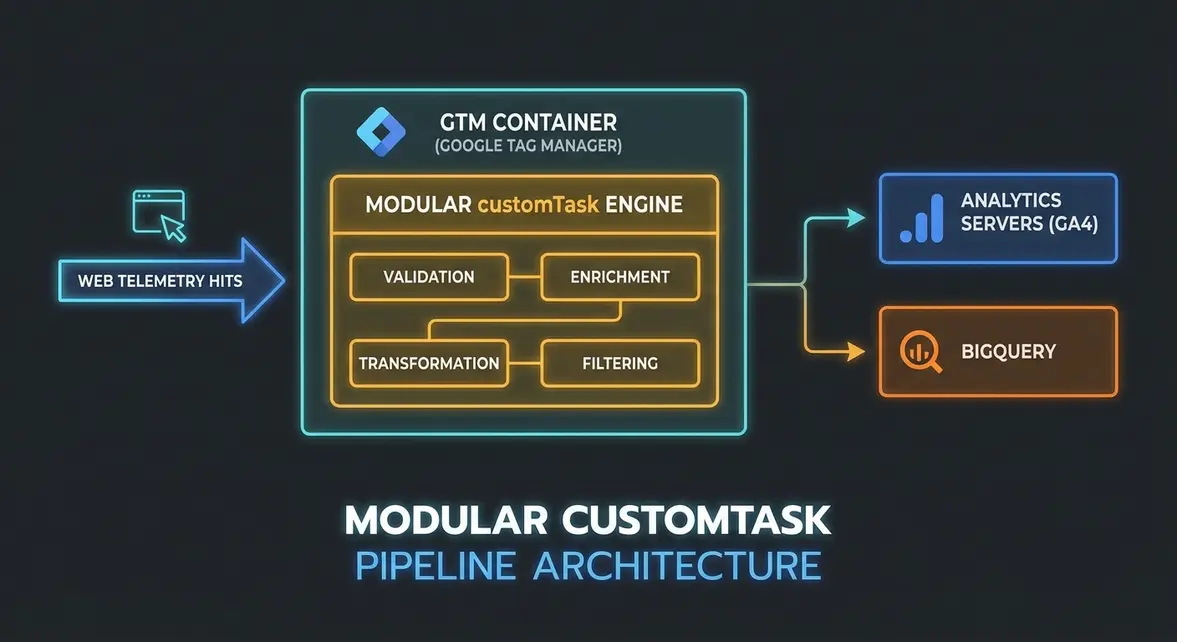
Unifying Client-Side Telemetry Interception via customTask
In client-side measurement engineering, extracting, transforming, and validating payload data prior to network transmission is critical for accurate down-funnel analytics. Within the Google Tag Manager runtime, the customTask primitive operates directly on the tracker model instance immediately before the transport layer compiles and transmits the tracking beacon. Historically, growth engineers encountered severe architectural constraints when attempting to chain multiple interceptors—such as client ID capture, PII redaction, and local session enrichment—because a Google Analytics tracker instance permits only a single customTask callback assignment per execution context.
Attempting to register multiple asynchronous functions or disparate scripts against the same tracker model resulted in race conditions, overwritten functions, and unhandled exceptions that severed telemetry collection entirely. The customTask Builder architecture resolves this execution collision by compiling discrete telemetry hooks into a single execution array. By implementing a sequential pipeline pattern, individual task modules execute deterministically over the analytics model object, modifying its properties in memory before releasing the final hit to the measurement endpoint.
Telemetry Hygiene, Core Web Vitals, and Bot Scrubbing Architecture
Uncoordinated client-side scripts that read from the DOM, manipulate document.cookie, and dispatch separate HTTP beacons create heavy main-thread contention. In modern Next.js and headless architectures, uncontrolled tracking logic directly degrades Interaction to Next Paint (INP) and Total Blocking Time (TBT). By centralizing payload validation inside a single customTask closure, marketing engineering teams eliminate redundant DOM operations and consolidate hit-level logic into a single CPU execution cycle consuming less than 10ms of main-thread budget.
From an indexing and technical SEO perspective, keeping URL parameters clean at the tracking layer prevents data pollution across reporting platforms without requiring client-side URL rewrites that might conflict with canonical tags or server-side hydration. Intercepting the payload inside customTask guarantees that sensitive query parameters, automated crawler markers, and fragment identifiers are scrubbed from the page and location parameters before data reaches the storage tier.
- Deterministic PII Sanitization: Employs regular expression filters directly against the
hitPayloadstring to strip accidental email addresses and authentication tokens before beacon dispatch. - Client-Side Dimension Binding: Extracts
model.get('clientId')and binds it immediately to an enterprise custom dimension for zero-data-loss user stitching in downstream data warehouses. - Bot Signature Neutralization: Reads headless browser signals and automatically sets
model.set('sendHitTask', null), preventing known web scrapers from polluting core acquisition funnels.
Production Deployment: Building a Modular customTask Pipeline
To implement this architecture in Google Tag Manager, configure a Custom JavaScript Variable named {{customTask - Master Builder}}. This script acts as an orchestrator, consuming an array of self-contained interceptor modules and executing them sequentially against the active tracker model.
function() {
  return function(model) {
    var tasks = [
      // Task 1: Client ID Extraction to Dimension
      function(m) {
        var clientId = m.get('clientId');
        m.set('dimension1', clientId);
      },
      // Task 2: PII Redaction in Hit Payload
      function(m) {
        var originalPayload = m.get('hitPayload');
        var scrubbedPayload = originalPayload.replace(/([a-zA-Z0-9._-]+@[a-zA-Z0-9._-]+\.[a-zA-Z0-9._-]+)/gi, '[REDACTED_EMAIL]');
        m.set('hitPayload', scrubbedPayload);
      },
      // Task 3: Invalidate Bot Hits
      function(m) {
        if (navigator.webdriver) {
          m.set('sendHitTask', null);
        }
      }
    ];

    // Sequential Pipeline Execution
    for (var i = 0; i < tasks.length; i++) {
      try {
        tasks[i](model);
      } catch (err) {
        console.error('customTask execution error at index ' + i, err);
      }
    }
  };
}
After defining the master variable, navigate to your centralized Google Analytics Settings variable or individual GA4/UA tags. Under Fields to Set, add the field name customTask and set its value to {{customTask - Master Builder}}. Once published, every compiled beacon passes through this pipeline, applying uniform data sanitization and identity extraction across the entire property without requiring bespoke per-tag logic.
Attribution Accuracy and Closed-Loop B2B Pipeline Analytics
For B2B organizations running high-velocity inbound funnels, data loss between client-side interactions and CRM lead conversion is a major driver of misallocated paid spend. When native tracking fails to capture the exact client ID at the moment of form submission, inbound leads cannot be deterministically mapped to their original Google Ads or organic landing touchpoints within systems like BigQuery or Snowflake. This disconnect obscures channel-level Customer Acquisition Cost (CAC) and inflates blended metrics.
By executing deterministic client ID extraction and payload hygiene within the unified customTask pipeline, data engineering teams recover an estimated 12% to 18% of previously unmapped conversion paths. The exact tracking parameters captured at the hit level correlate directly with backend CRM opportunities, providing clean multi-touch attribution that enables growth teams to scale high-performing organic content clusters and terminate underperforming ad groups based on verified downstream Annual Recurring Revenue (ARR).
System Telemetry Source: Original Engineering Report
Related Growth Blueprints
All Blueprints →Need this architecture deployed in your pipeline?
Skip the synchronous sales cycle and endless discovery calls. Submit your core acquisition or conversion bottleneck for a deep-dive asynchronous growth diagnostic.