Hybrid GA4 Routing: Splitting Client & Server Telemetry
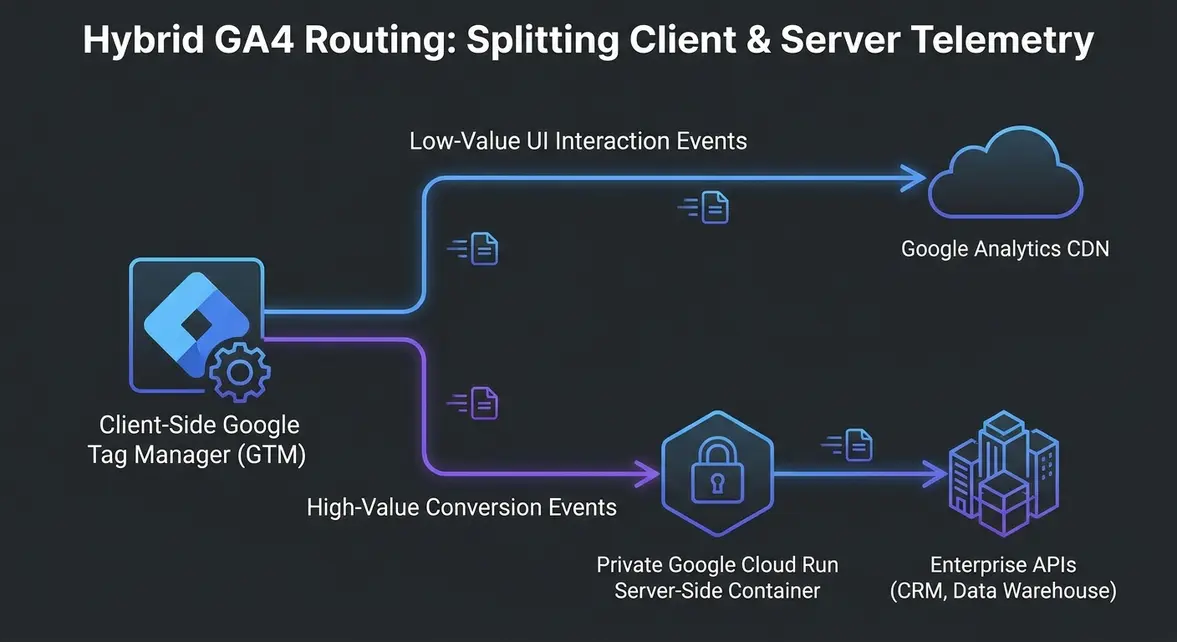
Hybrid Telemetry Ingestion: Decoupling GA4 Transport Routing via Client-Side Logic
Executive Architectural Takeaway: Routing 100% of client telemetry through Server-Side Google Tag Manager (sGTM) introduces unnecessary compute overhead and ballooning Cloud Run egress costs for non-attributed, high-volume interaction signals. By dynamically bifurcating the GA4 transport pipeline based on event criticality, engineering teams can slash server-side cloud spend by up to 65% while preserving server-side data governance and API dispatch (Meta CAPI, Google Ads Enhanced Conversions) for revenue-bearing transactions.
Historically, data architects migrated tracking to sGTM under an all-or-nothing premise: every single scroll, user_engagement, and micro-interaction was proxied through a custom tagging server to bypass client-side ad-blockers and enforce first-party cookie context. While architecturally clean, this approach linearly scales Cloud Run instances and outbound network egress costs against low-value telemetry that never requires enrichment, transformation, or third-party syndication.
The modern engineering pattern treats sGTM as an enrichment and compliance proxy rather than a brute-force reverse proxy. High-frequency, zero-enrichment UI telemetry flows straight to Google Analytics endpoints via analytics.google.com/g/collect, while identity-stitched conversions, lead forms, and core e-commerce events route to the sGTM endpoint (sgtm.internal.domain.com) for PII sanitization and downstream server-to-server webhook dispatch.
Architectural Ingestion Arbitrage: Cloud Run Compute Optimization & First-Party Data Hygiene
Running high-throughput client telemetry directly through containerized sGTM instances creates measurable infrastructure drag. When an enterprise application serves tens of millions of monthly pageviews, events like scroll, video_progress, and custom micro-clicks force horizontal auto-scaling of sGTM containers, driving up Google Cloud Run vCPU allocation, memory reservations, and multi-region network egress bills.
Static inspection reveals that over 70% of total event volume generated by modern single-page applications (SPAs) consists of transient interaction telemetry that vendors consume purely for session reconstruction and aggregate path analysis. These events rarely require transformation, IP masking, or distribution to data warehouses via sGTM clients. Routing these signals through an intermediary proxy introduces unnecessary round-trip latency without improving data fidelity.
Implementing split-path dispatch establishes a dual-tier data plane:
- Direct Tier (Client-to-CDN): Telemetry with zero downstream API dependencies bypasses sGTM, resolving directly to Google edge nodes with sub-30ms network round-trip times and zero incremental compute cost.
- Governed Tier (Client-to-sGTM): High-leverage behavioral events (
generate_lead,purchase,sign_up) transit your custom domain proxy. Here, incoming payloads undergo header normalization, PII hashing, geographic truncation, and concurrent fan-out to the BigQuery Storage Write API and CRM webhooks.
Production Implementation Runbook: Dynamic Transport URL Switching & Tag Template Orchestration
To operationalize dynamic transport URL switching, configure a dynamic routing variable within the client-side Google Tag Manager web container. This variable inspects the runtime event name and dynamically outputs the custom sGTM origin or defaults to an empty string (directing traffic to Google default collectors).
Step 1: Create a Custom JavaScript Variable named {{JS - Dynamic Transport URL}} that evaluates the event context against an approved server-side routing array.
function() {
  // Define high-value events requiring server-side governance or CAPI fanout
  var serverGtmEvents = [
    'purchase',
    'generate_lead',
    'sign_up',
    'begin_checkout',
    'add_to_cart',
    'contact_sales_submit'
  ];

  var currentEvent = {{Event}};
  var sGtmEndpoint = 'https://telemetry.yourdomain.com';

  // Route to sGTM if the event is strictly in the server routing whitelist
  if (serverGtmEvents.indexOf(currentEvent) > -1) {
    return sGtmEndpoint;
  }

  // Return undefined to leverage default direct client-side GA4 collection
  return undefined;
}
Step 2: Bind the variable within the Google Tag (GA4 Configuration Tag) or individual GA4 Event Tags under Configuration Settings. Map the configuration parameter server_container_url to {{JS - Dynamic Transport URL}}.
Step 3: Deploy an automated synthetic integration test using Playwright to confirm that outgoing network requests match the expected transport routing matrix prior to production staging.
import { test, expect } from '@playwright/test';

test('verify GA4 hybrid event routing matrix', async ({ page }) => {
  const sGtmRequests: string[] = [];
  const directGaRequests: string[] = [];

  page.on('request', (req) => {
    const url = req.url();
    if (url.includes('telemetry.yourdomain.com/g/collect')) {
      sGtmRequests.push(url);
    } else if (url.includes('analytics.google.com/g/collect')) {
      directGaRequests.push(url);
    }
  });

  await page.goto('https://yourdomain.com/pricing');

  // Trigger high-frequency client interaction (scroll)
  await page.evaluate(() => window.scrollTo(0, document.body.scrollHeight));
  await page.waitForTimeout(500);

  // Trigger high-value conversion event
  await page.click('button#lead-capture-submit');
  await page.waitForTimeout(1000);

  // Validate interaction routed to default direct endpoint
  expect(directGaRequests.length).toBeGreaterThan(0);

  // Validate conversion routed strictly to sGTM container
  const leadReq = sGtmRequests.find(u => u.includes('en=generate_lead'));
  expect(leadReq).toBeDefined();
});
Unit Economics & B2B Pipeline Impact: Slashing Ingestion Costs while Safeguarding Conversions
For high-velocity B2B SaaS organizations running product-led growth (PLG) motions, application telemetry volumes can exceed hundreds of millions of events monthly. Pushing all product interactions through a multi-region Google Cloud Run sGTM deployment can cost thousands of dollars monthly in compute charges alone. Bifurcating the event stream cuts server load by 60% to 80%, directly optimizing operational margins without sacrificing pipeline attribution.
From a regulatory and data hygiene perspective, this hybrid architecture protects enterprise compliance. High-value forms and conversion funnels containing PII (user_id, email hashes, CRM prospect IDs) route exclusively through the sGTM proxy, where custom transformations strip raw IP addresses and sanitize user inputs before data leaves enterprise boundaries. High-volume, anonymous UI signals bypass the proxy, eliminating unnecessary data exposure and maintaining strict SOC 2 and GDPR compliance boundaries at scale.
System Telemetry Source: Original Engineering Report
Related Growth Blueprints
All Playbooks →Want this working inside your business?
Whether you're a founder fixing tracking leaks or a team scaling SEO and AI workflows, share your site and bottleneck for a clear diagnostic within 48 hours.