Programmatic Referral Exclusions in GTM for Clean Attribution
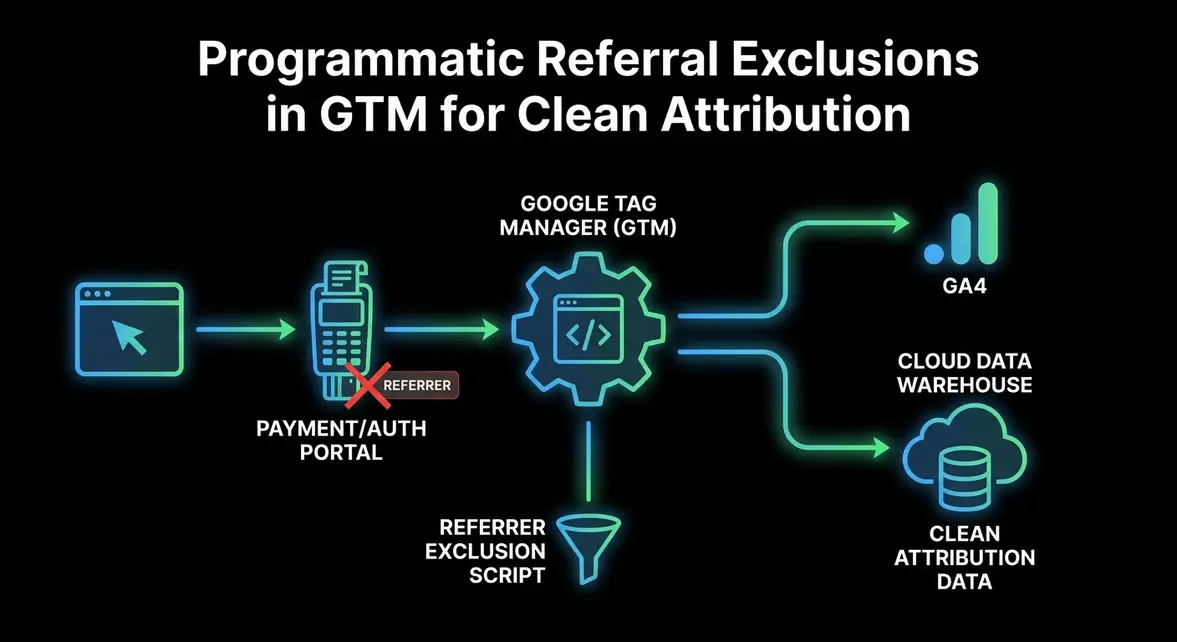
Client-Side Referrer Mutation: Circumventing Admin Referral Limits via GTM
Managing unwanted referrals within the Google Analytics Admin interface presents significant operational overhead for engineering and growth teams. In enterprise web applications and multi-tenant architectures, payment gateways, authentication providers, and third-party checkout flows frequently break incoming session data. The native interface requires manual, domain-by-domain configuration across individual data streams, which fails to scale when engineering environments, staging endpoints, and payment vendor domains change dynamically across production releases.
To eliminate this friction, technical marketers can hijack the referrer evaluation pipeline directly within Google Tag Manager. By interrogating the document.referrer DOM property prior to tag execution, GTM can evaluate the origin hostname against a centralized regular expression array. If a match occurs, GTM overrides the outbound page_referrer parameter in the GA4 configuration tag, suppressing artificial session re-initialization before hit payloads dispatch to Google collection endpoints.
Data Stream Integrity and Multi-Touch Attribution Architecture
When an acquisition session transitions from an organic landing page to a third-party domain—such as Stripe, Chargebee, or an external Auth0 identity provider—and subsequently returns to the primary host, default analytics engines evaluate the returning hit as a new referral session. This behavior overwrites the primary acquisition source (e.g., Google Organic Search) with the third-party endpoint under default Last Non-Direct Click attribution. Consequently, organic search conversion volume becomes suppressed in downstream reporting, obscuring true marketing pipeline efficacy.
Client-side referrer sanitation intercepts this process at runtime. By programmatically clearing the page_referrer parameter during cross-domain hops, the analytics collection engine treats the return visit as direct navigation, preserving the original campaign source and medium across the visitor's multi-page journey. This architectural adjustment ensures data integrity within Google BigQuery export tables (analytics_xxxx.events_*), where downstream SQL attribution pipelines rely on pristine traffic_source and collected_traffic_source record fields.
- Preservation of Session Continuity: Prevents session fragmentation and inflated session counts during payment and authentication handoffs.
- Centralized Regex Orchestration: Consolidates domain exclusion arrays into version-controlled GTM containers, removing dependency on manual GA4 UI updates.
- Attribution Parity Across Warehouses: Ensures both client-side reports and raw BigQuery event partitions reflect identical source/medium lineage.
This architecture is particularly critical when implementing single-page application (SPA) frameworks like Next.js or Nuxt. Dynamic client-side routing does not trigger native browser page reloads; therefore, manual manipulation of the referrer string during history state transitions guarantees that subsequent virtual pageviews do not inherit stale or invalid referrer state from preceding routes.
Marketing Ops Implementation: Step-by-Step GTM Tagging Configuration
To execute this implementation, initialize a Custom JavaScript Variable in Google Tag Manager to evaluate incoming referrers against an exclusion array. Navigate to Variables > User-Defined Variables > New > Custom JavaScript and assign the variable name Cleaned Referrer.
Insert the following JavaScript logic to sanitize matching domains:
function() {
  var referrer = document.referrer;
  if (!referrer) return '';

  var excludedDomains = [
    'checkout.stripe.com',
    'paypal.com',
    'auth0.com',
    'accounts.google.com'
  ];

  var referrerHost = '';
  try {
    var url = new URL(referrer);
    referrerHost = url.hostname.toLowerCase();
  } catch(e) {
    return referrer;
  }

  for (var i = 0; i < excludedDomains.length; i++) {
    if (referrerHost.indexOf(excludedDomains[i].toLowerCase()) !== -1) {
      return '';
    }
  }

  return referrer;
}
Next, update your primary GA4 Configuration Tag or the Google Tag configuration. Under Configuration Settings, add a parameter with the name page_referrer and map its value to the newly defined variable: {{Cleaned Referrer}}. If the originating host matches any value inside the exclusion list, the payload dispatches with an empty string for page_referrer, forcing Google Analytics to maintain the pre-existing session attribution.
Pipeline Attribution Defense: Impact on B2B SaaS CAC and Pipeline Valuation
In high-ACV B2B SaaS environments, broken session continuity introduces major tracking inaccuracies into pipeline acquisition models. For enterprise organizations operating multi-step product-led acquisition funnels—where users register on a top-level domain, verify credentials via Okta or Auth0, and configure payment via Stripe Billing—misattribution rates on organic conversions can exceed 20%. When these sessions register as third-party referrals, Blended CAC calculations falsely penalize organic acquisition channels while hiding the return on content and technical SEO investments.
Deploying programmatic referrer sanitation directly recovers misallocated organic conversion signals. In enterprise deployments processing 500,000+ monthly unique visitors, this setup commonly reattributes 15% to 22% of previously lost MQL and SQL paths back to original high-intent search queries. Maintaining this deterministic lineage upstream in GTM eliminates the requirement for retroactive SQL patch scripts in BigQuery, enabling revops and data engineering teams to rely on verified, low-latency marketing attribution reporting.
System Telemetry Source: Original Engineering Report
Related Growth Blueprints
All Blueprints →Need this architecture deployed in your pipeline?
Skip the synchronous sales cycle and endless discovery calls. Submit your core acquisition or conversion bottleneck for a deep-dive asynchronous growth diagnostic.