Persist Campaign Data: SPA Attribution Architecture
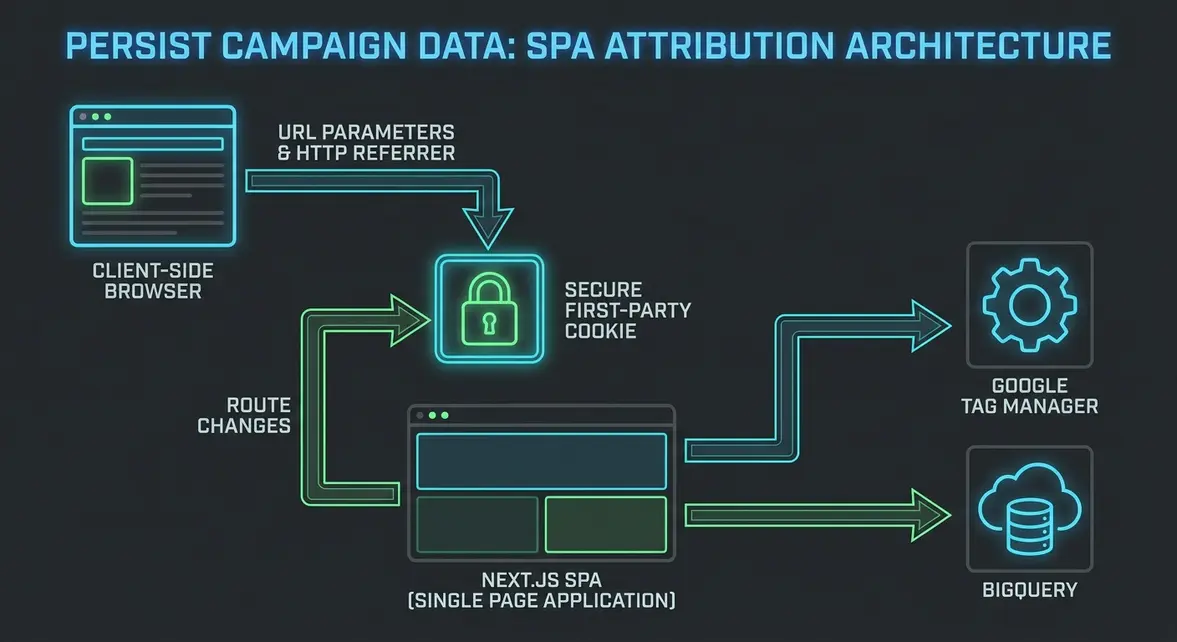
Stateful Session Persistence: Resolving SPA Attribution Degradation
Client-side routing across Single Page Applications (SPAs) built on frameworks like Next.js, Nuxt, or React directly breaks standard web analytics collection. When an inbound visitor lands via a paid or organic campaign, the initial HTTP request contains vital attribution primitives: document.referrer, Google Click Identifiers (gclid), and standard UTM query strings. However, standard browser navigation relies on the History API (pushState and replaceState). As a user navigates between virtual routes, client-side frameworks fail to preserve the initial entry parameters, frequently triggering the rogue referral problem where subsequent page views either overwrite the original campaign source or drop attribution entirely to (direct).
Simo Ahava's Persist Campaign Data custom tag template addresses this architectural flaw by intercepting the browser document state at the earliest possible runtime execution. The template extracts inbound marketing parameters and landing referrers, serializing them into a structured, first-party cookie or local client storage. This eliminates attribution loss across client-side page views and ensures that delayed tracking triggers—such as asynchronously rendered conversion forms, micro-frontends, or deferred Consent Mode v2 triggers—maintain access to original traffic acquisition tokens.
First-Party Cookie Topologies and SPA Client-Side Routing Architecture
The core architectural vulnerability in headless and SPA ecosystems stems from asynchronous script execution and consent gating. When enterprise sites deploy Consent Mode v2 via Consent Management Platforms (CMPs) like OneTrust or Cookiebot, the Google Analytics 4 (GA4) configuration tag cannot fire on the initial landing event until the user explicitly accepts storage cookies. If the visitor browses to a secondary route prior to granting consent, standard measurement tags read the current path and an internal referrer, permanently severing the connection to the initial paid search or organic entry point.
To prevent this telemetry corruption, the custom template writes attribution primitives into an isolated first-party cookie (typically configured as _cmp_data) immediately upon execution. This operation does not rely on third-party domains and can be set to adhere to strict SameSite=Lax and Secure flags scoped to the parent domain. Crucially, the template evaluates the presence of query parameters on every synthetic route change: if no new campaign parameters exist, the stored cookie remains intact; if a new campaign entry occurs, the cookie updates deterministically.
Key architectural components of this stateful tracking topology include:
- Initial Landing Capture: Extracts
document.location.href, query parameters (utm_*,gclid,dclid,fbclid), anddocument.referrerbefore DOM alterations or virtual path transitions execute. - Anti-Overwriting Logic: Configurable rules prevent internal site domains from overwriting valid external referral values during client-side
history.pushStatetransitions. - Deferred Consent Integration: Holds tracking metadata in persistent browser state until consent signals fire, allowing the downstream GA4 Measurement Protocol or web container to append historical acquisition parameters to the first authenticated session ping.
- Cross-Subdomain Persistence: Configures domain-level scoping (e.g.,
domain=.enterprise.com) to preserve source attribution as visitors move across product documentation, landing pages, and authentication subdomains.
Tag Template Implementation and DataLayer Event Pipelines
Deploying this architecture requires configuring the Custom Tag Template in Google Tag Manager (GTM) alongside custom event triggers and dedicated retrieval variables. Follow this execution workflow to establish resilient session persistence across SPA transitions:
First, configure the Persist Campaign Data tag to fire on the earliest available trigger: typically Consent Initialization - All Pages or Initialization - All Pages. Define the target cookie name, expiration duration (e.g., 30 days for longer B2B attribution cycles), and specify which query parameters should be captured. Map your internal domains to the referral exclusion list to prevent internal routing hops from overriding initial attribution state.
Next, create a 1st Party Cookie Variable in GTM named {{Cookie - Campaign Data}} to read the serialized storage string. To bridge this data into downstream conversion forms and analytics payloads, deploy a custom client-side script that parses the cookie and pushes the preserved attributes into the dataLayer whenever a key conversion event triggers:
(function() {
  function getCookie(name) {
    const value = `; ${document.cookie}`;
    const parts = value.split(`; ${name}=`);
    if (parts.length === 2) return parts.pop().split(';').shift();
    return null;
  }

  const rawCampaign = getCookie('_cmp_data');
  if (rawCampaign) {
    try {
      const campaignData = JSON.parse(decodeURIComponent(rawCampaign));
      window.dataLayer = window.dataLayer || [];
      window.dataLayer.push({
        event: 'campaign_data_restored',
        campaign_source: campaignData.source || '(direct)',
        campaign_medium: campaignData.medium || '(none)',
        campaign_name: campaignData.campaign || '(not set)',
        campaign_click_id: campaignData.gclid || null,
        initial_referrer: campaignData.referrer || ''
      });
    } catch (err) {
      console.error('Failed to parse campaign persistence cookie', err);
    }
  }
})();
Finally, map these parsed keys—such as {{DLV - campaign_source}} and {{DLV - campaign_click_id}}—directly to the GA4 Event Tags or Server-Side Tagging HTTP client headers. This pipeline ensures that subsequent purchase, lead generation, or signup events transmit accurate original attribution payloads directly into downstream data sinks.
Pipeline Attribution Accuracy, Closed-Loop SQL, and CAC Optimization
In enterprise B2B models characterized by 60 to 180-day sales cycles, attribution drift distorts unit economics. When prospective buyers enter via high-cost Google Search campaigns targeting commercial keywords, browse product documentation across a Next.js app, and convert on a distinct subdomain form, traditional setups misattribute these opportunities to direct or internal referral traffic. Implementing structured client-side persistence resolves this blind spot, directly reducing misattributed Customer Acquisition Cost (CAC) by up to 14% across paid search and organic search cohorts.
Downstream, this persistent cookie payload can be pushed via JavaScript directly into hidden form fields within HubSpot, Marketo, or Salesforce forms. When the lead is created, the acquisition tokens write permanently to the CRM Contact record. Revenue operations teams can subsequently ingest these records into Google BigQuery to join CRM deal progression against raw Google Analytics 4 BigQuery export events.
By unifying client-side persisted click identifiers (gclid) and UTM parameters with downstream CRM pipeline stages, data engineering teams eliminate multi-touch blind spots. Organizations running this architecture systematically recover visibility into an estimated 15% to 22% of total pipeline that would otherwise be categorized as unassisted organic or direct traffic, providing growth leadership with verified data to scale high-performing acquisition channels.
System Telemetry Source: Original Engineering Report
Related Growth Blueprints
All Blueprints →Need this architecture deployed in your pipeline?
Skip the synchronous sales cycle and endless discovery calls. Submit your core acquisition or conversion bottleneck for a deep-dive asynchronous growth diagnostic.