Deduplicating Analytics Transactions via customTask
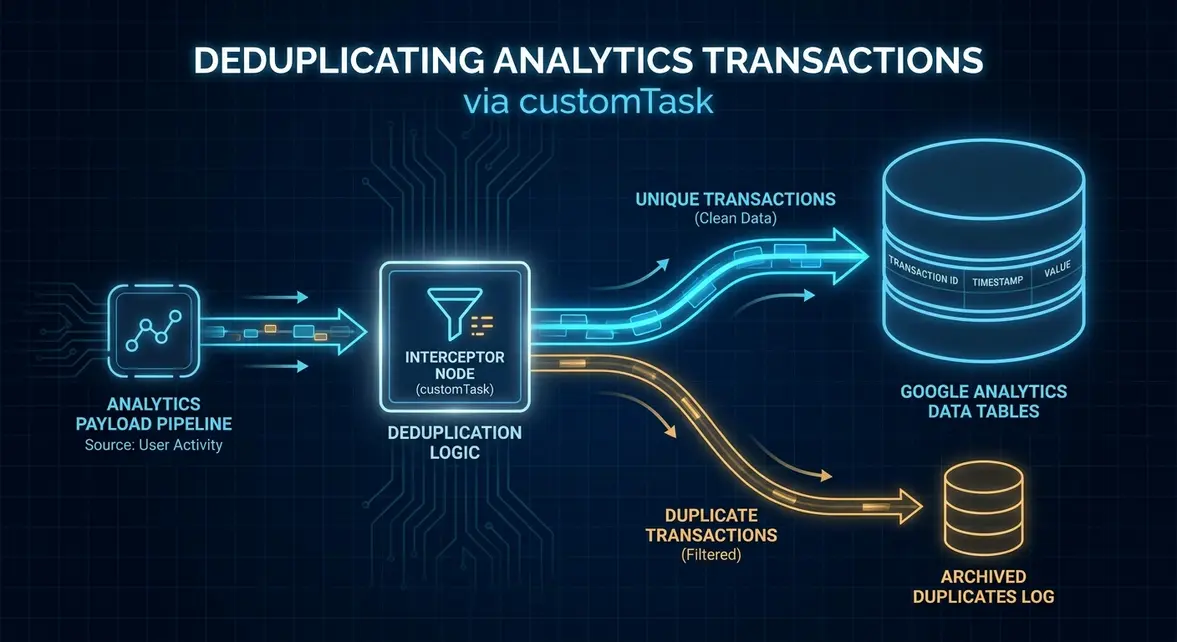
Deduplication Protocols: Resolving Analytics Immutability and Transaction Skew
Analytics telemetry suffers from a fundamental data model constraint: immutable row-level ingestion. Once a measurement hit registers on Google Analytics endpoints, the historical table locks that record permanently. In ecommerce and high-velocity SaaS checkouts, this vulnerability creates severe metric inflation. Common user behaviors—such as refreshing order confirmation screens, navigating backward through browser history, or re-opening cached receipt tabs across devices—trigger duplicate purchase events. When duplicate transactions hit downstream attribution models, return on ad spend (ROAS) and customer acquisition cost (CAC) calculations skew significantly, misallocating paid media budgets.
Historically, platforms offered minimal native protections against repeat transaction hits sharing identical identifiers. The deployment of Google Tag Manager’s customTask API creates an execution interception layer directly on the Universal Analytics tracking object (and analogously via transformation pipelines or server-side GTM for modern GA4 event models). By intercepting the hit model before telemetry dispatches across the wire, growth engineers can evaluate payloads against persistent storage primitives (such as browser localStorage or serverless key-value stores) and drop the payload if the unique transaction ID has already executed.
Data Layer Governance: Client-Side Storage Interception vs. Server-Side Tagging
At the browser runtime level, executing tracking tags without state validation introduces non-deterministic reporting. When an order confirmation page renders, your application layer pushes a purchase or transaction object to the dataLayer array. Without a deterministic deduplication mechanism, every re-render of this confirmation view re-executes the tag, sending identical transaction_id and revenue parameters downstream.
To resolve this, the data architecture relies on a pre-dispatch interceptor. When Tag Manager fires an ecommerce tag, customTask temporarily takes control of the tracker instance. The script reads the transaction identifier assigned to the current payload, checks an array of previously captured keys stored in browser localStorage, and executes one of two deterministic branching paths:
- Unique Transaction Identified: The transaction ID is appended to the serialized array within
localStorage, and the tracking hit proceeds to the Google Analytics collection endpoint without payload alterations. - Duplicate Transaction Detected: The interceptor overwrites the tracker’s transport task with an empty function or sets
sendHitTaskto null. This discards the tracking hit instantly within memory, preventing any network dispatch while preserving tag execution flow. - Storage Failover & Boundaries: If storage access is restricted due to incognito restrictions or Safari ITP boundaries, the engine safely fails open to avoid breaking essential UI execution, while maintaining an in-memory session cache for single-tab deduplication.
By enforcing this architecture, engineers isolate client-side data capture from user navigational volatility. Downstream analytics instances, data warehouses (such as Google BigQuery), and customer data platforms (CDPs) receive clean, validated streams that match true backend transactional realities.
Engineering customTask and LocalStorage Deduplication in Tag Manager
Implementing client-side transaction deduplication requires an evaluation function integrated directly into your base Google Analytics tracking configuration. The following implementation targets the tracking hit, reads the transaction ID, and aborts network transmission if an entry exists.
Create a Custom JavaScript Variable named {{JS - customTask Deduplication}} in Google Tag Manager:
function() {
  return function(model) {
    var storageKey = 'gtm_processed_transactions';
    var hitType = model.get('hitType');

    // Only target ecommerce transactions
    if (hitType !== 'transaction' && hitType !== 'item') {
      return;
    }

    var transactionId = model.get('transactionId') || model.get('&ti');
    if (!transactionId) {
      return;
    }

    try {
      var stored = window.localStorage.getItem(storageKey);
      var processedIds = stored ? JSON.parse(stored) : [];

      // Check if transaction ID has already been transmitted
      if (processedIds.indexOf(transactionId) > -1) {
        // Nullify sendHitTask to kill the network request
        model.set('sendHitTask', null);
        console.info('[Telemetry Engine] Blocked duplicate transaction hit: ' + transactionId);
        return;
      }

      // Append current ID and maintain rolling window (e.g., last 100 transactions)
      processedIds.push(transactionId);
      if (processedIds.length > 100) {
        processedIds.shift();
      }
      window.localStorage.setItem(storageKey, JSON.stringify(processedIds));
    } catch (e) {
      // Storage quota exceeded or disabled; fall back silently
      console.warn('[Telemetry Engine] Storage access restricted:', e);
    }
  };
}
Next, bind this logic inside your Google Analytics Settings variable or Universal Analytics Tag under Fields to Set. Assign the field name as customTask and provide the variable reference {{JS - customTask Deduplication}}.
For modern environments operating GA4 or Server-Side Tag Manager containers, configure an analogous server-side deduplication pipeline using an asynchronous Firestore or Redis lookup:
-- BigQuery audit query to detect duplicate transaction leakage
SELECT
  event_name,
  ep.value.string_value AS transaction_id,
  COUNT(1) AS occurrence_count
FROM
  `project_id.analytics_XXXXX.events_*`,
  UNNEST(event_params) AS ep
WHERE
  event_name = 'purchase'
  AND ep.key = 'transaction_id'
  AND _TABLE_SUFFIX = FORMAT_DATE('%Y%m%d', CURRENT_DATE())
GROUP BY
  1, 2
HAVING
  occurrence_count > 1;
```<h3>Downstream Revenue Attribution and CAC Precision for B2B SaaS</h3><p>In high-ACV (Annual Contract Value) B2B growth funnels, duplicate transaction events cause massive calculation errors. A enterprise client self-serving a tier upgrade representing $24,000 ARR that fires twice falsely registers $48,000 ARR in ad optimization engines (e.g., Google Ads, LinkedIn Campaign Manager). Conversion bid strategies, such as Target ROAS or Maximize Conversion Value, ingest this distorted telemetry and aggressively increase bids on underperforming acquisition channels, inflating real blended CAC by 15% to 35%.</p><p>Eliminating duplicate transactions restores programmatic integrity across performance attribution models. By ensuring 100% parity between raw CRM billings (Stripe, Chargebee) and analytics datasets, paid growth algorithms optimize against actual revenue thresholds. This technical defense mechanism removes false positives from pipeline velocity metrics, sharpens algorithmic budget allocation, and provides finance leaders with verifiable unit economics required during institutional capital deployments.</p>

---

*System Telemetry Source:* [Original Engineering Report](<https://www.simoahava.com/analytics/prevent-google-analytics-duplicate-transactions-with-customtask/>)
Related Growth Blueprints
All Blueprints →Need this architecture deployed in your pipeline?
Skip the synchronous sales cycle and endless discovery calls. Submit your core acquisition or conversion bottleneck for a deep-dive asynchronous growth diagnostic.