Server-Side GA4 to Piwik PRO Tracking Architecture
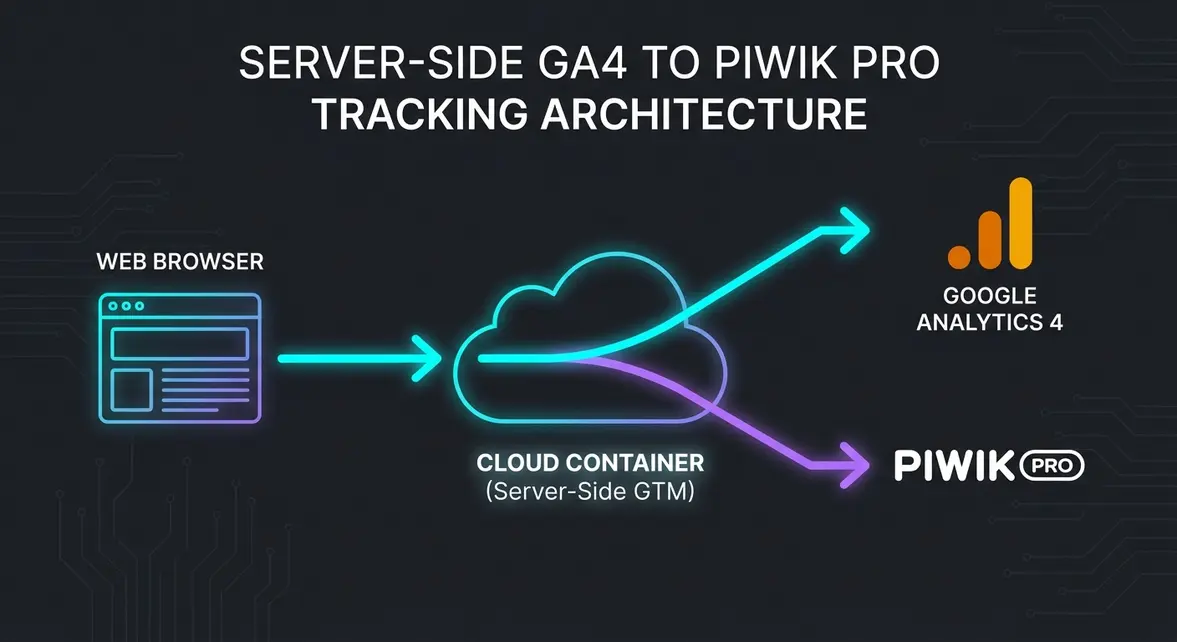
Decoupling Client-Side Vendors: Server-Side GA4 to Piwik PRO Event Bridging
Enterprise growth teams operating across North American and European markets frequently confront a dual analytics dilemma: marketing stakeholders require Google Analytics 4 (GA4) for Google Ads bidding optimization, while legal and enterprise security teams mandate Piwik PRO for GDPR-compliant data residency. Historically, executing this dual-engine strategy required loading two monolithic JavaScript tracking libraries into the user document: gtag.js and Piwik's ppms.js. This redundant client-side orchestration duplicated browser network requests, inflated script evaluation time, and created telemetry divergence across platforms.
The release of the official Piwik PRO custom Client and Tag templates for server-side Google Tag Manager (sGTM) provides an architectural solution to this operational bottleneck. Growth engineers can now deploy a single client-side event collector (GA4 Measurement Protocol format) and multiplex the incoming stream at the sGTM proxy level. The GA4 Client in sGTM claims the incoming HTTP payload, serializes the hit into standard sGTM Event Data, and passes that object to the Piwik PRO Tag template. The Piwik PRO Tag then maps the GA4 telemetry structure to the Piwik PRO HTTP Tracking API, eliminating duplicate client-side network overhead.
Core Web Vitals Optimization and Data Layer Governance
Offloading secondary analytics execution to a server-side proxy directly impacts technical SEO by preserving Core Web Vitals budgets. Third-party JavaScript execution remains the primary cause of poor Interaction to Next Paint (INP) scores and excessive Total Blocking Time (TBT). By decommissioning client-side tracking libraries in favor of a single lightweight data dispatch, teams can reduce DOM execution overhead by 40ms to 70ms on standard mobile viewports, keeping INP reliably under the 200ms threshold required by Google Search indexing systems.
From an indexing and user privacy standpoint, operating through an sGTM environment deployed on a first-party subdomain (such as metrics.brand.com) bypasses Safari Intelligent Tracking Prevention (ITP) constraints. Safari truncates cookies set via client-side JavaScript document APIs to a 7-day or 24-hour lifespan. By routing the request through sGTM on a first-party domain, session and identity cookies like Piwik PRO's _pk_id and GA4's _ga can be written via HTTP response headers (Set-Cookie), securing attribution windows across 400 days without running afoul of privacy sandbox frameworks.
- Unified Client Telemetry: A single browser-level dispatch feeds both ad-network optimization engines and self-hosted compliance analytics platforms simultaneously.
- Ad-Blocker and Tracking Protection Resilience: Routing hits through a first-party proxy running custom routing pathways prevents ad-blocking extensions and browser firewalls from dropping valuable B2B conversion signals.
- Server-Side Data Sanitization: Before payload forwarding to the Piwik PRO HTTP API, the sGTM container can programmatically purge personal identifiable information (PII) such as unhashed email queries, IP addresses, or sensitive URL parameters.
Marketing Ops Implementation: Pipeline Routing and Event Transformation
To implement this architecture, configure your web container to push conversion signals into a standardized dataLayer format. The web GA4 tag fires on this trigger and delivers the payload to the sGTM endpoint URL. Inside sGTM, the native GA4 Client captures the hit and creates the internal event_data variable matrix. The Piwik PRO Tag references these keys directly.
Deploy this client-side dataLayer.push pattern on key pipeline conversion events:
window.dataLayer = window.dataLayer || [];
window.dataLayer.push({
  event: 'lead_form_submitted',
  conversion_data: {
    lead_type: 'enterprise_mql',
    pipeline_value: 12000,
    account_tier: 'tier_1',
    crm_guid: 'usr_89f2c10a'
  }
});
Within the sGTM container, the Piwik PRO Tag template converts the GA4 payload parameters into a compliant Piwik PRO HTTP API request. To pass the custom parameters, create an Event Data variable targeting conversion_data.account_tier using the format {{Event Data - account_tier}} and map it to an assigned Piwik PRO custom dimension slot. The resulting outgoing HTTP POST payload dispatched from your Cloud Run container to Piwik PRO mirrors this structure:
{
  "idsite": "12345678-abcd-ef01-2345-6789abcdef01",
  "rec": 1,
  "action_name": "Lead Form Submitted",
  "e_c": "Lead Gen",
  "e_a": "Form Submission",
  "e_n": "enterprise_mql",
  "e_v": 12000,
  "_cvar": {
    "1": ["account_tier", "tier_1"],
    "2": ["crm_guid", "usr_89f2c10a"]
  },
  "url": "https://brand.com/platform/demo",
  "_id": "d3b07384d113edec"
}
B2B Enterprise Attribution and CAC Deflation
For B2B software companies marketing to technical buyers—such as engineers, CISOs, or IT administrators—standard client-side analytics tags suffer signal loss rates between 20% and 35% due to aggressive browser-level DNS filtering and enterprise proxy gateways. When attribution tags fail to register conversion events, Google Ads Smart Bidding algorithms overcompensate by driving up bid prices across secondary segments, inflating Customer Acquisition Cost (CAC) by 15% to 25% across competitive search terms.
By proxying traffic through first-party sGTM infrastructure into Piwik PRO, data fidelity is restored across high-intent, hard-to-track accounts. Marketing Operations gains precise attribution down to the initial paid search click identifier (GCLID) and organic query landing page. By eliminating telemetry blind spots, enterprise growth teams can reallocate marketing budget into high-velocity acquisition channels, accelerating qualified enterprise pipeline while remaining compliant with internal data residency standards.
System Telemetry Source: Original Engineering Report
Related Growth Blueprints
All Blueprints →Need this architecture deployed in your pipeline?
Skip the synchronous sales cycle and endless discovery calls. Submit your core acquisition or conversion bottleneck for a deep-dive asynchronous growth diagnostic.