Server-Side Data Enrichment with Cloud Firestore
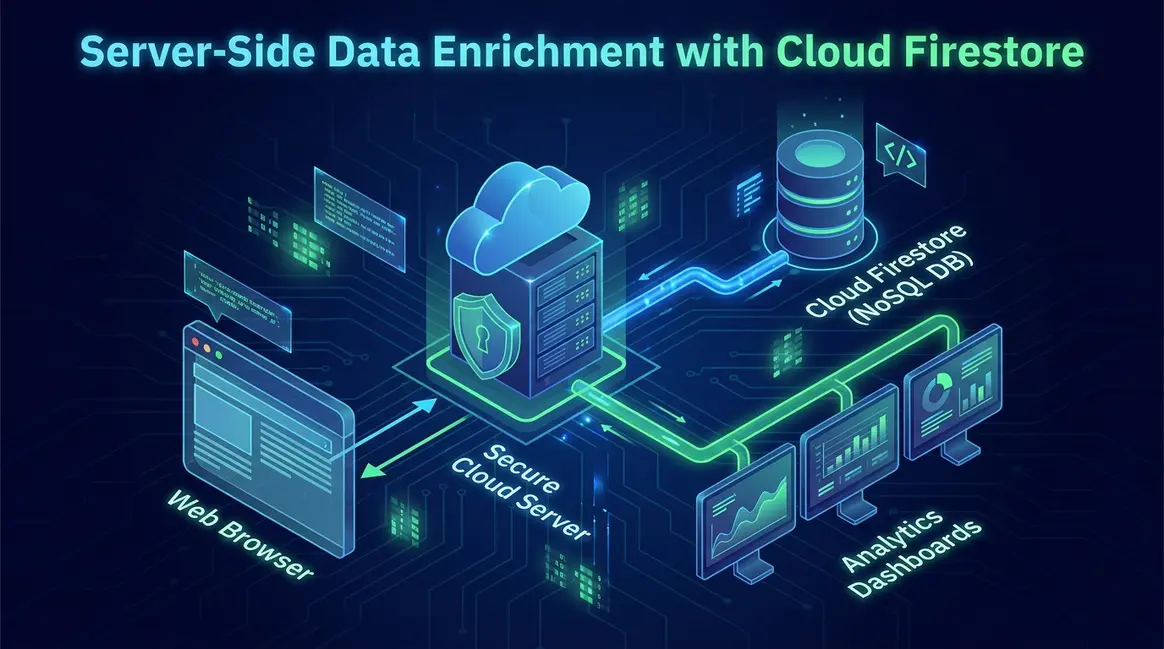
Overcoming Client-Side Limitations with Server-Side Firestore Enrichment
For years, digital marketers and analytics engineers have been constrained by the limitations of client-side tracking. Historically, enriching analytics payloads meant pushing massive amounts of user data—such as lifetime value, lead scores, or demographic details—directly into the browser's dataLayer. This standard setup not only bloated the client-side payload, degrading page performance, but also exposed sensitive Personally Identifiable Information (PII) to the browser DOM, creating significant security and compliance risks in a GDPR-heavy landscape.
The introduction of asynchronous variables in server-side Google Tag Manager (sGTM), coupled with the native Google Cloud Firestore API, fundamentally rewrites this primitive. Cloud Firestore is a highly scalable, NoSQL document database that offers near-real-time read and write capabilities. By integrating Firestore directly into the sGTM environment, engineers can now intercept a lightweight, anonymous identifier from the browser, asynchronously query the Firestore database for rich user attributes, and append that data to the payload entirely on the server. This shifts the heavy lifting away from the user's device, ensuring a secure, lightning-fast, and highly enriched data pipeline.
Architectural Shift: Decoupling Data Payloads for Enhanced Core Web Vitals
From a Technical SEO and data architecture perspective, moving data enrichment to the server side is a massive operational shift. When tracking scripts and dataLayer pushes are heavily reliant on the client, the browser's main thread becomes blocked by JavaScript execution. This directly harms Core Web Vitals, specifically Interaction to Next Paint (INP) and Largest Contentful Paint (LCP). By decoupling the data payload, the browser only needs to fire a single, minimal ping to your sGTM endpoint, drastically reducing client-side rendering bottlenecks.
The data integration logic operates on a highly efficient asynchronous model. When the sGTM container receives the initial HTTP request from the client, it triggers an asynchronous variable that connects to the Firestore API. Because the operation is asynchronous, the server does not block other tags from processing while waiting for the database response. Once the Firestore document is retrieved, the sGTM container maps the stored attributes (e.g., CRM data, historical purchase behavior) to the event data object, which is then dispatched to downstream endpoints like Google Analytics 4, Meta Conversions API, or BigQuery.
This architecture solves several critical bottlenecks. It bypasses aggressive client-side network restrictions (like ITP and ad blockers) by utilizing a first-party server context. Furthermore, it ensures that search engine crawlers are not bogged down by executing heavy third-party marketing scripts, allowing them to crawl and index content more efficiently. The "Why" is simple: maximum data fidelity with zero client-side performance penalty.
- Reduced JavaScript Execution: Offloading tracking logic to sGTM frees up the browser's main thread, directly improving Core Web Vitals and crawl budget efficiency.
- Secure PII Handling: Sensitive customer data never touches the browser; it is securely queried and appended within the Google Cloud environment.
- Asynchronous Processing: Non-blocking API calls ensure that high-volume event streams are processed without latency or data loss.
Step-by-Step Execution: Integrating sGTM with Cloud Firestore
Implementing this server-side enrichment pipeline requires coordination between your web application, Google Cloud Platform, and sGTM. First, you must ensure that your backend systems (like your CRM or authentication database) are writing user attributes to a Firestore collection. Each document in this collection should be keyed by a unique, non-PII identifier, such as a hashed User ID or a secure session token.
On the client side, your only responsibility is to push this unique identifier into the dataLayer and send it to your sGTM endpoint. Inside sGTM, you will configure a Firestore Lookup variable. This variable will use the incoming identifier to fetch the corresponding document from your Firestore database. Finally, you map the output of this variable to your server-side tags (e.g., GA4 or Meta CAPI) to ensure the enriched data is sent to your marketing platforms.
Below is a hypothetical implementation flow. First, the client-side dataLayer push:
window.dataLayer = window.dataLayer || [];
window.dataLayer.push({
  'event': 'purchase',
  'secure_user_id': 'usr_987654321',
  'transaction_id': 'tx_1001'
});
Next, the backend system ensures the Firestore document for usr_987654321 contains the enriched data:
{
  "customer_tier": "enterprise",
  "lifetime_value": 14500.00,
  "industry": "SaaS",
  "churn_risk": "low"
}
In sGTM, the asynchronous Firestore variable fetches this JSON. You can then map customer_tier and lifetime_value directly into your GA4 server-side tag as custom parameters, completely bypassing the browser.
Accelerating B2B Pipeline Velocity and Reducing CAC via Enriched Signals
For B2B SaaS companies, this server-side enrichment architecture is a massive lever for Growth and Monthly Recurring Revenue (MRR). Consider a scenario where a user signs up for a free trial. In a standard setup, the ad platforms (Google Ads, LinkedIn Ads) receive a generic "signup" conversion. However, not all signups are equal; a student using a personal email is vastly different from a VP of Engineering at a Fortune 500 company. By utilizing Firestore, the moment the signup event hits sGTM, it can query the database for enriched firmographic data (e.g., company size, industry, estimated revenue) that was appended by tools like Clearbit or ZoomInfo during the backend registration process.
By forwarding this enriched, high-intent signal back to the advertising algorithms via Server-to-Server integrations (like Meta CAPI or Google Ads Offline Conversions), you train the bidding models to optimize for enterprise leads rather than low-value freemium users. Theoretically, this high-fidelity feedback loop can lead to a 30-40% reduction in enterprise Customer Acquisition Cost (CAC) and a significant acceleration in sales pipeline velocity, as sales reps are fed leads that have already been algorithmically pre-qualified based on deep, server-side data.
System Telemetry Source: Original Engineering Report
Related Growth Blueprints
All Blueprints →Need this architecture deployed in your pipeline?
Skip the synchronous sales cycle and endless discovery calls. Submit your core acquisition or conversion bottleneck for a deep-dive asynchronous growth diagnostic.