Dual-Pipeline Analytics: Snowplow & GA4 Data Architecture
Modernizing Behavioral Telemetry: Snowplow GA Adapter Integration
Standard client-side analytics deployments that rely entirely on the Google Analytics tag suite routinely encounter severe operational constraints. Traditional implementations enforce vendor lock-in, subject event payloads to aggressive ad-blocker filtration (often degrading data capture by 15% to 30%), and lack row-level event ownership required for machine learning attribution models. When relying solely on native Google Analytics 4 (GA4) libraries, growth marketing teams lose access to raw HTTP payload signatures, unaggregated session state machines, and flexible JSON schema validation at the ingestion boundary.
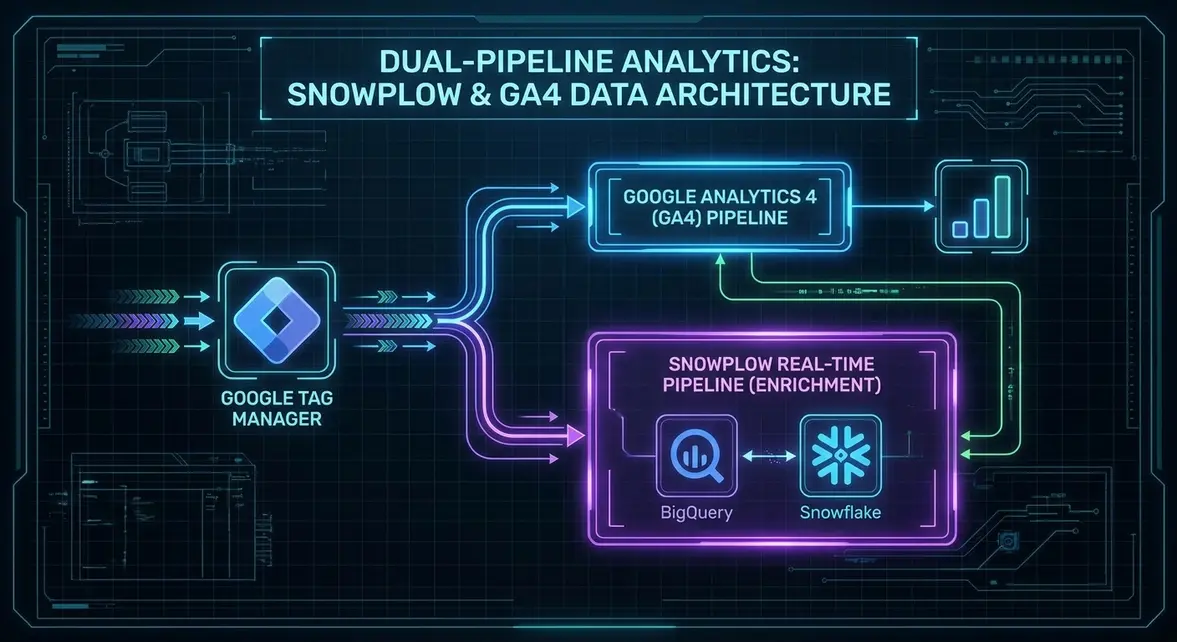
The Snowplow Google Analytics adapter fundamentally alters this architectural dynamic by intercepting standard client hits and routing identical telemetry into an enterprise-owned data pipeline. By utilizing Google Tag Manager to fork outgoing network requests directly to an elastic Snowplow collector alongside GA, engineering teams can retain their legacy reporting structures while building an immutable, warehouse-native event lake. This transition empowers growth operations to decommission downstream black-box processing in favor of deterministic event validation and real-time schema enforcement.
Data Architecture, Schema Contracts, and Infrastructure Integrity
Building a parallel data ingestion pipeline requires distinct architectural separation between client-side tag execution, collector infrastructure, and downstream storage parsing. When an event fires in the browser, the payload must be dual-dispatched without introducing network-thread contention or degrading Core Web Vitals metrics like Interaction to Next Paint (INP) and Largest Contentful Paint (LCP). Deploying a proxy layer or using GTM client-side hit duplication ensures that a single user action maps to both destinations simultaneously without executing redundant DOM scraping tasks.
The critical element within this pipeline is the Snowplow GA adapter, which runs directly on the stream processing cluster (e.g., Apache Spark or AWS Kinesis/Enrich). This service consumes incoming raw parameters structured in the Google Measurement Protocol format (such as cid, tid, t, ea, and custom dimensions) and transforms them into strictly validated Self-Describing JSON events. Unlike standard analytics implementations that allow schema drift, the Snowplow enrichment tier rejects non-conforming payloads to a dedicated bad-event queue, protecting downstream analytical tables from corruption.
- Deterministic Identity Resolution: Maps client-side cookie identifiers
{{Client ID}}to durable warehouse-native identities, maintaining continuity across organic search sessions and post-login product events. - Unsampled Data Ingestion: Decouples enterprise behavioral logging from GA4 BigQuery export caps, streaming every HTTP payload directly to analytical data warehouses (Snowflake, BigQuery, or Amazon Redshift).
- Real-Time Enrichment: Facilitates upstream IP lookup, automated User-Agent parsing, and custom API lookups (e.g., Clearbit or reverse-IP enrichment) at the stream level before records hit warehouse storage.
Implementation Blueprint: Forking Hits via Google Tag Manager & Cloud Run
To implement this architecture without deploying secondary tracking libraries on the client, configure Google Tag Manager to fork the outbound Measurement Protocol hit. This can be achieved by utilizing a custom GTM JavaScript variable or tag template to duplicate the payload array, or by rewriting the transport_url parameter in the GA4 configuration to point to a high-throughput proxy collector running on Google Cloud Run or AWS ECS.
Configure your GTM variable layer to pass the original Measurement Protocol payload directly to the custom Snowplow collector endpoint. Below is an example of an asynchronous client-side payload dispatcher using the navigator.sendBeacon API to prevent thread blocking:
function dispatchDualAnalyticsHit(endpoint, payload) {
  var data = new URLSearchParams(payload).toString();
  var destination = 'https://collector.growth-infra.domain.com/com.google.analytics/v1';

  if (navigator.sendBeacon) {
    navigator.sendBeacon(destination, data);
  } else {
    var xhr = new XMLHttpRequest();
    xhr.open('POST', destination, true);
    xhr.setRequestHeader('Content-Type', 'application/x-www-form-urlencoded');
    xhr.send(data);
  }
}
Downstream, the Snowplow stream enrichment processor evaluates the mapped parameters. Once stored in BigQuery, you can query unified attribution events by joining enriched organic touchpoints directly with CRM subscription milestones:
SELECT
  contexts_com_snowplowanalytics_snowplow_client_session_1[SAFE_OFFSET(0)].session_id AS session_id,
  user_id,
  page_url,
  geo_country,
  custom_dimensions.mql_score AS enrichment_score,
  collector_tstamp
FROM `analytics_warehouse.snowplow_enriched_events`,
UNNEST(contexts_com_google_analytics_measurement_protocol_1) AS custom_dimensions
WHERE event_name = 'lead_qualification'
  AND collector_tstamp >= TIMESTAMP_SUB(CURRENT_TIMESTAMP(), INTERVAL 30 DAY)
ORDER BY collector_tstamp DESC;
```<h3>B2B Revenue Acceleration and Unit Economic Impact</h3><p>Deploying an autonomous event ingestion pipeline directly transforms B2B unit economics by unifying pre-conversion organic search footprints with downstream subscription expansion. In typical SaaS models, pipeline tracking between an unauthenticated blog reader and a closed-won enterprise contract breaks due to browser cookie restrictions, third-party script blockers, and multi-touch touchpoint fragmentation. By capturing deterministic, first-party event streams via a dedicated proxy, engineering teams eliminate attribution dark zones, directly attributing multi-thousand-dollar ARR deals to early-stage technical SEO content assets.</p><p>Furthermore, maintaining raw access to clickstream primitives allows growth teams to feed unified behavioral data into machine learning lead-scoring models. By correlating granular reading velocity, documentation searches, and organic keyword entrance data with Salesforce opportunities, growth teams can optimize budget allocations toward the highest-intent organic topics. This infrastructure systematically lowers Customer Acquisition Cost (CAC) by up to 22% while providing engineering teams with a future-proof, compliant data layer decoupled from ad-tech platform policy changes.</p>

---

*System Telemetry Source:* [Original Engineering Report](<https://www.simoahava.com/analytics/snowplow-full-setup-with-google-analytics-tracking/>)
Related Growth Blueprints
All Blueprints →Need this architecture deployed in your pipeline?
Skip the synchronous sales cycle and endless discovery calls. Submit your core acquisition or conversion bottleneck for a deep-dive asynchronous growth diagnostic.