Fix SPA History Change Race Conditions in GTM
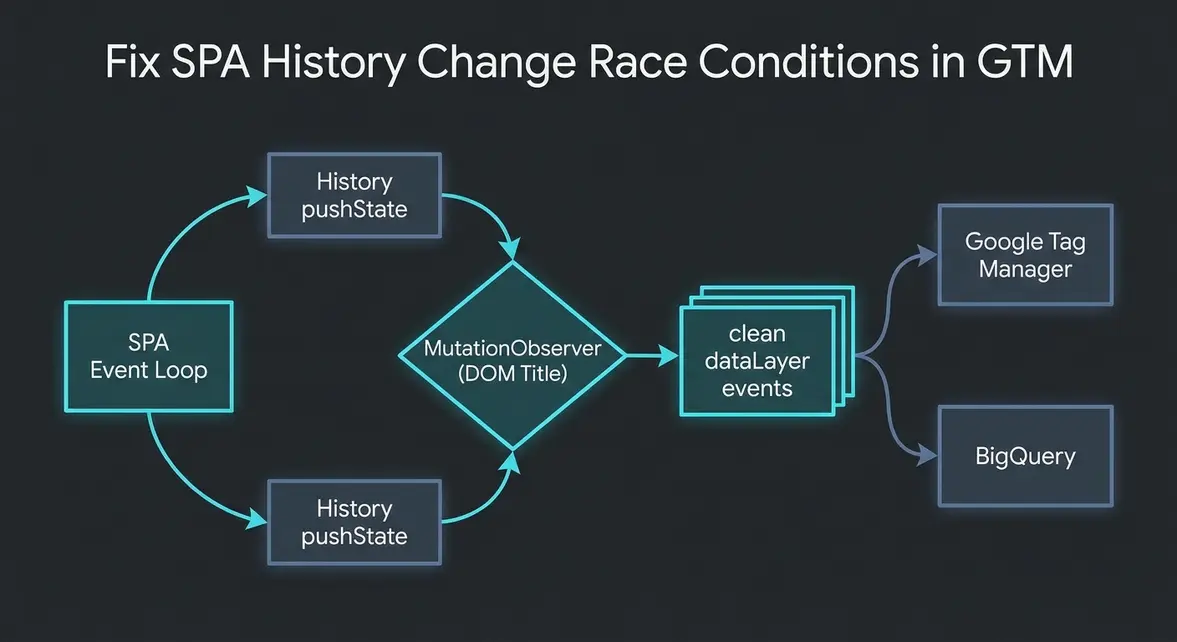
Deterministic State Sequencing in Client-Side SPA Ingestion
Default Google Tag Manager (GTM) History Change triggers execute synchronously with browser history API mutations, completely decoupled from frontend framework DOM reconciliation. In production React, Vue, or Next.js runtimes, this produces a critical asynchronous race condition: analytics tags fire before the virtual DOM updates the document title, canonical meta tags, or route-specific dataLayer primitives. As a consequence, telemetry pipelines systematically capture stale metadata from the preceding route, corrupting pathing models and attribution reporting.
Legacy tracking patterns treated client-side routing identically to static multi-page architecture (MPA), relying on history.pushState and history.replaceState listeners without state validation. When a user navigates between routes, the browser's URL bar updates instantaneously, but framework state re-renders (component unmounting, data fetching, DOM injection) resolve asynchronously across subsequent event loop ticks. Firing a Google Analytics 4 (GA4) page_view directly on the raw History Change trigger results in upwards of 20% to 40% of page views logging the page_title of the previous view, introducing persistent noise into BigQuery downstream exports.
Resolving this architectural breakdown requires shifting from reactive browser-event triggering to deterministic event sequencing. By intercepting navigation transitions and delaying the downstream dataLayer emission via microtask queue scheduling or MutationObserver routines, data engineering teams ensure that metadata hydration completes prior to firing conversion and routing tags.
Technical SEO Bottlenecks and Telemetry Pipeline Desynchronization
In headless runtimes and Single Page Application (SPA) architectures, rendering engines such as Googlebot's Web Rendering Service (WRS) evaluate page transitions under tight CPU budgets. While static HTML scrapers inspect the initial server response, analytics bots and client-side telemetry trackers evaluate DOM nodes at runtime. When GTM tags execute prior to the execution of head-element mutation routines, downstream warehouses capture corrupt state representations that break automated SEO monitoring systems.
From a data architecture perspective, asynchronous routing without deterministic execution delays introduces three primary structural failures:
- Attribute Incoherence in Data Warehouses: In BigQuery GA4 export tables, the
event_paramsrecord contains mismatched keys wherepage_locationreflects the newly mounted URL, butpage_titleand custom route dimensions contain values from the preceding view state. - Attribution Fragmentation and Rogue Referrals: In rapid client-side redirects or parameter alterations (such as stripping authentication tokens or UTM tags), un-delayed trigger execution captures transient URLs rather than final normalized canonical URLs, artificially inflating referral paths.
- Core Web Vitals Inaccuracies: Synthetic and real-user monitoring (RUM) scripts dispatched synchronously on
pushStatecompete with framework component mounting on the main thread, directly degrading Interaction to Next Paint (INP) thresholds during client-side transitions.
Deterministic delays isolate these concerns by guaranteeing that tracking scripts wait until the DOM stabilizes. Rather than polling arbitrary millisecond timeouts—which either introduce unnecessary latency or fail under heavy main-thread load—production tracking pipelines bind to explicit DOM mutation signals or framework route-change completion hooks.
Production Runbook: Implementing Mutation-Aware History Delays
To decouple tag execution from raw history transitions and eliminate race conditions, deploy a client-side listener that observes document title mutations before dispatching a normalized virtual_pageview event to the dataLayer.
Step 1: Client-Side Mutation Observer Listener
Deploy the following script via a GTM Custom HTML tag configured to fire once on the initial "Initialization - All Pages" trigger. This script wraps the native history.pushState API and delays event emission until the DOM updates <title> or reaches a 150ms timeout ceiling.
(function() {
  if (window._spaHistoryListenerAttached) return;
  window._spaHistoryListenerAttached = true;

  const fireVirtualPageview = function(url) {
    window.dataLayer = window.dataLayer || [];
    window.dataLayer.push({
      event: 'virtual_pageview',
      page_location: window.location.href,
      page_path: window.location.pathname,
      page_title: document.title,
      navigation_type: 'client_side_transition'
    });
  };

  const observeTitleChange = function(targetUrl) {
    const titleElement = document.querySelector('title');
    if (!titleElement) {
      setTimeout(function() { fireVirtualPageview(targetUrl); }, 50);
      return;
    }

    let resolved = false;
    const observer = new MutationObserver(function(mutations, obs) {
      resolved = true;
      obs.disconnect();
      // Execute in next macro-task to allow framework state to settle
      setTimeout(function() { fireVirtualPageview(targetUrl); }, 0);
    });

    observer.observe(titleElement, { childList: true, subtree: true, characterData: true });

    // Fallback safeguard against route changes where title remains identical
    setTimeout(function() {
      if (!resolved) {
        observer.disconnect();
        fireVirtualPageview(targetUrl);
      }
    }, 150);
  };

  const originalPushState = history.pushState;
  history.pushState = function(state, unused, url) {
    originalPushState.apply(this, arguments);
    observeTitleChange(url);
  };

  const originalReplaceState = history.replaceState;
  history.replaceState = function(state, unused, url) {
    originalReplaceState.apply(this, arguments);
    observeTitleChange(url);
  };
})();
In GTM, create a Custom Event trigger listening for virtual_pageview. Map all GA4 configuration and virtual page tracking tags exclusively to this event, entirely replacing the native {{History Change Delay}} trigger.
Step 2: BigQuery Telemetry Audit Query
Run this validation query across your raw GA4 export in BigQuery to detect historical occurrences of race-condition anomalies where the captured page_title failed to synchronize with the page_location.
WITH PageviewTelemetry AS (
  SELECT
    event_timestamp,
    user_pseudo_id,
    (SELECT value.string_value FROM UNNEST(event_params) WHERE key = 'page_location') AS page_location,
    (SELECT value.string_value FROM UNNEST(event_params) WHERE key = 'page_title') AS page_title,
    LAG((SELECT value.string_value FROM UNNEST(event_params) WHERE key = 'page_title'))
      OVER (PARTITION BY user_pseudo_id ORDER BY event_timestamp ASC) AS prev_page_title
  FROM
    `gcp-analytics-prod.analytics_123456789.events_*`
  WHERE
    event_name = 'page_view'
    AND _TABLE_SUFFIX = FORMAT_DATE('%Y%m%d', DATE_SUB(CURRENT_DATE(), INTERVAL 1 DAY))
)
SELECT
  page_location,
  page_title,
  prev_page_title,
  COUNT(1) AS desync_count
FROM
  PageviewTelemetry
WHERE
  page_title = prev_page_title
  AND page_location NOT LIKE '%#%'
GROUP BY
  1, 2, 3
HAVING
  desync_count > 5
ORDER BY
  desync_count DESC;
Enterprise Pipeline Integrity and Conversion Capitalization
In high-velocity enterprise B2B SaaS funnels, accurate client-side tracking across self-serve signups, product onboarding workflows, and billing portals is critical to maintaining multi-touch attribution integrity. When product applications operate as single-page interfaces, race conditions directly skew customer acquisition cost (CAC) calculations. For example, if a user transitions from a paid landing path to a dynamic signup step, an un-delayed tag execution can log the conversion under the landing path's metadata or drop attribution parameters entirely.
From a compliance and infrastructure governance perspective, implementing deterministic event dispatching protects consent propagation. When operating under strict privacy frameworks (such as GDPR or CPRA), consent state signals stored in memory or cookies must propagate through consent management platforms (CMPs) synchronously with route navigation. By structuring GTM execution via explicit virtual_pageview signals rather than untamed history changes, engineering teams ensure that consent variables ({{Consent State}}) and authentication parameters validate before server-side GTM containers forward hits to destination APIs.
Furthermore, this architecture insulates Core Web Vitals across user journeys. By deferring analytical payloads into macrotask queues via setTimeout(..., 0) following a MutationObserver confirmation, main-thread contention drops substantially during framework component mount cycles. This stabilizes INP scores below the 200ms threshold, protecting both organic search positioning and overall funnel conversion rates.
System Telemetry Source: Original Engineering Report
Related Growth Blueprints
All Playbooks →Want this working inside your business?
Whether you're a founder fixing tracking leaks or a team scaling SEO and AI workflows, share your site and bottleneck for a clear diagnostic within 48 hours.