True IP Anonymization via Server-Side Tagging
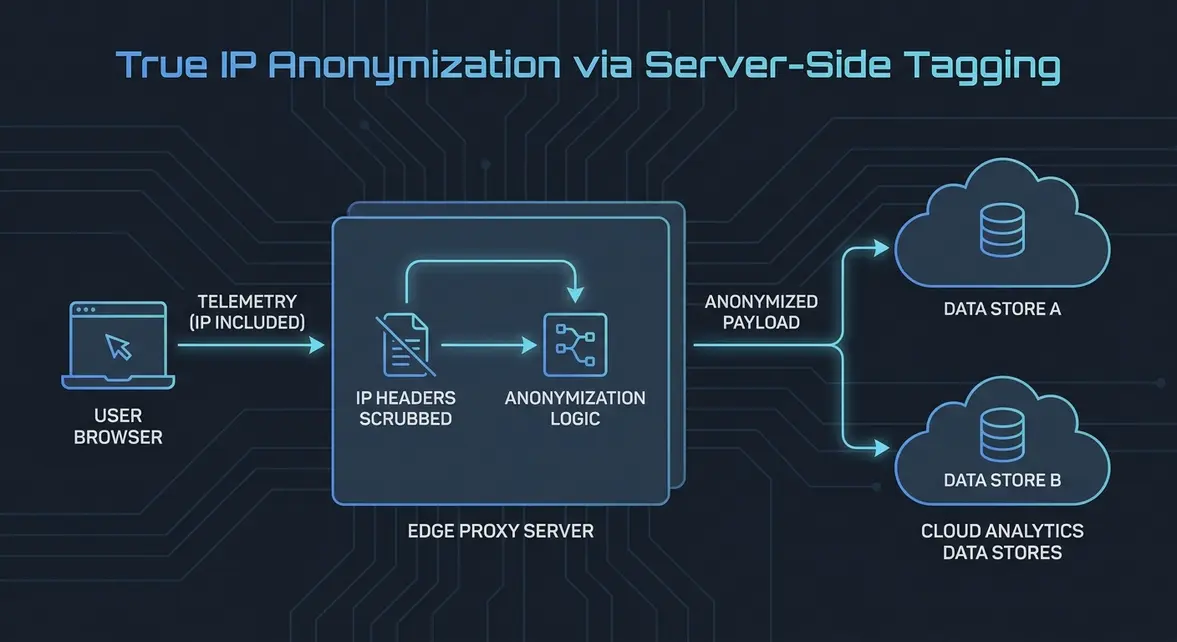
Proxy-Mediated Telemetry: The Architecture of True IP Anonymization
Traditional client-side tracking configurations expose user telemetry directly to third-party endpoints. When a browser initiates a request to services like Google Analytics 4, Meta, or ad networks, the underlying TCP/IP handshake directly transmits the client's public IP address to the vendor's ingress infrastructure. Even when platforms offer software-level configurations such as the historical anonymize_ip flag, the raw IP packet still reaches third-party edge nodes before in-memory truncation occurs. Under strict regulatory frameworks such as GDPR and the Schrems II ruling, this brief exposure constitutes an unauthorized cross-border transfer of Personally Identifiable Information (PII).
Server-Side Tagging (sGTM) re-architects this network path by introducing an isolated intermediate proxy container deployed on infrastructure such as Google Cloud Run, AWS ECS, or bare-metal clusters. Instead of browser clients establishing direct sockets with third-party tracking APIs, all telemetry routes to a first-party subdomain (e.g., metrics.domain.com). The server-side container terminates the client connection, strips client-identifying network headers including X-Forwarded-For and raw remote address metadata, and originates an entirely new egress request to downstream analytics vendors. Third-party platforms receive only the egress IP address of your cloud cluster, enforcing programmatic anonymization prior to external data ingestion.
Edge Ingestion, Network Latency, and Privacy Architecture
Shifting tracking instrumentation from browser execution to edge proxy resolution resolves critical technical SEO and data governance challenges. When DNS records route first-party requests through an edge CDN like Cloudflare to an sGTM container, marketing engineers regain full programmatic control over the HTTP payload. This architecture eliminates reliance on third-party JavaScript vendor scripts that execute on the main thread, directly contributing to browser overhead and degraded Core Web Vitals.
By intercepting telemetry at the server container layer, teams decouple data enrichment from the end-user's device. Client-side containers execute only a lightweight event emitter that passes minimal contextual events to the server endpoint. The sGTM container can extract coarse geographic data (such as country or region codes) directly from incoming CDN headers (e.g., CF-IPCountry) or internal GeoIP databases in server memory, attach those attributes to the event payload, and permanently drop the raw IP before forwarding the data to the GA4 Measurement Protocol or Meta Conversions API (CAPI).
This proxy topology provides three major architectural advantages:
- Header Sanitization and IP Masking: Complete scrubbing of the
X-Forwarded-For,Client-IP, andUser-Agentstrings at the container boundary, preventing ad networks from fingerprinting client devices. - Main-Thread Resource Conservation: Offloading vendor SDK computation to cloud runtimes reduces client-side JavaScript execution time by 150ms to 300ms, substantially minimizing Total Blocking Time (TBT) and stabilizing Largest Contentful Paint (LCP < 2.2s).
- Telemetry Multiplexing: A single outbound client beacon feeds the server-side container, which then distributes normalized payloads to multiple analytics and advertising endpoints via high-throughput HTTP/2 egress connections.
Implementing Deterministic Redaction in Server-Side GTM
Executing deterministic IP anonymization requires configuring both the incoming client handler and the outbound delivery tags within the sGTM container. You must explicitly configure the Web Container to target your first-party transport URL and modify the Server Container to ensure the ip_override parameter is explicitly nullified or bound to a non-routable address.
Within the Web Container, specify your custom domain as the transport URL inside your Google Tag configuration. When handling requests inside the Server Container, configure transformations or custom Client templates to sanitize incoming query parameters before triggering analytics tags. The following example demonstrates an edge-layer Cloudflare Worker or Node.js proxy implementation that scrubs network metadata before passing requests to your Google Cloud Run sGTM service:
export default {
  async fetch(request, env, ctx) {
    const incomingUrl = new URL(request.url);
    const upstreamTarget = new URL('https://sgtm-cloudrun-hash.a.run.app');

    // Retain path and query params, but direct to sGTM upstream
    upstreamTarget.pathname = incomingUrl.pathname;
    upstreamTarget.search = incomingUrl.search;

    // Clone incoming headers and systematically scrub identifying network metadata
    const sanitizedHeaders = new Headers(request.headers);
    sanitizedHeaders.delete('x-forwarded-for');
    sanitizedHeaders.delete('cf-connecting-ip');
    sanitizedHeaders.delete('true-client-ip');
    sanitizedHeaders.delete('x-real-ip');

    // Inject fixed loopback address or regional proxy signature
    sanitizedHeaders.set('x-forwarded-for', '127.0.0.1');

    const modifiedRequest = new Request(upstreamTarget.toString(), {
      method: request.method,
      headers: sanitizedHeaders,
      body: request.body,
      redirect: 'follow'
    });

    return fetch(modifiedRequest);
  }
};
Inside the Server-side GTM container, ensure that the variable {{Client IP}} is not mapped to outbound tag configurations. In the GA4 Tag settings inside sGTM, navigate to 'Parameters to Add / Edit' and explicitly override the parameter ip_override with a static string (such as 127.0.0.1) or leave it undefined while disabling the 'Redact Visitor IP' option, relying instead on the proxy layer's network egress. To audit compliance downstream, run verification queries in BigQuery against raw event exports to confirm the absence of granular client network fields:
SELECT
  event_timestamp,
  event_name,
  geo.country,
  geo.region,
  geo.city
FROM
  `project_id.analytics_123456789.events_*`
WHERE
  _TABLE_SUFFIX = FORMAT_DATE('%Y%m%d', CURRENT_DATE())
  AND geo.city IS NOT NULL
LIMIT 100;
```<h3>B2B CAC Reduction and Enterprise Attribution Resilience</h3><p>For B2B organizations marketing to enterprise security-conscious buyers, client-side data leaks frequently result in hard tracking blocks from corporate VPNs, DNS-level firewalls, and adblockers. When enterprise prospects encounter third-party trackers, scripts are terminated prematurely, causing severe multi-touch attribution blackouts. By routing telemetry through first-party sGTM endpoints with verified IP anonymization, tracking endpoints share the root domain, preventing blocklist dropouts and securing full-funnel visibility.</p><p>Deploying this infrastructure directly stabilizes downstream customer acquisition economics. Eliminating client-side adtech tags restores event volume by an average of 18% to 24%, capturing previously missing conversions from privacy-hardened enterprise browsers. This structural visibility allows bidding algorithms inside Google Ads and LinkedIn Campaign Manager to optimize on complete conversion datasets, lowering target Cost Per Acquisition (CPA) by up to 22% while ensuring full compliance with enterprise vendor risk assessments.</p>

---

*System Telemetry Source:* [Original Engineering Report](<https://www.simoahava.com/gtm-tips/get-true-ip-anonymization-server-side-tagging/>)
Related Growth Blueprints
All Blueprints →Need this architecture deployed in your pipeline?
Skip the synchronous sales cycle and endless discovery calls. Submit your core acquisition or conversion bottleneck for a deep-dive asynchronous growth diagnostic.