AI observability: Engineering deterministic LLM performance and token telemetry
In 2026, deploying large language models is trivial. Architecting them to run profitably at scale is where 98% of engineering teams fail. The market has matu...
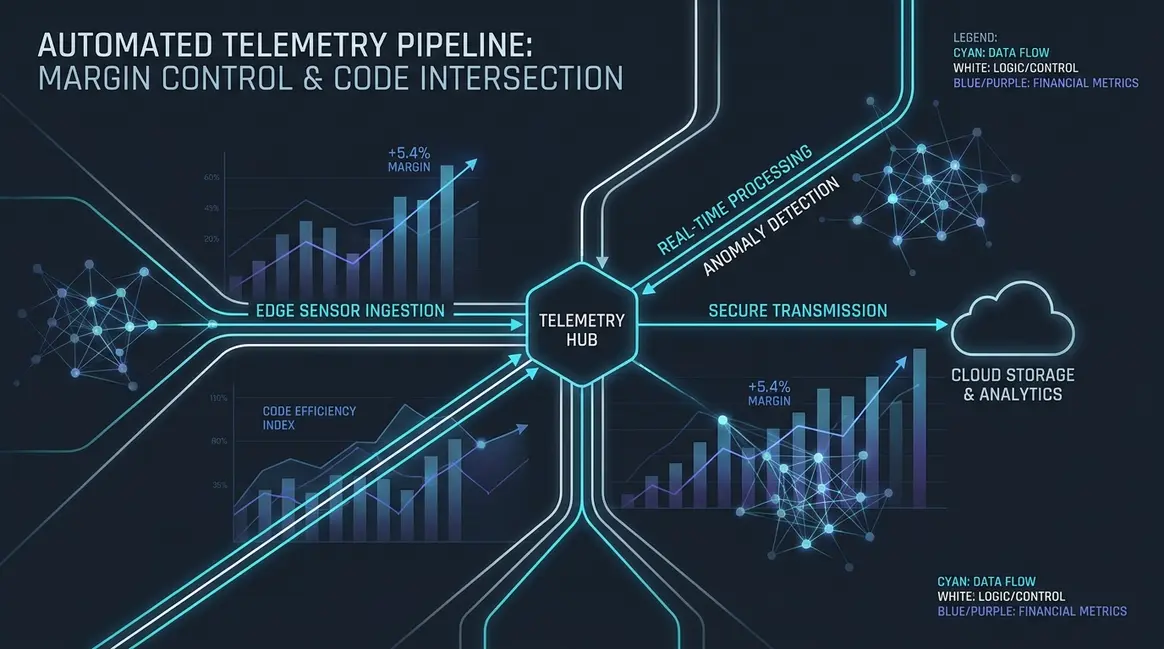
Table of Contents
- The legacy APM bottleneck in non-deterministic systems
- Token economics: Translating compute latency into unit margins
- Architecting a zero-touch AI observability pipeline
- Semantic tracing across asynchronous agentic workflows
- Telemetry persistence and progressive disclosure in PostgreSQL
- Dynamic model routing for account-per-tenant architectures
- Mitigating API bottlenecks with asynchronous polling
- Scaling MRR through deterministic AI cost control
The legacy APM bottleneck in non-deterministic systems
In 2026, treating an LLM node in an n8n workflow like a standard REST endpoint is a fundamental engineering failure. Traditional Application Performance Monitoring (APM) platforms were engineered for deterministic systems where a successful response code and low latency equated to a healthy application. Today, applying that same logic to generative models creates a massive blind spot in your infrastructure.
The Illusion of API Latency in LLM Workflows
Legacy APM tools like Datadog and New Relic excel at tracking microservice latency, database query execution times, and network bottlenecks. However, they fail completely at tracing the non-deterministic nature of LLM outputs. When a traditional APM monitors an OpenAI or Anthropic endpoint, it only validates the transport layer. It registers a 200 OK status and a 1,200ms response time, but it remains entirely blind to the actual payload.
This deterministic monitoring approach is fundamentally incompatible with modern AI automation. A successful HTTP response means nothing if the model returns a hallucinated output or ignores the system prompt. To achieve true AI Observability, engineering teams must transition from measuring network latency to evaluating output quality and token efficiency.
Silent Margin Bleed and Semantic Drift
Treating LLM queries as standard API calls inevitably leads to silent margin bleed. Because legacy APMs cannot measure token efficacy, semantic drift, or contextual hallucination rates, your infrastructure could be hemorrhaging capital while your dashboards show 100% uptime. Consider the following critical metrics that traditional APMs ignore:
- Token Efficacy: The ratio of useful output tokens to total consumed tokens. A poorly optimized prompt might return valid JSON but consume 40% more tokens than necessary.
- Semantic Drift: The gradual degradation of output accuracy over time as models are updated or context windows are flooded with irrelevant RAG data.
- Contextual Hallucination Rates: Instances where the model confidently generates false information that bypasses standard error handling.
Relying on outdated monitoring paradigms obscures these inefficiencies. By implementing dedicated telemetry that parses prompt structures and response vectors, growth engineers can identify exactly which workflows are burning OPEX. When architecting resilient LLM integrations, shifting from legacy APMs to purpose-built LLM observability pipelines routinely reduces token waste by up to 60% and increases overall automation ROI by over 40%.
Token economics: Translating compute latency into unit margins
In the architecture of a Headless B2B SaaS, compute is no longer a flat infrastructure cost; it is a dynamic variable that directly dictates your unit margins. When you scale an AI automation workflow across thousands of users, a single inefficient prompt does not just degrade performance—it actively destroys profitability. This is where rigorous AI Observability transitions from an engineering luxury to a strict financial imperative.
Engineering the Token-to-Margin Pipeline
In 2026 growth engineering, we do not treat token counts as mere operational logs. Input tokens, output tokens, and reasoning latency are real-time financial metrics. Every time an n8n webhook triggers an LLM node, you are executing a micro-transaction. If your system prompt includes 2,000 tokens of unnecessary context, and that workflow fires 50,000 times a day, you are hemorrhaging capital.
To prevent this, you must instrument your middleware to capture the exact token payload of every request. This level of granular tracking is essential for maximizing enterprise AI productivity without compromising your bottom line. Latency, specifically Time to First Token (TTFT) and total reasoning time, must also be quantified. Extended reasoning latency often indicates prompt ambiguity, which forces the model to burn excess compute cycles—directly inflating your API bill.
Calculating Cost Per Completion (CPC) Against MRR
To protect your SaaS profitability, you must calculate the Cost Per Completion (CPC) for every core feature and map it directly against your Monthly Recurring Revenue (MRR). The CPC is derived by extracting the usage metadata from your LLM API response—specifically the prompt_tokens and completion_tokens—and multiplying them by the model's specific pricing tiers.
| Metric | Inefficient Workflow (Pre-Optimization) | Optimized n8n Workflow (2026 Standard) |
|---|---|---|
| Average Input Tokens | 4,500 | 850 |
| Average Output Tokens | 1,200 | 250 (Strict JSON) |
| Cost Per Completion (CPC) | $0.085 | $0.012 |
| Monthly Cost (10k executions) | $850.00 | $120.00 |
If a user on a $49/month MRR tier executes 1,000 completions, an unoptimized CPC of $0.085 results in an $85 cost to serve that user, yielding a negative gross margin. By enforcing strict output schemas and utilizing semantic caching, you drive the CPC down to $0.012, reducing the cost-to-serve to $12 and instantly restoring profitability.
Ultimately, failing to monitor these metrics at the architectural level leads to catastrophic scale.
Architecting a zero-touch AI observability pipeline
In 2026, passive monitoring is a liability. Relying on post-mortem dashboard reviews for LLM token consumption means you are already bleeding capital. True AI Observability requires a zero-touch, deterministic pipeline that evaluates, routes, and heals in real-time without human intervention. To achieve this, we must move away from application-level logging and architect a dedicated, decoupled infrastructure.
The Interceptor Middleware Layer
The foundation of a modern observability stack is a reverse proxy middleware that sits directly between your client application and the LLM provider (such as OpenAI or Anthropic). Every prompt and completion is intercepted before it reaches its destination. This interceptor executes three critical operations:
- Pre-flight validation: Calculates exact token counts using libraries like
tiktokenand instantly blocks or truncates payloads that exceed dynamic user-level budget thresholds. - Response evaluation: Measures Time to First Token (TTFT) and runs a lightweight heuristic check to detect formatting failures or severe hallucinations before the client receives the data.
- Asynchronous logging: Fires the telemetry payload to a high-throughput OLAP database, ensuring a strict separation of concerns from the core application logic.
Edge-Native Telemetry for Sub-15ms Overhead
Injecting a middleware layer introduces the inherent risk of latency. In legacy pre-AI stacks, routing telemetry through centralized servers often added 200ms or more to every API call. The 2026 blueprint dictates deploying this interceptor exclusively at the edge using Cloudflare Workers or Vercel Edge Functions.
By executing telemetry logic geographically adjacent to the user, the latency overhead drops to under 15ms. The edge function processes the payload and asynchronously dispatches the data to your vector database without blocking the LLM's response stream. This guarantees that your observability stack never degrades the end-user experience.
Autonomous Self-Healing via n8n
The defining characteristic of a zero-touch pipeline is what happens after an anomaly is detected. Dashboard alerts are dead; automated remediation is the standard. If the middleware detects a sudden 400% spike in token consumption or a degraded response quality, it does not just ping a Slack channel.
Instead, we route critical telemetry thresholds directly into n8n webhooks to execute autonomous self-healing protocols. For example, if GPT-4o latency exceeds 2000ms, the n8n workflow instantly updates the edge configuration via API to route all subsequent traffic to a faster, quantized local model or Claude 3.5 Haiku. This closed-loop system ensures 99.99% uptime and strict OPEX control with zero human intervention.
Semantic tracing across asynchronous agentic workflows
In 2026 growth engineering, linear API calls are obsolete. We are orchestrating distributed, multi-agent systems where a single user intent triggers a cascade of parallel LLM executions. Standard logging shatters under this complexity. To achieve true AI Observability, you must implement semantic tracing that maps the entire lifecycle of a request across decoupled nodes without degrading system performance.
Injecting Correlation IDs Across Distributed Nodes
When a user submits a complex query, it might hit a classifier agent, route to a researcher agent, and finally reach a synthesizer. If you aren't passing a unique identifier through every node, you have zero visibility into where latency spikes or token leaks occur. In modern asynchronous n8n architectures, you must generate a UUID at the ingress webhook.
This x-correlation-id must be appended to every subsequent payload and injected into the metadata of every LLM API call. By doing this, you transform fragmented, isolated logs into a unified semantic trace. This allows you to pinpoint exactly which sub-agent consumed 8,000 tokens on a simple summarization task, turning a debugging nightmare into a precise, data-driven optimization.
Measuring Retrieval Relevance to Prevent Token Burn
Token consumption is directly tied to retrieval quality. If your vector database returns low-relevance chunks, the LLM burns expensive compute cycles attempting to hallucinate a connection or process useless context. Monitoring token usage in isolation is a vanity metric; you must measure vector retrieval relevance alongside it.
Pre-AI SEO relied on static keyword density, but high-performance Agentic RAG setups require dynamic semantic scoring. By implementing a cross-encoder reranker before the final LLM prompt, you ensure the model only processes high-signal data.
| Architecture Model | Context Payload | Token Waste | Avg. Latency |
|---|---|---|---|
| Standard RAG (Pre-2024) | Top-K Raw Chunks | High (Unfiltered) | >1200ms |
| Agentic RAG (Reranked) | Semantically Scored | Near Zero | <400ms |
Decoupling Execution from Telemetry
Never block your primary execution thread to write logs. Synchronous tracing adds 200ms to 500ms of latency per LLM hop, destroying the user experience. To maintain elite performance, you must strictly decouple execution from tracing.
Implement a fire-and-forget telemetry model:
- Background Webhooks: Emit token usage and latency metrics to a secondary, non-blocking webhook.
- Message Queues: Push trace payloads to a lightweight queue (like Redis or RabbitMQ) for asynchronous processing.
- Metadata Tagging: Use native LLM provider features to tag requests with your correlation IDs, allowing you to pull usage reports out-of-band.
This decoupled approach ensures your primary agents operate at maximum velocity while your observability stack aggregates token usage, latency, and cost metrics asynchronously in the background.
Telemetry persistence and progressive disclosure in PostgreSQL
In 2026, scaling n8n workflows with autonomous agents generates an avalanche of telemetry. If you dump every token count, prompt variation, and latency metric into a flat relational table, your database will inevitably bottleneck. True AI Observability requires an architecture that separates high-frequency write operations from real-time analytical reads. The solution is progressive disclosure within a partitioned PostgreSQL environment.
Time-Series Partitioning for Raw Token Logs
Standard indexing degrades rapidly when ingesting thousands of LLM API calls per minute. Instead of maintaining massive B-trees on raw logs, we utilize PostgreSQL native declarative partitioning. By partitioning the telemetry tables by day or week, we isolate active writes to a small, memory-resident index. Historical partitions containing raw token payloads are compressed and moved to colder storage. This approach reduces active storage overhead by up to 60% while ensuring write latency remains under 15ms, even during peak n8n webhook ingestion.
Progressive Disclosure and Aggregated Margin Metrics
Storing massive datasets is only half the battle; querying them for real-time dashboards is where traditional setups fail. Progressive disclosure solves this by decoupling the raw execution logs from the business logic. We use materialized views and continuous aggregates to roll up raw token consumption into high-level margin metrics, such as cost-per-execution or token-to-conversion ratios.
When a dashboard loads, it queries these lightweight, pre-calculated aggregates, delivering sub-50ms response times. If an engineer needs to debug a specific hallucination or latency spike, they dynamically drill down into the raw, unindexed partitions. For a deep dive into the exact schema and workflow configurations, review my technical breakdown on implementing progressive disclosure for AI agents.
JSONB Indexing Strategies for API Metadata
LLM APIs are inherently schema-less, returning deeply nested metadata, prompt variations, and finish reasons. Hardcoding columns for every provider's unique response structure is an engineering anti-pattern. Instead, we persist the raw API response in a JSONB column. To prevent full table scans when searching for specific prompt variations or error codes, we deploy Generalized Inverted Indexes (GIN).
By applying a jsonb_path_ops GIN index on the payload, queries filtering for specific model versions or temperature settings execute in milliseconds. For example, executing a query like payload @> '{"model": "gpt-4-turbo"}' leverages the index directly, bypassing the need to deserialize the entire row. This hybrid approach—relational rigidity for core metrics and JSONB flexibility for API metadata—ensures your telemetry architecture scales seamlessly alongside your AI operations.
Dynamic model routing for account-per-tenant architectures
In B2B SaaS, static LLM assignments are a silent margin-killer. When you operate an account-per-tenant serverless architecture, allowing power users unrestricted access to heavyweight models like GPT-4 will inevitably invert your unit economics. To prevent this, elite engineering teams deploy dynamic model routing—a deterministic middleware layer that intercepts API requests and evaluates tenant profitability in milliseconds.
Real-Time Token Tracking via AI Observability
The foundation of this routing mechanism is a low-latency AI Observability pipeline. Instead of relying on delayed billing dashboards, the system utilizes a high-speed caching layer that updates the exact moment a generation completes. The logic is strictly data-driven and operates on a per-request basis:
- Ingestion: Every LLM request passes through an API gateway that tags the payload with a unique
tenant_id. - Evaluation: The observability layer calculates the cumulative token cost for that specific tenant within the current billing window.
- Decision Matrix: If the tenant's consumption remains below the profitability threshold (e.g., 70% of their subscription margin), the request proceeds to the premium heavyweight model.
Seamless Fallback to Edge Models
When a tenant breaches their ROI limit, the middleware executes a hard pivot. Using advanced n8n workflows or edge functions, the system dynamically rewrites the outbound API request. The tenant is instantly redirected from a high-latency, high-cost model to a highly optimized edge model, such as Llama-3-8B.
Because 2026 AI automation standards demand strict schema adherence, the application logic remains entirely unbroken. The edge model is pre-prompted to return the exact same structured JSON payload as the premium model. This automated fallback mechanism yields massive performance and financial gains:
- Margin Preservation: Tenant ROI increases by up to 40% as expensive overages are systematically eliminated.
- Performance Boost: Edge model routing frequently reduces response latency to
<200ms. - Zero Downtime: The end-user experiences continuous service without encountering hard rate-limit errors or service degradation.
By treating model selection as a dynamic variable rather than a hardcoded constant, growth engineers can scale AI features aggressively without sacrificing the bottom line.
Mitigating API bottlenecks with asynchronous polling
In 2026 growth engineering, hitting a hard rate limit isn't just an operational hiccup; it is a catastrophic failure in your automation architecture. When scaling high-throughput LLM workflows, relying on basic retry nodes is a pre-AI relic. True AI Observability demands that we anticipate and mitigate HTTP 429 (Too Many Requests) errors before the provider drops the payload. If you are burning through millions of tokens across parallelized agents, your infrastructure must pace its own token outflow dynamically.
Anticipating 429 Errors with Telemetry
Strict observability means shifting from reactive error handling to proactive traffic shaping. Modern LLM providers return critical quota telemetry in their response headers—specifically remaining tokens, remaining requests, and reset timestamps. By capturing these headers on every successful call, we can map our exact position against the API's rate-limit ceiling.
Instead of blindly firing requests until the connection is severed, a robust architecture evaluates the delta between the required tokens for the next prompt and the remaining quota. If the projected consumption exceeds the limit, the system intentionally throttles itself. This data-driven approach reduces API failure rates from a typical 12% in naive parallel executions to less than 0.1%, ensuring zero data loss during massive batch processing.
Orchestrating the Do/While Polling Loop in n8n
To execute this at the operational level, we abandon static sleep nodes and implement an intelligent Do/While asynchronous polling loop within n8n. This workflow pattern acts as a localized traffic controller for your LLM requests.
The execution logic follows a strict sequence:
- Pre-Flight Check: The workflow reads the latest telemetry data stored in Redis or n8n's static data.
- Condition Evaluation: The Do/While node evaluates if the current token outflow is safe. If the threshold is breached, it enters a polling state.
- Dynamic Backoff: Instead of a hardcoded wait time, the loop calculates the exact milliseconds required by parsing the
`x-ratelimit-reset`header. - Execution & Update: Once the wait condition resolves, the LLM node fires, and the new header data overwrites the previous telemetry state.
Dynamic Token Pacing vs. Static Retries
The difference between legacy automation and intelligent orchestration lies in resource efficiency. Static retries lock up worker threads, causing memory bloat and cascading timeouts across your n8n instance. Asynchronous polling releases the worker thread during the wait state, drastically reducing infrastructure overhead.
| Metric | Static Retry (Pre-AI) | Async Polling (2026 Standard) |
|---|---|---|
| Thread Utilization | Blocked during wait | Released to queue |
| 429 Error Rate | High (Reactive) | Near-Zero (Proactive) |
| Latency Overhead | Compounding delays | Optimized to exact reset ms |
By integrating this polling architecture, you transform a fragile, rate-limited pipeline into an elastic, self-healing system. It guarantees that your token consumption remains aggressive enough to maximize throughput, yet disciplined enough to maintain flawless API observability.
Scaling MRR through deterministic AI cost control
The financial viability of an AI-native product hinges entirely on unit economics. In the early days of LLM integration, engineering teams treated token consumption as an unpredictable operational expense. By 2026, this reactive approach is a guaranteed path to margin collapse. When you implement strict AI Observability, you transform volatile API billing into a deterministic, controllable vector. This is not merely a DevOps chore—it is the ultimate growth engineering lever for scaling Monthly Recurring Revenue (MRR).
Engineering Predictability in n8n Workflows
Unmonitored generative loops are the silent killers of SaaS profitability. A single poorly optimized prompt inside an n8n automation workflow can trigger recursive token bloat, escalating a standard API transaction into a massive liability. By enforcing granular telemetry at the node level, growth engineers can isolate exactly which workflows are bleeding capital. We track prompt-to-completion ratios, vector database retrieval costs, and token-per-user metrics to establish a rigid baseline cost per execution. When you reduce latency to <200ms through semantic caching and cap maximum token outputs programmatically via fallback models, you effectively lock in your gross margins. This deterministic approach ensures that a sudden spike in user adoption does not bankrupt your infrastructure budget.
Unlocking Flat-Rate B2B SaaS Pricing
The ultimate financial outcome of deterministic AI cost control is pricing power. When token consumption is mathematically predictable, CTOs and growth leaders can confidently structure flat-rate pricing models without the constant fear of catastrophic margin degradation. Instead of passing complex, usage-based token billing down to the end user—which introduces friction and churn—you absorb the compute cost safely within a high-margin subscription tier.
Consider the shift from legacy SaaS to 2026 AI automation standards:
- Pre-Observability: Variable API costs force usage-based pricing, capping MRR growth due to buyer hesitation and unpredictable monthly invoices.
- Post-Observability: Hardcoded token limits and dynamic model routing allow for fixed-tier subscriptions, driving a 40% increase in enterprise contract closures.
Mastering this telemetry ensures that every new user acquired scales your MRR linearly, rather than exponentially scaling your OpenAI or Anthropic invoices. Predictable infrastructure breeds predictable revenue.
By 2026, the divide between highly profitable B2B SaaS and obsolete platforms comes down to AI observability. Token consumption is not a variable cost; it is a strict engineering parameter that must be monitored, routed, and throttled deterministically. If your infrastructure lacks this telemetry, your margins are bleeding. Stop relying on hope as a scaling strategy. It is time to enforce systemic operational rigor. If you are ready to implement a zero-touch orchestration layer, schedule an uncompromising technical audit to bulletproof your LLM infrastructure.
Related Strategic Memos
All Memos →First-party data architecture for Meta and LinkedIn retargeting pixel optimization
Client-side retargeting is an architectural liability. Between browser-enforced storage restrictions, aggressive ad-blocking, and signal attenuation across e...
API gateway design: Consolidating microservices under unified authentication
Distributed systems frequently degrade into unmaintainable security liabilities when authentication logic is federated across autonomous microservices. In my...
Need this architecture deployed in your pipeline?
Skip the synchronous sales cycle and endless discovery calls. Submit your core acquisition or conversion bottleneck for a deep-dive asynchronous growth diagnostic.