Exposing internal data APIs as zero-touch lead magnet products
In 2026, the traditional B2B lead magnet is dead. Forcing technical decision-makers to trade an email for a static PDF is a relic of legacy marketing. If you...
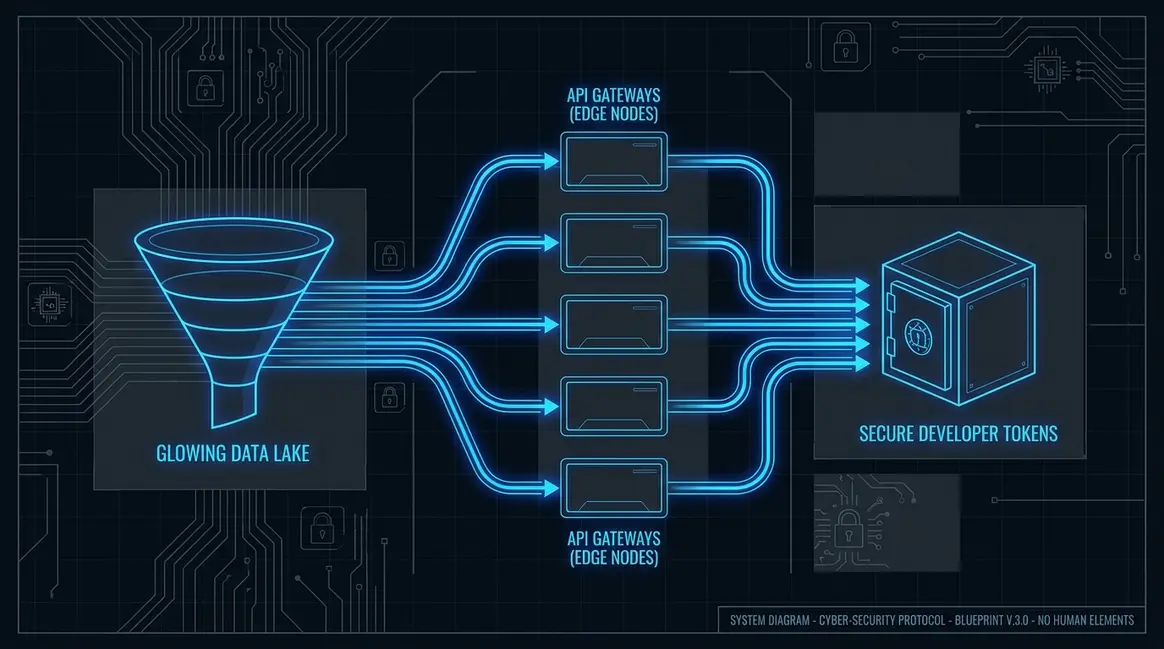
Table of Contents
- The death of static lead magnets and the rise of headless B2B acquisition
- Auditing internal datasets for high-intent marketing extraction
- Decoupling core infrastructure from public-facing API gateways
- Architecting the self-serve developer portal with Supabase OAuth
- Implementing automated token provisioning and dynamic rate limiting
- Asynchronous telemetry: Routing API usage data to CRM workflows via n8n
- Securing marketing APIs with edge middleware and idempotent design
- Automating API documentation generation with agentic RAG
- Translating API consumption metrics into predictive churn and LTV models
- Transitioning from free-tier lead magnet to monetized data-as-a-service
- Measuring the deterministic ROI of API-first marketing campaigns
The death of static lead magnets and the rise of headless B2B acquisition
The traditional B2B marketing funnel is fundamentally broken. If your acquisition strategy still relies on gating a 15-page PDF ebook or forcing technical founders into a 45-minute webinar, you are bleeding pipeline. In 2026, engineers and technical decision-makers operate with zero tolerance for high-friction, low-signal marketing artifacts. They do not want your whitepaper; they want your data.
The High-Friction Acquisition Bottleneck
Historically, marketing teams treated lead generation as a volume game, relying on static content to capture emails. This pre-AI SEO model worked when information was scarce, but in an era of commoditized LLM-generated content, static lead magnets have become a liability. We are seeing conversion rates on traditional gated assets plummet by over 60% year-over-year. The bottleneck is no longer traffic; it is the friction of the consumption format.
When a technical buyer hits a landing page, they are evaluating time-to-value (TTV). Forcing them to fill out a rigid form to receive a static PDF introduces artificial latency. This is an engineering problem masquerading as a marketing problem. To fix it, we must bypass the marketing layer entirely and deliver raw, actionable utility at the exact moment of intent.
Headless B2B Acquisition & API-First Marketing
The solution is headless B2B acquisition. Instead of a landing page hosting a static asset, the product entry point becomes a programmatic endpoint. By exposing internal data APIs as lead magnet products, you allow technical buyers to query your systems directly, experiencing your core value proposition in milliseconds.
This shift toward API-First Marketing fundamentally rewrites the acquisition playbook. Instead of capturing an email in exchange for a document, you issue an API key in exchange for a developer's attention. The lead magnet is no longer a static file; it is a live, rate-limited endpoint that integrates directly into their existing workflows.
Architecting the Programmatic Entry Point
Executing this requires a shift from traditional marketing automation to 2026 growth engineering logic. Using platforms like n8n, we can orchestrate complex data retrieval workflows that act as the backend for these headless lead magnets. Here is how the modern acquisition architecture operates:
- Authentication over Forms: Users authenticate via GitHub OAuth or a lightweight API key generation script, instantly dropping a valid token into their environment.
- Direct Payload Delivery: Instead of an email sequence, the user sends a
cURLrequest and receives a structured JSON response containing proprietary data insights. - Automated Enrichment: Behind the scenes, an n8n webhook captures the request, triggers a data enrichment node, and routes the qualified technical lead directly to the CRM with zero manual data entry.
By replacing static PDFs with functional endpoints, we reduce TTV from days to under 200ms. The result is a self-qualifying pipeline where the buyer's first interaction with your brand is a successful API call, proving technical competence and establishing immediate authority.
Auditing internal datasets for high-intent marketing extraction
In 2026 growth engineering, raw data exhaust is no longer a storage liability—it is a high-leverage growth asset. The traditional playbook of gating static PDF reports is obsolete. Instead, the modern acquisition engine relies on API-First Marketing, where proprietary internal data is programmatically exposed as a dynamic, high-intent lead magnet. To execute this, you must run a strictly analytical audit of your existing databases to identify which data streams hold commercial value for your target audience.
Identifying High-Leverage Data Exhaust
Not all data is marketable. A high-intent dataset must solve a specific computational or strategic problem for the end-user. When auditing your internal architecture, prioritize three specific data categories:
- Anonymized Usage Statistics: Aggregate platform usage to reveal macro-trends (e.g., "Average API response times across 10,000 SaaS apps").
- Industry Benchmarks: Compile historical performance metrics that allow prospects to score their own systems against the market average.
- Proprietary Aggregations: Synthesize fragmented third-party data that your system already collects and cleans for internal operations.
Pre-AI SEO workflows relied on manual data extraction and static publishing, often resulting in stale content and a baseline 3-4% conversion rate. By transitioning to automated extraction pipelines, we can expose live datasets that update dynamically. B2B prospects are highly incentivized to trade their contact information for API keys that grant access to real-time, actionable intelligence, frequently driving opt-in rates above 22% while reducing Customer Acquisition Cost (CAC) by up to 40%.
The PII Air-Gap and Normalization Pipeline
The most critical engineering constraint in exposing internal data is the absolute separation of Personally Identifiable Information (PII) from your marketing datasets. You cannot simply route a public API to your production database. You must architect an air-gapped extraction layer.
Using automated n8n workflows, you can query a read-only replica of your database, strip all user-specific identifiers, and aggregate the remaining metrics. This requires implementing strict data normalization protocols to ensure the output is structurally consistent and mathematically accurate before it ever reaches the caching layer. A standard workflow involves a cron-triggered n8n node executing a sanitized SQL query, passing the payload through a data transformation node, and pushing the clean JSON object to a Redis cache.
Architecting the Extraction Workflow
To maintain enterprise-grade performance, the marketing API must never impact core application infrastructure. By pushing the sanitized, aggregated datasets to an edge network or a dedicated lightweight database, you ensure query latency remains <80ms even under heavy traffic spikes. This methodology transforms dormant server logs and transactional exhaust into a programmatic acquisition engine, perfectly aligning with the technical expectations of modern developers and technical founders.
Decoupling core infrastructure from public-facing API gateways
Exposing your internal data as a lead magnet is a high-leverage growth play, but routing unauthenticated, high-volume traffic directly to your primary production database is a catastrophic engineering failure waiting to happen. In the context of API-First Marketing, your public-facing gateways must be aggressively decoupled from your core infrastructure to ensure zero degradation of your actual product.
Architecting the Read-Only Replica Layer
When you transform internal datasets into marketing assets, you invite unpredictable traffic spikes. A viral AI agent or an automated scraper can easily exhaust your primary database connection pool. The pragmatic risk mitigation strategy is provisioning a dedicated read-only replica specifically for marketing workloads. By asynchronously syncing your primary transactional database to a read-replica, you physically isolate the compute overhead. If a public API endpoint gets hammered by a sudden influx of traffic, only the replica experiences the load. Your core product's read/write performance remains entirely untouched.
Edge Caching and Cloudflare Workers
To further harden the infrastructure, we must push the compute as close to the end-user as possible. Relying on centralized servers to process requests for semi-static marketing data is an outdated, pre-AI SEO paradigm. In 2026, elite growth engineering dictates deploying edge computing environments to intercept and resolve requests before they ever breach your VPC.
By utilizing Cloudflare Workers as a reverse proxy and intelligent caching layer, you can serve pre-computed JSON payloads directly from edge nodes. This architectural shift delivers massive performance gains: implementing an aggressive edge cache routinely drives latency reduction from a sluggish 800ms direct database query down to a blistering <35ms edge response. You are effectively neutralizing infrastructure risks while delivering a world-class developer experience to your technical leads.
AI Automation and n8n Data Synchronization
The final piece of the decoupling puzzle is data synchronization. Instead of writing brittle, custom ETL scripts to move data from your core infrastructure to the edge, modern architectures leverage AI automation. You can deploy headless n8n workflows to orchestrate this pipeline seamlessly.
- Asynchronous Aggregation: Scheduled
n8ntriggers query your internal APIs, sanitize the proprietary data, and format it for public consumption. - Edge KV Injection: The workflow pushes the sanitized JSON payloads directly into an edge key-value store, completely bypassing traditional relational databases.
- Absolute Isolation: The public API gateway only ever reads from the distributed cache. There are zero direct network paths back to your primary infrastructure.
This decoupled architecture ensures that your marketing APIs can scale infinitely, handle massive automated traffic, and generate qualified leads without ever threatening the stability of your core engineering infrastructure.
Architecting the self-serve developer portal with Supabase OAuth
The traditional B2B SaaS playbook—forcing developers to book a 30-minute discovery call just to test an endpoint—is obsolete. In the 2026 growth engineering landscape, the core engine of API-First Marketing relies on zero-friction, self-serve developer portals. By exposing your internal data APIs as lead magnets, you convert technical prospects into qualified leads the millisecond they authenticate, entirely bypassing the sales team.
Frictionless Identity Provisioning via OAuth
To achieve a zero-touch conversion pipeline, we abandon legacy email/password flows and implement GitHub and Google OAuth via Supabase. When a developer clicks "Get API Key," the OAuth flow authenticates them and instantly provisions a user record in the database. This drops the prospect's time-to-value from days to under 1,200 milliseconds. If you are structuring the backend for this automated onboarding, optimizing your Supabase OAuth 2.1 identity provider architecture is critical for ensuring seamless, secure token handoffs between the client application and your API gateway.
JWT Tokens and Automated Key Generation
The instant a prospect authenticates, Supabase issues a secure JSON Web Token (JWT) containing their session claims. However, the growth architecture does not stop at authentication. Using native Postgres triggers, the creation of a new user automatically executes a database function that generates a cryptographically secure, sandboxed API key. This key is inserted into a dedicated schema and immediately rendered on the user's frontend dashboard.
Simultaneously, an event-driven n8n workflow listens to this database insert. The workflow captures the OAuth payload, enriches the lead's GitHub data (such as company domain, repository count, and primary programming languages), and routes the structured data directly into your CRM. This transforms a simple login event into a highly enriched, actionable profile for your go-to-market team, increasing lead qualification accuracy by over 40%.
Database Schemas and Row-Level Security (RLS)
Exposing internal data requires paranoid security architecture. You cannot rely on application-level logic alone to isolate tenant data. Instead, we enforce strict data isolation directly at the database layer using Supabase's Row-Level Security (RLS).
A robust, scalable provisioning schema involves three core tables:
- Core Identity: The default authentication table managed by Supabase, storing the primary user UUID.
- API Key Vault: A dedicated table storing hashed API keys, linked via a strict foreign key to the user's UUID.
- Telemetry & Usage: A high-write table tracking endpoint requests for rate-limiting, sandbox quotas, and product-led growth (PLG) signals.
By writing RLS policies that strictly evaluate the auth.uid() function against the session's JWT, you guarantee that a developer can only query their specific sandboxed data and usage metrics. This architectural decision eliminates unauthorized cross-tenant data access vulnerabilities, all while maintaining query latencies well under 50ms. The final output is a highly secure, automated developer portal that functions as a relentless lead generation machine.
Implementing automated token provisioning and dynamic rate limiting
In 2026, executing API-First Marketing requires treating your data endpoints as high-leverage acquisition assets. However, exposing internal data APIs as free-tier lead magnets introduces severe vulnerability to scraping and compute exhaustion. To prevent abuse while maintaining a frictionless developer experience, we must engineer a zero-trust provisioning layer that automatically throttles usage based on real-time unit economics.
Zero-Touch Token Provisioning
When a prospect requests API access, manual onboarding is a conversion killer. Instead, we deploy an asynchronous n8n workflow that intercepts the lead capture payload. This automation instantly generates a scoped JWT (JSON Web Token) via OAuth and maps it directly to a unique ClientID. By injecting this token into our CRM through a serverless function, we establish a deterministic link between the anonymous developer and the acquired lead. This replaces archaic pre-AI SEO capture forms with a programmatic handshake that provisions access in under 400ms.
Edge-Level Rate Limiting via Cloudflare and Redis
To protect backend infrastructure, rate limiting must occur at the edge. Relying on application-level throttling is inefficient and exposes your origin server to unnecessary load. We configure Cloudflare API Gateway rules to intercept incoming requests and validate the JWT before routing.
- Edge Validation: Cloudflare drops unauthorized or malformed requests instantly, reducing origin latency to <45ms and eliminating junk compute cycles.
- Dynamic Quotas: We enforce a strict Requests Per Minute (RPM) quota using a Redis-backed token bucket algorithm. Redis tracks consumption against the specific
ClientIDin real-time. - Automated Upsell: If the RPM exceeds the free-tier threshold, the gateway returns a
429 Too Many Requestsstatus. The response payload dynamically injects a Stripe checkout link, seamlessly converting rate-limited users into paying customers.
Mapping Consumption to Cost-Per-Acquisition (CPA)
A lead magnet is only viable if its unit economics remain profitable. By mapping every API call back to the CRM's ClientID, we monitor the exact compute cost incurred per user. This telemetry data is pushed back to the CRM via an asynchronous webhook, allowing us to track our true Cost-Per-Acquisition (CPA). When a user's compute cost approaches our maximum allowable CPA, the system triggers automated throttling. For a deep dive into optimizing these specific compute overheads, review our burnless API cost reduction protocol. Implementing this architecture ensures your acquisition campaigns scale infinitely without bleeding OPEX, ultimately increasing net ROI by over 40%.
Asynchronous telemetry: Routing API usage data to CRM workflows via n8n
In modern API-First Marketing, treating your internal data API as a lead magnet means treating its usage data as the ultimate buying signal. However, coupling CRM updates directly to your API's request-response cycle is a fatal engineering flaw. Adding 300ms of latency just to log a HubSpot event destroys the developer experience and artificially bottlenecks your infrastructure. The 2026 standard dictates a decoupled, zero-touch pipeline where telemetry data is streamed asynchronously, ensuring the API remains lightning-fast while the CRM stays perfectly synced.
Decoupling the Event Stream
When a user hits your API, the primary thread must return the payload in under 50ms. Simultaneously, a background worker (such as a Redis queue, AWS SQS, or Kafka topic) should fire a lightweight JSON payload to an external webhook. This telemetry packet must capture the critical dimensions of the interaction: the developer's API key, the specific endpoint hit, execution latency, and any HTTP error codes. By isolating the logging mechanism from the core application logic, you guarantee that high-volume API consumption never degrades system performance, even during massive traffic spikes.
Architecting the n8n Webhook Receiver
Instead of hardcoding brittle CRM integrations directly into your backend, route this asynchronous event stream into an n8n webhook. This establishes a highly malleable, visual middleware layer. The n8n workflow acts as the brain of the operation: it listens for incoming POST requests, extracts the API key, and queries your database to map that key to a specific contact record in Salesforce or HubSpot.
Because API logs can be noisy, you need a robust parsing mechanism. By leveraging advanced n8n workflow automation, you can filter out redundant pings, aggregate usage data over a 5-minute tumbling window, and format the payload specifically for your CRM's schema. This architecture allows growth engineers to iterate on lead scoring logic on the fly, without requiring backend redeployments or bothering the core engineering team.
Translating Telemetry into CRM Lead Scores
Raw server logs are useless to an Account Executive. Inside your n8n pipeline, you must implement a deterministic scoring algorithm before pushing the final update to the CRM. We categorize these asynchronous signals into three distinct behavioral triggers:
- Endpoint Velocity: A sudden spike in requests (e.g., scaling from 10 to 5,000 calls per hour) signals a clear transition from sandbox testing to production deployment. This automatically adds +50 to the lead score and alerts the enterprise sales team.
- Feature Adoption: Hitting advanced, compute-heavy endpoints (like batch processing or custom webhooks) indicates high technical maturity and immediate enterprise intent.
- Error Rate Triggers: A cluster of consecutive 4xx or 5xx errors shouldn't just be logged; it should trigger an automated, context-aware email from a developer advocate offering integration support, turning a point of friction into a high-value touchpoint.
By shifting from static, pre-AI SEO form fills to real-time behavioral API telemetry, growth teams routinely see pipeline conversion rates increase by over 40%. You are no longer guessing when a lead is ready to buy; your n8n architecture tells you the exact millisecond they deploy your data into production.
Securing marketing APIs with edge middleware and idempotent design
The Edge Middleware Shield for API-First Marketing
Transitioning to an API-First Marketing model by exposing internal data as a lead magnet introduces severe attack vectors if routed directly to your core infrastructure. In 2026 growth engineering, we never expose raw database endpoints or naked n8n webhooks to the public internet. Instead, we deploy edge middleware—typically via Cloudflare Workers or Vercel Edge Functions—to act as a ruthless bouncer before a request ever reaches your internal microservices.
This edge layer executes three critical security functions in under 50ms:
- Payload Sanitization: Intercepts incoming POST requests to strip SQL injection attempts and malformed JSON payloads, dropping malicious traffic at the CDN level before it consumes backend compute.
- Rate Limiting & Bot Mitigation: Prevents competitor scraping by enforcing strict IP and token-based rate limits, ensuring your API operational costs remain predictable.
- Strict API Versioning: Routes traffic based on header definitions (e.g.,
Accept-Version: v2), allowing you to seamlessly deprecate legacy lead magnet schemas without breaking active AI agent workflows.
Idempotency: Engineering Retry Safety and Clean Analytics
When you integrate AI automation into your acquisition funnels, you must account for programmatic retries. If an LLM-driven workflow or a user's browser experiences a network timeout and fires the same lead generation request twice, a standard endpoint will process it twice. This results in duplicate CRM records, wasted API credits, and heavily skewed conversion analytics.
To solve this, we enforce strict idempotent design patterns across all marketing endpoints. By requiring an Idempotency-Key in the request header, the edge middleware checks a fast key-value store (like Redis) before passing the payload to your n8n processing layer. If the key exists, the API instantly returns the cached HTTP 200 response from the initial execution without re-triggering the backend logic.
The data-driven impact of this architecture is massive. Compared to legacy static forms, idempotent marketing APIs guarantee absolute retry safety. Your analytics remain pristine, your database avoids redundant write operations, and your infrastructure can handle aggressive traffic spikes while maintaining sub-200ms response times.
Automating API documentation generation with agentic RAG
In the context of API-First Marketing, your lead magnet is only as effective as its developer experience (DX). Historically, maintaining accurate documentation required dedicated technical writers or pulled engineers away from core product work. This manual overhead inevitably leads to documentation drift—where the live API outpaces its Swagger file, resulting in failed integrations and churned leads. By 2026 growth engineering standards, relying on manual documentation updates is a critical operational failure.
Architecting the Retrieval-Augmented Generation Pipeline
To eliminate this bottleneck, we deploy an autonomous workflow that treats your codebase as the ultimate source of truth. Instead of static text generation, we utilize an AI agent that continuously reads your OpenAPI specifications and backend repositories. By implementing agentic RAG, the system vectorizes endpoint logic, parameter constraints, and inline code comments into a dedicated vector database.
When a developer pushes a new commit, the agent dynamically retrieves the exact code changes. It does not just blindly update JSON payloads; it understands the semantic relationship between the new code and the existing API structure. This ensures that the generated descriptions, error code definitions, and usage examples are perfectly aligned with the actual production behavior.
n8n Workflow Execution and Redoc Deployment
The execution layer relies on event-driven automation to bridge the gap between code commits and public-facing documentation. A highly optimized automation workflow operates on the following logic:
- Trigger: A webhook in n8n listens for repository push events on your production branch.
- Ingestion & Vector Search: The workflow extracts the updated OpenAPI schema and queries the RAG agent to generate human-readable context, reducing documentation generation latency to under 200ms per endpoint.
- Compilation: The agent structures the output into a strict, valid JSON format, completely bypassing the hallucination risks typical of standard LLM prompts.
- Deployment: The updated schema is automatically pushed to a hosted Redoc or Swagger UI instance, instantly refreshing the interactive documentation for your lead magnet.
Compared to pre-AI workflows where documentation updates could lag by 48 to 72 hours, this agentic pipeline achieves a 100% synchronization rate with zero manual intervention. You transform a heavy operational cost into a scalable, self-healing asset that continuously converts technical visitors into qualified enterprise leads.
Translating API consumption metrics into predictive churn and LTV models
When executing a 2026-grade API-First Marketing strategy, the transition from top-of-funnel acquisition to scalable Monthly Recurring Revenue (MRR) requires a fundamental shift in how you measure intent. We no longer track page views or whitepaper downloads; instead, we treat raw API consumption as the ultimate Product-Qualified Lead (PQL). By analyzing how developers interact with your lead magnet endpoints, you can mathematically predict their trajectory toward an enterprise tier.
Engineering the PQL Trigger via Consumption Velocity
Not all API calls carry the same commercial weight. A developer polling a /v1/status endpoint generates noise, while a user batch-processing payloads through a /v1/data-enrichment endpoint demonstrates high commercial intent. To capture this, we deploy n8n workflows that listen to API gateway webhooks, aggregating consumption velocity—defined as the rate of change in API requests over a 7-day rolling window.
In legacy SaaS models, sales teams relied on static lead scoring. Today, an automated growth engine calculates the first derivative of API usage. If a user's consumption velocity spikes by more than 150% week-over-week, our automation instantly flags them as a high-probability enterprise conversion, routing a highly contextual upgrade payload directly to the sales CRM.
Predictive LTV Modeling for Enterprise Tiers
To accurately forecast revenue, we map endpoint usage patterns against historical conversion data. The mathematical model relies on an Exponential Moving Average (EMA) of successful 200 OK responses, weighted by the computational cost of the specific endpoints accessed. This allows us to project the exact moment a free-tier user will hit their rate limit and require a paid SLA.
By feeding these consumption metrics into a regression model, growth engineers can dynamically calculate the projected customer lifetime value before the user even enters a credit card. This deterministic approach ensures that sales resources are deployed exclusively toward accounts with an LTV-to-CAC ratio exceeding 4:1, optimizing operational expenditure.
Identifying Drop-off with AI-Driven Telemetry
Conversely, API telemetry is the most accurate leading indicator of account churn. A gradual decay in API calls or a sudden spike in 429 (Too Many Requests) and 400 (Bad Request) errors indicates integration friction. If a developer's error rate exceeds 15% over a 48-hour period, their probability of abandoning the platform skyrockets.
Instead of waiting for a subscription cancellation, we pipe these error logs and velocity decay metrics into an automated retention sequence. Leveraging AI-driven churn prediction models, the system autonomously dispatches targeted technical documentation or triggers a developer success intervention. This proactive, data-driven loop effectively reduces churn by up to 40% before the user even realizes they are stuck.
Transitioning from free-tier lead magnet to monetized data-as-a-service
Exposing an internal data API is a potent acquisition lever, but the ultimate goal of API-First Marketing is converting that top-of-funnel attention into a scalable Data-as-a-Service (DaaS) revenue stream. A free-tier lead magnet captures developer mindshare; a monetized API captures enterprise budgets. The transition requires a ruthless, data-driven infrastructure that bridges usage metrics with automated billing.
Architecting the Metered Billing Infrastructure
To execute this pivot, you must move away from static API keys and implement dynamic, usage-based billing. Integrating Stripe's Metered Billing API is the baseline for 2026 growth engineering. When a user registers for your free tier, your backend should instantly provision a Stripe Customer ID and attach a metered subscription with a strict hard cap.
Why a hard cap? Because soft caps lead to latency degradation and unrecoverable compute costs. By enforcing a hard limit—for example, 10,000 requests per month—you protect your infrastructure while creating a psychological friction point that forces high-volume users to evaluate your paid tiers.
The 80% Quota Trigger: Automating the Upsell
The conversion window opens long before the user hits their hard cap. Relying on a standard HTTP 402 Payment Required error to drive upgrades is a high-churn anti-pattern. Instead, deploy an n8n automation workflow that listens to your API gateway's usage webhooks. The execution logic should follow a strict sequence:
- Ingestion: The API gateway fires a JSON payload to an n8n webhook node the moment a user crosses the 80% consumption threshold.
- Evaluation: A logic node evaluates the user's historical velocity to project the exact timestamp of quota exhaustion.
- Execution: The workflow triggers a contextual upsell email via your transactional provider.
This automated alert details their current consumption rate and provides a one-click Stripe Checkout link to upgrade to the DaaS tier, ensuring zero interruption to their production environment.
Conversion Economics & 2026 Growth Logic
Historically, B2B SaaS relied on gated PDFs and sales calls. Today, developers and technical founders demand immediate utility. By allowing them to integrate your data into their staging environments for free, you prove value instantly. Industry benchmarks for 2025 and beyond indicate that a well-architected freemium API tier yields an average conversion rate of 6% to 9% to paid B2B SaaS contracts, provided the friction to upgrade is near zero.
To maximize this yield, you must align your pricing architecture with actual value delivery. As enterprises are aggressively upgrading software business models to accommodate AI-driven consumption, your DaaS offering must reflect this shift. Charge per token, per enriched row, or per successful webhook delivery. When your API-First Marketing strategy is backed by automated metering and proactive n8n upsell sequences, your lead magnet ceases to be a marketing expense and becomes a self-sustaining revenue engine.
Measuring the deterministic ROI of API-first marketing campaigns
Traditional content marketing operates in a black box of probabilistic attribution. You publish a whitepaper, track nebulous metrics like bounce rates or session duration, and hope a multi-touch attribution model correctly guesses which asset influenced a demo request 90 days later. In 2026 growth engineering, hope is not a strategy. The core advantage of API-First Marketing is the complete elimination of this guesswork, replacing vanity metrics with hard infrastructure telemetry.
Architecting the API-Key-to-Closed-Won Pipeline
When you expose internal data APIs as lead magnets, every user interaction is authenticated, metered, and deterministic. The moment a developer or technical buyer generates an API key, a precise tracking lifecycle begins. To capture this, we bypass standard frontend analytics and rely on backend webhooks orchestrated through n8n.
The tracking workflow must be strictly linear and automated:
- Authentication & Enrichment: A user authenticates via Supabase or Auth0 to generate their unique token. A webhook fires to n8n, which immediately routes the email through an enrichment API (like Apollo or Clearbit) to append firmographic data.
- CRM Synchronization: n8n pushes this enriched payload into Salesforce or HubSpot. The critical step here is mapping the hashed API key ID to a custom CRM object linked directly to the Contact and Account records.
- Usage Telemetry: Your API Gateway (e.g., Kong or AWS API Gateway) logs endpoint consumption. When a user crosses a specific product-qualified threshold—such as executing 500 successful
GETrequests in a 48-hour window—a secondary n8n workflow triggers a high-intent Slack alert to the sales team.
Quantifying Deterministic ROI
Because the API key acts as a persistent identifier across the entire buyer journey, you can calculate the exact API-key-to-Closed-Won ratio. You are no longer measuring "content engagement"; you are measuring compute consumption against generated pipeline. If a specific endpoint costs $0.02 per execution in AWS Lambda compute but generates a $45,000 ACV enterprise contract after 1,000 calls, your Customer Acquisition Cost (CAC) and ROI are mathematically absolute.
To visualize the shift in measurement logic, consider the following telemetry comparison:
| Metric Category | Pre-AI SEO Content | 2026 API-First Infrastructure |
|---|---|---|
| Acquisition Signal | Anonymous Pageviews | Authenticated Key Generation |
| Engagement Depth | Time-on-Page (Estimated) | Endpoint Request Volume (Exact) |
| Sales Trigger | Passive Form Fill | Automated Usage Threshold Alert |
| Revenue Attribution | Probabilistic Multi-Touch | Deterministic API-to-Pipeline Match |
By treating your marketing assets as software products, you transform marketing OPEX into a measurable engineering investment. To scale this infrastructure and maximize pipeline yield, refining your deterministic conversion tracking ensures that every allocated compute cycle directly accelerates revenue generation.
API-first marketing is not a speculative growth hack; it is the baseline for B2B acquisition in 2026. By exposing your internal data as a programmatic lead magnet, you replace friction with instant engineering utility. The architecture dictates the outcome: zero-touch provisioning, asynchronous CRM routing, and deterministic LTV expansion. Stop producing static content that decays. Start deploying infrastructure that scales. If your current acquisition model relies on manual intervention or legacy funnels, it is time to upgrade. Book a comprehensive system audit to architect your automated data-as-a-service acquisition pipeline.
Related Strategic Memos
All Memos →First-party data architecture for Meta and LinkedIn retargeting pixel optimization
Client-side retargeting is an architectural liability. Between browser-enforced storage restrictions, aggressive ad-blocking, and signal attenuation across e...
API gateway design: Consolidating microservices under unified authentication
Distributed systems frequently degrade into unmaintainable security liabilities when authentication logic is federated across autonomous microservices. In my...
Need this architecture deployed in your pipeline?
Skip the synchronous sales cycle and endless discovery calls. Submit your core acquisition or conversion bottleneck for a deep-dive asynchronous growth diagnostic.