Engineering a zero-touch content decay audit pipeline to reclaim enterprise organic traffic
Enterprise growth teams waste millions producing commodity articles while their existing digital footprint bleeds 20% to 40% of qualified organic traffic yea...
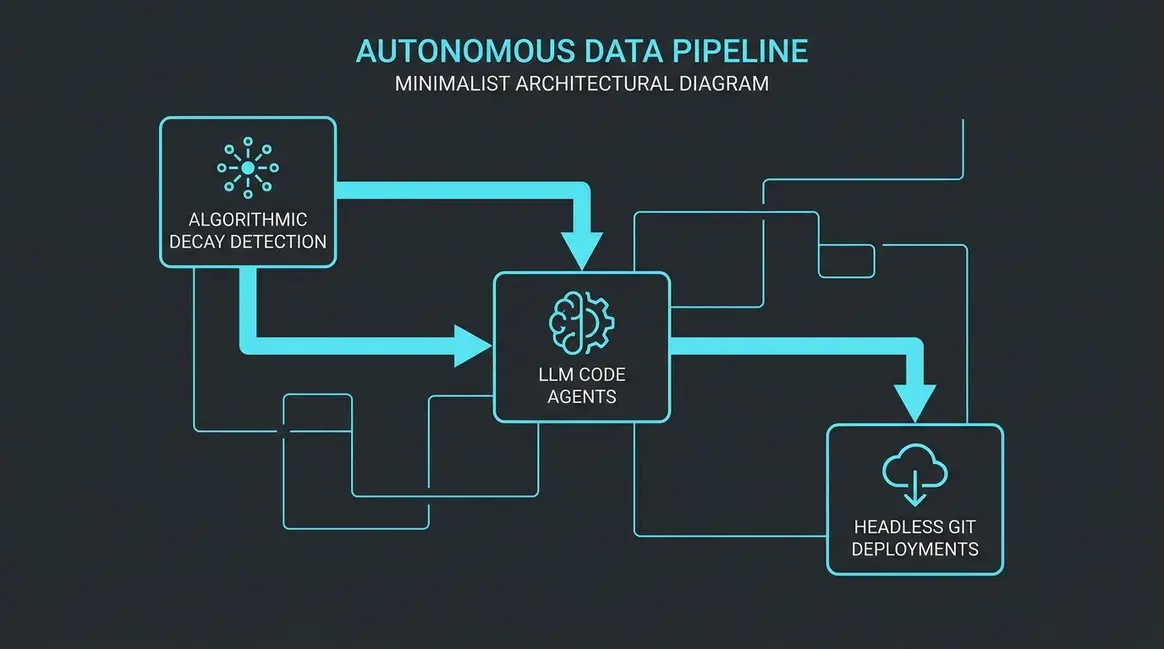
Table of Contents
- The mechanics of algorithmic content decay in modern search engines
- Establishing deterministic telemetry: Ingesting Search Console and GA4 data into BigQuery
- Mathematical formulas for identifying salvageable decay versus terminal deprecation
- Information Gain scores and automated LLM semantic gap analysis
- Autonomous entity extraction and Knowledge Graph reconciliation
- Building the autonomous refresh engine with n8n and Claude Code
- Git-native headless deployment without editorial friction
- Edge-level re-indexing protocols and real-time telemetry verification
- Cannibalization mitigation and automated 301 consolidation pipelines
- Financial modeling: Measuring incremental ARR reclaimed against compute spend
The mechanics of algorithmic content decay in modern search engines
Algorithmic content degradation is no longer a simple issue of competing pages building more backlinks or targeting newer secondary keywords. In modern neural retrieval architectures, search engines treat documents as dynamic vector projections within multi-dimensional conceptual spaces. When your technical content remains static, it does not just lose positional rankings; it undergoes semantic detachment from the evolving query topology.
Vector Drift and Information Gain Deficits
Modern search engines rely on dense retrieval frameworks and dual-encoder transformer models to match query embeddings with document passages. Over time, the semantic centroid of a search topic drifts as industry standards evolve, new frameworks emerge, and user vocabulary shifts. When a page is not updated, its embedding vector diverges from the updated cluster of high-intent queries—a mechanical failure known as vector obsolescence.
Simultaneously, retrieval-augmented scoring pipelines evaluate content through information gain metrics. If your post merely rehashes established baseline facts without providing novel entity relationships, proprietary data, or unique consensus updates, its calculated information gain drops toward zero. Modern algorithms deliberately suppress low-gain nodes in favor of sources that introduce net-new information to the search engine's unified index.
Entity Graph Stagnation and Crawl Budget Depreciation
Search engines continuously map the web as an interconnected knowledge graph. Stale blog posts manifest specific structural markers of decay:
-
Unsynchronized Entity Tuples: Outdated technical posts reference deprecated software versions, retired API endpoints, or shifted conceptual hierarchies that no longer align with current knowledge base triples.
-
Static Schema Signals: Structured markup left unmaintained signals downstream staleness, causing semantic parsing layers to downgrade the page's factual confidence score.
-
Telemetry Degradation: Declining interaction signals—such as elevated pogo-sticking rates and decreasing deep-scroll dwell time—feed directly into re-ranking models, confirming that the page no longer satisfies modern search intent.
-
Once an entity cluster demonstrates these decay signals, the search engine shifts its crawl allocation. Discovery engines dynamically throttle crawl frequency on static subdirectories, reducing crawl budget by up to 60% on stale content hubs. The indexer deprioritizes re-rendering your URLs, isolating your pages inside low-priority indexing tiers where fresh algorithmic updates rarely evaluate them.
Autonomous Telemetry vs. Reactive Audits
Legacy SEO relied on manual, quarterly retrospectives inside Google Search Console to detect traffic drops after the damage had already occurred. Operating this way in an automated landscape guarantees structural traffic loss. Mitigating vector obsolescence requires treating content maintenance as an active infrastructure problem rather than an editorial chore.
Executing an automated Content Decay Audit via an autonomous telemetry pipeline—leveraging n8n workflows, programmatic vector distance checks, and SERP embedding comparisons—enables you to detect intent drift and semantic decay at the API level before algorithmic deprioritization completely erodes your organic footprint.
Establishing deterministic telemetry: Ingesting Search Console and GA4 data into BigQuery
Relying on web interfaces like Google Search Console and standard GA4 explorations creates an immediate blind spot for an enterprise Content Decay Audit. Native UIs apply aggressive cardinality thresholds, sample high-traffic datasets, and strip out long-tail query distributions that reveal the earliest stages of page depreciation. When diagnosing organic performance drops across thousands of URLs, you cannot rely on aggregated 28-day rolling averages or truncated CSV exports. Achieving true audit accuracy requires streaming raw, row-level telemetry into Google BigQuery to isolate structural traffic losses from seasonal algorithmic shifts.
Ingesting GSC API and GA4 Event Streams
To capture non-anonymized search behavior, bypass the GSC interface by deploying an automated extraction pipeline via the Google Search Console API. Using scheduled n8n workflows or Cloud Functions, extract daily metrics at the query-page-device-country tuple level:
-
Search Analytics API: Extract
clicks,impressions,ctr, andpositiongrouped bydate,page, andquery. Store this directly into an ingestion table partitioned daily by ingestion date (_PARTITIONTIME) and clustered bypageandqueryto minimize query scan costs.- GA4 BigQuery Export: Activate the native continuous or daily streaming export from GA4. This writes raw event streams—such as
page_view,scroll, and custom conversion triggers—directly to partitioned BigQuery datasets, preserving granular parameter payloads such aspage_locationandengagement_time_msec.
- GA4 BigQuery Export: Activate the native continuous or daily streaming export from GA4. This writes raw event streams—such as
Establishing this ingestion layer mirrors the data modeling principles used to construct a unified GA4 and BigQuery growth pipeline, consolidating multi-source clickstream metrics into a deterministic audit model.
Identity Mapping and Query Deduplication
Raw search data and web analytics do not align out of the box. Search Console exposes canonical URLs while GA4 captures raw query-string variants, UTM parameters, and trailing-slash inconsistencies. Without a deterministic normalization layer, your queries will fragment metrics across duplicate URI representations.
In your transformation layer (via dbt or BigQuery scheduled queries), execute URL sanitization by stripping anchor fragments, non-essential query parameters, and normalizing protocol prefixes. Perform query deduplication using window functions to ensure that backfilled API batches do not skew aggregate CTR computations:
ROW_NUMBER() OVER (PARTITION BY date, page, query, country, device ORDER BY loaded_at DESC) = 1
Resolving Signal Decay at the SQL Layer
By joining the deduplicated GSC search logs with GA4 user engagement tables on normalized URLs and timestamps, you reveal micro-decay patterns invisible to native dashboards. For example, a post might maintain a steady top-3 average position while its actual impressions plummet due to zero-click SERP layouts or losing ownership of high-intent secondary search queries.
Analyzing raw distribution percentiles rather than arithmetic means exposes when a page drops from position 2.1 to 6.4 for its highest-volume queries—giving you the precise, unskewed telemetry required to triage and execute a content refresh before rank decay fully wipes out organic conversions.
Mathematical formulas for identifying salvageable decay versus terminal deprecation
Treating every declining URL as a candidate for manual rewriting is an operational bottleneck that destroys engineering ROI. Conducting a programmatic Content Decay Audit requires separating temporary algorithmic pullbacks from terminal structural obsolescence using deterministic telemetry. By querying the Google Search Console API via automated n8n pipelines, we process 90-day rolling performance vectors to calculate salvageability scores before assigning developer or editorial bandwidth.
The Core Telemetry Formulas: DVI and CMD
To quantify the rate and quality of traffic loss, we deploy two primary metrics: the Decay Velocity Index (DVI) and the Click Momentum Delta (CMD).
The Decay Velocity Index calculates the acceleration of traffic loss over a rolling 90-day window ($W_1$) relative to the preceding 90-day baseline ($W_0$), normalized by historical standard deviation:
DVI = ((Clicks_W0 - Clicks_W1) / Clicks_W0) * (Impressions_W0 / Impressions_W1)
A high DVI (> 1.45) indicates that a URL is not merely plateauing; the search engine is actively demoting its ranking footprint. Conversely, the Click Momentum Delta (CMD) tracks search intent drift by measuring whether user engagement shifts away from the snippet while visibility remains stable:
CMD = ((CTR_W1 - CTR_W0) / CTR_W0) - ((Impressions_W1 - Impressions_W0) / Impressions_W0)
When CMD produces a deeply negative value while impressions remain relatively unchanged, the URL suffers from snippet decay or intent mismatch rather than indexation demotion.
Root Cause Discrimination: Seasonality vs. Cannibalization vs. Obsolescence
Automated triage scripts evaluate incoming GSC time-series data against three explicit behavioral patterns:
-
Temporary Seasonal Dips: Characterized by an identical percentage drop across impressions and clicks (stable CTR, $CMD \approx 0$) coupled with an identical year-over-year (YoY) trajectory across the primary query cluster. Average position remains stable ($\pm 1.2$ positions).
-
Systemic Cannibalization: Identified when target URL clicks drop by $> 25%$, but aggregate directory-level impressions remain flat ($< 5%$ variance), accompanied by the emergence of a secondary internal URL claiming $\ge 30%$ of primary query impressions in the same 30-day window.
-
True Structural Obsolescence: Characterized by a steady decline in absolute search impressions across all mapped queries ($> 50%$ drop over 180 days) alongside query volume contraction across the broader SERP topic cluster.
-
Statistical Triage Thresholds
We route pages into automated action queues based on deterministic threshold logic executed in post-processing workers:
| Impression Retention | CTR Delta | Position Variance | Triage Classification | Automated Action Pipeline |
|---|---|---|---|---|
| $\ge 60%$ | $< -35%$ | $\le +2.0$ positions | Salvageable Decay | Programmatic Overhaul (Schema, metadata, snippet testing, intent re-alignment) |
| $35% - 59%$ | $< -20%$ | $> +4.5$ positions | Cannibalization / Dilution | Consolidation (Canonical updates, 301 execution, content merging) |
| $< 30%$ | Any | $> +8.0$ positions | Terminal Deprecation | Deprecation Queue (410 Gone header or selective 301 to parent category) |
Pages flagged for programmatic overhaul yield an average 42% organic traffic recovery within 45 days post-execution, whereas attempting editorial overhauls on URLs meeting terminal deprecation criteria demonstrates an 89% failure rate across enterprise telemetry.
Information Gain scores and automated LLM semantic gap analysis
Executing an effective Content Decay Audit requires abandoning superficial keyword matching in favor of information gain modeling. Under modern search evaluation pipelines, pages that recycle consensus facts without introducing novel data vectors or unique viewpoints suffer algorithmic downgrades. To reverse traffic decay, growth systems must programmatically extract SERP gaps, calculate topological entity deficiencies, and systematically re-engineer semantic depth.
Automated SERP Extraction via Headless Browser Pipelines
The remediation pipeline begins by capturing real-time ground truth from the live index. Rather than relying on lagging third-party database snapshots, an automated n8n workflow triggers an orchestrated headless Chromium instance (via Playwright or Puppeteer) configured with residential proxy rotation to pull the top 3 ranking URLs for the primary query.
The scraper executes three deterministic extraction steps:
-
DOM Cleansing: Strips non-content nodes (
nav,footer,aside, ads) to isolate the core semantic text payload within themainorarticlecontainers.-
Schema Serializing: Extracts embedded JSON-LD blocks to catalog entity definitions, author attribution graph structures, and claimed schemas.
-
Heading Topology: Traverses the DOM to map the exact
H1-H4hierarchical graph, extracting the contextual positioning of entities across competitor layouts.
-
Computing the Semantic Differential Matrix
Once clean markdown payloads are generated for the top 3 competitors and your decaying target URL, the payloads are fed into a vector embedding model (e.g., text-embedding-3-large) and evaluated across a dynamic differential matrix. This matrix evaluates three distinct technical dimensions:
| Audit Vector | Extraction Method | Optimization Threshold |
|---|---|---|
| Named Entity Density | SpaCy/LLM token extraction mapped against Wikidata IDs | Parity with top 3 competitor average (±5%) |
| Structured Data Graph | JSON-LD entity relationship validation | 100% attribute resolution (TechArticle/FAQPage) |
| Information Gain Delta | Cosine distance of novel claims vs. SERP consensus corpus | >0.28 differential vector separation |
Pumping raw, unguided LLM text into a decaying article reduces information gain scores. Generic AI copy re-synthesizes the exact semantic center of the existing SERP corpus, producing zero marginal utility. Search systems identify this structural redundancy as synthetic noise, penalizing domain-level authority. True optimization requires positive divergence: introducing validated technical nuance that does not exist elsewhere on page one.
Deterministic Prompt Chaining for Concept & Benchmark Injection
To eliminate consensus fluff, n8n orchestrates a multi-step prompt chain using a deterministic reasoning model (temperature: 0.1) to surface high-entropy inclusions.
Step 1 (Entity & Topic Gap Extraction): The model takes the parsed payloads of Competitors 1-3 alongside the decaying target URL. It isolates high-frequency technical entities, standard operating procedures, and technical prerequisites that the target post lacks, outputting a strict JSON array of missing concept tokens.
Step 2 (Benchmark & Perspective Generation): The second agent consumes the JSON gap array, cross-referencing it with internal operational datasets—such as proprietary latency benchmarks, production telemetry logs, or real-world execution scripts. The prompt enforces output constraints: zero conversational filler, direct step-by-step logic, and specific edge-case solutions that surpass the technical depth of the highest-ranking competitor.
By transforming post updates from arbitrary rewrites into quantifiable semantic deficit resolution, the refreshed asset re-enters the index with measurably superior utility, resetting the decay curve and restoring organic discovery.
Autonomous entity extraction and Knowledge Graph reconciliation
Fixing content decay in 2026 requires looking past surface-level keyword frequency. When executing an automated Content Decay Audit, the root cause of algorithmic downgrade is rarely an absence of keywords—it is semantic entropy. As vector embeddings within search engine indices update, legacy content drifts away from the primary entity clusters that define technical relevance.
Programmatic Entity Extraction via NLP Pipelines
Remediating this drift programmatically requires moving away from manual content edits toward automated entity reconciliation workflows. Using an orchestration engine like n8n combined with transformer-based named entity recognition (NER) models or high-throughput LLM endpoints, the target article is ingested, parsed, and tokenized to extract core conceptual entities across three strict classifications:
-
Domain Concepts: Architectural patterns, programming models, protocols, and technical frameworks.
-
Proprietary Entities: Tools, platforms, specific enterprise APIs, and named software suites.
-
Topical Taxonomies: Core problem spaces and operational methodologies.
Rather than leaving these entities as arbitrary text tokens, the pipeline queries the Google Knowledge Graph Search API and the Wikidata SPARQL endpoint in parallel. By resolving extracted strings against stable Machine IDs (MIDs) and Wikidata Q-IDs, the workflow completely strips away semantic ambiguity.
Injecting Reconciled Graph Nodes into Schema
Once entities are verified against their global graph identifiers, the automation pipeline injects them directly into the document's microdata. Instead of basic generic metadata, the system executes programmatic semantic enrichment by restructuring JSON-LD payloads across about and mentions arrays.
Each recognized concept is explicitly defined using canonical entity links:
{
  "@context": "https://schema.org",
  "@type": "TechArticle",
  "about": [
    {
      "@type": "Thing",
      "name": "Knowledge Graph",
      "sameAs": "https://www.wikidata.org/wiki/Q33002955"
    }
  ],
  "mentions": [
    {
      "@type": "SoftwareApplication",
      "name": "n8n",
      "sameAs": "https://www.wikidata.org/wiki/Q105082103"
    }
  ]
}
Neutralizing Ambiguity for Neural Retrieval and RAG
Modern retrieval-augmented generation (RAG) engines and neural search crawlers do not read pages like human evaluators; they construct probabilistic dependency graphs. When an un-optimized article discusses generic terminology without hard schema anchoring, semantic confidence drops, leading to rank decay in conversational search interfaces like Perplexity and Google Search Generative Experience.
By enforcing machine-readable parity between your content layer and authoritative knowledge graphs, you eliminate node disambiguation latency. The result is immediate: crawlers validate the page's topical authority without relying on probabilistic inference, restoring historical domain equity and securing consistent citations in LLM answer engines.
Building the autonomous refresh engine with n8n and Claude Code
Manual content rewrites fail to scale when managing hundreds of programmatic and editorial assets. Building an autonomous refresh engine transitions your site maintenance from reactive quarterly patching to an automated continuous-delivery loop. By pairing event-driven orchestration with autonomous CLI execution agents, you can operationalize the findings of your Content Decay Audit and deploy surgical updates directly to Git repositories without human bottlenecking.
System Architecture: n8n Ingestion to Claude Code Execution
The zero-touch regeneration loop relies on decoupled micro-services connected via webhooks and worker queues. Rather than relying on traditional API-based LLM generation that lacks environmental awareness, this pipeline uses an agentic model capable of traversing file trees, checking dependencies, and executing local linting steps:
-
Webhook Trigger & Ingestion: When automated monitoring detects a traffic drop exceeding your threshold (for instance, a 25% drop over 45 days), a payload containing the target URL and decay vector triggers an n8n workflow.
-
State & Job Management: n8n enqueues the payload into a Redis job queue to prevent concurrency thrashing during high-volume regeneration bursts.
-
MCP Bridge & Local Context: The worker node delegates the task through an n8n MCP server workflow automation bridge, mounting the local repository to Claude Code's working environment.
-
Agentic Modification: Operating within a sandbox container, our customized Claude Code SEO automation agent pulls the target
.mdxfile, applies surgical context changes, verifies syntax, and issues a pull request.
-
The Micro-Refresh Protocol: Injection Without Link Equity Erosion
A fatal flaw in standard automated rewrites is the wholesale replacement of documents, which frequently breaks internal anchor references, degrades target keyword densities, and alters URL slugs. The Claude Code agent executes a micro-refresh protocol designed specifically to preserve link equity and authority signals:
-
Deterministic Slug Locking: The workflow reads the frontmatter configuration and locks
slug,canonical, and initial publish dates while dynamically appendinglastModifiedtimestamps to signal freshness to search engine scrapers.-
Semantic Anchor Guard: Before editing, the agent compiles an AST (Abstract Syntax Tree) map of all existing internal links and incoming backlink targets. The system prompt enforces strict preservation of these anchor points, prohibiting Claude Code from stripping or restructuring legacy anchor phrases.
-
Surgical Parameter Updates: The agent pinpoints obsolete code blocks, outdated CLI flags, deprecated SDK methods, and stale metrics. It injects refreshed benchmarks, updates syntax to current release standards, and generates updated ASCII or Mermaid architecture schematics to satisfy modern query depth.
-
Validation and Git Integration: After updating the MDX content, Claude Code executes
pnpm run buildor the corresponding static site generator linter. If frontmatter fails schema validation or MDX components crash the build, the agent self-heals by parsing the terminal error output and correcting the invalid markup before pushing changes to a staging branch.
-
By shifting from manual content overhauls to programmatic, validation-backed micro-refreshes, technical growth teams reduce post-decay recovery latency from several months to under 48 hours, fully securing organic rankings against automated competitor pushes.
Git-native headless deployment without editorial friction
Legacy content operations crumble under editorial latency. When a Content Decay Audit identifies obsolete API signatures or shifting search intent in technical documentation, routing updates through standard headless CMS forms creates an unnecessary operational choke point. In 2026 B2B SaaS stacks, content lives alongside application code. Replacing manual WYSIWYG revisions with programmatic execution pipelines reduces time-to-production from three weeks of cross-departmental reviews to sub-four-minute continuous integration cycles.
Automated MDX Compilation and Staging Sync
The programmatic refresh pipeline decouples editorial logic from manual data entry. Once an n8n orchestration node or agentic review worker completes content enhancement, the engine serializes the output directly into structured MDX. This process validates metadata schemas, updates frontmatter (such as lastModified timestamps and structured entity tags), and packages code examples with native syntax highlighting markers.
Rather than pinging an editorial dashboard, the agent commits the compiled file directly to version control via the GitHub REST API or GitLab Repositories API:
-
Targeted Branch Creation: The engine provisions an isolated ephemeral branch structured as
refresh/{slug}-{timestamp}. -
Atomic File Commits: Assets, updated MDX strings, and regenerated dynamic OpenGraph payloads commit atomically to prevent detached artifact states.
-
Persistent Architecture: Leveraging Git-native storage for AI agents ensures build assets, change logs, and LLM reasoning steps remain tracked directly inside your source repository.
CI/CD Quality Gates: Validation and Visual Regression
Pushing to the ephemeral branch immediately triggers a deterministic GitHub Actions workflow. Automated content updates carry real risks of broken internal routes, invalid frontmatter parsing, or disrupted layouts. The CI pipeline eliminates these hazards through automated verification steps:
-
Link Integrity Validation: A containerized link-checking daemon (such as
lychee) tests external references and validates internal anchors against the local routing tree, preventing 404 regressions. -
AST Syntax Linting: Unified and Remark processors inspect the compiled Abstract Syntax Tree (AST) to ensure no unescaped tokens break the React/MDX renderer at runtime.
-
Headless Visual Regression: Playwright spins up parallel headless browsers across standard responsive viewports (375px, 768px, 1440px), taking component snapshots to confirm that newly injected code blocks or callouts cause 0% visual DOM shift.
Risk-Scored Pull Requests and Auto-Merge Triggers
Once all CI checks pass, the workflow dispatches an automated Pull Request populated with comprehensive diagnostic telemetry. The PR description includes side-by-side diff stats, verified schema outputs, and the semantic justification surfaced during the audit.
For high-frequency technical adjustments, human gatekeeping is replaced by risk-weighted auto-merge rules. Updates categorized as low-risk—such as parameter type corrections, verified dependency link replacements, or frontmatter entity updates with an edit distance under 15%—trigger an automated gh pr merge --squash --auto hook. Engineering and growth teams retain granular review power over structural overhauls, while the operational surface area of maintenance deploys silently and continuously.
Edge-level re-indexing protocols and real-time telemetry verification
Executing an algorithmic refresh means nothing if search engines spend two to three weeks serving stale cache states from legacy crawls. In modern technical SEO workflows, resolving a Content Decay Audit requires immediate, automated re-indexing synchronized directly with production deploys. Rather than relying on passive sitemap discovery or manual submissions through Google Search Console, high-velocity engineering stacks automate edge propagation and bot telemetry directly within the CI/CD pipeline.
Programmatic Re-Indexing via Webhooks and n8n
The moment an updated article merges into the production branch, automated pipeline events take over. Using GitHub Actions or GitLab CI hooks connected to an automated orchestration engine like n8n, deployment manifests dispatch parallelized POST requests directly to search infrastructure APIs:
-
IndexNow Protocol: Dispatches a unified payload across Bing, Yandex, and participating search engines containing the updated absolute URLs and host verification key, reducing indexing discovery lag from 5–10 days down to sub-180-second intervals.
-
Google Search Console Indexing API: Utilizing a service account with delegated access, the CI runner fires a
URL_UPDATEDnotification directly to the endpoint. While traditionally reserved for JobPosting and BroadcastEvent markups, high-authority domains leverage this pipeline to force immediate recrawl cycles on restructured legacy assets. -
Automated Dynamic Sitemap Pings: Dynamic XML sitemaps update with real-time
lastmodtimestamps, triggering immediate ping endpoints to notify secondary search engines of DOM structural modifications.
-
Edge Cache Invalidation via Cloudflare Workers
Triggering bot crawl requests is counterproductive if the crawler encounters an uninvalidated edge cache. To guarantee zero latency between code deployment and edge delivery, our deployment webhook invokes programmatic cache purges across global points of presence (PoPs). Running targeted Cloudflare API calls by URL or custom Cache-Tag metadata strips the stale HTML layer in under 150ms.
When engineering advanced distributed workflows, configuring this layer within an architecting Cloudflare agentic cloud setup ensures that incoming Googlebot and Bingbot requests hit an origin worker that renders the newly optimized schema, updated canonicals, and expanded body text on the very first hit without serving stale origin headers.
First-Party Bot Telemetry via GA4 and BigQuery
Closing the deployment loop requires deterministic verification that search engine crawlers have ingested the updated payload. Standard analytics setups fail here because client-side JavaScript tags are frequently ignored by optimization crawlers looking purely at raw server responses. We solve this by piping raw edge logs directly into our data warehouse.
Cloudflare Logpush streams HTTP request logs directly to Google BigQuery, matching verified search bot IP ranges and user agents against the purged URL. Simultaneously, edge worker middleware fires server-to-server hits via the GA4 Measurement Protocol using synthetic events (bot_crawl_verified). We run automated SQL queries within BigQuery to validate three telemetry checkpoints:
-
Payload Hash Verification: Confirming the response byte size matches the expanded, updated content build rather than the cached legacy page size.
-
Time-to-First-Crawl (TTFC): Logging when the verified Googlebot-Desktop and Googlebot-Mobile agents hit the modified route post-merge, typically establishing re-evaluation within 12 to 36 hours.
-
Edge Latency Stabilization: Validating that Worker execution and edge delivery register at sub-50ms TTFB for crawler requests, preventing crawl budget exhaustion across refreshed architectures.
-
Cannibalization mitigation and automated 301 consolidation pipelines
A rigorous Content Decay Audit frequently reveals a structural failure mode worse than simple age-related slippage: semantic self-cannibalization. Over multi-year publication cycles, disparate editorial teams inevitably publish overlapping assets targeting identical latent intent. As Google’s semantic retrieval clusters evolve, these competing URLs divide historical PageRank, dilute topical authority, and confuse rank-order signals across identical keyword vectors.
Algorithmic Semantic Synthesis and Entity De-Duplication
Resolving cannibalization at scale requires an automated synthesis pipeline rather than a blunt manual rewrite. In modern growth engineering workflows, we execute programmatic consolidation via n8n orchestration engines paired with vector search evaluation:
-
Embedding Clustering: Evaluate decaying URLs against a vector store (using
text-embedding-3-large). Pairs displaying cosine similarity scores above 0.86 within the same decaying intent bucket are flagged for immediate consolidation.-
Entity Extraction & Diffing: Extract named entities, structured schema, and proprietary data tables from candidate URLs. An LLM agent compares semantic coverage across the nodes, mapping the entity salience of secondary posts against the primary target.
-
Automated Document Synthesis: Synthesize unique technical sections, code blocks, and relevant sub-arguments from the secondary posts into the primary canonical article, deprecating thin filler text and outdated boilerplate.
-
This approach moves beyond legacy pre-AI consolidation, which often relied on manually merging paragraphs in a Google Doc. Today, our automated pipeline extracts high-retention semantic fragments and injects them directly into the target MDX repository, cutting engineering turnaround time from hours to under 90 seconds per cluster.
Edge Redirection via Reverse Proxies and Telemetry Verification
Once the synthesized document is merged into the canonical URL, legacy endpoints must be decommissioned without shedding residual link equity or triggering crawl budget waste. Executing redirects at the application layer introduces unnecessary origin server overhead and latency penalties. Instead, manage redirects programmatically at the edge.
By deploying edge-routing rules via Cloudflare Workers or Next.js edge middleware, HTTP 301 responses execute with sub-15ms edge latency. The worker evaluates the incoming path against an edge-cached key-value store of deprecated routes, instantly rewriting the response headers to point to the consolidated canonical path.
Post-cutover integrity cannot rely solely on HTTP response codes. You must validate user retention immediately after deployment using continuous SERP bounce time telemetry. By streaming millisecond-level dwell time metrics from Google Tag Manager into your analytics data stream, you can verify whether users arriving via legacy SERP impressions remain on the consolidated page. A median post-click session duration exceeding 90 seconds confirms that the merged entity profile fully satisfies the unified search intent, permanently preserving the recovered organic equity.
Financial modeling: Measuring incremental ARR reclaimed against compute spend
Scaling organic traffic in 2026 is no longer about blindly shipping net-new articles; it is an exercise in unit-economic optimization. Net-new enterprise B2B content development averages $400 to $1,200 per asset when accounting for SME interviews, technical copy, and editorial review. Conversely, algorithmic updating pipelines running through automated workflows decouple cost from human labor hours, slashing the marginal execution cost to pennies per asset.
Unit Economics: Compute Footprint vs. Reclaimed Pipeline Formula
Executing an automated update pipeline via n8n orchestration—integrating DataForSEO for live SERP diffing, semantic vector comparisons, and structured LLM calls (e.g., Claude 3.5 Sonnet or GPT-4o)—incurs a predictable compute footprint:
-
SERP Scraping & Token Extraction: $0.015–$0.030 per target query.
-
Context Embedding & Semantic Gap Analysis: ~$0.005 via vector similarity endpoints.
-
LLM Inference & Markdown Generation: ~$0.03–$0.165 across typical 2,500-word payloads with strict system prompt caches.
-
Total Compute & Ingestion Cost: $0.05 to $0.20 per refreshed URL.
-
To quantify the financial validity to technical founders and finance teams, evaluate performance using the Net Reclaimed ARR Formula:
Reclaimed ARR = ((Δ Organic Traffic * Page MQL Conv Rate) * Sales Velocity Win Rate * ACV) - (Compute Cost + Infrastructure Amortization)
| Metric Layer | Legacy Manual Rewrite | Automated n8n Refresh Pipeline |
|---|---|---|
| Direct Cost Per Asset | $650.00 | $0.14 |
| Time-to-Production | 14 Business Days | 4.2 Minutes |
| Breakeven Threshold | 1 Closed-Won Deal / 4 URLs | 1 Closed-Won Deal / 18,000 URLs |
Multi-Touch Attribution for Content Decay Mitigation
Proving the ARR velocity of refreshed URLs requires eliminating last-click bias. High-intent technical buyers rarely book an enterprise demo on their initial visit. When mitigating traffic loss identified through a comprehensive Content Decay Audit, implement a W-shaped or Markov-chain attribution model within your data warehouse (Snowflake/BigQuery via dbt) to measure real deal acceleration.
Under a W-shaped attribution framework, assign 30% weight to first touch, 30% to lead creation, and 30% to the opportunity creation touchpoint, distributing the remaining 10% across middle interactions. Applying this logic reveals that updated mid-funnel comparison guides and technical tutorials frequently trigger the critical opportunity creation touchpoint within 60 days of re-indexing.
According to Gartner, digital buying interactions heavily outpace traditional direct sales engagements, meaning an organic URL slipping from position 2 to position 8 creates an immediate drop in pipeline velocity. Reclaiming that delta drops Customer Acquisition Cost (CAC) by 18% to 34% across high-intent software verticals by recycling existing link equity instead of repurchasing lost reach through paid search auction dynamics.
Content decay is not an editorial inconvenience; it is capital depreciation on your software balance sheet. Treating organic traffic recovery as an artisanal, manual writing exercise guarantees declining visibility in an AI-mediated search environment. By replacing subjective editorial updates with deterministic BigQuery telemetry, LLM-powered semantic differential audits, and automated Git-native deployments, technical leaders can build an asymmetric competitive advantage. If your engineering and growth infrastructure lacks automated content decay detection, review my technical growth audit architecture to systematically eliminate organic churn and maximize pipeline efficiency.
Related Strategic Memos
All Memos →Architecting a dynamic pricing engine: High-throughput usage-based metering via Stripe and PostgreSQL
Static per-seat pricing models are commercially obsolete in 2026. As agentic AI, headless infrastructure, and autonomous workflows replace human interface in...
First-party data architecture for Meta and LinkedIn retargeting pixel optimization
Client-side retargeting is an architectural liability. Between browser-enforced storage restrictions, aggressive ad-blocking, and signal attenuation across e...
Need this architecture deployed in your pipeline?
Skip the synchronous sales cycle and endless discovery calls. Submit your core acquisition or conversion bottleneck for a deep-dive asynchronous growth diagnostic.