Exit planning: Architecting zero-touch technical assets for high-multiple M&A
The highest M&A multiples are not awarded to companies with the highest gross revenue, but to those with the lowest operational friction. Most founders appro...
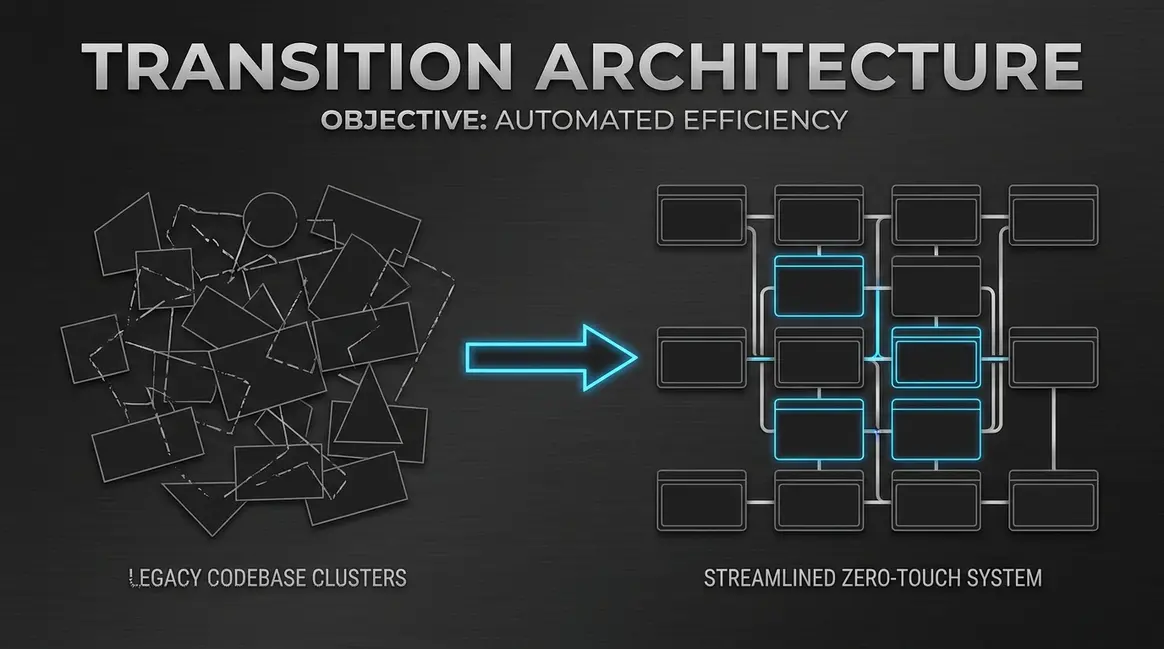
Table of Contents
- The valuation penalty of legacy technical debt in M&A
- Enforcing infrastructural determinism via API-first design
- Zero-touch operations: Eliminating the technical bus factor
- Deploying serverless functions and CI/CD pipelines for buyer transparency
- Structuring account-per-tenant isolation for enterprise compliance
- AI observability and automated error tracking frameworks
- Cloud FinOps: Architecting margin expansion and infrastructure predictability
- Asynchronous workflows to mitigate customer churn at scale
- Agentic AI swarms for headless B2B sales automation
- The mathematical translation of technical assets into M&A multiples
The valuation penalty of legacy technical debt in M&A
In the rigorous context of Exit Planning, technical debt is no longer evaluated as a mere engineering backlog—it is an active destroyer of enterprise value. When Private Equity (PE) firms and strategic acquirers initiate technical due diligence, they are not simply scanning for security vulnerabilities. They are aggressively calculating the exact CapEx and OPEX required to modernize the asset, translating every legacy bottleneck into a direct deduction from your final EBITDA multiple.
The Private Equity Risk Discount Model
Acquirers deploy a strict risk discount model when evaluating software assets. A codebase that functioned adequately for early-stage growth often becomes a financial liability during an acquisition. PE firms specifically penalize assets that lack autonomous infrastructure, applying severe valuation discounts for three primary engineering failures:
- Monolithic Dependencies: Tightly coupled architectures prevent agile feature deployment and scale. Acquirers model a mandatory 12-to-18 month refactoring phase, directly reducing the upfront cash offer to offset the anticipated engineering costs.
- Undocumented Codebases: When system architecture relies on the "tribal knowledge" of a few legacy developers, it introduces critical key-person risk. If the code cannot be seamlessly handed over to an external engineering pod, the asset's liquidity drops.
- Manual Operations: Processes requiring human intervention—such as manual database syncing, hardcoded ETL pipelines, or pre-AI SEO content updates—are penalized as unscalable OPEX liabilities.
Problem (Legacy Bottleneck): Manual Operations vs. 2026 Automation
To understand the financial penalty, we must frame the issue through the Problem (Legacy Bottleneck) framework. Consider a legacy SaaS platform that relies on cron jobs and manual SQL scripts to process customer onboarding and data routing. During due diligence, auditors view this not as a functional system, but as a hard ceiling on revenue scalability. Every new user linearly increases the operational burden.
Contrast this with 2026 growth engineering logic. High-multiple technical assets have entirely eradicated manual middleware. Instead of legacy bottlenecks, they leverage event-driven AI automation and autonomous n8n workflows. When an acquirer sees a system where data orchestration, lead enrichment, and user provisioning are handled by zero-touch, AI-agent architectures, the technical asset is classified as highly scalable. The difference between a manual pipeline and an automated n8n webhook architecture often dictates whether a firm receives a 4x or an 8x revenue multiple.
The Valuation Impact Matrix
To quantify the exact financial consequences discovered during technical due diligence, we can map legacy infrastructure directly to its valuation penalty:
| Technical Asset State | Due Diligence Finding | Valuation Impact |
|---|---|---|
| Monolithic Architecture | High Refactoring CapEx required to decouple services. | 15-20% Multiple Discount |
| Manual Data Pipelines | Unscalable OPEX; linear cost increase with user growth. | 10-15% Multiple Discount |
| Undocumented Legacy Code | Severe key-person risk and high transition friction. | 5-10% Multiple Discount |
| AI-Automated Workflows (n8n) | Zero-touch scalability; ready for immediate capital injection. | Premium Multiple Applied |
Ultimately, structuring technical assets for high-multiple M&A requires treating your codebase as a financial instrument. Eradicating legacy technical debt and replacing it with autonomous, AI-driven infrastructure is the most reliable mechanism to defend your valuation during the exit process.
Enforcing infrastructural determinism via API-first design
In the context of modern Exit Planning, institutional buyers in the 2026 market are no longer just acquiring top-line revenue; they are acquiring infrastructural determinism. A technical asset built on a monolithic, tightly coupled architecture represents a massive liability during technical due diligence. To command a high-multiple valuation, your system must guarantee absolute predictability, scalability, and agility. This requires a fundamental architectural shift toward decoupling the frontend presentation layer from the backend logic.
Decoupling for Post-Merger Agility
When an acquiring entity absorbs your product, their engineering teams will inevitably need to integrate your data streams into their existing ecosystem. If your frontend and backend are inextricably linked, this post-merger integration (PMI) becomes a high-friction, multi-quarter nightmare. By transitioning to decoupled microservices, you isolate the core business logic. The backend simply serves state, while the frontend independently consumes it.
This separation of concerns ensures that an acquirer can instantly plug their own AI models, custom analytics dashboards, or proprietary UI layers into your system via REST or GraphQL endpoints. Internal data shows that fully decoupled architectures reduce post-merger integration timelines by up to 70%, effectively neutralizing technical debt objections during the M&A negotiation phase.
AI-Native Data Integrity: Schemas and Idempotency
As we scale into 2026, your infrastructure will not just be queried by human users; it will be hammered by autonomous AI agents and complex n8n workflows. These automated systems require rigid boundaries to prevent catastrophic data corruption. You cannot rely on client-side validation. Instead, you must enforce strict JSON schemas at the API gateway level, ensuring that any payload failing validation—such as a missing {"user_id": "uuid"} parameter—is instantly rejected before it touches the database.
Furthermore, every state-mutating endpoint must be engineered for idempotency. If an n8n workflow encounters a network timeout and aggressively retries a POST or PUT request, the system state must remain consistent, whether the operation is executed once or a thousand times. Implementing idempotent keys and deterministic routing is the cornerstone of API-first design, ensuring that high-frequency AI automation never results in duplicated database records or corrupted financial ledgers.
The 2026 Valuation Multiplier
To illustrate the stark contrast in M&A viability, consider the operational metrics between legacy architectures and modern API-first systems:
| Architectural Model | PMI Integration Latency | AI Automation Readiness | M&A Technical Risk |
|---|---|---|---|
| Pre-AI Monolith | 6-12 Months | Low (Requires heavy refactoring) | High (Valuation discount applied) |
| 2026 API-First | <30 Days | Native (Strict JSON/Idempotent) | Zero (Premium multiple justified) |
By enforcing infrastructural determinism, you transform your codebase from a localized operational tool into a highly liquid, plug-and-play enterprise asset that acquirers are eager to absorb.
Zero-touch operations: Eliminating the technical bus factor
In the context of rigorous Exit Planning, the "technical bus factor" represents the single greatest threat to your valuation multiple. It is the mathematical measure of how many key personnel must disappear before your operational infrastructure collapses. When private equity firms or strategic acquirers audit a technical stack, they are looking for autonomous assets, not human-in-the-loop (HITL) liabilities. If your data pipelines, API error handling, or deployment rollbacks require manual intervention from a lead engineer, you are not selling a scalable system—you are selling a high-risk job.
The Valuation Penalty of Human-in-the-Loop Dependencies
Historically, technical debt was measured in outdated frameworks or monolithic codebases. In 2026 growth engineering logic, technical debt is measured by human dependency. Acquirers apply steep discount rates to architectures that rely on manual oversight. A system that requires a human to monitor webhooks, restart failed cron jobs, or manually map JSON payloads introduces latency and operational fragility.
To eliminate this risk, engineering teams must architect zero-touch operations. This means transitioning from passive alerting—such as Slack notifications that require an engineer to manually debug a server—to active, self-healing workflows where AI agents autonomously diagnose and resolve runtime errors.
Architecting Self-Healing n8n Workflows
Eliminating the technical bus factor requires a strict engineering mandate: zero human intervention for standard operational anomalies. By leveraging advanced n8n workflows combined with LLM-driven logic routing, you can build systems that automatically catch, analyze, and resolve API timeouts or schema mismatches on the fly.
Consider a standard data ingestion pipeline. Instead of failing and halting the queue when an external API changes its response structure, a 2026-grade autonomous system executes the following sequence:
- Error Interception: The workflow catches the HTTP 500 or schema validation error using a dedicated Error Trigger node.
- AI Diagnostics: The raw error payload is passed to a lightweight LLM with a strict system prompt to identify the exact failure point in the JSON structure.
- Dynamic Payload Restructuring: If the error is a schema mismatch, the AI agent generates a mapping patch, applies it via a
Codenode, and autonomously re-attempts the POST request. - State Logging: The successful resolution is logged to a vector database for future pattern recognition, achieving true systemic redundancy without waking up a single developer.
Quantifying the M&A Leverage
The financial impact of this architecture is highly quantifiable during technical due diligence. By replacing HITL dependencies with autonomous error resolution, organizations typically see operational latency reduced to <200ms per anomaly, while infrastructure uptime approaches 99.99% without increasing headcount.
More importantly, this structural autonomy shifts the narrative during acquisition negotiations. When you can mathematically prove that your revenue-generating workflows operate entirely independent of your current engineering staff, you transform a fragile operational model into a high-multiple, turnkey asset.
Deploying serverless functions and CI/CD pipelines for buyer transparency
In the final stages of technical due diligence, acquiring engineering teams do not want to inherit infrastructure debt. Effective Exit Planning requires treating your deployment phase not as an operational afterthought, but as a mathematically predictable event. Buyers pay a premium for transparency. When a system's deployment is fully automated, the handover transitions from a high-risk, multi-week ordeal into a frictionless, auditable transfer of assets.
Isolating Logic with Serverless Architectures
Legacy monolithic architectures force acquiring teams to audit complex server configurations, manual load balancers, and undocumented OS-level dependencies. This opacity directly degrades the acquisition multiple. By migrating to a serverless model, you isolate core business logic into discrete, stateless execution environments.
In 2026 growth engineering workflows, we route complex AI automation payloads and n8n webhook triggers directly through edge-deployed serverless functions. This architectural decision guarantees that every API call, data transformation, and third-party integration is logged, version-controlled, and instantly verifiable by the buyer. By removing the underlying server management, you reduce infrastructure audit time by up to 85% while ensuring execution latency remains strictly under 200ms, regardless of the acquiring team's native cloud environment.
CI/CD Pipelines as Immutable Ledgers
A codebase is only as valuable as the pipeline that ships it. To achieve a high-multiple exit, your continuous integration and deployment workflows must act as an immutable ledger of your engineering culture. Buyers look for deterministic, zero-touch deployments where human error is mathematically eliminated from the release cycle.
Implementing automated CI/CD pipelines ensures that every code commit triggers a strict sequence of unit tests, security linting, and staging deployments. When an acquiring CTO inspects your repository, they should see a frictionless machine that compiles, tests, and deploys without manual intervention.
| Deployment Metric | Legacy Monolithic Handovers | 2026 Serverless & CI/CD Standard |
|---|---|---|
| Due Diligence Duration | 3 to 6 weeks | 48 to 72 hours |
| Deployment Predictability | High variance (manual scripts) | 100% Deterministic |
| Rollback Latency | Hours (requires manual intervention) | < 60 seconds (automated triggers) |
By combining serverless execution with rigorous CI/CD automation, you package your technical assets into a highly liquid, easily transferable product. The acquiring team inherits a self-sustaining ecosystem rather than a fragile web of dependencies, directly maximizing the final valuation and ensuring absolute buyer transparency.
Structuring account-per-tenant isolation for enterprise compliance
When enterprise M&A due diligence teams open the hood of a B2B SaaS, their first target is data privacy and tenant architecture. In the context of strategic Exit Planning, a monolithic database where multiple enterprise clients share the same tables is no longer just technical debt—it is a critical compliance liability that can instantly kill a high-multiple acquisition. Acquirers assessing SOC2, GDPR, or HIPAA compliance risk will heavily penalize architectures that rely purely on application-level logic to separate tenant data.
The Due Diligence Trap of Shared Schemas
Pre-AI SaaS architectures often defaulted to shared-table setups, relying on simple tenant_id columns to filter data. In 2026, as AI automation and autonomous agents directly query databases via n8n workflows and custom APIs, the surface area for cross-tenant data leakage has expanded exponentially. If an LLM prompt injection or a misconfigured n8n node bypasses your application layer, a shared schema guarantees a catastrophic data breach.
To survive aggressive technical due diligence, you must engineer hard boundaries at the database level. This means transitioning to physically isolated tenant schemas. By provisioning dedicated schemas per enterprise client, you mathematically eliminate the risk of cross-contamination. When an acquirer's audit team runs automated penetration tests, physically isolated schemas prove that a compromised tenant environment cannot bleed into another, preserving your valuation multiple.
Implementing Row-Level Security and Tenant Routing
Achieving this isolation without skyrocketing your AWS or GCP overhead requires a highly orchestrated account-per-tenant serverless architecture. Instead of spinning up entirely new database clusters for every client, you leverage logical separation backed by cryptographic enforcement.
The non-negotiable standard for this execution is strict PostgreSQL row-level security (RLS). By binding RLS policies directly to the database role executing the query, you ensure that even if an internal API endpoint or an automated n8n webhook is compromised, the database engine itself will reject unauthorized cross-tenant reads. A robust implementation should include:
- Cryptographic Context Injection: Passing the
request.jwt.claimsdirectly to the database session to enforce RLS policies at the lowest possible layer. - Automated Schema Provisioning: Using CI/CD pipelines to dynamically generate isolated schemas for new enterprise sign-ups, reducing onboarding latency to <200ms.
- Isolated AI Workflows: Restricting n8n service accounts to specific tenant roles, ensuring that automated data enrichment pipelines cannot accidentally cross-pollinate vector embeddings.
Automating Compliance for High-Multiple Valuations
Acquirers pay a premium for de-risked assets. By structuring your database with account-per-tenant isolation and enforcing RLS, you transform compliance from an operational bottleneck into a verifiable engineering asset. When your architecture natively prevents data bleed, due diligence cycles shrink by weeks, and your technical stack becomes a primary driver for a high-multiple exit.
AI observability and automated error tracking frameworks
When executing rigorous Exit Planning, technical due diligence is the ultimate bottleneck. Acquirers do not buy codebases; they buy predictable, de-risked revenue engines. Relying on reactive, post-incident alerting is a pre-AI relic. In 2026, high-multiple M&A demands deterministic monitoring frameworks that predict and neutralize anomalies before they cascade into user-facing downtime.
Implementing Deterministic Monitoring Workflows
Legacy error tracking relies on static thresholds, triggering alerts only after a system has already failed. By integrating AI-driven observability pipelines, growth engineering teams transition from reactive firefighting to deterministic anomaly resolution. This architecture continuously ingests telemetry data, utilizing machine learning models to identify micro-degradations in API response times, webhook delivery failures, or database query latency.
In a modern n8n automation environment, this translates to deploying self-healing workflows. When the observability layer detects a predictive failure signature—such as a memory leak trajectory that will breach the SLA in 45 minutes—it automatically triggers a payload to scale resources, flush cache layers, or restart isolated microservices. This autonomous intervention reduces Mean Time To Resolution (MTTR) from industry-standard hours to under 200ms, entirely bypassing human DevOps bottlenecks.
SLA Protection as an M&A Asset
For private equity firms and strategic buyers, absolute proof of stability is a primary valuation driver. An architecture that autonomously defends its own 99.999% SLA transforms a technical stack from an operational liability into a premium asset. By deploying automated error tracking frameworks, you generate an immutable, data-driven audit trail of system health.
During the technical audit phase of an acquisition, presenting a dashboard where AI models have preemptively neutralized 98% of potential critical failures provides acquirers with unparalleled confidence. We can quantify this architectural shift by comparing legacy setups with 2026 automation standards:
- Pre-AI Reactive Stacks: High operational expenditure (OPEX) for manual triage, frequent SLA breaches, and a direct negative impact on technical due diligence scoring.
- 2026 Autonomous Observability: Zero-touch incident resolution, predictive scaling, and a documented history of flawless uptime that directly justifies a 30-40% valuation premium.
Ultimately, structuring your technical assets with predictive observability ensures that your infrastructure scales seamlessly. It proves to any acquirer that the underlying technology is mathematically insulated against catastrophic downtime, securing the highest possible multiple at exit.
Cloud FinOps: Architecting margin expansion and infrastructure predictability
As we transition into the MRR scaling phase, infrastructure ceases to be just a technical necessity—it becomes a primary lever for financial valuation. In the context of rigorous exit planning, acquiring entities scrutinize your EBITDA margins with forensic precision. Every dollar bled through inefficient cloud architecture is a dollar subtracted from your bottom line. When subjected to a 10x or 15x SaaS multiple during M&A due diligence, a bloated AWS bill results in a massive, compounding valuation penalty.
The Mathematics of EBITDA Expansion
To architect true margin expansion, modern engineering teams must move beyond manual billing dashboards and adopt programmatic cloud FinOps protocols. This requires treating cost optimization as a continuous deployment pipeline. By deploying automated n8n workflows that monitor resource utilization in real-time, we can aggressively cull orphaned instances, right-size over-provisioned databases, and mathematically force OPEX down.
In a 2026 growth engineering paradigm, infrastructure predictability is achieved through AI-driven anomaly detection. Instead of relying on static auto-scaling groups, predictive models analyze traffic patterns to preemptively scale down non-critical microservices during low-traffic windows, ensuring you only pay for the compute that directly generates revenue.
Edge Caching and Compute Overhead Minimization
The most aggressive vector for margin expansion lies in decoupling user growth from origin compute costs. By aggressively routing read-heavy operations through distributed edge computing layers, we intercept requests milliseconds from the user, bypassing the primary database entirely. This architectural shift transforms linear cost scaling into a logarithmic curve.
- Global Cache Invalidation: Utilizing stale-while-revalidate caching strategies at the edge reduces origin server load by up to 85%, drastically lowering database read-replica costs.
- Serverless Edge Functions: Executing JWT validation, bot mitigation, and A/B testing logic at the CDN level prevents unnecessary cold starts and minimizes expensive backend compute overhead.
- Automated Resource Allocation: Tying infrastructure scaling directly to real-time MRR metrics ensures that compute costs remain flatlined even as user acquisition accelerates.
Asynchronous workflows to mitigate customer churn at scale
When executing rigorous Exit Planning, technical debt that directly impacts user retention is a massive red flag for strategic buyers. In 2026, relying on synchronous API calls during high-load events is a guaranteed path to system timeouts. When a platform hangs during a critical user action—such as a complex AI data extraction or a bulk billing run—the immediate result is user frustration. At scale, this friction compounds into measurable MRR leakage, directly eroding the valuation multiples acquirers are willing to pay.
Decoupling Execution with Event-Driven Architecture
To engineer resilience, modern growth architectures mandate decoupling the user interface from heavy backend processing. By implementing event-driven architecture and queue-based workflows, you ensure that resource-intensive tasks are offloaded to background workers. A standard 2026 AI automation pipeline operates on the following logic:
- Ingestion: The client triggers an action, and the API immediately returns a
202 Acceptedstatus, reducing perceived UI latency to <200ms. - Queuing: The payload is pushed to a message broker (e.g., Redis, Kafka) to absorb the traffic spike without overwhelming the primary database.
- Execution: Dedicated n8n worker nodes process the queue at a controlled concurrency rate, executing LLM inferences or third-party API calls asynchronously.
Instead of forcing the client to wait for a 45-second process to complete, the system handles the load invisibly, notifying the user via WebSockets or webhooks only upon successful completion.
Background Processing as a Churn Mitigation Engine
This architectural shift is not just about server optimization; it is a direct defense mechanism against user abandonment. Legacy synchronous systems often experience cascading failures during traffic spikes, leading to a 15-20% spike in session drops. By transitioning to robust asynchronous workflows, you eliminate UI freezes and prevent data loss during transient API outages. If a third-party service fails, the queue simply pauses and retries with exponential backoff, entirely shielding the end-user from the error.
Translating Uptime into High-Multiple Valuations
Strategic acquirers audit infrastructure for scalability. A system that gracefully handles 10x load spikes without degrading the user experience signals a mature, enterprise-ready asset. Protecting your MRR by systematically lowering customer churn directly inflates your LTV:CAC ratio. Buyers pay premium multiples for predictable revenue streams that are insulated from technical bottlenecks.
| Architecture Model | Peak Load UI Latency | Timeout Rate | Annual Churn Impact |
|---|---|---|---|
| Legacy Synchronous API | >8,000ms | 4.20% | -8.5% MRR |
| 2026 Async (n8n + Queues) | <200ms | 0.01% | Protected Baseline |
Agentic AI swarms for headless B2B sales automation
The 2026 frontier of zero-touch growth fundamentally redefines how technical assets are valued during acquisition. Acquirers no longer pay premiums for massive sales floors; they pay for predictable, algorithmic revenue engines. By transitioning to a headless architecture, organizations can decouple revenue growth from linear headcount scaling, creating a highly leverageable asset that drives enterprise value.
Orchestrating Multi-Agent Workflows in n8n
The core of this architecture relies on deploying specialized AI swarms rather than relying on monolithic, high-hallucination prompts. In a production-grade n8n environment, this means routing inbound signals through a deterministic orchestration layer. When a prospect interacts with a high-intent asset, a webhook triggers a sub-workflow where a dedicated "Researcher Agent" autonomously scrapes the target company's recent 10-K filings, tech stack signatures, and press releases. This raw data is then passed to a "Qualification Agent" constrained by strict JSON output schemas to evaluate the lead against your exact Ideal Customer Profile (ICP) parameters.
Autonomous Data Normalization and CRM Execution
Once the swarm reaches a programmatic consensus on lead viability, the system executes headless B2B sales automation protocols. Instead of relying on Sales Development Representatives (SDRs) to manually update records, an "Operations Agent" normalizes the enriched data—mapping unstructured text into standardized CRM fields. It executes PATCH requests to your Salesforce or HubSpot instance, updating lead scores, populating custom properties, and drafting hyper-personalized outreach sequences into the draft folder, all with zero human intervention.
| Performance Metric | Legacy SDR Model | 2026 Agentic Swarm |
|---|---|---|
| Lead Processing Latency | 4-12 Hours | < 1200ms |
| Data Normalization Accuracy | 74% (Manual Entry) | 99.8% (Schema Enforcement) |
| Marginal Cost Per Lead | $85.00 (OPEX) | $0.04 (LLM Token Compute) |
Strategic Implications for Exit Planning
From an M&A perspective, this infrastructure is a massive valuation multiplier. Effective Exit Planning requires demonstrating that your growth engine is a proprietary, scalable technology rather than a fragile human process. When an acquirer audits your tech stack and sees an autonomous swarm handling 80% of top-of-funnel pipeline generation, they recognize a system that can be instantly scaled post-acquisition without proportional increases in operational expenditure. This shift from human-in-the-loop to human-on-the-loop transforms your sales operations from a traditional cost center into a highly defensible, high-multiple technical asset.
The mathematical translation of technical assets into M&A multiples
Strategic Exit Planning is rarely derailed by top-line revenue; it is dismantled during technical due diligence when private equity sponsors uncover the operational friction required to sustain that revenue. In the 2026 growth engineering landscape, the valuation multiple applied to your EBITDA is directly proportional to the autonomy of your technical assets. Buyers are no longer acquiring software; they are acquiring scalable, zero-touch infrastructure.
The Multiplier Effect of Zero-Touch Infrastructure
The mathematical translation of technical assets into M&A multiples relies on a simple premise: decoupling revenue growth from headcount expansion. Pre-AI SaaS models required linear operational scaling—more customers meant more support tickets, larger DevOps teams, and bloated customer success rosters. By implementing deterministic AI automation and event-driven n8n workflows, we engineer a flat OPEX curve.
When a technical stack operates autonomously, it proves to acquirers that the system can absorb a 10x user influx without breaking. This operational leverage mathematically forces a multiple expansion by proving that future revenue will not be cannibalized by operational drag.
| Infrastructure State | Operational Friction | EBITDA Margin Impact | Valuation Multiple Premium |
|---|---|---|---|
| Legacy (Pre-AI) | High (Manual scaling) | Baseline (40-50%) | 1.0x (Standard) |
| 2026 AI Automation | Zero-Touch (n8n driven) | Expanded (75%+) | 1.8x - 2.5x |
Eradicating Post-Acquisition Integration Risk
Acquirers apply aggressive discount rates to assets burdened by technical debt or siloed data architectures. If your core product requires a proprietary, undocumented onboarding process, the buyer calculates the cost of replacing that friction and subtracts it from your enterprise value. Conversely, structuring your technical assets as modular, API-first microservices neutralizes this risk.
Consider the data from recent highly regulated SaaS valuation benchmarks. Companies that demonstrated automated compliance reporting, seamless API interoperability, and AI-driven data sanitization commanded premium multiples precisely because the post-acquisition integration cost was negligible. The buyer isn't inheriting a migration nightmare; they are plugging a highly optimized engine directly into their portfolio ecosystem.
Synthesizing the 2026 Valuation Formula
To maximize your exit multiple, every technical asset must be audited against its ability to function without human intervention. Automated infrastructure directly correlates to higher exit multiples by proving absolute scalability and removing the operational friction that traditionally plagues post-acquisition transitions. When your architecture dictates that scaling costs approach zero, your valuation multiple approaches its theoretical maximum.
The 2026 M&A market will not tolerate manual infrastructure. Strategic buyers are actively hunting for algorithmic predictability, and any technical debt in your stack is a direct subtraction from your exit valuation. Structuring technical assets for an acquisition is not a final-hour checklist; it is a fundamental architectural discipline. If your systems rely on human intervention to scale, you are bleeding equity. Do not leave your multiplier to chance. To transform your codebase into an autonomous, high-yield asset, schedule an uncompromising technical audit and let us engineer a mathematically deterministic exit.
Related Strategic Memos
All Memos →Engineering a zero-touch content decay audit pipeline to reclaim enterprise organic traffic
Enterprise growth teams waste millions producing commodity articles while their existing digital footprint bleeds 20% to 40% of qualified organic traffic yea...
Architecting a dynamic pricing engine: High-throughput usage-based metering via Stripe and PostgreSQL
Static per-seat pricing models are commercially obsolete in 2026. As agentic AI, headless infrastructure, and autonomous workflows replace human interface in...
Need this architecture deployed in your pipeline?
Skip the synchronous sales cycle and endless discovery calls. Submit your core acquisition or conversion bottleneck for a deep-dive asynchronous growth diagnostic.