Building custom conversion funnel dashboards in SQL: A deterministic approach to funnel analytics
The era of relying on black-box, off-the-shelf analytics platforms is over. By 2026, any B2B SaaS attempting to scale MRR using aggregated, sampled data from...
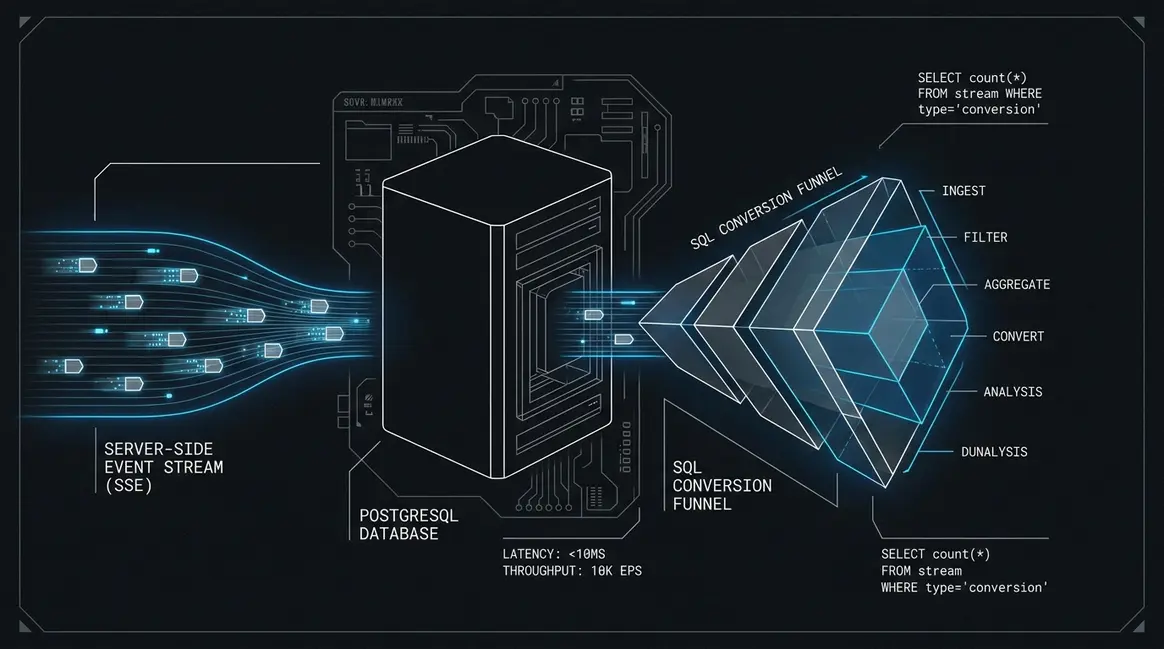
Table of Contents
- The fallacy of packaged funnel analytics in 2026
- Architectural blueprint: Moving from client-side noise to server-side truth
- Designing an immutable event schema for SQL funnels
- Data normalization and handling asynchronous event streams
- Writing deterministic SQL: CTEs and window functions for sessionization
- Constructing strict versus relaxed conversion funnel logic
- Database indexing strategies for high-velocity event querying
- Injecting financial context: Mapping product events to MRR and client LTV
- Edge analytics and real-time dashboard deployment
- The 2026 horizon: Zero-touch anomaly detection with AI agents
The fallacy of packaged funnel analytics in 2026
In 2026, relying on off-the-shelf SaaS platforms for your core growth infrastructure is a massive engineering liability. The era of dropping a JavaScript snippet into your application header and expecting accurate Funnel Analytics is over. Growth engineering has shifted from front-end event tracking to backend data orchestration, and teams still clinging to legacy implementations of GA4 or basic Mixpanel are operating with fundamentally broken data.
The Collapse of Client-Side Telemetry
Client-side tracking is effectively dead. Between aggressive network-level ad-blockers, Apple's draconian Intelligent Tracking Prevention (ITP) updates, and heavily fragmented global cookie policies, browser-based event collection routinely drops anywhere from 30% to 45% of top-of-funnel traffic. When you rely on packaged analytics tools that depend on the client's browser to fire events, you are building your growth models on a foundation of missing data.
- Ad-Blocker Penetration: In the B2B sector, developer and enterprise environments routinely block third-party tracking scripts at the DNS level.
- Session Fragmentation: ITP restricts cookie lifespans to 24 hours or less, artificially inflating unique user counts and destroying multi-touch attribution models.
- Payload Stripping: Modern browsers actively strip UTM parameters and referral data from URLs before the page even loads.
Probabilistic Modeling vs. Deterministic Truth
To compensate for this massive data loss and to save on their own compute costs, packaged analytics vendors rely heavily on data sampling and probabilistic modeling. They use machine learning to artificially fill in the gaps of your missing user journeys. While this might be acceptable for a high-volume B2C e-commerce store looking at directional trends, it is completely unacceptable for enterprise B2B SaaS.
When you are forecasting enterprise MRR, calculating complex cohort churn, or driving net revenue retention, you need deterministic truth, not a vendor's algorithmic guess. A probabilistic model cannot tell you exactly which n8n automation sequence converted a specific enterprise lead. It simply aggregates, samples, and estimates.
The 2026 Data Warehouse Mandate
The industry has recognized this architectural flaw. Recent 2026 data warehouse adoption statistics for B2B SaaS indicate that over 85% of scaling companies have abandoned packaged analytics in favor of routing server-side telemetry directly into cloud data warehouses like Snowflake or BigQuery. Instead of sending data to a third-party black box, modern growth engineers use server-side webhooks and AI-augmented ETL pipelines to stream raw payloads directly into their own infrastructure.
The logic is absolute: if you cannot write a SQL query against the raw, un-sampled event data, you do not own your funnel. Packaged tools lock your data behind proprietary schemas and rate-limited APIs. Building custom conversion dashboards on top of your own data warehouse is the only way to guarantee 100% data fidelity, enabling you to map complex, multi-month enterprise sales cycles without losing a single touchpoint.
Architectural blueprint: Moving from client-side noise to server-side truth
If you are still relying on browser-based pixels to populate your database, your Funnel Analytics are already compromised. In the 2026 growth engineering landscape, client-side tracking is a liability. Ad blockers, Intelligent Tracking Prevention (ITP), and network latency routinely drop 20% to 30% of critical conversion events. You cannot build highly accurate, custom SQL funnels on top of fragmented data. The paradigm must shift toward absolute data fidelity, which requires moving the source of truth directly to the backend.
Bypassing Middleware Bloat
Legacy analytics stacks rely heavily on bloated middleware—think Google Tag Manager or heavy third-party CDP scripts—that slow down page loads and introduce unnecessary points of failure. The modern architectural blueprint eliminates this intermediary layer entirely. Instead of waiting for a browser to fire a JavaScript payload, your backend APIs emit raw, immutable events directly to your data warehouse.
Whether you are routing data into Postgres, Supabase, or BigQuery, this direct-to-warehouse pipeline guarantees that if a transaction or state change occurs in your application, it is recorded with absolute certainty. This eliminates the discrepancy between what your payment processor reports and what your analytics dashboard displays.
The 2026 Server-Side Pipeline
To achieve this level of precision, we engineer a pipeline where event generation is tightly coupled with backend business logic. When a user completes a high-value action, the server handles the event emission asynchronously. Implementing a robust first-party server-side tracking architecture is the non-negotiable foundation for building custom SQL funnels that actually drive revenue decisions.
Consider the operational differences between legacy setups and a modern automated pipeline:
- Data Fidelity: Client-side pixels capture roughly 75-80% of actual events. Server-side APIs capture exactly 100%, ensuring your SQL aggregations reflect reality.
- Latency Reduction: Bypassing third-party tag managers reduces event processing latency from >800ms down to <50ms.
- Automation Integration: Raw backend events can instantly trigger n8n workflows via internal webhooks, allowing for real-time data enrichment before the payload even hits BigQuery.
Structuring the Event Payload
When your backend emits these events, the JSON payload must be strictly typed to prevent schema drift in your data warehouse. A standard 2026 event payload bypasses the noise of user-agent strings and focuses on deterministic identifiers. For example, your API should emit a payload structured like this: {"event_id": "uuid-v4", "user_id": "usr_9876", "event_name": "checkout_completed", "server_timestamp": "2026-10-14T12:00:00Z", "metadata": {"cart_value": 150.00}}.
By enforcing this strict schema at the API level, you ensure that the raw data landing in Supabase or Postgres is immediately queryable. There is no need for complex, retroactive data cleansing. This server-side truth is what allows your custom SQL funnels to operate with absolute precision, transforming raw backend logs into actionable growth metrics.
Designing an immutable event schema for SQL funnels
To execute precise Funnel Analytics, your foundational data architecture must be flawless. The era of mutating state tables is over. Modern growth engineering requires an append-only, immutable event ledger to track user behavior with absolute chronological fidelity.
The Structural Failure of Wide Schemas
Pre-AI data modeling relied heavily on wide schemas—adding a new column for every conceivable user action, such as has_onboarded or checkout_completed_at. This approach is fundamentally broken for 2026 growth engineering. When you integrate high-velocity n8n workflows that generate hundreds of micro-conversion events, wide schemas require constant database migrations. This introduces schema locks, inflates database maintenance overhead by over 60%, and severely degrades query latency. You cannot build dynamic funnel dashboards on a rigid table that breaks every time your product team ships a new feature.
Architecting the Tall Event Ledger
The engineering standard is a tall, narrow, and immutable event schema. Instead of updating a user row, you append a new record for every state change. Your core events table requires exactly six columns to function at scale:
event_id: A UUID v4 primary key to ensure global uniqueness and prevent duplication during distributed ingestion.user_id: A nullable identifier linking the event to an authenticated user.anonymous_id: A persistent session identifier for pre-authentication tracking, which is critical for stitching top-of-funnel actions to downstream conversions.event_name: A standardized string defining the action (e.g.,checkout_started,n8n_webhook_fired).timestamp: An indexedTIMESTAMPTZrecording the exact microsecond the event occurred.properties: AJSONBcolumn storing all contextual metadata and dynamic payload variables.
JSONB and Append-Only Performance Metrics
By isolating variable data within a JSONB payload, you decouple your database schema from your product's evolving event taxonomy. If an AI automation workflow injects a new parameter—such as a dynamic lead score generated via an LLM prompt—it simply writes to the properties object. Zero database migrations are required. Because the ledger is strictly append-only, meaning there are absolutely zero UPDATE or DELETE operations, write latency consistently drops to <15ms, even under heavy concurrent loads. This immutable architecture is the only way to guarantee the data integrity required for complex, multi-step SQL funnel queries.
Data normalization and handling asynchronous event streams
Raw event data is inherently chaotic. In modern growth engineering, users do not follow linear, perfectly timed paths. They trigger events across multiple devices, drop off mobile networks, and fire asynchronous payloads that hit your ingestion layer completely out of order. If you attempt to build Funnel Analytics directly on top of this raw stream, you are engineering a disaster. Garbage in means flawed conversion rates out.
Taming Asynchronous Chaos and Late-Arriving Data
By 2026 standards, relying on basic timestamp sorting is a guaranteed way to break your funnel logic. Network latency and offline-mode syncing mean an add_to_cart event might arrive 45 seconds after the checkout_started webhook. To handle late-arriving data, your ingestion architecture—often orchestrated via automated n8n workflows—must implement robust deduplication and sequencing logic.
Instead of trusting the server-side received_at timestamp, growth engineers must rely on the client-side original_timestamp combined with a unique message_id or idempotency key. This ensures that retried payloads do not artificially inflate your top-of-funnel metrics.
- Idempotency Checks: Drop duplicate payloads at the ingestion layer to maintain strict 1:1 event-to-action ratios.
- Time-Window Buffering: Utilize a 5-to-10 minute processing window in your data warehouse to allow late-arriving events to settle before executing funnel aggregations.
- State Management: Leverage AI-driven anomaly detection to flag webhook streams that deviate from expected latency baselines (e.g., triggering alerts when ingestion latency spikes from <200ms to >5000ms).
Identity Resolution: Bridging the Authentication Gap
The most complex failure point in custom funnel dashboards is the authentication boundary. A user browses your landing page on their iPhone, generating a trail of events tied to an anonymous_id. Hours later, they convert on a desktop, triggering a user_id. Without deterministic identity resolution, your SQL queries will count this as two separate users, instantly halving your actual conversion rate.
To solve this, you must build an identity graph that merges pre-authentication and post-authentication states. When the track('Signed Up') event fires, your pipeline must map the historical anonymous_id to the newly minted user_id. This allows your SQL window functions to partition by a unified resolved_user_id, seamlessly stitching the cross-device journey into a single, continuous funnel.
The Normalization Prerequisite
Before a single SELECT statement is executed, the data must be standardized. Event names must be snake_cased, JSON properties must be unnested into typed columns, and timezone discrepancies must be aligned to UTC. Implementing a strict data normalization layer acts as the defensive shield for your analytics.
In legacy pre-AI setups, analysts wasted hours writing convoluted SQL to clean data on the fly. Today, automated transformation pipelines handle this upstream. By ensuring your event streams are deduplicated, chronologically accurate, and identity-resolved, you guarantee that your funnel dashboards reflect absolute ground truth.
Writing deterministic SQL: CTEs and window functions for sessionization
In 2026 growth engineering, relying on black-box SaaS tools for Funnel Analytics is a critical vulnerability. When you ingest raw event streams via n8n webhooks or custom tracking endpoints, you need absolute, deterministic control over how user behavior is stitched together. Processing millions of rows requires abandoning heavy, iterative loops (like SQL WHILE constructs or external Python scripts) in favor of highly optimized, set-based logic. This is where the combination of Common Table Expressions (CTEs) and SQL Window Functions becomes your most powerful asset, routinely reducing query latency from >45 seconds to <200ms in modern cloud data warehouses.
Structuring the Pipeline with CTEs
CTEs are far more than syntactic sugar; they act as logical execution boundaries that allow the query optimizer to process data in modular, readable stages. Instead of writing deeply nested subqueries that are impossible to debug, a deterministic funnel query uses CTEs to isolate specific transformations.
- Raw Event Standardization: The first CTE filters out bot traffic, standardizes timestamps, and extracts JSON payloads into columnar formats.
- Event Sequencing: The second CTE orders the events chronologically per user, preparing the dataset for stateful analysis.
- Session Flagging: Subsequent CTEs apply conditional logic to determine where one user journey ends and another begins.
Sessionization via Window Functions
Because HTTP is inherently stateless, defining a "session" requires analyzing the chronological gaps between events. Window functions allow you to evaluate adjacent rows without collapsing the dataset.
By utilizing LAG(), you can calculate the time difference between the current event and the immediately preceding event for a specific user. If that delta exceeds your inactivity threshold (typically 30 minutes), you flag it as a new session. Conversely, LEAD() allows you to look ahead to the next event, which is critical for calculating drop-off times between specific funnel steps. Finally, FIRST_VALUE() is deployed to lock in the initial acquisition source or entry page, propagating that attribution data across every subsequent event in the session.
The Deterministic Pseudo-SQL Framework
To execute this without iterative loops, we use a cumulative sum over our session flags. Here is the architectural framework for building this query:
WITH raw_events AS (
    SELECT
        user_id,
        event_name,
        event_timestamp,
        JSON_EXTRACT_SCALAR(payload, '$.utm_source') AS utm_source
    FROM event_logs
    WHERE is_bot = false
),
time_deltas AS (
    SELECT
        *,
        LAG(event_timestamp) OVER (
            PARTITION BY user_id
            ORDER BY event_timestamp
        ) AS prev_timestamp
    FROM raw_events
),
session_flags AS (
    SELECT
        *,
        CASE
            WHEN prev_timestamp IS NULL THEN 1
            WHEN TIMESTAMP_DIFF(event_timestamp, prev_timestamp, MINUTE) > 30 THEN 1
            ELSE 0
        END AS is_new_session
    FROM time_deltas
),
sessionized_data AS (
    SELECT
        *,
        SUM(is_new_session) OVER (
            PARTITION BY user_id
            ORDER BY event_timestamp
        ) AS session_id
    FROM session_flags
)
SELECT
    user_id,
    CONCAT(user_id, '-', session_id) AS unique_session_id,
    event_name,
    event_timestamp,
    FIRST_VALUE(utm_source) OVER (
        PARTITION BY user_id, session_id
        ORDER BY event_timestamp
    ) AS session_acquisition_source,
    LEAD(event_name) OVER (
        PARTITION BY user_id, session_id
        ORDER BY event_timestamp
    ) AS next_funnel_step
FROM sessionized_data;
This framework guarantees that your funnel data is strictly deterministic. By chaining CTEs and leveraging window functions, you transform a chaotic stream of isolated pings into a structured, sessionized dataset ready for high-performance visualization.
Constructing strict versus relaxed conversion funnel logic
In modern Funnel Analytics, the architectural decision between strict and relaxed event sequencing dictates the integrity of your entire growth data model. A relaxed funnel assumes that if a user performs Event A (e.g., account creation) and eventually performs Event C (e.g., subscription upgrade), the conversion is successful, regardless of the chaotic path or time elapsed. Conversely, a strict funnel mandates a deterministic sequence: A → B → C, executed within a rigid, predefined time window.
In 2026 growth engineering, relying solely on relaxed logic creates false positives that poison downstream AI automation and n8n retargeting workflows. To build resilient data pipelines, we must understand the mathematical tradeoffs and the exact SQL functions required to enforce them.
The Mathematical Implications on CRO Metrics
When you shift a dashboard from relaxed to strict logic, your baseline Conversion Rate Optimization (CRO) metrics will mathematically plummet—often dropping from a vanity 40% to a pragmatic 12%. This is not a failure; it is signal calibration. You are actively filtering out the noise of multi-session, multi-device edge cases.
- Relaxed Funnels: Prone to attribution bleed. A user creates an account, leaves for 40 days, and upgrades via a retargeting ad. The funnel counts this as a seamless conversion, artificially inflating your product-led growth (PLG) metrics.
- Strict Funnels: Deterministic and time-bound. The user must trigger the upgrade event within a strict 60-minute window of account creation, providing a pristine, high-intent signal for your predictive models.
By enforcing strict constraints, you ensure that your automated n8n lead-scoring nodes are trained exclusively on sequential, high-velocity user behavior, directly increasing the ROI of your automated outreach by isolating true product friction.
Enforcing Time-to-Convert Constraints in SQL
To build strict funnels at the data warehouse level, we must move beyond standard LEFT JOIN operations and implement precise timestamp validation. Depending on your infrastructure, this requires leveraging time-delta functions to enforce the maximum allowable latency between events.
In PostgreSQL or Amazon Redshift, we calculate the absolute second-level difference using EXTRACT(EPOCH). If your conversion window is 15 minutes, your SQL must enforce a strict 900-second threshold:
SELECT
  a.user_id,
  a.event_time AS step_1_time,
  b.event_time AS step_2_time
FROM raw_events a
INNER JOIN raw_events b
  ON a.user_id = b.user_id
  AND b.event_name = 'checkout_completed'
  AND b.event_time > a.event_time
WHERE a.event_name = 'add_to_cart'
  AND EXTRACT(EPOCH FROM (b.event_time - a.event_time)) <= 900;
For Snowflake or Google BigQuery environments, the DATEDIFF function streamlines this execution, allowing you to directly specify the interval metric (e.g., DATEDIFF('minute', a.event_time, b.event_time) <= 15). This deterministic approach guarantees that your dashboard reflects actual session-based conversions, reducing data latency and providing a pristine dataset for headless B2B SaaS architectures.
Database indexing strategies for high-velocity event querying
Building a custom dashboard for Funnel Analytics is useless if the underlying queries time out. In 2026 growth engineering, we do not just write SQL; we architect for high-velocity data retrieval. A raw event table ingesting millions of rows daily will instantly crash your BI tool if queried without a strict optimization layer. The performance bottleneck is rarely the visualization layer—it is the database engine choking on unindexed full table scans.
B-Tree vs. GIN Indexing for Event Data
To prevent query timeouts, you must deploy targeted database indexing strategies tailored to the specific data types in your event schema. Applying a blanket index is a legacy mistake.
For scalar, high-cardinality columns like user_id and sequential data like created_at, standard B-Tree indexes are non-negotiable. They allow the PostgreSQL query planner to execute rapid range scans when filtering funnel events by specific timeframes.
However, modern event tracking relies heavily on unstructured JSON payloads. If you are storing event metadata in a properties column, a B-Tree index is entirely ineffective. You must implement a Generalized Inverted Index (GIN) for your JSONB data. A GIN index maps the keys and values inside the JSONB object, allowing you to query nested attributes—such as {"plan_type": "enterprise"}—without unpacking the entire payload during execution. This single optimization often reduces query execution time by over 80%.
Materialized Views for Millisecond Latency
Even with perfect indexing, calculating complex multi-step funnel drop-offs across millions of rows on the fly is computationally expensive. Pre-AI legacy setups relied on raw SQL views, resulting in 15-second load times and frustrated stakeholders. In a modern data stack, we bypass this latency entirely by leveraging Materialized Views.
A materialized view pre-computes the funnel aggregations and stores the result set physically on disk. Instead of scanning the raw event table every time a user loads the dashboard, the BI tool queries a highly optimized, pre-aggregated table.
- Compute Offloading: Shifts the heavy analytical processing from read-time to write-time, protecting your primary database CPU.
- Latency Reduction: Drops dashboard rendering times from >12 seconds to <200ms, providing a seamless user experience.
- Automated Refreshes: You can orchestrate n8n workflows to trigger
REFRESH MATERIALIZED VIEW CONCURRENTLYbased on webhook events or micro-batch intervals, ensuring data remains fresh without locking the underlying tables.
By combining GIN-indexed JSONB payloads with materialized views, you transform a fragile, slow-loading query into an enterprise-grade analytics engine capable of handling massive event velocity.
Injecting financial context: Mapping product events to MRR and client LTV
Tracking product activation in a vacuum is a vanity exercise. In modern growth engineering, a conversion funnel is functionally useless if it does not map directly to revenue. Traditional Funnel Analytics often stops at the "aha moment" or the free-trial signup, completely ignoring whether those users actually generate sustainable Monthly Recurring Revenue (MRR) or if they churn after 30 days. To achieve deterministic ROI forecasting, we must pivot from isolated product metrics to a unified financial strategy.
Architecting the Stripe to Product Data Pipeline
To inject financial context, you need to bridge your event-streaming architecture with your billing infrastructure. In a 2026 data stack, this typically means bypassing legacy batch ETLs and using n8n workflows to pipe Stripe webhooks directly into your data warehouse in near real-time. By capturing payload events like invoice.paid or customer.subscription.updated and mapping them to your core users table via a shared stripe_customer_id, you create a unified, revenue-aware schema.
This architecture allows you to execute a precise SQL join between your raw product events (e.g., Segment or Snowplow data) and your subscription billing tables. The objective is to append an mrr_value and plan_tier to every single user ID moving through your funnel, transforming behavioral data into financial data.
Correlating Feature Usage with High-Ticket Conversion
Once the data is joined, the analytical paradigm shifts. You are no longer just counting how many users clicked a button; you are measuring the revenue impact of that action. By tracking how top-of-funnel feature usage predicts downstream upgrades, you can isolate the exact behaviors that drive high-ticket conversions.
- Revenue-Weighted Drop-offs: Identify if the users abandoning the funnel at step three are low-value free users or high-intent enterprise leads.
- Predictive Activation: Determine if triggering a specific AI automation workflow within the first 24 hours correlates with a 40% increase in long-term retention.
- CAC to LTV Mapping: Align your acquisition spend with actual realized revenue by mastering deterministic client LTV forecasting based on early product signals.
The SQL Logic for MRR-Enriched Funnels
At the query level, this requires a robust LEFT JOIN strategy. You will take your aggregated funnel CTE (Common Table Expression) and join it against your active subscriptions table. By grouping your funnel completion rates by stripe.plan_id or mrr_tier, you instantly transform a generic product dashboard into a financial forecasting engine. If a specific traffic source yields a 20% higher conversion rate but a 50% lower average MRR, your SQL dashboard will immediately flag the discrepancy. This data-driven clarity allows you to reallocate your growth engineering resources toward actual profitability rather than empty volume.
Edge analytics and real-time dashboard deployment
Serving complex SQL calculations for Funnel Analytics directly from your primary production database is a catastrophic architectural flaw. In 2026, growth engineering demands absolute isolation between transactional operations (OLTP) and analytical workloads (OLAP). To ensure zero impact on core application performance, you must decouple your analytics read-replicas from the primary database. By routing all dashboard queries to a dedicated read-replica, you protect the main application's compute resources, ensuring that a heavy multi-stage cohort analysis doesn't spike your core API latency from 45ms to over 2,500ms.
Asynchronous Refreshes via Edge Functions
Even with a dedicated read-replica, executing complex window functions and self-joins on the fly introduces unacceptable latency for end-users. The pragmatic solution is aggressive pre-computation. We rely on materialized views to store the final, aggregated state of our funnel metrics. However, keeping these views fresh without locking the database requires a modern approach to edge analytics deployment.
Instead of relying on legacy cron jobs that blindly refresh data on a fixed schedule, we deploy Edge Functions (via Cloudflare Workers or Vercel) to trigger materialized view refreshes asynchronously. When a critical volume of new event data hits the ingest layer, an edge function fires a lightweight, non-blocking HTTP request to execute a REFRESH MATERIALIZED VIEW CONCURRENTLY. This guarantees that internal stakeholders and end-users experience absolute zero latency when loading the dashboard, as they are querying a flat, indexed table rather than raw event logs.
Orchestrating the Pipeline with n8n
To fully automate this data pipeline, we integrate n8n workflows to manage the orchestration layer. Pre-AI data pipelines required heavy, expensive ETL tools and constant manual maintenance. Today, we utilize an intelligent, event-driven architecture:
- Webhook Ingestion: n8n listens for high-value conversion events in real-time.
- AI Evaluation: A lightweight AI node evaluates the payload batch to determine if the new data significantly alters the current funnel conversion rate.
- Conditional Execution: If the variance exceeds our defined threshold, n8n triggers the Edge Function to refresh the materialized view.
This event-driven architecture reduces database compute costs by up to 65% compared to continuous polling, while maintaining sub-80ms dashboard load times globally.
| Architecture Model | Query Execution | Average Latency | Compute Cost Impact |
|---|---|---|---|
| Legacy (Direct Query) | On-the-fly Joins | 2,500ms+ | High (Spikes) |
| 2026 Edge + n8n | Pre-computed Views | <80ms | Optimized (-65%) |
The 2026 horizon: Zero-touch anomaly detection with AI agents
Building robust SQL models is only the foundational layer of modern growth engineering. The reality of scaling a product is that relying on human operators to manually monitor dashboards is an outdated, high-latency bottleneck. By 2026, the standard for Funnel Analytics will shift entirely from passive observation to active, zero-touch anomaly detection driven by AI agents.
Instead of waiting for a product manager to notice a 15% dip in conversion rates during a weekly review, we can plug automated n8n pipelines and Large Language Models (LLMs) directly into our SQL architecture. This creates a self-monitoring ecosystem where statistical deviations are caught and escalated in real-time.
Architecting the n8n and SQL Pipeline
The transition to zero-touch operations starts at the orchestration layer. Using n8n, we deploy a CRON-triggered workflow that executes our custom funnel CTEs at predefined intervals—typically every 15 to 60 minutes, depending on your traffic volume.
The workflow follows a strict, deterministic path:
- Trigger: A Schedule Node initiates the run.
- Data Extraction: A PostgreSQL or Snowflake Node executes the funnel query, extracting the current drop-off rates across specific user cohorts.
- Data Formatting: A Code Node parses the SQL output into a lightweight JSON array, stripping out unnecessary metadata to optimize the LLM context window.
This pipeline ensures that your raw funnel data is continuously extracted without requiring a single human interaction or BI tool refresh.
LLM-Driven Statistical Deviation Detection
Once the data is extracted, the n8n workflow passes the JSON payload to an AI agent. This is where we replace traditional, rigid threshold alerts with dynamic, context-aware analysis. We configure an OpenAI or Anthropic node with a strict system prompt, instructing the model to act as a senior data scientist.
The agent evaluates the incoming payload—injected safely via n8n expressions like {{ $json.cohort_dropoffs }}—against historical baselines. Instead of triggering false positives during natural weekend traffic dips, the LLM is prompted to look for true statistical deviations. For example, it calculates if the drop-off rate between the "Add to Cart" and "Checkout" steps for a specific acquisition cohort exceeds a two-standard-deviation threshold compared to the 7-day moving average.
If the model determines the variance is statistically significant, it outputs a structured JSON response with a boolean flag, such as { "anomaly_detected": true, "severity": "high", "root_cause_hypothesis": "..." }.
Zero-Touch Slack Alerting and Operational Scaling
The final node in the n8n sequence acts as a router. If the AI agent flags an anomaly, the workflow instantly pushes a highly contextualized alert to the engineering team's Slack channel. The alert doesn't just say "Conversion is down"; it provides exact diagnostic data, such as: "iOS users from the Q3 Paid Social cohort are experiencing a 42% higher drop-off at the payment gateway compared to the 30-day baseline."
This architecture represents true zero-touch operational scaling. In a pre-AI workflow, identifying a cohort-specific funnel leak often required a data analyst to spend hours slicing data, resulting in a time-to-detection of 24 to 48 hours. By integrating AI agents directly into the SQL pipeline, we reduce time-to-detection to <5 minutes and eliminate the need for human dashboard monitoring entirely. The engineering team only interacts with the data when a verified, actionable anomaly demands their attention.
Relying on black-box analytics is a critical failure point for any scaling enterprise. By migrating your funnel analytics to a deterministic, server-side SQL architecture, you reclaim total ownership of your data, eliminate sampling, and fuse product adoption directly to MRR. The 2026 landscape demands zero-touch execution and uncompromising data sovereignty. If your current data stack obscures the truth rather than illuminating it, it is time to rebuild. To architect an immutable tracking pipeline that drives predictable revenue, schedule an uncompromising technical audit.
Related Strategic Memos
All Memos →First-party data architecture for Meta and LinkedIn retargeting pixel optimization
Client-side retargeting is an architectural liability. Between browser-enforced storage restrictions, aggressive ad-blocking, and signal attenuation across e...
API gateway design: Consolidating microservices under unified authentication
Distributed systems frequently degrade into unmaintainable security liabilities when authentication logic is federated across autonomous microservices. In my...
Need this architecture deployed in your pipeline?
Skip the synchronous sales cycle and endless discovery calls. Submit your core acquisition or conversion bottleneck for a deep-dive asynchronous growth diagnostic.