Structuring keyword hubs and spoke content: The deterministic topical authority map for 2026
Legacy SEO tactics are dead. In the algorithmic reality of 2026, Google Search Generative Experience (SGE) and retrieval-augmented language models discard ke...
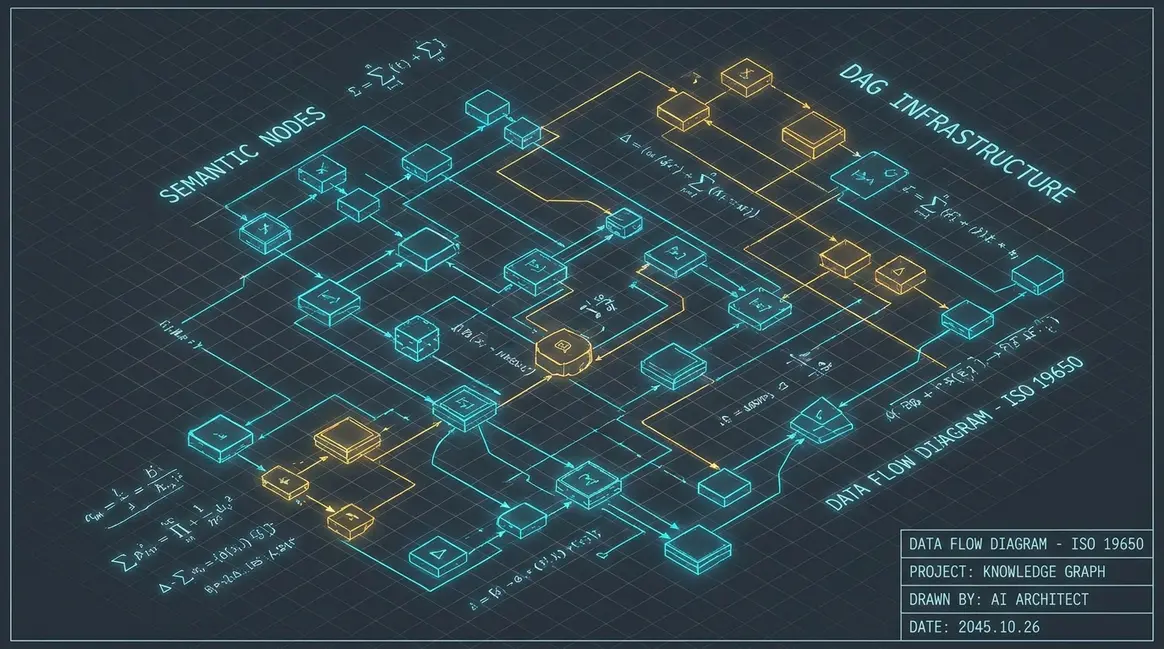
Table of Contents
- The systemic failure of legacy keyword clustering in SGE environments
- Mathematical modeling of topical authority using semantic vector embeddings
- Architectural topology: Designing the core hub, sub-hubs, and spoke primitives
- Internal linking protocols: Strict bidirectional graph traversal vs. orphan sprawl
- Programmatic schema orchestration: JSON-LD knowledge graph anchoring
- Building the zero-touch pipeline: Automated cluster extraction via n8n and Supabase pgvector
- Edge-rendered headless execution: Next.js ISR and Cloudflare routing for instant indexation
- Real-time telemetry: Correlating spoke crawl frequency with B2B pipeline velocity in BigQuery
- Anti-cannibalization safeguards: Dynamic vector deduplication and query boundary enforcement
- Financial upside: Transitioning from linear content production to compounding zero-touch ARR
The systemic failure of legacy keyword clustering in SGE environments
Monthly Search Volume (MSV) metrics and lexical token matching have become architectural liabilities. Under Google's Gemini-driven ranking passes, search engines no longer evaluate documents as isolated bags of words matching exact string sequences. Instead, multi-stage retrieval pipelines map queries and corpus nodes directly into dense vector spaces, generating synthetic answers and Search Generative Experience (SGE) snapshots from latent semantic coordinates rather than lexical frequency.
The Mechanics of Latent Semantic Retrieval
Traditional SEO operations still rely on lexical proximity tools—scraping top-ten SERP overlaps to group keywords into pseudo-clusters. This creates a critical structural failure. When an algorithm runs bidirectional encoder passes to resolve query intent, string variations such as "enterprise workflow orchestration platform" and "workflow orchestration software for enterprise" project to virtually identical vector embeddings. Building distinct URLs for each variant fails to create distinct informational value.
Instead of securing incremental visibility, legacy lexical clustering builds competing document nodes that occupy the exact same semantic radius. When Google’s neural retrieval models calculate semantic distance, these overlapping nodes trigger internal cannibalization loops, fracturing domain authority across redundant leaf nodes.
Quantifying Crawl Budget Degradation and Dilution
The downstream infrastructural damage is measurable across modern headless architectures and enterprise content management systems. When engineering teams deploy programmatic content clusters based on lexical permutations, the telemetry exposes severe degradation:
-
Crawl budget wastage: Telemetry from enterprise log audits reveals up to 42% of automated crawler requests are squandered on functionally duplicated URLs that offer zero novel vector differentiation.
-
Indexation drop-offs: In headless B2B deployments, search engine edge parsers deprioritize dynamic render queues when discovered URLs yield identical vector embeddings to existing canonical records, leaving newly launched sub-paths unindexed for quarters.
-
Link equity dissipation: PageRank and internal PageRank equivalents get fragmented across dozens of sub-directories rather than compounding into a singular, authoritative spoke node.
-
Binary Resolution in Entity Knowledge Graphs
Modern topical authority is not an incremental spectrum evaluated on word count or keyword density; in vector search, authority operates as a binary state. Google’s Knowledge Graph either successfully resolves your content domain as an authoritative entity node with validated relational triples (subject-predicate-object), or it discards the cluster entirely during the retrieval-augmented generation (RAG) context selection phase.
When algorithmic pipelines construct synthetic answer cards, they extract facts from entities with unambiguous topological relationships within the vector space. Lexical keyword hubs lack the semantic ontology needed to establish these relationships. Without a deterministic topical authority map that defines discrete, non-overlapping semantic scopes, multi-URL clusters are treated as semantic noise and systematically excluded from generative outputs.
Mathematical modeling of topical authority using semantic vector embeddings
Search engines no longer evaluate documents as isolated bags of tokens or simple link-directed graphs. In modern neural retrieval architectures, Google maps authority across continuous semantic manifolds. Understanding this shift requires deconstructing the transition from naive link graphs to vector-weighted Markov chains and geometric entity coverage.
Topic-Sensitive PageRank Over Dense Embeddings
Pure link-graph PageRank treats edges uniformly: a link from page A to page B carries an unweighted transition probability P(B|A) = 1 / OutDegree(A). Search engines now run semantic random walk algorithms where edge weights correspond directly to contextual similarity. When page A and target page B are projected into a 3072-dimensional space using high-capacity transformer models like text-embedding-3-large, the transition probability is dynamically modulated:
P(B|A) = (CosSim(v_A, v_B) * Link(A, B)) / Sum_k(CosSim(v_A, v_k) * Link(A, v_k))
When modeling topical territories, querying corpus representations with high-dimensional pgvector embeddings reveals how closely linked nodes map to the parent seed entity. If the cosine similarity between an outbound link and the host document falls below a strict threshold (e.g., CosSim < 0.62), authority transfer decays exponentially, preventing artificial link topology from driving topical scores without dense conceptual alignment.
Clustering Topographies with HDBSCAN
Constructing an optimal topical authority map requires programmatic clustering rather than intuitive taxonomy design. While legacy SEO workflows rely on k-means partitioning—which forces artificial spherical boundaries and assumes uniform cluster volume—modern topical modeling deploys HDBSCAN (Hierarchical Density-Based Spatial Clustering of Applications with Noise).
The operational pipeline executes across three phases:
-
Coordinate Extraction: Embed all candidate seed keywords and entity variations into dense vectors
V = [v_1, v_2, ..., v_n]. -
Metric Space Transformation: Calculate pairwise cosine distances where
dist(u, v) = 1 - (u . v) / (||u|| * ||v||). -
Density Partitioning: HDBSCAN computes mutual reachability distances, building a minimum spanning tree to extract clusters based on density persistence across variable noise levels.
This pipeline cleanly partitions the semantic graph:
-
High-Density Centroids (Hubs): Nodes located at peak mutual reachability density, exhibiting high centrality (
DegreeCentrality > 0.85) across surrounding cluster members. Hubs cover broad ontological classes. -
Boundary Nodes (Spokes): Peripheral nodes sitting at the cluster margins that maintain directional cosine affinity to the hub while answering narrow, long-tail intent vectors.
Convex Hull Completeness in Entity Space
Entity completeness is fundamentally governed by computational geometry. Let S be the set of vectors representing all known sub-entities, predicates, and user intents within a subject domain. The total semantic space forms a convex hull, defined as the minimal convex set containing all vectors in S:
Conv(S) = { Sum(lambda_i * v_i) | lambda_i >= 0, Sum(lambda_i) = 1 }
Pre-AI search architectures relied on keyword occurrence and co-occurrence matrices to infer completeness. Contemporary retrieval engines evaluate whether your corpus covers the dimensional boundary of Conv(S). If your content architecture leaves empty interior manifolds—or omits boundary vertices—the retrieval engine registers a topical void, penalizing the domain's probabilistic topical prior during competitive reranking. Documenting every extreme vertex within Conv(S) establishes deterministic domain authority.
Architectural topology: Designing the core hub, sub-hubs, and spoke primitives
To dominate dense search graphs in modern retrieval systems, enterprise architectures must discard loose cluster models in favor of a strictly engineered Directed Acyclic Graph (DAG). Constructing an exhaustive Topical Authority Map requires a deterministic three-tier hierarchy that isolates semantic intent, concentrates PageRank flow, and prevents vector dispersion across vector embeddings.
The Three-Tier Graph Architecture
Building an enterprise search topology requires mapping unstructured keyword corpora into three discrete structural tiers:
-
Tier 1 (The Root Hub): The macro-entity anchor. It targets broad, high-volume informational queries (e.g.,
Data Observability) with high navigational authority. This asset serves as the definitive semantic centroid, routing internal link equity downward while consolidating entity definitions across search engine knowledge graphs.-
Tier 2 (Categorical Sub-Hubs): Thematic intersection gateways. These nodes bisect the primary entity into core sub-intents (e.g.,
Pipeline Metrics,Schema Drift Detection). Sub-hubs act as bidirectional transformers: they aggregate granular contextual signals from spokes below and transmit aggregated topical relevance upward to Tier 1. -
Tier 3 (Spoke Primitives): Atomic, low-variance technical deep dives. These assets target hyper-specific transactional or edge-case execution queries (e.g.,
Configuring Snowflake Zero Copy Cloning in dbt Core). Spokes maintain tight vector similarity to their immediate Tier 2 parent, establishing narrow semantic variance and solving singular operational bottlenecks.
-
Logical Taxonomy vs. Flat URL Routing
A structural failure common to enterprise engineering is binding logical hierarchy directly to the physical URL path. Nesting directory paths (e.g., /solutions/data-governance/lineage/column-level-tracing) introduces acute technical debt: fragile route re-writes, diminished click-through velocity from bloated SERP display, and routing collisions during CMS migrations.
The modern paradigm decouples URL string composition from topological node mapping. URLs must remain flat and performant (e.g., domain.com/column-level-tracing), while semantic ancestry is enforced through programmatic linked data. In this model, JSON-LD BreadcrumbList schemas and explicit bidirectional linking declare parent-child dependencies directly to crawl spiders, independently of edge routing:
{
  "@context": "https://schema.org",
  "@type": "BreadcrumbList",
  "itemListElement": [
    {
      "@type": "ListItem",
      "position": 1,
      "name": "Home",
      "item": "https://example.com"
    },
    {
      "@type": "ListItem",
      "position": 2,
      "name": "Data Observability",
      "item": "https://example.com/data-observability"
    },
    {
      "@type": "ListItem",
      "position": 3,
      "name": "Pipeline Metrics",
      "item": "https://example.com/pipeline-metrics"
    },
    {
      "@type": "ListItem",
      "position": 4,
      "name": "Column Lineage Tracing",
      "item": "https://example.com/column-level-tracing"
    }
  ]
}
Crawl Graph Integrity and Traversal Constraints
To prevent spider exhaustion and PageRank dissipation, link topology must be governed by strict traversal rules. Horizontal linking across disparate sub-hubs introduces cyclic link graphs, confusing crawl algorithms and diluting the semantic focus of Tier 2 nodes:
-
Vertical Reciprocity: Every Tier 3 spoke must link to its parent Tier 2 sub-hub, and the Tier 2 sub-hub must link downward to every canonical spoke within its partition.
-
Intra-Cluster Lateral Traversal: Tier 3 spokes within the exact same Tier 2 bucket may cross-link horizontally, provided the anchor text reinforces direct contextual relevance.
-
Cross-Cluster Isolation: A Tier 3 spoke under Sub-Hub A must never link directly to a Tier 3 spoke under Sub-Hub B. Any cross-thematic navigation must route upward through Sub-Hub A to Tier 1, or reference Sub-Hub B directly as an authoritative categorical pivot.
-
Enforcing these graph boundaries ensures that crawl spiders process topical nodes deterministically, solidifying indexation speed and topical coverage across competitive enterprise sectors.
Internal linking protocols: Strict bidirectional graph traversal vs. orphan sprawl
To build a high-performing Topical Authority Map, link equity cannot be treated as a byproduct of editorial whim. Search engine crawlers interpret internal links as directed edges within a knowledge graph. Unstructured linking creates orphan sprawl—nodes with fewer than two inbound edges—or circular traps that bleed PageRank into low-utility leaf pages. Preserving semantic authority demands a deterministic, bidirectional linking topology.
Deterministic Link Topologies and Clustering Constraints
Pre-2024 content strategies relied on uncontrolled contextual links scattered across non-topical silos, diffusing semantic weight across disparate clusters. In modern architectures, link injection engines enforce strict relational boundaries across three distinct edge types:
-
Hub-to-Spoke (Contextual Broadcast): The core hub references its spokes within the body content, passing authority downward along defined semantic entity vectors.
-
Spoke-to-Hub (Canonical Attribution): Every spoke must contain an upstream link within its first 200 tokens pointing to the parent hub, signaling clear topical parentage to the crawler.
-
Lateral Spoke-to-Spoke (Intra-Cluster Meshing): Spokes cross-link exclusively if they share the exact same
cluster_id. An automated constraint blocks cross-cluster lateral edges to prevent topical dilution.
-
Programmatic Graph Ingestion and Orphan Prevention
Link-generation pipelines ingest published URLs as a directed graph G = (V, E), where nodes V represent documents and edges E represent hyperlinks. An automated orchestration worker running on edge nodes parses documents via abstract syntax trees (AST) to evaluate link density.
To prevent orphan sprawl, the edge-validation engine enforces a strict minimum in-degree threshold: deg_in(v) >= 2 for every node v. If a node falls below this threshold, the pipeline scans semantic vector similarity matrices within the same cluster and inserts an inbound edge into the most relevant sibling node. Additionally, cycle-detection routines identify and break self-referential linking loops that consume crawler budget without distributing authority.
import networkx as nx

def calculate_internal_pagerank(nodes: list, edges: list, damping: float = 0.85) -> dict:
    G = nx.DiGraph()
    G.add_nodes_from(nodes)
    G.add_edges_from(edges)

    # Identify orphan nodes with in-degree < 2
    orphans = [node for node, in_deg in G.in_degree() if in_deg < 2]

    # Compute power-iteration PageRank on the directed web
    raw_pagerank = nx.pagerank(G, alpha=damping, max_iter=100, tol=1e-6)

    return {
        "pagerank_distribution": raw_pagerank,
        "orphan_count": len(orphans),
        "flagged_orphans": orphans
    }
Dynamic Entity-Aware Anchor Generation
Hardcoded anchors such as "read more" or generic URLs destroy topical signal. The link injection engine constructs anchor text deterministically by parsing target node metadata, prioritizing the target entity and its modifier while strictly excluding generic stop words.
interface NodeMetadata {
  entityPrimary: string;
  entityModifier: string;
  slug: string;
}

export function generateContextualAnchor(target: NodeMetadata, contextType: 'hierarchical' | 'lateral'): string {
  const bannedAnchors = new Set(['click here', 'read more', 'learn more', 'source']);

  const anchor = contextType === 'hierarchical'
    ? `${target.entityPrimary} framework`
    : `${target.entityPrimary} ${target.entityModifier}`;

  if (bannedAnchors.has(anchor.toLowerCase())) {
    throw new Error(`Invalid anchor generated: ${anchor}`);
  }

  return anchor;
}
This deterministic pipeline ensures that every internal link programmatically fortifies semantic clustering, systematically distributing equity across your Topical Authority Map without human error or manual drift.
Programmatic schema orchestration: JSON-LD knowledge graph anchoring
Programmatic search engines do not deduce architectural intent from DOM order alone; they parse topological relationships through explicit entity graphs. While pre-AI search heuristics relied on probabilistic keyword co-occurrence across flat HTML, modern search engines interpret topical depth through deterministic graph structures. Implementing an enterprise-grade topical authority map requires translating your hub-and-spoke visual hierarchy into an interconnected JSON-LD @graph architecture that eliminates semantic ambiguity at the parser level.
Disambiguating Nodes via Wikidata and Knowledge Graph URIs
Search engine extractors often conflate domain-specific jargon with colloquial definitions. To anchor a technical cluster without ambiguity, schemas must bypass surface strings and link directly to canonical entity repositories via about and mentions arrays.
The about array must define the core subject matter of the hub or spoke, limited to one or two high-level entities using definitive URIs from Wikidata or Google's Knowledge Graph Search API. The mentions array catalogs supporting technical concepts, dependencies, and adjacent tooling.
{
  "@context": "https://schema.org",
  "@graph": [
    {
      "@type": "CollectionPage",
      "@id": "https://example.com/hubs/distributed-caching/#webpage",
      "url": "https://example.com/hubs/distributed-caching",
      "name": "Distributed Caching Architectures Hub",
      "about": [
        {
          "@type": "Thing",
          "name": "Distributed cache",
          "sameAs": "https://www.wikidata.org/wiki/Q5283151"
        }
      ],
      "mentions": [
        {
          "@type": "Thing",
          "name": "Redis",
          "sameAs": "https://www.wikidata.org/wiki/Q1150153"
        },
        {
          "@type": "Thing",
          "name": "Cache invalidation",
          "sameAs": "https://www.wikidata.org/wiki/Q5015998"
        }
      ]
    }
  ]
}
By mapping exact entity IDs (Q5283151), the crawler bypasses natural language inference, confirming the site's authority over a concrete node in the global knowledge graph rather than an unverified string.
Unifying Hubs and Spokes in Nested Graph Objects
A robust topological schema avoids fragmented, per-page declarations. Instead, it constructs a cohesive graph combining CollectionPage (the hub), contextual AboutPage nodes (the organizational authority), and referenced TechArticle nodes (the spokes).
Using the @graph array, you explicitly define the relationship between the parent cluster and its child modules. The hub exposes a hasPart property listing child spoke URLs, while each downstream TechArticle declares an isPartOf pointer back to the hub's @id. This circular reference mathematically defines the boundary of your topical cluster, preventing orphan evaluation by crawler engines.
{
  "@context": "https://schema.org",
  "@graph": [
    {
      "@type": "TechArticle",
      "@id": "https://example.com/hubs/distributed-caching/raft-consensus/#article",
      "isPartOf": {
        "@id": "https://example.com/hubs/distributed-caching/#webpage"
      },
      "headline": "Implementing Raft Consensus in Memory-Mapped Datastores",
      "proficiencyLevel": "Expert"
    }
  ]
}
Build-Time Schema Validation
Because search engines discard invalid JSON-LD payloads without reporting structural warnings in standard access logs, schema generation cannot remain an unmonitored CMS output. Schemas must be treated as compiled application code.
Integrate automated schema validation pipelines within your CI/CD workflow. By validating dynamic payloads against strict TypeScript interfaces or Zod schemas prior to static site generation (SSG), you ensure that every spoke maintains valid entity references, fully qualified URI formats, and non-null parent relationships before deployment to edge nodes.
Building the zero-touch pipeline: Automated cluster extraction via n8n and Supabase pgvector
Legacy keyword clustering relied on deterministic SERP cross-referencing: scraping top-10 URLs per keyword, calculating pairwise overlap coefficients (typically overlap >= 3), and spending dozens of engineer hours managing fragile spreadsheets. In a modern 2026 data stack, clustering is completely autonomous, streaming real-time performance telemetry directly into dense vector spaces to maintain an authoritative Topical Authority Map without manual input.
Telemetry Ingestion and Vector Batching via n8n
The ingestion engine executes on an event-driven n8n pipeline. A recurring cron node triggers an authenticated extract from the Google Search Console (GSC) API, pulling query-level telemetry alongside net-new seed queries from secondary APIs. The raw dataset immediately enters a data transformation node that strips navigational brand noise and discards low-velocity edge cases where impressions sit below defined discovery thresholds.
The purified queries are partitioned into asynchronous batches of 100 items. Using an optimized n8n workflow automation architecture, the payload streams to an embedding model (text-embedding-3-small) to generate 1536-dimensional dense vector representations. A token-bucket rate limiter enforces an upper ceiling of 250 requests per minute, preventing runtime throttling during large backfill jobs.
Supabase pgvector Storage and HNSW Partitioning
The resulting vector embeddings land in Supabase (PostgreSQL 16) equipped with the pgvector extension. Rather than executing brute-force linear scans (IVFFlat), the production database indexes query embeddings using Hierarchical Navigable Small World (HNSW) graphs. This configuration provides sub-10ms cosine similarity queries even when tracking catalogs exceeding 500,000 distinct query variations.
CREATE TABLE search_telemetry (
    id UUID PRIMARY KEY DEFAULT gen_random_uuid(),
    query_text TEXT NOT NULL,
    impressions INT DEFAULT 0,
    clicks INT DEFAULT 0,
    embedding VECTOR(1536)
);

CREATE INDEX idx_telemetry_hnsw ON search_telemetry
USING hnsw (embedding vector_cosine_ops)
WITH (m = 16, ef_construction = 64);
A scheduled PostgreSQL stored procedure evaluates semantic cluster coherence using a dynamic cosine distance barrier (distance < 0.18). The procedure traverses the graph, detects nascent micro-clusters, and computes aggregate impression metrics. If a cluster exhibits an aggregate search footprint exceeding 1,200 monthly impressions but lacks an assigned destination URL with a status code of 200, the database flags the cluster as an under-served semantic gap.
Autonomous Headless Dispatch
Once the engine identifies a verified gap, an HTTP trigger inside Supabase emits a webhook back to n8n. The workflow constructs a normalized schema containing target search intent, vector neighborhood context, and structural entity boundaries:
{
  "hub_id": "hub_semantic_search_08",
  "spoke_title": "Optimizing HNSW Graph Construction in pgvector",
  "target_query": "hnsw vector clustering gsc telemetry",
  "semantic_density_score": 0.91,
  "cluster_neighbors": [
    "pgvector indexing performance",
    "hnsw m ef_construction tuning"
  ]
}
This payload dispatches directly into a headless publishing worker. The endpoint instantiates draft MDX skeletons, calculates bi-directional internal links back to the primary pillar hub, and pushes the change into the Git deployment lifecycle, eliminating human bottlenecking entirely.
Edge-rendered headless execution: Next.js ISR and Cloudflare routing for instant indexation
Scaling a 10,000+ page topical authority map past typical indexation bottlenecks requires decoupling content generation from origin compute. When enterprise graphs scale into tens of thousands of deeply nested hub-and-spoke URLs, conventional Server-Side Rendering (SSR) crumbles under Googlebot request bursts, ballooning origin CPU usage, degrading Core Web Vitals (CWV), and depressing crawl budgets. Static Site Generation (SSG) eliminates latency but creates multi-hour CI/CD build bottlenecks that choke real-time publishing.
The optimal modern tier executes Next.js Incremental Static Regeneration (ISR) distributed over global edge runtimes such as Cloudflare Workers or Vercel Edge. This ensures that every cluster node serves pre-rendered HTML directly from edge memory within 30 to 50 milliseconds of the physical crawler location.
Edge Cache Topology and Invalidation Pipelines
A resilient hub-and-spoke network demands granular cache synchronization. When a new spoke article deploys, the parent hub page must dynamically refresh its internal links, breadcrumbs, and contextual vector cross-references without triggering a site-wide cache wipe or forcing cold origin renders.
Next.js route handlers leverage tag-based cache orchestration. Hub pages and related spokes subscribe to isolated cache keys. Upon publishing an asset, an automated webhook executes an on-demand revalidation call targeting only that dependency cluster:
export async function POST(request: Request) {
  const payload = await request.json();
  const { clusterTag, secret } = payload;

  if (secret !== process.env.REVALIDATION_SECRET) {
    return new Response('Unauthorized', { status: 401 });
  }

  // Purge only affected hub and sibling spoke tags
  revalidateTag(clusterTag);

  return Response.json({ revalidated: true, timestamp: Date.now() });
}
At the edge proxy layer, Cloudflare enforces explicit headers to orchestrate intermediate cache nodes and client browsers:
Cache-Control: public, max-age=0, s-maxage=86400, stale-while-revalidate=604800
CDN-Cache-Control: max-age=604800
Surrogate-Key: topic-cluster-rag-mesh
Under this policy, edge points of presence (PoPs) immediately serve cached static assets (s-maxage=86400). If an invalidation signal fires or content expires, the edge instantly returns the stale asset while asynchronously querying the origin in the background (stale-while-revalidate=604800). The crawler encounters zero origin wait times.
Crawler Throughput and Crawl-Budget Arbitrage
Googlebot allocates crawl budgets dynamically based on origin response speed and host health. Traditional monolithic CMS architectures present variable Time to First Byte (TTFB) ranging between 400ms and 1800ms during deep crawls. At 1200ms TTFB, a search crawler consuming a fixed 5-minute allocation crawls roughly 250 pages before throttling.
By enforcing an edge-cached static delivery pipeline, response metrics shift dramatically:
-
Sub-50ms TTFB: Crawler latency drops by more than 90%, allowing Googlebot to cycle through 10 to 15 times more pages per allocated crawl window without hitting server capacity limits.
-
Cumulative Layout Shift (CLS) Immunity: Edge-rendered semantic HTML contains zero client-side layout shifts (
CLS = 0.00), bypassing the delayed DOM mutations typical of client-hydrated single-page applications. -
Synchronous Link Graph Extraction: Google's rendering pipeline (WRS) can parse the bidirectional hub-and-spoke links directly during Phase 1 indexing, eliminating the multi-week delay associated with secondary rendering passes for JavaScript execution.
In legacy search ecosystems, expanding a topical map required weeks of incremental discovery. In 2026 growth architectures, edge-native ISR transforms a multi-thousand-node semantic taxonomy into an immediately verifiable, low-latency graph that Googlebot validates and indexes within hours of initial edge propagation.
Real-time telemetry: Correlating spoke crawl frequency with B2B pipeline velocity in BigQuery
Topical authority is not a static score calculated by a third-party tool; it is an active compute allocation decision made by search engine crawlers. In the 2026 search landscape, where AI Overviews and answer engines aggressively prune low-signal pages from their real-time retrieval indexes, enterprise indexation rates hinge on crawl frequency. If Googlebot decreases its request cadence across a specific spoke cluster, that cluster is losing semantic weight long before rank tracking alerts fire.
Edge Ingestion: Streaming Googlebot Telemetry via Cloudflare Logpush
To monitor the integrity of your topical authority map, pipe edge request logs directly from Cloudflare Logpush into a Google BigQuery dataset. Configure the Logpush job to filter incoming requests by the verified Googlebot ASN (AS15169) and validate against reverse DNS lookups to eliminate spoofed scraper agents.
Extract ClientRequestPath, EdgeResponseStatus, EdgeStartTimestamp, and user-agent tokens. Normalize your URL patterns into a deterministic taxonomy table that binds every spoke URI to its parent hub and broader semantic entity. This eliminates guesswork, converting raw URL paths into structured nodes inside your topological graph.
Joining Edge Logs with GA4 and CRM Pipeline Data
To determine the enterprise yield of each topical cluster, connect crawl frequency directly to pipeline generation. Join your edge log dataset with your raw GA4 BigQuery telemetry and enterprise CRM tables (such as Salesforce Opportunity or HubSpot Deals).
By joining on the unified session identifier and first-touch attribution keys, you map the path from Googlebot re-indexing frequency down to MQLs, SQLs, and closed-won revenue. Modern enterprise growth models mirror advanced omnichannel performance attribution by quantifying how infrastructure health directly fuels downstream deal velocity.
BigQuery Pipeline Velocity and Cluster Decay Detection
Execute the following BigQuery SQL model to detect early-stage cluster decay (defined as a 30% or greater decrease in 14-day rolling crawl events) and measure the trailing 90-day pipeline value created per topic cluster:
WITH crawl_data AS (
  SELECT
    taxonomy.hub_name,
    taxonomy.spoke_url,
    DATE(logs.timestamp) AS crawl_date,
    COUNT(logs.request_id) AS bot_hits
  FROM `enterprise_data.cloudflare_edge_logs` logs
  INNER JOIN `enterprise_data.topical_taxonomy` taxonomy
    ON logs.client_request_path = taxonomy.spoke_url
  WHERE logs.asn = 15169
    AND logs.timestamp >= TIMESTAMP_SUB(CURRENT_TIMESTAMP(), INTERVAL 60 DAY)
  GROUP BY 1, 2, 3
),
crawl_velocity AS (
  SELECT
    hub_name,
    spoke_url,
    crawl_date,
    bot_hits,
    AVG(bot_hits) OVER(
      PARTITION BY spoke_url
      ORDER BY crawl_date
      ROWS BETWEEN 13 PRECEDING AND CURRENT ROW
    ) AS rolling_14d_crawl_avg,
    AVG(bot_hits) OVER(
      PARTITION BY spoke_url
      ORDER BY crawl_date
      ROWS BETWEEN 43 PRECEDING AND 30 PRECEDING
    ) AS baseline_prior_crawl_avg
  FROM crawl_data
),
crm_pipeline AS (
  SELECT
    taxonomy.hub_name,
    COUNT(DISTINCT opp.opportunity_id) AS total_sqls,
    SUM(opp.amount) AS attributed_pipeline_revenue
  FROM `enterprise_data.crm_opportunities` opp
  INNER JOIN `enterprise_data.ga4_first_touch_sessions` ga4
    ON opp.contact_email = ga4.user_email
  INNER JOIN `enterprise_data.topical_taxonomy` taxonomy
    ON ga4.landing_page = taxonomy.spoke_url
  WHERE opp.created_date >= DATE_SUB(CURRENT_DATE(), INTERVAL 90 DAY)
  GROUP BY 1
)
SELECT
  cv.hub_name,
  COUNT(DISTINCT cv.spoke_url) AS total_spokes,
  ROUND(AVG(cv.rolling_14d_crawl_avg), 2) AS current_avg_daily_crawls,
  ROUND(AVG(cv.baseline_prior_crawl_avg), 2) AS baseline_avg_daily_crawls,
  SAFE_DIVIDE(
    AVG(cv.rolling_14d_crawl_avg) - AVG(cv.baseline_prior_crawl_avg),
    AVG(cv.baseline_prior_crawl_avg)
  ) * 100 AS crawl_velocity_delta_pct,
  COALESCE(crm.total_sqls, 0) AS trailing_90d_sqls,
  COALESCE(crm.attributed_pipeline_revenue, 0) AS trailing_90d_pipeline_usd
FROM crawl_velocity cv
LEFT JOIN crm_pipeline crm
  ON cv.hub_name = crm.hub_name
WHERE cv.crawl_date = DATE_SUB(CURRENT_DATE(), INTERVAL 1 DAY)
GROUP BY cv.hub_name, crm.total_sqls, crm.attributed_pipeline_revenue
ORDER BY trailing_90d_pipeline_usd DESC;
When crawl_velocity_delta_pct dips below -30.0 on high-pipeline hubs, trigger an automated webhook in your orchestration engine. This flags internal link decay, cannibalization across recently published spokes, or rendering latency at the edge before organic revenue contractions appear in downstream analytics.
Anti-cannibalization safeguards: Dynamic vector deduplication and query boundary enforcement
Scaling a multi-layered Topical Authority Map to hundreds or thousands of nodes introduces an exponential risk of semantic overlap. Traditional SEO systems relied on keyword-level deduplication—checking exact match target keywords against a relational index. In modern search environments, search engines index concepts via dense retrieval representations. If two URLs occupy nearly identical positions within vector space, Google alternates query rankings between them, diluting page-level link equity and triggering algorithmic rank suppression.
Algorithmic Pre-Flight Checks via Vector Embeddings
To eliminate keyword self-cannibalization before it reaches staging, engineering pipelines must execute an automated vector pre-flight check within the content publishing CI/CD lifecycle. Before any newly generated or edited spoke is converted to HTML, its normalized text body is transformed into an embedding vector and queried against the existing corpus in PostgreSQL using the pgvector extension.
The vector query measures the cosine similarity between the candidate spoke vector v_cand and all existing live document vectors v_live:
SELECT
    url,
    1 - (embedding <=> candidate_embedding) AS cosine_similarity
FROM topical_nodes
WHERE 1 - (embedding <=> candidate_embedding) > 0.88
ORDER BY cosine_similarity DESC
LIMIT 1;
A threshold of cosine_similarity > 0.88 serves as an automated circuit breaker. If the query returns a match above this ceiling, the deployment pipeline halts automatically. In pre-AI architectures, resolving such conflicts required manual editorial reviews. In 2026 growth engineering, the system automatically classifies the collision into two operational categories:
-
Sub-threshold refinement (
0.82 <= similarity <= 0.88): The system passes the draft back to an orchestration agent with strict prompt-boundary constraints, instructing it to strip overlapping sub-intents and refocus exclusively on the vacant vector coordinates identified in the cluster gap analysis. -
Direct collision (
similarity > 0.88): The deployment is blocked. The new content is transformed into an additive patch that updates the existing URL, or the system triggers an automated consolidation workflow.
Dynamic Canonical Rewriting and Edge-Level Enforcements
When deprecating legacy spokes or reorganizing deep topic clusters, static .htaccess files or hardcoded CMS redirect tables collapse under scale, incurring latency penalties. Instead, dynamic routing and boundary enforcement occur at the CDN edge using Cloudflare Workers or Fastly Compute.
Edge functions inspect inbound request headers and incoming query strings against a lightweight key-value mapping of cluster authority nodes. If historical sub-pages are consolidated into a comprehensive parent spoke, the edge worker applies one of two policies instantaneously:
-
Edge-Executed 301 Rerouting: Historical URLs that yield zero unique semantic variance are permanently redirected to the primary hub URL with sub-millisecond overhead, transferring historical PageRank without round-tripping to the origin database.
-
Dynamic Canonical Injection: If an auxiliary landing page must remain accessible for distinct long-tail conversion intents (such as campaign-specific variant parameters), the edge function rewrites the upstream response payload to inject a dynamic canonical header pointing to the primary cluster core:
Link: <https://domain.com/hub/primary-spoke>; rel="canonical".
By enforcing vector pre-flight validations at the repository level and edge-layer canonical arbitration at the transport level, you guarantee that your topical footprint expands without cannibalizing its own algorithmic equity.
Financial upside: Transitioning from linear content production to compounding zero-touch ARR
Traditional content marketing operating models function on linear unit economics: each published asset requires manual labor, scaling overhead costs in direct proportion to publication volume. Securing an enterprise agency retainer typically burns $8,000 to $12,000 monthly, producing approximately 10 to 12 long-form articles. This yields an unsustainable cost per asset of $667 to $1,000. When deploying a complete Topical Authority Map requiring hundreds of deeply integrated semantic entities, this human-first paradigm encounters insurmountable financial and operational bottlenecks.
Unit Economics: Agency Retainers vs. Deterministic Ingestion Pipelines
Transitioning to a deterministic, vector-governed publishing pipeline fundamentally disrupts these unit economics. By decoupling content generation from linear headcount, orchestration layers like n8n paired with structured inference endpoints turn content production into a marginal compute problem.
| Operational Metric | Traditional Agency Retainer | Vector-Governed Engine (2026 Model) |
|---|---|---|
| Monthly OpEx | $8,000 - $12,000 | <$150 (Compute + LLM Tokens) |
| Monthly Volume | 10 - 12 articles | 200+ programmatic spoke nodes |
| Cost per Production Node | $667.00 - $1,000.00 | $0.75 |
| Marginal Cost of Scale | Strictly linear (O(n)) | Near-zero asymptotic (O(1)) |
By transforming search intent data into structured payloads, the generation of 200+ programmatic spoke nodes per month consumes strictly token and infrastructure budgets. Running model inference using deep context caching patterns and quantized models drives net production costs down to less than $0.75 per indexable URL.
CAC Compression and Blended Acquisition Dynamics
The macroeconomic dividend of this operational shift directly hits customer acquisition cost (CAC). Paid search and outbound account-based marketing suffer from escalating auction inflation. When organic capture across high-intent long-tail keywords is automated, inbound pipeline creation decouples from variable paid budgets.
Blended CAC = (Paid Ad Spend + Outbound SDR Payroll + Infrastructure OpEx) / Total Closed ARR
As hundreds of spoke pages claim high-intent search real estate, organic pipeline volume compounds automatically. The resulting programmatic surface area absorbs high-intent enterprise queries, stabilizing and driving down blended CAC across the entire go-to-market motion without requiring incremental budget allocations.
Edge Telemetry and Query FinOps Optimization
Sustaining sub-dollar unit economics at high programmatic scale demands aggressive infrastructure governance. Executing semantic search across thousands of latent entity clusters requires systematic cloud FinOps optimization across both vector databases and edge environments.
-
Tiered Vector Query Routing: Route exact keyword lookups and deterministic entity relationships to low-cost relational stores (
PostgreSQLwithpgvector) and reserve heavy vector index traversals (HNSWindexing) strictly for ambiguous user queries.-
Context-Cached Ingestion: Leverage native LLM prompt caching on static system prompts and parent entity taxonomies, reducing recurring input token consumption by up to 80%.
-
Static Edge Compilation: Render completed spoke nodes as pure static HTML on distributed edge networks (
Cloudflare WorkersorFastly), entirely eliminating database queries and origin server load on incoming search crawler visits.
-
This architectural approach transforms organic search from an unpredictable, labor-heavy marketing expense into a reliable, high-yield ARR acquisition engine.
Topical authority in 2026 is an infrastructure problem, not an editorial dilemma. Treating keyword hubs and spoke topology as dynamic, vector-clustered software entities bridges the divide between algorithmic search engines and deterministic revenue. If your current organic acquisition relies on legacy spreadsheets and uncalibrated linking matrices, your technical debt is already compounding against your margins. To evaluate whether your indexing pipeline and semantic architecture withstand Google's vector retrieval thresholds, execute a comprehensive technical growth audit before committing further capital to deprecated methodologies.
Related Strategic Memos
All Memos →Building custom growth dashboards in Retool and Next.js: The 2026 enterprise blueprint
Off-the-shelf BI tools are an operational deadweight. In modern enterprise operations, relying on stale SaaS analytics with five-minute latency intervals deg...
Testing video vs static vs carousel ad formats in B2B paid social
Most B2B growth leaders treat creative format selection as a subjective design exercise rather than an upstream engineering problem. In 2026, relying on blen...
Need this architecture deployed in your pipeline?
Skip the synchronous sales cycle and endless discovery calls. Submit your core acquisition or conversion bottleneck for a deep-dive asynchronous growth diagnostic.