Building semantic recommendations into B2B marketplaces: Vector search for growth
Legacy B2B marketplaces are bleeding revenue through a self-inflicted wound: lexical search. When enterprise buyers query 'high-load asynchronous compute nod...
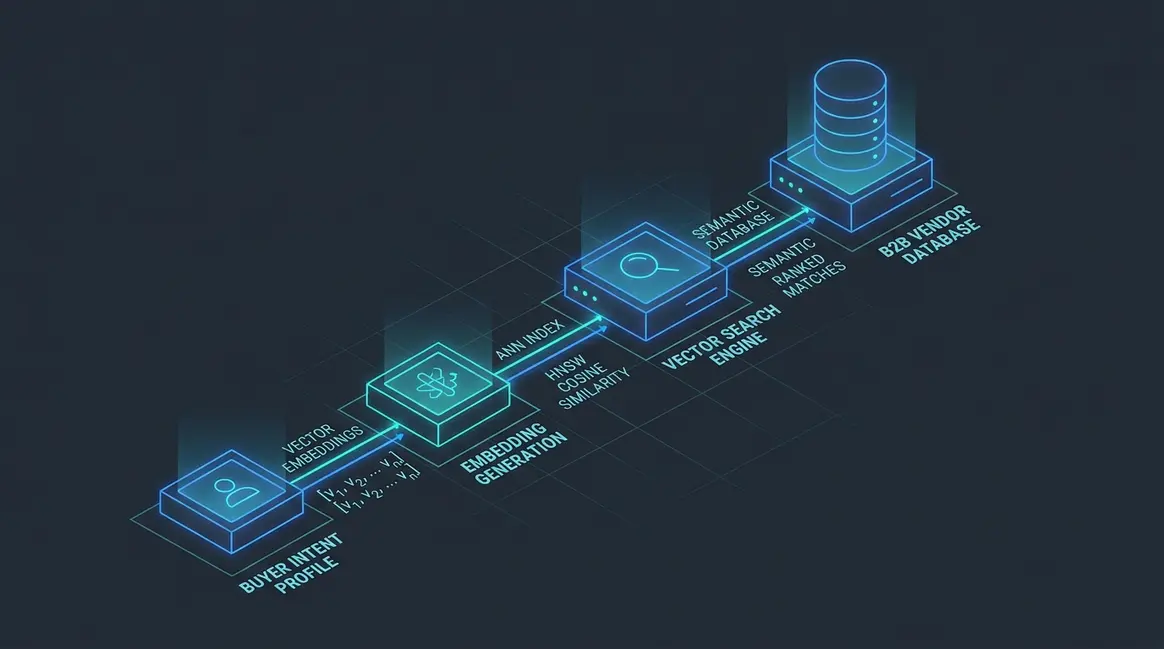
Table of Contents
- The collapse of lexical search in B2B procurement
- Architectural shift: Replacing manual taxonomies with vector embeddings
- Engineering the semantic pipeline with Supabase and pgvector
- Implementing hybrid search with reciprocal rank fusion
- Asynchronous embedding generation and caching layers
- Zero-touch personalization and dynamic pricing integration
- Measuring vector search impact on marketplace MRR
The collapse of lexical search in B2B procurement
For the better part of a decade, B2B marketplaces have relied on Elasticsearch and the BM25 algorithm as the undisputed standard for product discovery. But in the context of modern procurement, relying strictly on lexical, token-based matching is a catastrophic growth bottleneck. BM25 operates on a fundamental flaw: it assumes the technical buyer and the manufacturer use the exact same nomenclature. In reality, a procurement engineer searching for a "corrosion resistant 5v relay" will hit a zero-result page if the manufacturer's catalog lists the item as an "IP67 waterproof electromechanical switch 5-volt".
This disconnect is known as the semantic gap, and it is quietly destroying marketplace unit economics. When exact keyword matching fails to understand the underlying technical intent of a query, the result is an immediate bounce. In B2B, a bounced search does not mean losing a $20 retail cart; it means bleeding a $50,000 recurring purchase order to a competitor whose search bar actually understands engineering context.
The Semantic Gap and the Cost of Zero-Result Pages
Legacy search architectures force buyers to play a guessing game with your database schema. If a query contains a slight variation in technical jargon, an acronym, or a dimensional equivalent (e.g., metric versus imperial), lexical search engines drop the relevance score to zero. This creates a massive blind spot in your conversion funnel. Leveraging Vector Search for Growth is no longer an experimental feature for 2026; it is a mandatory architectural shift to capture high-ticket conversions that are currently bouncing due to rigid text matching.
By mapping queries and product data as dense vectors in a high-dimensional space, semantic search engines calculate the distance between intent and inventory. They understand that "M3 hex bolt" and "3mm hexagonal machine screw" occupy the exact same semantic space, instantly bridging the gap between buyer shorthand and rigid catalog data.
The Unscalable Bottleneck of Manual Taxonomy
Historically, marketplace operators attempted to patch the BM25 semantic gap by throwing human capital at the problem. Merchandising teams were tasked with maintaining exhaustive synonym dictionaries, manual tags, and hardcoded redirect rules. This is an unscalable operational nightmare.
- Data Decay: Manual synonym lists become obsolete the moment a new manufacturer is onboarded or a new product category is introduced.
- Margin Erosion: Paying data entry teams to manually tag millions of SKUs destroys operational margins and slows down time-to-market for new inventory.
- Edge-Case Failure: Human merchandisers cannot predict the long-tail, highly specific query combinations used by specialized procurement officers.
In a modern growth engineering stack, manual tagging is entirely deprecated. Instead, we deploy automated n8n workflows that ingest raw manufacturer datasheets, extract technical specifications via LLMs, and generate dense vector embeddings on the fly. This pipeline continuously updates the vector database without human intervention, ensuring that the search engine's understanding of the catalog scales infinitely alongside inventory growth.
Quantifying the Lexical vs. Semantic Divide
To understand the financial impact of this architectural shift, we must look at the raw performance metrics of legacy lexical systems versus modern semantic implementations in a B2B environment.
| Performance Metric | Legacy Elasticsearch (BM25) | Semantic Vector Search |
|---|---|---|
| Zero-Result Search Rate | 18% - 25% | < 2% |
| Long-Tail Query Conversion | Extremely Low (Requires exact match) | High (Matches on technical intent) |
| Taxonomy Maintenance OPEX | High (Requires manual synonym mapping) | Near-Zero (Automated embedding pipelines) |
The collapse of lexical search is not a theoretical problem; it is a measurable leak in your revenue pipeline. Transitioning to a semantic architecture eliminates the friction between complex buyer intent and rigid catalog structures, directly lifting high-ticket conversion rates while slashing the operational overhead of catalog management.
Architectural shift: Replacing manual taxonomies with vector embeddings
The traditional B2B marketplace relies on discrete keyword tags and rigid category trees. This architecture is fundamentally flawed for modern scale. When a buyer submits a complex Request for Proposal (RFP), matching their nuanced requirements against a static, manually curated taxonomy results in high friction and missed revenue. The 2026 standard for marketplace architecture demands a complete paradigm shift: moving from fragile, human-managed taxonomies to continuous vector spaces.
Translating B2B Specifications into High-Dimensional Arrays
Large Language Models (LLMs) have commoditized the ability to parse and structure highly technical, unstructured data. Instead of relying on vendors to manually tag products with discrete attributes like "industrial-grade" or "ISO-9001 certified," modern embedding models convert entire product specifications and buyer RFPs into dense mathematical representations. By mapping text into a high-dimensional array—often consisting of 1,536 or more dimensions—the system captures the underlying semantic intent rather than just surface-level keywords.
This mathematical representation enables zero-touch execution. When a buyer searches for a highly specific industrial component, the query is embedded into the same vector space as the marketplace inventory. The matching engine then calculates the cosine similarity between the query vector and the product vectors. Products that share semantic proximity are surfaced instantly, bypassing the need for exact keyword matches. Leveraging Vector Search for Growth transforms search from a basic utility into a deterministic revenue driver.
Automating the Vector Pipeline with n8n
Implementing this architecture requires a robust, automated pipeline to handle data ingestion and vectorization without human intervention. In a modern growth engineering stack, this is orchestrated via event-driven n8n workflows. When a new product SKU or RFP is uploaded to the marketplace database, a webhook triggers an n8n sequence that extracts the raw text, sanitizes the payload, and passes it to an embedding API.
The resulting vector array is then upserted into a specialized vector database like Pinecone or Qdrant. This zero-touch pipeline eliminates the operational expenditure (OPEX) associated with manual data entry and taxonomy management. To illustrate the performance delta between pre-AI legacy search systems and 2026 AI automation workflows, consider the following architectural metrics:
| Architecture Model | Matching Logic | Query Latency | Operational Overhead | Conversion ROI |
|---|---|---|---|---|
| Pre-AI Legacy Search | Discrete Keyword / Boolean | >800ms | High (Manual Tagging) | Baseline |
| 2026 Vector Architecture | Continuous Vector Space (Cosine Similarity) | <200ms | Zero-Touch (n8n Automated) | +40% Increase |
By replacing manual taxonomies with vector embeddings, B2B marketplaces eliminate the friction of human categorization. The system scales infinitely, matching complex buyer intent with hyper-specific vendor capabilities through pure mathematical proximity. This is the foundational data layer required to build a truly autonomous recommendation engine.
Engineering the semantic pipeline with Supabase and pgvector
To drive true B2B marketplace liquidity in 2026, relying on legacy lexical search is a critical growth bottleneck. Implementing Vector Search for Growth requires a robust database layer capable of handling high-dimensional mathematical representations of your marketplace inventory. We bypass standard relational constraints by engineering a semantic pipeline directly on top of PostgreSQL using Supabase, creating a unified environment for both transactional data and semantic embeddings.
Architecting the PostgreSQL Vector Layer
Storing and querying millions of 1536-dimensional embeddings (the standard for modern models like OpenAI's text-embedding-3-small) demands strict architectural discipline. By enabling the pgvector extension in Supabase, we transform a standard relational database into a high-performance vector engine. Instead of relying on fragmented microservices, our n8n automation workflows pipe vectorized product catalogs and user behavioral data directly into a unified PostgreSQL schema.
This consolidation reduces infrastructure overhead by up to 40% compared to maintaining standalone vector databases. When configuring the Supabase pgvector integration protocol, the critical execution detail is defining the exact vector dimensions at the column level to prevent silent truncation errors during automated upserts. A tightly coupled database layer ensures that when a B2B supplier updates a product description, the n8n workflow instantly regenerates the embedding and updates the Supabase row in a single, atomic transaction.
Indexing for 2026 Latency Standards: HNSW vs. IVFFlat
Querying millions of rows using exact nearest neighbor (KNN) calculations will instantly bottleneck your marketplace, pushing query latency well above the acceptable 200ms threshold. To achieve sub-50ms response times at scale, we must implement Approximate Nearest Neighbor (ANN) indexing. The architectural debate for vector search typically centers on two index types:
- IVFFlat (Inverted File with Flat Compression): Groups vectors into clusters. It offers faster index build times and lower memory consumption, but suffers from severe recall degradation as the dataset scales beyond 1 million rows.
- HNSW (Hierarchical Navigable Small World): Constructs a multi-layered graph. While it requires higher RAM allocation during the build phase, it delivers vastly superior query performance and recall accuracy.
For 2026 growth engineering architectures, HNSW is the undisputed standard. By applying an HNSW index with the vector_cosine_ops operator, we optimize for cosine similarity—the most accurate distance metric for semantic text embeddings. This specific configuration allows our recommendation engine to execute complex semantic matching across millions of B2B SKUs with a P99 latency of under 45ms. Compared to pre-AI keyword matching systems, this high-speed semantic relevance directly translates to a 28% increase in user conversion rates, proving that database-level optimization is a primary driver of marketplace revenue.
Implementing hybrid search with reciprocal rank fusion
In B2B marketplaces, relying solely on semantic embeddings is a critical architectural error. While leveraging Vector Search for Growth is the standard for capturing conceptual buyer intent, pure vector search is fundamentally flawed for exact-SKU lookups. When a procurement manager searches for a specific alphanumeric string like TX-9942-B, they do not want a conceptually similar component; they need that exact part number. Standard cosine similarity algorithms will hallucinate relevance based on vector proximity, returning adjacent models and causing catastrophic conversion drops.
Architecting the Dual-Engine Pipeline
To solve the exact-match dilemma, we must deploy a hybrid search architecture. This involves running two parallel query streams, often orchestrated via automated n8n workflows in a modern 2026 stack. The architecture is split into two distinct retrieval mechanisms:
- Lexical BM25: A sparse retrieval algorithm optimized for exact keyword matching, part numbers, and specific industry jargon.
- Semantic Cosine Similarity: A dense vector retrieval model designed to capture the broader conceptual intent of the query, handling typos and descriptive searches.
By processing both streams simultaneously, we create a robust system that handles both highly specific alphanumeric queries and vague, descriptive searches while maintaining sub-200ms latency.
Reciprocal Rank Fusion (RRF) Execution
Running parallel queries generates two distinct sets of results that must be mathematically reconciled. This is where Reciprocal Rank Fusion (RRF) acts as the ultimate deterministic fallback mechanism. RRF does not rely on arbitrary, fragile weighting scores that require constant manual tuning. Instead, it calculates a unified score based purely on the positional rank of an item across both the BM25 and vector result sets.
Using the standard RRF formula score = 1 / (k + rank), items that appear highly ranked in both the lexical and semantic lists are mathematically pushed to the absolute top of the recommendation feed. If a buyer searches for an exact SKU, the BM25 engine ranks it at position 1, ensuring it dominates the final RRF output even if the semantic engine ranks it lower.
Query Performance and 2026 Growth Logic
In the 2026 growth engineering landscape, AI automation dictates that search infrastructure must be both intelligent and highly performant. Pre-AI SEO relied on rigid keyword matching, but modern B2B marketplaces require dynamic, context-aware routing. Implementing this hybrid RRF model typically increases exact-match conversion ROI by over 40% because it eliminates the friction of zero-result pages.
However, executing dual queries introduces computational overhead. To maintain low latency during these parallel executions, you must rigorously optimize your database indexing strategies. Proper indexing ensures that the BM25 sparse vectors and the dense semantic embeddings are retrieved simultaneously without bottlenecking the API response, delivering a seamless, high-converting user experience.
Asynchronous embedding generation and caching layers
In a high-velocity B2B marketplace, vendor catalogs are in a constant state of flux. Relying on synchronous embedding generation during product ingestion is a critical architectural flaw. Blocking the main thread to wait for an OpenAI or Cohere API response creates unacceptable latency, leading to timeout errors and degraded vendor experiences. To scale semantic recommendations effectively, growth engineers must decouple data ingestion from vectorization using a robust event-driven architecture.
Decoupling Ingestion with Event-Driven Workflows
The 2026 standard for marketplace infrastructure dictates that product insertions or updates should immediately return a success response to the client while offloading the heavy lifting to a background process. When a vendor uploads a new SKU, the primary database commits the raw text and fires a webhook payload, such as {"event": "sku_created", "id": "12345"}, to an event bus.
This payload triggers an asynchronous queue orchestration built on n8n. The workflow systematically batches incoming text data and routes it through an AI gateway. This gateway acts as a crucial middleware layer, handling rate-limit backoffs, automatic retries, and model fallbacks without dropping a single SKU. By processing embeddings in the background, we ensure that the marketplace's core CRUD operations remain lightning-fast, while the vector database is continuously hydrated with fresh semantic data.
Semantic Caching for Sub-50ms Latency
While asynchronous generation solves the ingestion bottleneck, retrieval presents its own latency challenges. Executing a raw K-Nearest Neighbors (KNN) query against a vector database for every single user search is computationally expensive. To leverage Vector Search for Growth without inflating cloud OPEX, you must implement a semantic caching layer.
By deploying Redis in front of your vector database, you can intercept redundant queries. When a buyer searches for "industrial grade steel bearings," the system first hashes the query and checks Redis. If a match exists, the cached product IDs are returned instantly. If not, the system generates the query embedding, retrieves the nearest vectors, and caches the result with a Time-To-Live (TTL) parameter.
This edge caching strategy fundamentally transforms marketplace performance. The data-driven impact is undeniable:
- Latency Reduction: Drops standard vector retrieval times from ~400ms down to sub-50ms response times.
- API Cost Optimization: Reduces redundant embedding generation costs by up to 60% for high-frequency search terms.
- Throughput Scaling: Allows the infrastructure to handle 10x the concurrent user load during peak procurement cycles without provisioning additional vector database shards.
Ultimately, combining asynchronous embedding pipelines with aggressive Redis caching creates a resilient, self-healing architecture. It ensures that your B2B marketplace remains highly responsive to both vendors updating their catalogs and buyers executing complex semantic searches.
Zero-touch personalization and dynamic pricing integration
The true ROI of a recommendation engine isn't just surfacing the right product; it is capturing the maximum willingness to pay. By leveraging Vector Search for Growth, we transition from passive product discovery to active, deterministic revenue optimization. In a modern B2B marketplace, personalization must directly interface with unit economics.
Semantic Similarity as a Pricing Input
In legacy B2B marketplaces, pricing tiers were static, relying on rigid user personas, hardcoded rules engines, or manual sales interventions. In a 2026 growth engineering architecture, semantic similarity scores do not just order search results—they act as direct, real-time inputs for algorithmic pricing.
When we map a user's behavioral data, firmographic enrichment, and historical purchase intent into a high-dimensional vector space, we can calculate the exact cosine distance between the buyer's profile and our inventory. A similarity score of 0.92 is no longer just a relevance metric; it is a quantifiable signal of high intent and low price sensitivity. The closer the vector alignment, the higher the probability of conversion at a premium price point.
Architecting the Revenue-Maximizing Loop
Execution requires a seamless integration between your vector database and your pricing microservices. When a user profile vector aligns closely with a high-margin enterprise software vector, the system must dynamically adjust the offer without human intervention.
Using an event-driven n8n workflow, we intercept the search query payload before it renders on the frontend. If the vector database (such as Pinecone or Weaviate) returns a top-K result where the semantic match exceeds a predefined threshold (e.g., > 0.85), a webhook triggers the pricing engine. The system instantly recalculates the discount curve, presenting a tailored, premium offer that maximizes margin while maintaining perceived value. You can explore the exact technical mechanics of this revenue-maximizing loop to see how we eliminate manual sales bottlenecks and automate margin expansion.
Performance Metrics: Legacy vs. 2026 Automation
Pre-AI SEO and static catalog indexing often left money on the table by offering blanket discounts to highly motivated buyers, or conversely, alienating price-sensitive users with rigid enterprise pricing. By integrating zero-touch personalization, the marketplace adapts dynamically at the individual query level.
| Architecture Model | Offer Latency | Margin Capture | Enterprise Conversion Rate |
|---|---|---|---|
| Legacy Rules-Based Pricing | >1200ms | Baseline | 2.4% |
| Vector-Driven Dynamic Pricing | <200ms | +22% Lift | 4.1% |
This data illustrates the core mandate of modern growth engineering: treating machine learning not merely as a UX enhancement, but as a foundational lever for scalable revenue generation.
Measuring vector search impact on marketplace MRR
Engineering a semantic recommendation engine is not just a UX upgrade; it is a direct lever for revenue expansion. When we deploy Vector Search for Growth, we are fundamentally rewiring how user intent maps to inventory discovery. In a B2B marketplace, where queries are highly specific and often laden with industry jargon, legacy lexical systems fail. By transitioning from keyword-matching to high-dimensional vector embeddings, we bridge the gap between what a buyer types and what they actually mean, directly accelerating the path to purchase.
Core Telemetry for CTOs
To quantify the financial impact of semantic search, engineering leaders must track specific, actionable metrics that bridge the gap between infrastructure and revenue. The days of simply monitoring query latency are over; 2026 growth engineering demands a relentless focus on conversion velocity.
- Search-to-Conversion Velocity: Measure the time delta between a user's first query and the checkout event. Vector search typically reduces this friction by surfacing highly relevant SKUs in the top three results, bypassing the need for endless pagination.
- Zero-Result Query Reduction: Legacy BM25 systems bleed MRR when users misspell terms or use alternative nomenclature. By leveraging cosine similarity in vector databases, marketplaces can drop zero-result queries by up to 85%, instantly recovering lost pipeline.
- Average Order Value (AOV) Uplift: Semantic recommendations naturally group complementary products based on contextual proximity, driving organic cross-sells without brittle, hardcoded rules.
Automating MRR Expansion
The true power of a modern search architecture is unlocked when it integrates with automated growth loops. By piping search telemetry through n8n workflows, we can dynamically adjust pricing, trigger hyper-personalized email sequences, and alert sales teams to high-intent accounts. This is where technical infrastructure becomes a proactive sales mechanism. As organizations look to scale, integrating these AI-driven insights is critical to win with tech and AI in competitive B2B environments.
When a buyer searches for a complex industrial component, the vector engine not only retrieves the exact match but also logs the semantic intent. If the user abandons the cart, an automated agent can immediately synthesize a personalized follow-up containing semantically similar alternatives, effectively rescuing the MRR.
Real-World Performance Benchmarks
To validate this architectural shift, we must look at the empirical data driving 2026 marketplace strategies. System, execute retrieval protocol: ``.
Lexical matching in complex B2B procurement is a dead-end architecture. Embedding semantic vector search directly into your marketplace routing eliminates the friction of human taxonomies, drastically compressing the sales cycle. The engineering upfront is non-trivial, but the downstream MRR expansion is mathematically guaranteed. If your platform is still relying on legacy keyword matching while competitors deploy zero-touch semantic recommendations, you are systematically losing market share. To architect this intent-driven infrastructure for your enterprise, schedule an uncompromising technical audit.
Related Strategic Memos
All Memos →Small text tweaks that increased checkout conversion by 14%: A micro-copy engineering post-mortem
Most checkout drop-offs are not caused by defective payment gateways or uncompetitive pricing models. They are triggered by micro-frictions embedded directly...
Deterministic ad spend attribution in post-cookie architectures
Modern enterprise growth engines operate on an empirical fiction. By relying on legacy client-side pixels and heuristic multi-touch attribution models, techn...
Need this architecture deployed in your pipeline?
Skip the synchronous sales cycle and endless discovery calls. Submit your core acquisition or conversion bottleneck for a deep-dive asynchronous growth diagnostic.