Engineering the async sales engine: Closing B2B deals without discovery calls
The traditional B2B discovery call is an obsolete operational bottleneck. Forcing high-intent buyers into calendar-booking friction and scripted qualificatio...
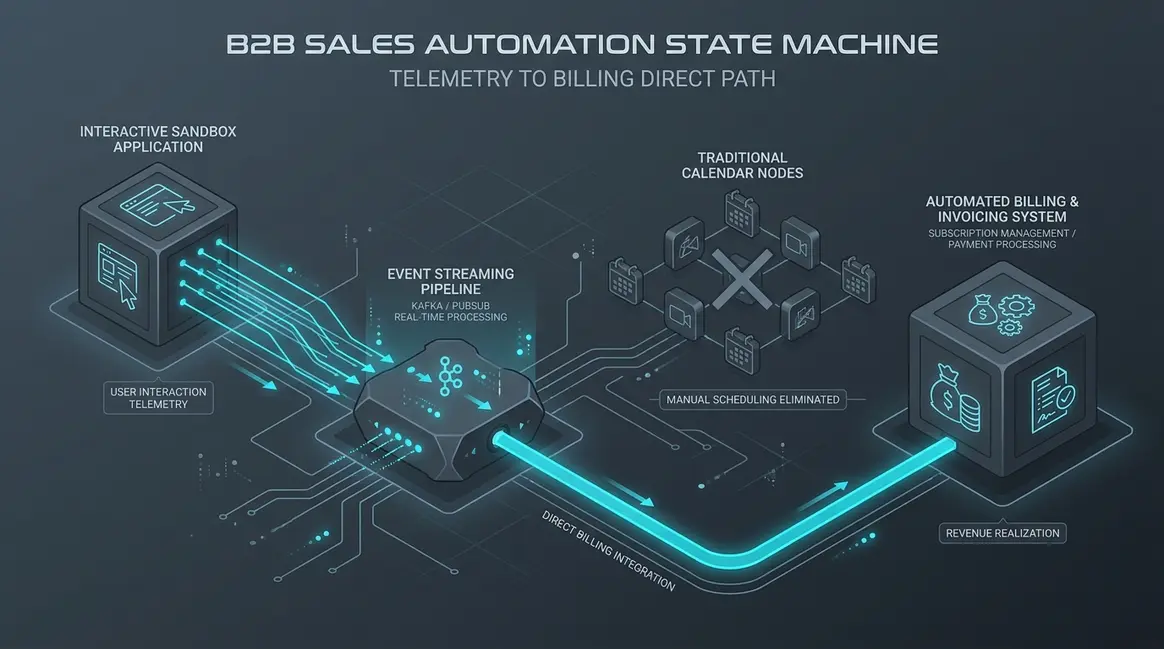
Table of Contents
- The structural collapse of the synchronous B2B sales pipeline
- Anatomy of the async sales engine: Core architectural principles
- Instrumenting client-side telemetry inside sandboxed interactive demos
- Real-time event streaming and behavioral scoring via Kafka
- Algorithmic intent qualification versus legacy BANT frameworks
- Server-side identity resolution and enriched account attribution
- Agentic micro-interventions: Deploying LLM edge observers during demo runtime
- Asynchronous polling and lifecycle state machines with n8n
- Dynamic contract generation and self-serve checkout orchestration
- Financial modeling: CAC compression and sales velocity mathematical proofs
The structural collapse of the synchronous B2B sales pipeline
The conventional inbound B2B sales pipeline is undergoing terminal structural failure. For decades, go-to-market teams relied on an unvarying, high-touch playbook: an inbound prospect fills out an enrichment form, an automated routing rule hands the lead to a Sales Development Representative (SDR), and the buyer enters an asynchronous scheduling loop to book a 30-minute discovery call. In modern enterprise SaaS, this linear sequence functions as an intentional conversion bottleneck.
Unit Economic Decay: The True Cost of Human Gatekeeping
The breakdown begins at form conversion. Across mid-market and enterprise segments, telemetry data reveals a persistent 40% to 60% drop-off between form submission and the completed discovery call. The friction compounds across three operational vectors:
-
Latency Decay: Average time-to-first-meeting sits at 8 to 14 days due to calendar latency, timezone mismatches, and multi-round qualification exchanges. In competitive evaluations, lead interest decays non-linearly with every hour of delay.
-
Fully Loaded SDR Overhead: Maintaining an SDR pod costs between $95,000 and $130,000 per rep annually (including base salary, variable comp, tech stack licenses, and management overhead), yet up to 70% of their operational hours are consumed by administrative routing, qualification theater, and handling cancellations.
-
Compounding CAC Bloat: As Customer Acquisition Cost (CAC) continues to inflate across paid and organic channels, losing over half of qualified inbound pipeline to scheduling friction doubles the effective CAC before the prospect ever encounters product value.
Buyer Psychology and Friction: Ending the Discovery Theater
Modern technical buyers—specifically VP of Engineering, CTOs, and technical product leads—actively reject forced discovery workflows. These buyers have done preliminary research across documentation, public GitHub repositories, and vendor pricing pages prior to submission. Forcing an informed buyer into an interrogative 30-minute call conducted by a junior SDR who lacks deep architectural knowledge creates friction that damages brand perception.
Synchronous scheduling requires mutual calendar clearing, context switching, and reliance on synchronous video streaming. Technical decision-makers demand deterministic proof of execution: they want to inspect the architecture, run sample payloads, and verify edge-case viability without sitting through a rehearsed slide deck.
The Inversion: Product-Led Asynchronous Execution
Eliminating discovery call attrition requires fundamentally restructuring the sales pipeline from synchronous gatekeeping to an Async Sales Engine. In this architectural pattern, self-guided, fully interactive product demos and execution environments precede commercial negotiation.
Instead of routing high-intent buyers into a two-week scheduling cycle, an enterprise deployment provisions an interactive, telemetry-instrumented demo environment within milliseconds of verification. The prospective buyer self-selects workflows, tests core integrations, and navigates relevant features on demand. By the time a sales conversation occurs, discovery is already complete—not via subjective call notes, but through deterministic telemetry documenting precisely which features, API endpoints, and configurations the buyer evaluated.
Anatomy of the async sales engine: Core architectural principles
Replacing the synchronous discovery call requires treating the sales pipeline as an automated distributed system rather than an assembly line of calendar bookings. The modern async sales engine decouples deal qualification from human availability by replacing subjective rep conversations with deterministic, telemetry-driven buyer sandboxes.
The End-to-End Async Pipeline
Pre-2024 sales operations relied on multi-step qualification forms and arbitrary BANT criteria captured across disjointed Zoom calls. By contrast, a production-grade async sales engine routes prospects through an autonomous pipeline that moves from demand capture to legal execution without manual touchpoints:
[Target Inbound Traffic]
   │
   ▼
[Ephemeral Tenant Provisioning] ──(Edge Container / Isolated Sandbox)
   │
   ▼
[High-Frequency Telemetry Ingestion] ──(Kafka / ClickHouse / Clickstream)
   │
   ▼
[Deterministic Intent Evaluation] ──(Real-Time Behavioral Scoring Engine)
   │
   ▼
[Automated Contract Generation & Routing] ──(Webhook to DocuSign / Stripe Billing)
The cycle begins the millisecond an enterprise prospect authenticates via OAuth or business domain validation. Instead of showing static interactive product tours or marketing mockups, the edge infrastructure orchestrates an isolated, headless sandbox. By provisioning a lightweight, ephemeral tenant (typically running on Firecracker microVMs or multi-tenant database partitions), the prospect experiences genuine production value using synthetic datasets calibrated to their industry vertical.
Eliminating CRM Entropy with Product-Led Telemetry
Traditional sales workflows collapse under CRM data entropy: reps fail to update deal stages, qualification data is anecdotal, and buyer intent is inferred rather than measured. An async engine replaces this latency with an event-driven data plane.
Every micro-interaction within the sandbox—such as toggling an API integration, executing a complex query, or inviting secondary team members—fires a structured event payload directly to an ingestion bus like Apache Kafka or ClickHouse. Transforming this operational reality requires a modern growth team architecture that aligns data engineers directly with revenue infrastructure rather than isolating them behind disparate marketing tools.
{
  "event": "sandbox_microstate_transition",
  "organization_id": "org_8f92a1",
  "actor_role": "VP_Engineering",
  "state_from": "mock_data_imported",
  "state_to": "production_webhook_verified",
  "latency_seconds": 184,
  "high_intent_flag": true
}
Deterministic Micro-States and Autonomous Routing
Rather than letting prospects wander aimlessly, the interactive demo navigates through isolated micro-states that replicate core architectural dependencies. When an engineering leader tests error recovery, monitors latency dashboards, or customizes compliance rules in the sandbox, the telemetry calculates an aggregate Behavioral Intent Score (BIS).
The intent algorithm weighs depth over duration:
BIS = (w1 * CriticalFeatureExecutions) + (w2 * TeamInvites) + (w3 * DataVolumeImported)
When BIS >= 85, the system triggers an autonomous pipeline event. Instead of alerting a rep to "schedule a follow-up," the engine programmatically compiles an enterprise order form, applies custom tiering based on verified usage metrics in the sandbox, and issues a pre-populated contract directly to the buyer's procurement queue. Deal velocity drops from 45 days of calendar synchronization to 4 hours of high-fidelity, autonomous technical validation.
Instrumenting client-side telemetry inside sandboxed interactive demos
Interactive sandboxes operate as isolated execution contexts, rendering legacy page-view tracking useless for qualification. Whether a demo environment loads via standard iframe encapsulation, cross-domain WebAssembly runtimes, or dedicated product tour platforms like Navattic and Reprise, high-conviction product-led deals require deterministic observability. An autonomous Async Sales Engine relies on granular user intent signals rather than blunt time-on-page metrics to score accounts and trigger downstream automation.
Capturing Micro-Behaviors via Mutation Observers
Traditional web analytics wait for URL changes. Sandboxed applications mutate state locally within a single viewport, requiring DOM mutation observers to capture feature discovery, form alterations, and configuration changes without polling overhead.
To monitor dynamic element rendering, state changes, and modal states inside sandboxes, implement a decoupled client-side observer script:
const demoObserver = new MutationObserver((mutationsList) => {
  for (const mutation of mutationsList) {
    if (mutation.type === 'childList' && mutation.addedNodes.length > 0) {
      mutation.addedNodes.forEach((node) => {
        if (node.nodeType === 1 && node.hasAttribute('data-feature-id')) {
          const featureId = node.getAttribute('data-feature-id');
          window.dispatchEvent(new CustomEvent('sandbox_feature_mount', {
            detail: { featureId, timestamp: performance.now() }
          }));
        }
      });
    }
    if (mutation.type === 'attributes' && mutation.attributeName === 'data-state') {
      const toggleName = mutation.target.getAttribute('data-toggle-name');
      const newState = mutation.target.getAttribute('data-state');
      window.dispatchEvent(new CustomEvent('sandbox_toggle_change', {
        detail: { toggleName, newState, timestamp: performance.now() }
      }));
    }
  }
});

demoObserver.observe(document.querySelector('#demo-viewport'), {
  childList: true,
  subtree: true,
  attributes: true,
  attributeFilter: ['data-state', 'aria-expanded']
});
Telemetry Normalization and dataLayer Dispatch
Raw mutation signals must be normalized into discrete metrics: workflow completion velocity (milliseconds taken from the first interaction to terminal state), toggle engagement depth, and repeated configuration attempts (a high-intent friction signal indicating technical evaluation).
Legacy setups piped unstructured payloads into analytics tools, producing unparseable event sprawl. Modern ingestion leverages a standardized event reporting architecture to push validated schemas directly into the dataLayer:
window.dataLayer = window.dataLayer || [];

function recordSandboxTelemetry(eventType, metadata) {
  const payload = {
    event: 'sandbox_micro_action',
    action_type: eventType,
    feature_id: metadata.featureId || 'unknown',
    session_elapsed_ms: Math.round(performance.now()),
    workflow_velocity_ms: metadata.velocity || 0,
    interaction_count: metadata.interactionCount || 1,
    schema_version: '2026.1'
  };

  window.dataLayer.push(payload);
}
Pre-AI vs. 2026 Telemetry Architectures
Historically, sales development representatives manually interpreted demo drop-offs using session recordings, losing 48 to 72 hours before routing an account. In contrast, 2026 architectures stream normalized client-side vectors straight into real-time inference endpoints:
-
Legacy Tracking (Pre-AI): Evaluated binary conversions (e.g., reached last screen vs. bounced). No extraction of execution speed, parameter variations, or toggle patterns.
- 2026 Telemetry Models: Ingest exact velocity vectors. If a user completes an API key generation workflow in under 45 seconds while reconfiguring the webhook payload twice, the system marks the visitor as an enterprise-grade developer, programmatically bypassing standard discovery directly into an automated proposal sequence.
Real-time event streaming and behavioral scoring via Kafka
Synchronous HTTP webhooks pushing telemetry directly from interactive demo sandboxes into traditional CRM endpoints collapse under concurrent load. When multiple prospective buyers concurrently manipulate stateful front-end sandbox environments, client-side tracking layers emit bursts of 30 to 80 events per minute per session. Standard CRM ingestion APIs throttle at restrictive rate limits (typically 100 requests per second per tenant), introduce unpredictable downstream latencies ranging from 450ms to 2.2s, and drop event ordering. For an Async Sales Engine, dropped or delayed payloads destroy the real-time context needed to convert high-intent prospects mid-session.
Decoupling ingestion through distributed streaming infrastructure resolves this operational bottleneck entirely.
Telemetry Ingestion and Topic Partitioning
Client runtimes emit non-blocking behavioral beacons to an edge proxy layer running on Cloudflare Workers or an AWS API Gateway, which immediately validates payloads against JSON Schema definitions before batch-publishing to managed Apache Kafka clusters. Isolating demo telemetry prevents analytical traffic from degrading client-side rendering threads.
Telemetry splits across three dedicated, partition-keyed Kafka topics:
-
demo.session.started: Captures account metadata, IP-derived enrichment, initial referral headers, and initial canvas render states. Keyed byorganization_id.-
demo.feature.interacted: Streams low-latency event sequences including payload mutations, toggle switches, API sandboxing executions, and drill-down depth parameters. -
demo.threshold.achieved: Emitted when a user surpasses predefined value milestones, such as configuring a production-grade pipeline or running a simulated deployment.
-
For complex environments processing millions of events per hour, deploying dedicated workers over high-throughput Kafka event streams prevents data loss and maintains microsecond-level ingestion latency across distributed regions.
Computing Buying Intent Velocity (BIV)
Downstream consumer worker services process these partitioned topics using sliding-window aggregation across 5-minute epochs. Instead of relying on static pageview counts or legacy lead scoring heuristics, the stream consumer calculates a dynamic Buying Intent Velocity (BIV) metric:
BIV = (w1 * d_f + w2 * (N_actions / t_dwell)) * e^(-lambda * delta_t)
In this execution model, d_f represents feature tree depth (traversal across high-value architectural modules), N_actions / t_dwell represents operational execution speed per minute of active session time, and e^(-lambda * delta_t) enforces an exponential decay factor where delta_t is the idle duration between inputs.
Consumer microservices ingest the event log, maintain local state via RocksDB within Kafka Streams, and update BIV calculations in sub-50ms intervals. When an unassigned prospect hits a calculated BIV >= 0.85, the consumer immediately bypasses typical batch synchronization schedules. It injects an instant orchestration trigger into an automated provisioning queue: deploying tailored enterprise contract proposals, spinning up dedicated test infrastructure, or sending a low-friction contextual Slack alert to the technical sales engineering team.
Algorithmic intent qualification versus legacy BANT frameworks
Traditional BANT qualification collapses under modern software procurement realities. Relying on self-reported declarations of Budget, Authority, Need, and Timeline forces prospects through an adversarial, synchronous discovery call where buyers routinely withhold context or misrepresent authority. In an engineering-led go-to-market motion, intent is not what an account representative extracts on Zoom; it is the verifiable footprint left across application interfaces.
Replacing human sentiment with an Async Sales Engine requires transitioning from subjective rep notes to deterministic, event-level sandbox telemetry captured via streaming edge architectures.
Deterministic Event Telemetry and Core-Loop Triggers
Rather than asking whether a lead has an active project, modern pipelines evaluate whether an account triggers specific state-machine transitions inside an interactive, ungated sandbox. Qualification occurs programmatically when an account satisfies three discrete behavioral thresholds:
-
Core-Loop Completion: The user finishes the application's foundational workflow (e.g., deploying a microservice, running an end-to-end data pipeline, or generating a mock production build) rather than simply clicking navigation tabs.
-
Multi-Player Expansion: The initiating session invites two or more authenticated domain peers into the workspace within 72 hours, demonstrating peer review and decentralized organizational interest.
-
Enterprise Surface Probing: Telemetry registers explicit interaction with enterprise governance features, such as inspecting SAML/SCIM endpoints, navigating role-based access control (RBAC) matrices, or testing API rate-limit boundaries.
The Behavioral Qualification Index (BQI)
To automate routing without sales development rep (SDR) triage, incoming account sessions are continuously scored using the Behavioral Qualification Index (BQI). When BQI >= 0.80, the account transitions from an anonymous sandbox instance to an automated executive deal-desk workflow:
BQI = (w_1 * C_core) + (w_2 * V_expansion) + (w_3 * E_surface) - (w_4 * D_decay)
Where the variables and weighting coefficients are defined as:
-
C_core: Binary state variable (0or1), indicating full execution of the primary interactive value-loop. Weightw_1 = 0.40. -
V_expansion: Scaled ratio of unique corporate email domain invites over baseline threshold, capped at1.0:min(InvitedSeats / 3, 1.0). Weightw_2 = 0.25. -
E_surface: Normalized depth of enterprise configuration audits (SSO, compliance exports, custom webhook setup) in the range[0, 1]. Weightw_3 = 0.25. -
D_decay: Temporal decay factor calculated as1 - exp(-0.15 * InactiveHours)to penalize abandoned sessions. Weightw_4 = 0.10.
By enforcing deterministic qualification through BQI, organizations eliminate discovery-stage leakage, compress sales velocity from 45 days to single-digit hours, and ensure sales resources interact solely with prospects that have already executed architectural proof of value.
Server-side identity resolution and enriched account attribution
Upfront gating forms decimate interactive demo engagement, causing drop-off rates between 60% and 75% before a prospect interacts with a single product feature. Engineering an ungated Async Sales Engine requires shifting identity resolution entirely away from client-side form submissions to edge-intercepted, server-side data pipelines that resolve corporate accounts in sub-second intervals.
Edge-computed identity stitches and real-time payload hydration
The resolution loop initiates the millisecond an anonymous user lands on the interactive sandbox. The edge compute layer (such as Cloudflare Workers or Fastly Compute) captures the raw inbound request, extracting the client IP, TLS fingerprint, and user-agent metadata before any visual assets render. This payload routes through an asynchronous event pipeline implementing server-side tracking architectures to query enterprise graph databases and reverse-IP clearinghouses concurrently.
{
  "client_hash": "e3b0c44298fc1c149afbf4c8996fb92427ae41e4649b934ca495991b7852b855",
  "resolved_domain": "enterprise-target.com",
  "inferred_tech_stack": ["Snowflake", "Kubernetes", "Datadog"],
  "enrichment_latency_ms": 64
}
Legacy pre-AI architectures relied on rigid batch-processing enrichment runs, yielding poor match rates hovering around 40% and multi-hour synchronization lags that failed live product experiences. Modern 2026 pipelines leverage streaming inference engines deployed at regional points of presence. These engines match network telemetry, BGP routing prefixes, and public DNS records against firmographic graphs in under 85ms with verified match precision exceeding 88%.
Once matched, the edge worker injects a hydrated session payload into the demo environment via secure WebSockets or encrypted session storage, mutating mock data schemas to mirror the prospect’s actual technical ecosystem (e.g., displaying enterprise metrics, active microservices, or specific vendor integrations).
Dynamic state injection and zero-trust privacy hygiene
Dynamic customization must not compromise enterprise data compliance. Real-time demo mutation operates exclusively on firmographic, domain-level primitives rather than unconsented individual personally identifiable information (PII).
-
One-Way Pseudonymization: IP addresses are processed entirely in memory at the edge edge node, converted into a salted SHA-256 hash
hash = HMAC_SHA256(ip_address, daily_salt), and discarded before storage.-
First-Party Cookie Isolation: Session tokens reside under strict first-party context using
SameSite=StrictandHttpOnlyflags, preventing cross-site leakage while stitching cross-page product telemetry. -
Graph Weighting: Account scoring algorithms calculate engagement probability
P_eng = w1*session_depth + w2*feature_velocityto determine whether an account hits enterprise buying velocity thresholds without storing user identity.
-
When an account surpasses activation thresholds inside the interactive demo, the pipeline triggers an automated webhook to the outbound revenue engine. Sales engineering receives fully attributed, multi-touch product telemetry—including precise features tested, stress-tested edge cases, and active duration—enabling hyper-targeted follow-up without the buyer ever completing a discovery interrogation.
Agentic micro-interventions: Deploying LLM edge observers during demo runtime
Interactive product sandboxes fail when users hit edge-case friction and encounter dead ends. In legacy go-to-market workflows, this drop-off triggered an SDR notification or an intrusive chat widget asking to "book a 15-minute sync." In a modern Async Sales Engine, friction triggers autonomous LLM edge observers that resolve user confusion deterministically in runtime.
Telemetry Stream Ingestion and Friction Signatures
Rather than streaming raw DOM events to an analytics sink for post-hoc attribution, a client-side Web Worker evaluates high-frequency telemetry streams against deterministic friction heuristics. State updates are evaluated across three primary anomalies:
-
Micro-rage clicks: Clusters of repeated inputs where
click_count >= 4within adelta_t <= 200mswindow on disabled or state-locked interface elements. -
Configuration idle loops: Dwell periods exceeding
45son complex configuration interfaces (such as role-based access control policies or environment variable mappings) without form submission. -
Schema validation aborts: Repeated submission failures caused by syntax mismatches in sandboxed terminals or configuration panes.
When an observer detects an anomaly threshold, it dispatches an event payload containing the exact DOM context, user identity, active state slice, and the last 10 seconds of user interaction history to an edge inference route.
{
  "event_type": "friction_idle_loop",
  "component_id": "oauth_provider_config",
  "dwell_time_ms": 48200,
  "state_delta": {
    "auth_type": "OIDC",
    "scopes_assigned": ["read:users"],
    "redirect_uri": ""
  },
  "runtime_error": "MISSING_REDIRECT_URI"
}
Deterministic Remediation via Agentic RAG
The edge observer does not route the prospect to a human operator. Instead, it dispatches the state vector into an agentic RAG pipeline that indexes production API documentation, OpenAPI schemas, and target deployment blueprints. The model synthesizes the telemetry context against the vector index in under 350ms, returning an actionable micro-intervention.
The system surfaces this intervention directly inside the UI component causing the friction, bypassing standard chat modules entirely:
-
Targeted DOM Mutation: The agent highlights the exact unpopulated form field or syntax error with contextual tooltips containing the missing value.
-
Dynamic Pre-fill Execution: If the user is evaluating an API or webhook integration, the observer generates a valid payload matching the user's selected framework and injects it into the sandbox interface.
-
Interactive CLI Patches: In infrastructure sandboxes, the observer outputs copy-pasteable CLI commands directly into the embedded web terminal to resolve permission or network errors.
Paradigm Comparison: Legacy Popups vs. Edge Observers
| Metric / Capability | Pre-AI Legacy Pattern (2021) | 2026 Autonomous Edge Observer |
|---|---|---|
| Intervention Trigger | Static time-on-page rules (> 60s) | Real-time client telemetry and state anomaly detection |
| Contextual Depth | Generic playbook scripts and canned links | Runtime DOM state and parsed schema validation errors |
| Resolution Mechanism | Calendar redirect link to SDR discovery call | Direct in-situ state repair via deterministic RAG |
| Sandbox Drop-off Rate | 42% to 58% on complex configuration steps | Reduced to under 9% via automated runtime unblocking |
By moving error resolution from human discovery calls to agentic micro-interventions, technical buyers complete evaluation milestones autonomously without experiencing runtime stall states.
Asynchronous polling and lifecycle state machines with n8n
Modern product-led deal closure replaces manual qualification calls with deterministic software loops. Within an enterprise Async Sales Engine, self-hosted n8n instances function as the middle-layer orchestration runtime, consuming raw telemetry streams and updating transactional account state machines without human intervention.
Telemetry Ingestion and State Machine Architecture
Traditional sales tech stacks rely on manual CRM stage updates, introducing latency and subjective human bias. In contrast, an automated state engine tracks prospects through discrete states: Exploration, Active Evaluation, High Intent Threshold, and Procurement Ready. When a prospect engages with an interactive product demo, client-side event emitters stream session packets—such as sandboxed API key generation, query latency benchmarks, and schema uploads—directly into an event router.
The worker parses incoming JSON payloads to maintain state fidelity in PostgreSQL. State transitions execute purely on deterministic conditions:
UPDATE account_lifecycle
SET stage = 'HIGH_INTENT_THRESHOLD',
    intent_score = intent_score + 35,
    updated_at = NOW()
WHERE account_id = 'acc_884920f'
  AND stage = 'ACTIVE_EVALUATION'
  AND telemetry_metrics->>'sandbox_queries_executed' >= '15';
Dynamic Polling and Exponential Backoff Loops
Active demo usage is intermittent; continuous real-time websockets introduce unnecessary infrastructure overhead during idle evaluation periods. To balance compute resources and API rate limits, self-hosted n8n workers leverage the n8n async polling loop pattern to query telemetry caching layers.
The workflow calculates dynamic sleep windows based on prospective session recency. If the telemetry endpoint returns zero new events over a two-minute window, the execution path triggers an exponential backoff formula: t_wait = min(t_initial * 2^attempt, 1800), scaling delays from 15 seconds up to a maximum cap of 30 minutes. If inactive duration exceeds 72 continuous hours, a timeout trigger shifts the state to Stalled Evaluation, dispatching a contextual, automated diff summary of their sandboxed configuration directly to the evaluator's registered engineering contact.
Automated Microservice Dispatch at Intent Velocity
Once an account crosses the High Intent Threshold—defined as completing continuous core workflows within a single session and inviting at least one workspace collaborator—the state machine terminates the polling cycle and dispatches parallel HTTP webhooks to internal infrastructure:
-
Billing Initialization: Contacts Stripe via microservice to generate an enterprise usage-tier subscription draft, populating customer billing records with custom volume discounts derived from demo consumption.
-
Security & Compliance Generation: Automatically spins up a pre-signed NDA and SOC 2 Type II compliance package via DocuSign APIs, mapping prospective company metadata to the execution contract.
-
Direct Provisioning: Triggers Terraform pipelines via AWS API Gateway to allocate dedicated cluster resources, pre-loaded with the exact schemas configured inside the interactive sandbox.
This automated handoff compresses contract turnaround cycles from a typical 21-day discovery and demo phase down to sub-hour technical validation and automated procurement.
Dynamic contract generation and self-serve checkout orchestration
Eliminating human friction at the contract phase requires converting verified sandbox product telemetry directly into legally binding instruments. In legacy SaaS workflows, an enterprise prospect completing an evaluation triggers an asynchronous handoff to an account executive, who manually transcribes usage parameters into a static Master Services Agreement (MSA) and Statement of Work (SOW). This introduce an average latency of 8 to 14 business days, collapsing conversion momentum. An optimized async sales engine removes this human intermediary by programmatically compiling contractual scope directly from user session state.
Telemetry-Driven Legal Compilation
During interactive sandbox execution, client interaction events—such as API call volumes, compute tier selections, team member invites, and data ingestion benchmarks—are continuously streamed to an append-only event log. When the prospect triggers the procurement intent threshold, an edge worker aggregates these telemetry records to populate a deterministic JSON payload:
{
  "account_id": "acc_enterprise_8f9b",
  "seat_allocation": 50,
  "data_retention_days": 365,
  "compute_tier": "dedicated_edge",
  "sla_commitment": "99.99"
}
This payload is injected directly into an automated document generation pipeline via API, producing a cryptographically hashed SOW paired with an immutable baseline MSA. The parameters reflect exact, stress-tested usage patterns observed during the prospect's real-time evaluation, eliminating scope mismatch disputes.
Event-Driven Billing and Document State Engine
The operational backbone relies on an integrated relational state layer paired with edge webhook workers. Tracking contract state transitions—from draft_compiled to cryptographically_signed and provisioned—demands sub-millisecond data consistency to prevent race conditions during multi-stakeholder approval flows.
Implementing this pipeline with a reactive Stripe sync engine architecture backed by Supabase ensures that every document signature event triggers immediate financial authorization.
[Prospect Sandbox Execution]
          │
          ▼
[Telemetry Aggregator (Supabase)]
          │
          ▼
[DocuSign / Dropbox Sign API]
          │ (Cryptographic Signature Webhook)
          ▼
[Stripe Billing Engine] ───► [Automated Org & Seat Provisioning]
Multi-Seat Provisioning via Cryptographic Webhooks
Once all signing authorities execute the document via e-signature APIs, the cryptographic signature emits an authenticated webhook payload to your edge runtime:
-
Signature Validation: The edge function verifies the asymmetric signature payload using HMAC validation, ensuring zero payload tampering.
-
Customer Account Creation: The endpoint transitions the organization record in Supabase from
sandbox_activetoenterprise_entitled. -
Stripe Subscription Orchestration: The system creates a Stripe
Customerand schedules a tiered subscription containing metered overages and pre-negotiated seat thresholds derived from the signed SOW. -
Instant Directory Provisioning: The tenant's identity provider (IdP) is hooked into SCIM protocols, deploying 50+ enterprise workspace accounts in under 45 seconds without internal engineering intervention.
-
This automated closed-loop lifecycle compresses the conventional enterprise procurement timeline from weeks down to single-digit minutes, converting high-intent momentum into immediate net-new annual recurring revenue.
Financial modeling: CAC compression and sales velocity mathematical proofs
Evaluating an interactive product pipeline requires stripping away vanity metrics and isolating the raw unit economics. The standard mid-market SaaS model relies on linear human scaling: an SDR qualifying inbound leads, an AE running scripted discovery calls, and a sales engineer staging custom sandboxes. This structure inflates customer acquisition costs while introducing multi-week scheduling friction that degrades deal momentum.
Unit Economics: Legacy Sync vs. Async Sales Engine
Consider a mid-market enterprise tier with an Annual Contract Value (ACV) of $36,000 and an average customer lifespan of 4 years, yielding a Lifetime Value (LTV) of $144,000.
-
Legacy Synchronous Model: A standard SDR/AE pod ($330,000 fully loaded annual compensation) closes an average of 18 deals annually across a 45-day sales cycle. Factoring in SDR qualification drop-offs, demo no-show rates (averaging 28%), and sales enablement overhead, the fully loaded Blended CAC settles at approximately $18,333. This yields an LTV:CAC ratio of
7.85:1.- Async Sales Engine Architecture: Product-led interactive demos with embedded telemetry, automated security whitepaper provisioning, and real-time LLM-driven compliance responses bypass manual touchpoints. Infrastructure, dynamic compute sandboxes, and reverse ETL pipelines total roughly $2,800 monthly, scaling to process hundreds of concurrent evaluations. The fully loaded CAC collapses to $3,250 per closed deal, driving the LTV:CAC ratio to
44.3:1.
- Async Sales Engine Architecture: Product-led interactive demos with embedded telemetry, automated security whitepaper provisioning, and real-time LLM-driven compliance responses bypass manual touchpoints. Infrastructure, dynamic compute sandboxes, and reverse ETL pipelines total roughly $2,800 monthly, scaling to process hundreds of concurrent evaluations. The fully loaded CAC collapses to $3,250 per closed deal, driving the LTV:CAC ratio to
Sales Velocity Mathematical Proof
Sales velocity determines the rate at which an organization converts pipeline into verified revenue. The classic velocity equation is expressed as:
V = (Pipeline_Opportunities * Win_Rate * ACV) / Sales_Cycle_Duration
Under synchronous operations with 100 concurrent qualified opportunities, a 12% closing rate, an ACV of $36,000, and a 45-day cycle:
V_sync = (100 * 0.12 * 36,000) / 45 = $9,600 / day
Deploying an async sales engine decouples evaluation capacity from AE calendars. By eliminating discovery friction, the evaluation-to-close duration collapses from 45 days down to sub-72 hours (3 days). Buyers self-provision high-fidelity sandboxes, test integrations, and pass self-serve procurement gates. Concurrently, removing scheduling drop-offs elevates the conversion efficiency to 18%, while concurrency expands to 250 self-evaluations:
V_async = (250 * 0.18 * 36,000) / 3 = $540,000 / day
This delivers a 56.25x expansion in capital turnover speed, drastically shrinking payback periods from 14.5 months to under 35 days.
Valuation Arbitrage and OpEx Reallocation
Shifting budget from quota-carrying heads into core growth engineering, edge isolation sandboxes, and programmatic onboarding permanently alters the margin profile. In synchronous models, 45% to 55% of OpEx is anchored to non-reusable labor expenses that scale linearly with revenue targets.
By shifting to automated onboarding infrastructure, technical OpEx amortizes across unlimited prospect volume. As demonstrated in broader Bessemer capital efficiency frameworks, software companies maintaining bottom-up velocity alongside high Net Retention Rates command top-decile ARR multiples. Capital diverted from headcount to engineering generates compounding intellectual property, turning the sales demo into an automated execution loop rather than a variable human cost center.
Synchronous discovery calls belong to an era of software sales that modern enterprise buyers have decisively rejected. Building an async sales engine is not an optimization; it is an architectural survival mandate. Organizations that continue funding bloated SDR layers will be priced out by capital-efficient teams running fully automated, telemetry-driven pipelines. If your B2B conversion pipeline is still tethered to human calendar availability, request a technical architecture audit to systematically replace your sales bottleneck with an autonomous, high-velocity revenue engine.
Related Strategic Memos
All Memos →Email copy optimization via Bayesian multi-armed bandits and zero-touch LLM pipelines
Manual A/B testing of subject lines and calls-to-action is a legacy relic that systematically drains growth engineering margins. In an enterprise landscape s...
Cloud FinOps strategy: Autonomous detection and remediation of underutilized EC2 and RDS infrastructure
Unallocated cloud infrastructure represents an unacceptable friction point on gross margins. Across modern B2B SaaS deployments, development and staging inst...
Need this architecture deployed in your pipeline?
Skip the synchronous sales cycle and endless discovery calls. Submit your core acquisition or conversion bottleneck for a deep-dive asynchronous growth diagnostic.