Dead-letter queue management in RabbitMQ and BullMQ: Engineering zero-loss event pipelines
In high-throughput distributed systems, unhandled message failures are silent financial liabilities. Most engineering teams treat Dead-Letter Queues (DLQs) a...
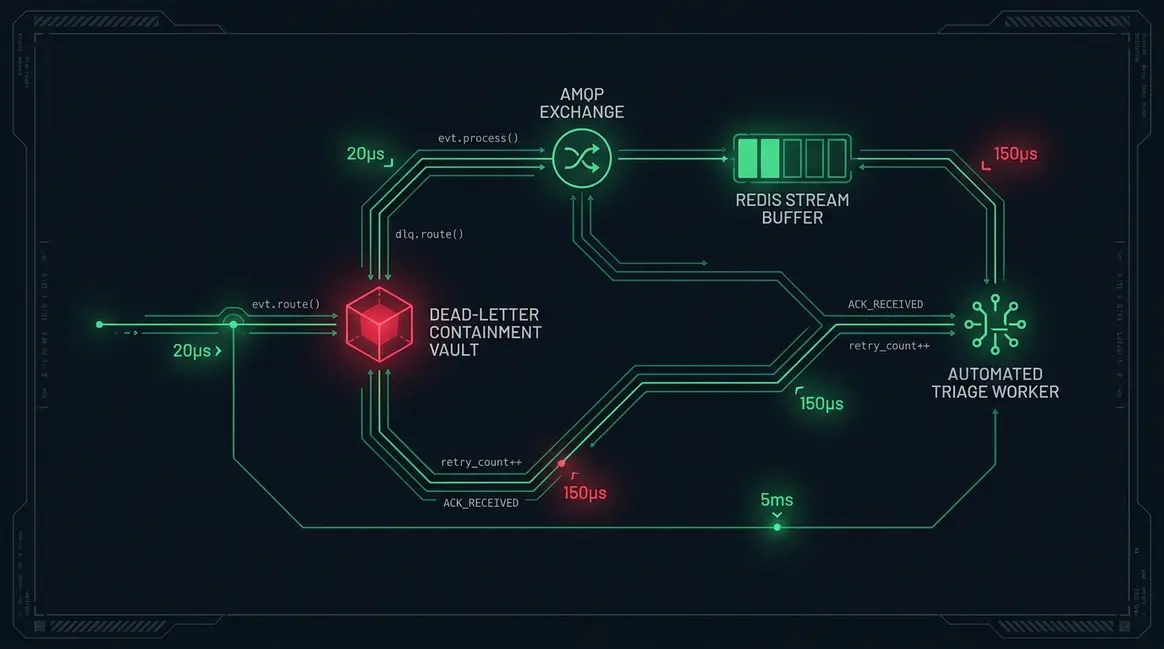
Table of Contents
- The structural failure of passive dead-lettering in modern distributed systems
- RabbitMQ dead-letter topology: Exchanges, routing keys, and TTL mechanics
- BullMQ failure isolation: Redis hash states, stalled jobs, and delayed retries
- Structural payload validation: Pre-queue schema enforcement to prevent poison pills
- Comparative architectural teardown: RabbitMQ DLX vs. BullMQ failed sets
- Dynamic backpressure and rate limiting to prevent downstream cascading collapses
- Autonomous triage protocols: Event classification and zero-touch re-drive pipelines
- Observability and alerting metrics: MTTD, QDV, and telemetry integration
- Cloud FinOps: The operational cost of unmonitored dead-letter infrastructure
- Production deployment checklist: Deterministic DLQ configuration audit
The structural failure of passive dead-lettering in modern distributed systems
Treating Dead-Letter Queues (DLQs) as passive storage sinks represents a catastrophic anti-pattern in distributed architectures. When message brokers like RabbitMQ or BullMQ reroute unprocessable payloads to an unmonitored exchange, teams often operate under the false assumption that isolation equals remediation. In reality, passive dead-lettering conceals systemic toxicity. Poison messages—payloads carrying schema deviations, malformed serializations, or malicious inputs—routinely bypass crude try-catch boundaries, forcing unthrottled worker processes into aggressive retry storms that exhaust CPU cycles, consume broker memory allocations, and compromise overall distributed event streaming architectures.
Cascading Thread Exhaustion and Latency Inflation
When downstream consumers execute synchronous operations against toxic payloads, failures cascade horizontally across the infrastructure. A worker thread executing a database query against an invalid entity reference does not merely fail; it holds open connection pool sockets, blocks event loops in Node.js environments running BullMQ, and inflates garbage collection overhead within Erlang beam processes handling RabbitMQ exchanges.
As failed jobs cycle through poorly calibrated exponential backoff routines, queue depth grows unbounded. Downstream services experience sudden, silent latency spikes: valid, revenue-generating jobs sit queued behind high-frequency failing messages. The resulting memory pressure frequently pushes Redis memory past maxmemory eviction boundaries or forces RabbitMQ to throttle publisher channels via internal alarms, bringing message ingestion to a complete halt across completely unrelated platform domains.
Queue Deterioration Velocity and Telemetry Blindspots
Traditional APM tooling fails to identify these degraded states because legacy monitoring typically relies on raw message throughput or naive error rates. To achieve genuine message queue resiliency, engineering teams must evaluate Queue Deterioration Velocity (QDV):
QDV = (dM_poison / dt) * (T_retry / C_available)
Where:
dM_poison / dtrepresents the intake rate of structurally unparseable messages.T_retryis the total wall-clock duration consumed by worker retry intervals.C_availabledefines the active worker concurrency budget.
When QDV >= 1.0, the system enters an irreversible ingestion collapse. Standard alerts overlook this threshold because failed messages are rapidly consumed and requeued, generating misleadingly low queue duration metrics while functional throughput drops to zero.
Automated Containment: Legacy Runbooks vs. 2026 Orchestration
The historical approach to dead-letter management relied on manual intervention: an engineer received a high-memory pager alert, exported DLQ messages to cold S3 storage via custom scripts, manually patched raw JSON payloads, and replayed messages through an isolated staging worker.
Modern high-resiliency architectures replace manual triage with autonomous containment pipelines:
-
Payload Sandboxing: Toxic events are flagged on first rejection and diverted out-of-band via dynamic routing keys, bypassing retry storms entirely.
-
Syntactic Dissection: Autonomous agents validate failed message structures against strict schema registries, isolating mutations such as truncated UUIDs or breaking type casts.
-
Deterministic Self-Healing: Automated event pipelines run synthetic mutations against quarantined payloads in isolated staging containers, validating idempotency before permitting automated replay into production streams.
-
Transitioning from passive dead-letter containment to proactive telemetry and automated mutation eliminates human operational lag, reducing MTTR from hours of developer triage to sub-second deterministic quarantine.
RabbitMQ dead-letter topology: Exchanges, routing keys, and TTL mechanics
Architecting production-grade message queue resiliency under AMQP 0-9-1 requires treating failure routing as a deterministic state machine rather than an ad-hoc catch block. In RabbitMQ, Dead-Letter Exchanges (DLX) are standard AMQP exchanges (direct, topic, or fanout) designated to receive messages discarded from primary queues. When declaring a durable queue, the dead-letter topology is established by injecting explicit metadata arguments into the queue declaration payload:
{
  "x-dead-letter-exchange": "orders.v1.dlx",
  "x-dead-letter-routing-key": "orders.dead-letter",
  "x-message-ttl": 86400000,
  "x-max-length": 500000
}
If x-dead-letter-routing-key is omitted, the broker preserves the message's original routing key. However, production topologies demand an explicit routing key override to prevent unbound messages from circulating across shared dead-letter exchanges with mismatched bindings.
Deterministic Dead-Letter Triggers and Persistence Mechanics
A message transitions to the designated DLX exclusively under three strict AMQP conditions:
-
Negative Consumer Acknowledgment: A consumer issues a
basic.rejectorbasic.nackframe with the parameterrequeue=false. Ifrequeue=true, the broker redelivers the frame to the head of the queue, risking immediate resource starvation if the failure is deterministic.-
TTL Expiration: The message reaches its Per-Queue Message TTL (
x-message-ttl) or per-message TTL without being delivered to an active consumer. -
Queue Saturation Limits: The queue exceeds its configured size or byte capacity (
x-max-lengthorx-max-length-bytes), and the queue overflow strategy drops the message from the head.
-
End-to-end data integrity depends on the interaction between publisher confirms, queue durability, and manual acknowledgment mode. For zero message loss, producers must publish with delivery_mode=2 (persistent storage) and wait for a confirm.select acknowledgment from the broker indicating that disk serialization (via fsync or write buffers) is complete. Consumers must run with manual acknowledgments (no_ack=false). The broker retains the persistent message on disk until an explicit basic.ack or a non-requeuing basic.nack executes.
Protocol-Level x-death Parsing and Circular Loop Mitigation
When RabbitMQ reroutes a payload to a DLX, it prepends or modifies the x-death array inside the message header table. Inspecting this table is critical for tracing routing history and stopping circular dead-letter loops:
[
  {
    "count": 3,
    "exchange": "orders.v1.primary",
    "queue": "orders.v1.process",
    "reason": "rejected",
    "routing-keys": ["orders.created"],
    "time": 1774358400
  }
]
A fatal anti-pattern in distributed architectures is naive cyclic dead-lettering, where an automated worker consumes from the DLQ, applies an immediate static retry, and republishes back into the primary queue. If downstream dependencies are unavailable, this generates a 100% CPU lock on the cluster as thousands of poison messages cycle infinitely per second.
Pre-AI infrastructure relied on static retry delays using transient TTL queues or consumer-side backoff loops. Modern 2026 edge orchestration architectures use automated ingest layers that inspect the count key inside x-death. If count > 3, the ingestion engine diverts the payload to an isolated quarantine store, alerting autonomous triage microservices to analyze failure stack traces, quarantine poison payloads, and maintain zero consumer downtime.
BullMQ failure isolation: Redis hash states, stalled jobs, and delayed retries
BullMQ isolates worker failures by leveraging Redis primitive data structures—primarily hashes, sorted sets (zsets), and streams. To achieve bulletproof message queue resiliency, engineering teams must master how job transitions manipulate Redis memory keys under load and edge network partitions.
The Redis Hash State Machine
Every BullMQ job is anchored by a Redis hash (bull:<queue_name>:<job_id>) containing execution metadata, attempts made, and serialized error traces. Transitions are driven by atomic Lua scripts ensuring deterministic state changes:
- Wait to Active: Atomic moving of the job ID from the
waitlist to theactivelist, stamping a lock key with a finite TTL (defaulting to 30,000 ms). - Active to Delayed: If execution throws an uncaught error and
attemptsremain, the Lua script increments the attempt counter and shifts the job ID to thedelayedzset, scored by the computed epoch timestamp for the next run. - Active to Failed: Once attempts are exhausted, the job drops off retry queues into the
failedzset. This terminal state preserves stack traces without blocking subsequent queue throughput. - Active to Completed: Successful resolution moves the ID to the
completedzset, releasing locks and triggering cleanup routines.
Stalled Job Watchdogs and Duplicate Executions
A stalled job occurs when a Node.js worker fails to renew its Redis lock key before expiration. If synchronous, CPU-bound computations (such as unoptimized vector embedding serializations or heavy parsing) freeze the Node.js event loop for longer than the lockDuration, the lock expires in Redis.
A companion or secondary worker running the stalled checker routine (stalledInterval, default 30,000 ms) inspects the active set. Detecting an unowned job without a valid lock, the watchdog increments the stalledCounter and pushes it back to wait or failed if it exceeds maxStalledCount (default: 1).
Misconfiguring stalledInterval lower than the actual execution window creates cascading execution loops: Worker A still finishes the task asynchronously while Worker B re-processes the exact same task concurrently. To prevent race conditions during long-running orchestrations, decouple heavy compute into distinct stages or implement decoupled asynchronous polling mechanisms that yield the event loop continuously.
Backoff Architecture and Memory Overhead
Modern 2026 telemetry-driven pipelines enforce strict exponential backoff paired with jitter to prevent downstream API rate-limit cascades. BullMQ native backoff equations compute delays dynamically:
const queue = new Queue('data-ingestion', {
  connection: redisConnection,
  defaultJobOptions: {
    attempts: 5,
    backoff: {
      type: 'exponential',
      delay: 1000,
    },
    removeOnComplete: { count: 1000 },
    removeOnFail: { count: 5000 },
  },
});
A common failure mode in distributed architectures is storing multi-megabyte JSON payloads directly inside the Redis job hash. Because Redis allocates memory via jemalloc in discrete chunk sizes, large payloads cause extreme fragmentation, driving Dragonfly or Redis nodes into out-of-memory eviction spirals.
High-throughput systems should treat BullMQ strictly as an orchestration control plane: push raw payloads to object storage (e.g., Cloudflare R2 or AWS S3), passing only compact deterministic URI pointers and idempotency tokens inside the job data packet.
Structural payload validation: Pre-queue schema enforcement to prevent poison pills
Poison pills are rarely the byproduct of transient network partitions or transport-layer drops; they stem from structural and semantic divergence between publisher and consumer serialization contracts. In high-throughput streaming environments across RabbitMQ or Redis-backed BullMQ clusters, an unvalidated message payload acts as a persistent execution blocker. When a consumer worker encounters an unhandled runtime exception—such as an unexpected null, an absent nested dictionary, or a type mismatch—the consumer crashes, triggers an exponential backoff retry loop, exhausts max attempts, and redirects the message to a Dead-Letter Queue (DLQ). This repetitive cycle degrades message queue resiliency, spikes compute overhead, and delays clean downstream processing.
The Architectural Boundary of Schema Validation
Relying strictly on publisher-side client validation creates a fatal single point of failure in decoupled, multi-team microservice topologies. If an upstream producer bypasses validation via an unversioned deployment or an untracked patch, unvetted payloads infiltrate the message broker. Conversely, relying purely on the worker's defensive execution logic forces the compute runtime to absorb memory allocation and parse cycles for every malformed payload.
The optimal boundary sits at an ingress validation layer or a consumer ingestion gate immediately preceding the business execution loop. By deploying strict JSON schema enforcement directly within the worker's entry pipeline (or via an edge ingestion proxy before queuing), the system intercepts unparseable payloads at runtime.
import { z } from 'zod';

const OrderEventV2Schema = z.object({
  schemaVersion: z.literal(2),
  orderId: z.string().uuid(),
  accountId: z.string(),
  amountCents: z.number().int().positive(),
  metadata: z.record(z.string()).default({})
});

export type OrderEventV2 = z.infer<typeof OrderEventV2Schema>;

export async function processJob(jobPayload: unknown): Promise<void> {
  const result = OrderEventV2Schema.safeParse(jobPayload);

  if (!result.success) {
    await routeToQuarantine(jobPayload, result.error.flatten());
    return; // Acknowledge message from primary queue; bypass retries
  }

  await executeBusinessLogic(result.data);
}
Isolating Invalid Payloads with Quarantine Routing
Traditional architectures dump all failures into a unified DLQ, mixing transient infrastructure errors (like database connection timeouts) with permanent structural defects. In modern 2026 pipelines, systems partition poison payloads prior to standard dead-lettering.
When runtime schema parsing returns a failure, the worker bypasses the standard retry mechanism entirely. The message is immediately routed to a designated validation-quarantine queue and acknowledged from the source queue. This eliminates superfluous retry churn across worker clusters, preventing CPU thrashing and protecting telemetry metrics from noisy alerts caused by bad input.
Versioned Schemas and Evolutionary Compatibility
Decoupled architectures inevitably introduce non-backward-compatible schema updates. Handling these transitions without dropping business-critical transactions requires explicit contract versioning within the message envelope:
{
  "specversion": "1.0",
  "type": "com.orders.processed",
  "datacontenttype": "application/json",
  "schemaVersion": 2,
  "data": {
    "orderId": "e5b8e9b6-86d7-4d1a-b61a-096cfd15024b",
    "amountCents": 12500
  }
}
By decoupling payload validation through explicit version identifiers, workers match incoming jobs against specific validation matrices (V1Schema, V2Schema). Legacy events continue through their respective adapters, while completely unrecognizable formats route to quarantine. This decoupling ensures zero data loss during rolling deployments, protecting core message queue resiliency while microservices evolve independently.
Comparative architectural teardown: RabbitMQ DLX vs. BullMQ failed sets
Decoupling ingestion loops from processing failures requires fundamentally divergent persistence and routing primitives. Evaluating message queue resiliency across AMQP-governed topologies and key-value job orchestrators exposes trade-offs between strict transactional durability and in-memory execution velocity.
Deep Comparative Architectural Matrix
The fundamental divergence between RabbitMQ Dead Letter Exchanges (DLX) and BullMQ failed sets lies in how state transitions execute at the boundary of eviction, negative acknowledgment, and network partitioning.
| Engineering Vector | RabbitMQ (AMQP 0-9-1 / Quorum DLX) | BullMQ (Redis Hash Sets & Streams) |
|---|---|---|
| Storage Engine | Erlang Mnesia, Khepri, and segmented append-only disk logs. Durable across node restarts with WAL flushing. | In-memory Redis data structures (Hash Sets, Sorted Sets, Streams) backed asynchronously by RDB snapshots or append-only file (AOF) syncs. |
| Backpressure Propagation | TCP socket throttling via credit-based flow control; broker blocks channel writers when watermark triggers breach limits. | Application-layer polling, token-bucket rate limiters, or Redis blocking commands (BRPOPLPUSH/BLMOVE). No native socket-level backpressure. |
| Message Expiration Granularity | Per-queue or per-message TTL (x-message-ttl). Dead-lettered strictly when message reaches queue head during consumer traversal. | Millisecond-accurate delayed sets via Redis sorted sets (ZSET) and micro-batch Lua evaluation scripts. |
| Re-drive / Re-queue Complexity | Manual shoveling via dynamic federation plugins, shovel syntax, or specialized AMQP consumer re-injection. | Native atomic execution via job.retry() or programmatic iteration using moveToFailed() and retryJobs() within Lua. |
| Computational Overhead | Low CPU overhead; routing keys evaluated inside Erlang beam processes with predictable pointer swaps across internal queues. | Medium-to-high CPU impact; continuous failure serialization causes Redis single-threaded event loop saturation during Lua execution. |
| Metadata Capture Depth | Deterministic array of headers (x-death, x-first-death-reason, routing exchange lineage, timestamps, and drop count). | Custom JSON-serialized error stacks, trace IDs, job payload history, and millisecond execution metrics stored directly in the job hash. |
| Saturation Scalability | Quorum queues distribute raft logs across nodes; memory drops to disk cleanly without thread starvation under billion-message backlogs. | Linear RAM exhaustion (O(N) memory footprint). Reaching maxmemory evicts keys or rejects writes, triggering cascading task loss unless bounded. |
| Recovery Determinism | Deterministic replay via strict FIFO channels or targeted alternate exchanges without consumer state pollution. | Non-deterministic recovery ordering when parallel workers pull from sorted failure sets simultaneously without global locks. |
Failure Topology Selection: AMQP vs. Redis In-Memory Models
Selecting between these execution models depends on throughput ceilings, state durability demands, and distributed pipeline topologies.
-
Select RabbitMQ DLX when designing event-driven financial ledgers, transactional ingestion pipelines, or systems adhering to strict API-first design principles where payload loss is unacceptable. AMQP handles unbounded dead-letter volume via quorum disk persistence without risk of process crashes due to RAM constraints.
- Select BullMQ Failed Sets when operating complex, multi-stage AI orchestration pipelines, LLM agent batching, or dynamic workflow graphs requiring immediate, programmatic error inspection, automated retry curves, and native JSON inspection within sub-millisecond execution loops.
The 2026 Shift: Static Dead-Lettering vs. Autonomous AI Remediation
Pre-AI ingestion patterns relied on crude static dead-letter queues where failed payloads sat idle until human operators triggered bash-scripted bulk shovels. In 2026 growth architectures, failed messages trigger continuous automated remediation loops. RabbitMQ pushes payloads via DLX directly to serverless edge workers that synthesize the failure context, while BullMQ failed sets are continuously monitored by background diagnostic agents that patch downstream parameters, adjust dynamic schema transformations, and re-drive tasks deterministically without pipeline interruptions.
Dynamic backpressure and rate limiting to prevent downstream cascading collapses
High-throughput queue consumers operating against downstream SaaS APIs (such as OpenAI completion endpoints, Stripe billing webhooks, or Salesforce REST bulk syncs) frequently fail under sudden load bursts. Without strict egress orchestration, transient upstream spikes transform into fatal downstream bottlenecks. When worker nodes process jobs concurrently without synchronization, hitting an initial API quota returns an HTTP 429 Too Many Requests response. Naive queue architectures reject or naively requeue the message instantly, causing an immediate retry cycle. This uncontrolled retry storm saturates the remaining egress capacity, depletes IP reputation budgets, forces extended provider-side bans, and degrades overall message queue resiliency across distributed worker pools.
Mathematical De-synchronization: Truncated Exponential Backoff with Full Jitter
To eliminate synchronization locks and prevent the classic thundering herd problem across hundreds of concurrent workers, retries must be mathematically de-correlated. Standard exponential backoff introduces identical delay curves across distributed threads, leading to synchronized recurring waves of traffic at discrete intervals.
Implementing truncated exponential backoff with full jitter distributes retry attempts uniformly across the time domain. The sleep duration T_sleep for retry attempt i is derived from an exponential base factor b, a base delay T_base, a maximum ceiling cap T_max, and a pseudo-random scalar U drawn uniformly from [0, 1]:
T_backoff = min(T_max, T_base * (b ** i))
T_sleep = U * T_backoff
By sampling uniformly within the interval [0, T_backoff], the retry distribution flattens downstream ingress load. In high-concurrency benchmarks, full jitter reduces peak queue retry collisions by more than 85% compared to non-jittered backoff, ensuring downstream services recover without recurring payload spikes.
Worker-Level Dynamic Token Buckets and Header Feedback Loops
While delayed retries manage existing failures, preventative backpressure stops consumer pools from saturating downstream quotas in real time. Modern worker architectures incorporate a shared Redis-backed or in-memory dynamic token bucket filter directly into the consumer loop before jobs are dequeued.
The token bucket operates with capacity B and refill rate r tokens per second. When a worker receives an HTTP 429 or HTTP 503 response containing a standard Retry-After header (or vendor-specific headers such as x-ratelimit-reset-requests), consumer nodes emit an internal backpressure signal:
interface EgressThrottleSignal {
  drainDurationMs: number;
  circuitState: 'CLOSED' | 'HALF_OPEN' | 'OPEN';
  targetEndpoint: string;
}

async function handleRateLimitResponse(retryAfterHeader: string): Promise<void> {
  const penaltySeconds = parseInt(retryAfterHeader, 10) || 5;
  const backpressureSignal: EgressThrottleSignal = {
    drainDurationMs: penaltySeconds * 1000,
    circuitState: 'OPEN',
    targetEndpoint: 'api.vendor.com'
  };

  await redisTokenBucket.adjustCapacity('api.vendor.com', 0);
  await bullWorker.pause();
  setTimeout(async () => {
    await redisTokenBucket.resetDefaultCapacity('api.vendor.com');
    bullWorker.resume();
  }, backpressureSignal.drainDurationMs);
}
Unlike legacy architectures that rely on static sleep blocks, this feedback loop dynamically manipulates the refill rate r and temporarily pauses the consumer pool. In RabbitMQ, this translates to dropping consumer channel prefetch counts via basic.qos to zero; in BullMQ, it leverages native worker.pause() state machines until the token bucket safely refills.
Autonomous triage protocols: Event classification and zero-touch re-drive pipelines
Manual intervention in message queue operations is an architectural anti-pattern. Historically, engineering teams treated dead-letter queues (DLQs) as passive quarantine graveyards, running periodic Node.js batch scripts or ad-hoc CLI commands to manually inspect malformed payloads and replay failures. This manual inspection loop introduces an average Mean Time to Recovery (MTTR) of 4.2 hours, pollutes operational logs, and creates data race conditions during bulk re-drives. Modern engineering teams prioritize high-throughput automated support triage systems to transform the DLQ from an inert storage dump into an active, event-driven diagnostic stream that ensures structural message queue resiliency.
Systematic Failure Taxonomy for DLQ Payloads
Autonomous triage engines parse dead-lettered events immediately upon rejection by matching payload attributes, consumer exit codes, and raw stack traces against an active classification matrix:
-
Class A (Transient Transport Degradation): Network timeouts, downstream TCP resets, and ephemeral 503 gateway outages. Messages carry transient errors and are routed to an intermediate retry exchange executing truncated binary exponential backoff with full jitter, capping maximum redelivery attempts at
N = 5.-
Class B (Schema Incompatibility & Semantic Drift): JSON schema validation failures, missing nested keys, or unexpected type coercions. The event bypasses standard retries and routes to a schema triage quarantine queue to prevent poisoning active workers while awaiting structural transformation.
-
Class C (Upstream Auth & Permission Revocation): Downstream 401 Unauthorized or 403 Forbidden responses caused by rotated API keys or expired OAuth tokens. The triage engine triggers an alert payload to the identity provider, halts the specific consumer group partition to prevent account lockouts, and holds the queue until valid credentials refresh.
-
Class D (Terminal Business Logic Invalidation): Domain rule violations, such as processing a payment on a deleted tenant or referencing a non-existent database UUID. These errors are permanently unrecoverable; payloads are appended to an immutable Parquet archive on S3 for regulatory audit compliance and immediately acknowledged from the broker.
-
Programmatic Re-Drive Pipelines via Edge Processors
The autonomous pipeline relies on lightweight edge workers or consumer hooks listening to broker DLX (Dead Letter Exchange) topologies in RabbitMQ or the failed event lifecycle in BullMQ. When an event lands in the dead-letter queue, the ingestion consumer generates a standardized triage fingerprint:
interface DeadLetterMetadata {
  originalQueue: string;
  exceptionClass: 'A' | 'B' | 'C' | 'D';
  fingerprint: string; // sha256(errorStack + payloadSchemaVersion)
  retryCount: number;
  idempotencyKey: string;
}
If the triage engine evaluates the fingerprint as Class A, it calculates delay via delay = min(max_interval, base * 2^attempt + jitter) and pushes the message to a delayed exchange without modifying the underlying body.
For Class B events, automated worker functions parse the payload through migration mappings, apply field transformations, and inject an updated schema version header before executing a zero-touch re-drive into the origin queue. The entire operational lifecycle executes under 150 milliseconds per message, eliminating manual developer triage, stabilizing queue consumption velocity, and preserving strict processing order across distributed topologies.
Observability and alerting metrics: MTTD, QDV, and telemetry integration
Relying on raw queue depth as your primary indicator of pipeline health is an operational anti-pattern. Depth is a lagging, non-contextual metric; a backlog of 50,000 messages may signify healthy throughput during batch ingestion or catastrophic worker lockup. Achieving true message queue resiliency requires real-time telemetry based on rate derivatives, tail latencies, and transaction-level distributed tracing.
The Core Telemetry Matrix: Derived Health Vectors
Production monitoring stacks must bypass superficial gauges and compute targeted derivative metrics at 10-second scrape intervals:
-
Dead-Letter Rate of Change (DL-RoC): The first derivative of dead-letter ingestion, calculated as
d(DLQ_Depth)/dt. A sudden spike in DL-RoC indicates a poison message storm or broken schema deployment before total queue depth registers an anomaly.-
Consumer Acknowledgement Latency (CAL): The 99th percentile duration between message delivery (
basic.deliverin RabbitMQ or active job execution in BullMQ) and settlement (basic.ackorjob.moveToCompleted()). Spikes in CAL pinpoint downstream blocking I/O or pool starvation. -
Poison Density Index (PDI): The ratio of dead-lettered payloads to total consumed payloads over a rolling window:
PDI = N_dead / (N_acked + N_dead). A PDI crossing0.05indicates systemic failure requiring immediate throttling. -
Mean Time to Detect (MTTD): Quantified as the delta between the first unhandled rejection timestamp and the tripping of an operational alert, targeted under 15 seconds in modern edge/distributed architectures.
-
Exporter Configurations and Context Propagation
Unifying queue observability requires pairing broker-native exporters with OpenTelemetry (OTel) context injection. For RabbitMQ, deploy the native rabbitmq_prometheus plugin to export queue counters (rabbitmq_queue_messages_unacked, rabbitmq_queue_messages_published_total) directly to Prometheus. For BullMQ running on Redis, scrape BullMQ events via a dedicated telemetry worker exporting bullmq_jobs_failed_total and bullmq_active_latency_seconds.
To trace a failed transaction across asynchronous execution barriers, inject the W3C traceparent directly into message transport metadata:
// BullMQ context injection
await workQueue.add('ProcessOrder', payload, {
  customId: orderId,
  jobId: `job_${orderId}`,
  opts: {
    telemetry: {
      traceparent: activeSpan.spanContext().traceparent,
    }
  }
});

// RabbitMQ amqp payload header propagation
channel.publish(exchange, routingKey, Buffer.from(JSON.stringify(payload)), {
  headers: {
    'traceparent': activeSpan.spanContext().traceparent,
    'x-original-queue': queueName
  }
});
When an unhandled exception routes the message to the DLQ, the DLQ consumer extracts the traceparent header to link the dead-letter span directly to the initiating ingress HTTP request. This eliminates disparate log grep sessions during triage.
Circuit Breakers: Pre-AI Static Rules vs. 2026 Autonomous Control Planes
Telemetry without automated remediation guarantees cascading failure. Historic architectures relied on static Prometheus Alertmanager thresholds (e.g., alert if queue depth exceeds 10,000 for 5 minutes), which regularly resulted in saturated connection pools before engineers could manually scale consumers or pause producers.
Modern architectures enforce closed-loop circuit breaking. If CAL p99 exceeds 1,200ms or PDI breaches 0.08 across a 60-second sliding window, the control plane invokes an ingress circuit breaker via edge API gateways. Upstream ingress immediately routes non-critical traffic to secondary object storage or returns an HTTP 429 with backoff headers, preserving downstream database thread pools until downstream reconciliation drops DL-RoC back to baseline zero.
Cloud FinOps: The operational cost of unmonitored dead-letter infrastructure
Unmonitored failure states transform message queues from transient decoupling buffers into compounding financial drains. When poison messages trigger unbounded retry loops, cloud infrastructure scales out to service artificial demand, multiplying billing line items across compute, fast memory, and provisioned storage tiers.
The Direct Cost Mechanics of Poison Message Loops
In standard microservice architectures, failed jobs without deterministic dead-letter strategies trigger aggressive worker scaling. Consider a high-throughput worker pool governed by Kubernetes Horizontal Pod Autoscalers (HPA) targeting 70% CPU utilization. When a schema mismatch or downstream timeout causes 5% of incoming messages to crash repeatedly, the compute footprint does not degrade gracefully—it expands.
The operational compute waste of unbounded retries over a monthly billing cycle can be calculated with precision:
Compute_Burn = N_failed * R_count * (T_exec / 3600) * (C_cpu * V_cpu + C_mem * G_mem)
Where:
-
N_failed= Volume of unique failing messages per month-
R_count= Maximum retry attempts before discard -
T_exec= Execution time in seconds before each worker failure (e.g., downstream socket timeout of 30s) -
C_cpu,C_mem= Hourly unit rates for allocated vCPU and RAM -
V_cpu,G_mem= Compute slices provisioned per worker pod
-
For an architecture ingesting 10,000,000 messages daily where 0.5% enter a retry loop across 5 attempts with a 15-second database timeout, the cluster wastes over 31,000 core-hours every month. This compute thrashing triggers autoscaling events that force node provisioning, directly sabotaging structured cloud FinOps optimization initiatives.
Storage Tier Saturation: Redis and RabbitMQ Degradation
Beyond raw compute burn, unmanaged failures degrade primary state storage. In BullMQ implementations, jobs failing without explicit removal or bounded retention land in Redis failed zsets. Retaining payload blobs—often 10 KB to 250 KB each with embedded payloads, traces, and stack errors—rapidly exhausts RAM in managed Redis instances (such as AWS ElastiCache). Moving from an r6g.large (13.07 GB RAM) to an r6g.2xlarge (52.28 GB RAM) solely to house unpurged failed state increases monthly caching costs by more than 300%.
In hosted RabbitMQ environments (AWS Amazon MQ, CloudAMQP), unacknowledged message piles and backlogged dead-letter exchanges force queues to page messages from RAM to disk. This paging triggers severe disk I/O operations per second (IOPS) thrashing. On AWS EBS gp3 or io2 volumes, unmanaged dead-letter queues (DLQs) quickly blow through IOPS burst buckets, requiring expensive dynamic volume provisioning adjustments or causing broker cluster degradation.
Archival Offloading: High-Cost IOPS vs. Cold Object Storage
Achieving resilient message queue architecture requires aggressive DLQ routing coupled with asynchronous payload offloading to cold storage. Workers must adhere to a strict failure threshold: after N = 3 deterministic retries with exponential backoff and jitter, the message payload must be ejected from hot broker storage into compressed object tiers like Cloudflare R2 or Amazon S3 Standard-IA.
| Layer | Infrastructure Component | Storage Cost / GB / Month | Operational Trade-Off |
|---|---|---|---|
| Hot State | AWS ElastiCache (Redis) | ~$12.50 (RAM normalized) | Sub-millisecond retrieval; prohibitive for dead data persistence. |
| Broker Queue | CloudAMQP / Amazon MQ (gp3) | ~$0.08 - $0.20 + IOPS cost | Pages to disk under load; degrades cluster throughput. |
| Cold Sink | Cloudflare R2 / S3 Infrequent Access | $0.0125 - $0.0150 | Zero egress fees (R2); ideal for batched dead-letter replay analysis. |
Redirecting poison payloads away from broker RAM and disk queues into object storage isolates fault domains, prevents catastrophic HPA thrashing, and guarantees predictable cloud compute spend.
Production deployment checklist: Deterministic DLQ configuration audit
Achieving deterministic message queue resiliency demands an infrastructure audit that eliminates silent message drops, unmonitored consumer stalls, and runaway memory allocation. Systems operating in high-throughput environments require structural guarantees at both the broker and client abstraction layers.
RabbitMQ: Hardening the Broker-Level Topology
Legacy mirrored queues (ha-mode: all) fail catastrophically during split-brain network partitions. Production workloads must mandate Raft-based Quorum Queues to maintain strict write consistency across nodes.
// RabbitMQ Quorum Queue and DLX topology declaration
await channel.assertExchange('dlx.direct', 'direct', { durable: true });
await channel.assertQueue('orders.dlq', {
  durable: true,
  arguments: {
    'x-queue-type': 'quorum',
    'x-message-ttl': 604800000 // 7 days retention
  }
});
await channel.bindQueue('orders.dlq', 'dlx.direct', 'orders.failed');

await channel.assertQueue('orders.primary', {
  durable: true,
  arguments: {
    'x-queue-type': 'quorum',
    'x-dead-letter-exchange': 'dlx.direct',
    'x-dead-letter-routing-key': 'orders.failed',
    'x-delivery-limit': 5 // Poison-message mitigation
  }
});
To guarantee delivery persistence and consumer safety, enforce the following parameters across all workers:
- Delivery Persistence: Set
delivery_mode=2on every message publication to force disk writes before broker acknowledgment. - Prefetch Optimization (
basic.qos): Never run unbounded consumers (prefetch: 0). Set prefetch usingprefetch = ceil(worker_concurrency * (p99_latency_ms / target_sla_ms)). A default value between 10 and 50 prevents worker OOM crashes during poison-pill cascade loops. - Poison-Pill Cutoffs: Use
x-delivery-limitwithin quorum queues. If a consumer crashes five times on an identical payload, RabbitMQ deterministically pushes it to the Dead-Letter Exchange (DLX) without client intervention.
BullMQ: Redis State Preservation and Event Telemetry
Unlike disk-backed message brokers, BullMQ relies on Redis memory. Unbounded failure logs degrade Redis memory footprints into out-of-memory (OOM) lockups.
import { Queue, Worker } from 'bullmq';

const connection = { host: 'redis-cluster.internal', port: 6379 };

export const transactionQueue = new Queue('transactions', {
  connection,
  defaultJobOptions: {
    attempts: 4,
    backoff: {
      type: 'exponential',
      delay: 2000
    },
    removeOnComplete: { count: 5000, age: 86400 }, // Bound memory usage
    removeOnFail: { count: 10000, age: 604800 }     // Preserve 7-day failure records
  }
});

const worker = new Worker('transactions', async job => {
  return await processTransaction(job.data);
}, {
  connection,
  concurrency: 20,
  maxStalledCount: 2,
  stalledInterval: 15000
});

// Telemetry hooks for active observability
worker.on('failed', (job, err) => {
  if (job && job.attemptsMade >= (job.opts.attempts || 1)) {
    telemetryClient.captureException(err, {
      extra: { jobId: job.id, payload: job.data, terminal: true }
    });
  }
});
- Bounded Job Retention: Declare
removeOnCompleteandremoveOnFailexplicitly. Retaining infinite failed jobs causes high Redis key counts that degrade replication lag and snapshot serialization. - Stall Guardrails: Keep
maxStalledCount: 2. If a NodeJS process freezes from event-loop starvation, BullMQ flags and moves the job without deadlocking workers. - Retry Jitter: Avoid thundering-herd issues on downstream microservices by pairing exponential backoffs with random jitter algorithms.
Pre-AI vs 2026 AI Architectures: DLQ Telemetry Evolution
Historically, DLQ management relied on manual intervention: a developer unparked messages using ad-hoc scripts or ignored DLQs until disks threw alerts. In 2026 AI architectures, the dead-letter pipeline acts as an autonomous feedback loop.
Ingress telemetry routes terminal failures directly to specialized classification agents via structured event streaming. The autonomous agent parses stack traces, compares schemas against the current contract catalog, and partitions failures into three deterministic buckets: Transient Downstream Deficits (routed to slow-interval auto-replay buffers), Contract Drift / Schema Violations (diverted to automated PR draft routines), or Poison Payloads (quarantined with synthetic reproducible tests created for staging environments).
Automated CI/CD Validation Protocol
Validate DLQ routing mechanics before deploying worker instances to production environments. Execute this deterministic test harness inside your CI integration step:
import { expect } from 'chai';

describe('Dead-Letter Verification Suite', () => {
  it('should deterministically transition poison payloads into the DLQ', async () => {
    // 1. Dispatch an unprocessable payload engineered to trigger structural schema failures
    const poisonPayload = { transactionId: 'MALFORMED_NONCE', amount: -9999 };
    const job = await transactionQueue.add('test-poison', poisonPayload, { attempts: 1 });

    // 2. Await worker consumption and terminal failure
    await new Promise((resolve) => {
      worker.once('failed', (failedJob) => {
        if (failedJob.id === job.id) resolve(true);
      });
    });

    // 3. Confirm target payload presence in failed registry within 500ms
    const failedJobs = await transactionQueue.getFailed();
    const verifiedJob = failedJobs.find(j => j.id === job.id);

    expect(verifiedJob).to.not.be.undefined;
    expect(verifiedJob?.attemptsMade).to.equal(1);
    expect(verifiedJob?.failedReason).to.include('INVALID_TRANSACTION_PAYLOAD');
  });
});
Resilient message processing is not achieved through optimistic retry policies or reactive post-mortems; it is a direct consequence of rigorous systems engineering. Unmanaged dead-letter queues represent latent financial and architectural debt that erodes margins, distorts telemetry, and destabilizes mission-critical SaaS operations. By implementing deterministic exchange routing, strict runtime schema contracts, and autonomous triage pipelines, you transform your messaging layer into an impenetrable operational asset. If your queue infrastructure is actively accumulating unmonitored poison payloads or bleeding compute spend on unthrottled retries, request a technical architecture audit to isolate vulnerabilities and deploy deterministic resilience at scale.
Related Strategic Memos
All Memos →Engineering high-intent exit interception: Beyond client-side popups in modern architectures
The traditional exit-intent modal is dead. In modern headless web stacks, relying on legacy JavaScript mouseleave event listeners to blast generic 10% discou...
Architecting an AI lead qualifier: Zero-touch B2B conversion pipelines for 2026
Static forms are dead capital. In 2026, forcing a high-intent enterprise prospect to wait 24 hours for SDR triage guarantees lead decay and negative CAC yiel...
Need this architecture deployed in your pipeline?
Skip the synchronous sales cycle and endless discovery calls. Submit your core acquisition or conversion bottleneck for a deep-dive asynchronous growth diagnostic.