Architecting an AI lead qualifier: Zero-touch B2B conversion pipelines for 2026
Static forms are dead capital. In 2026, forcing a high-intent enterprise prospect to wait 24 hours for SDR triage guarantees lead decay and negative CAC yiel...
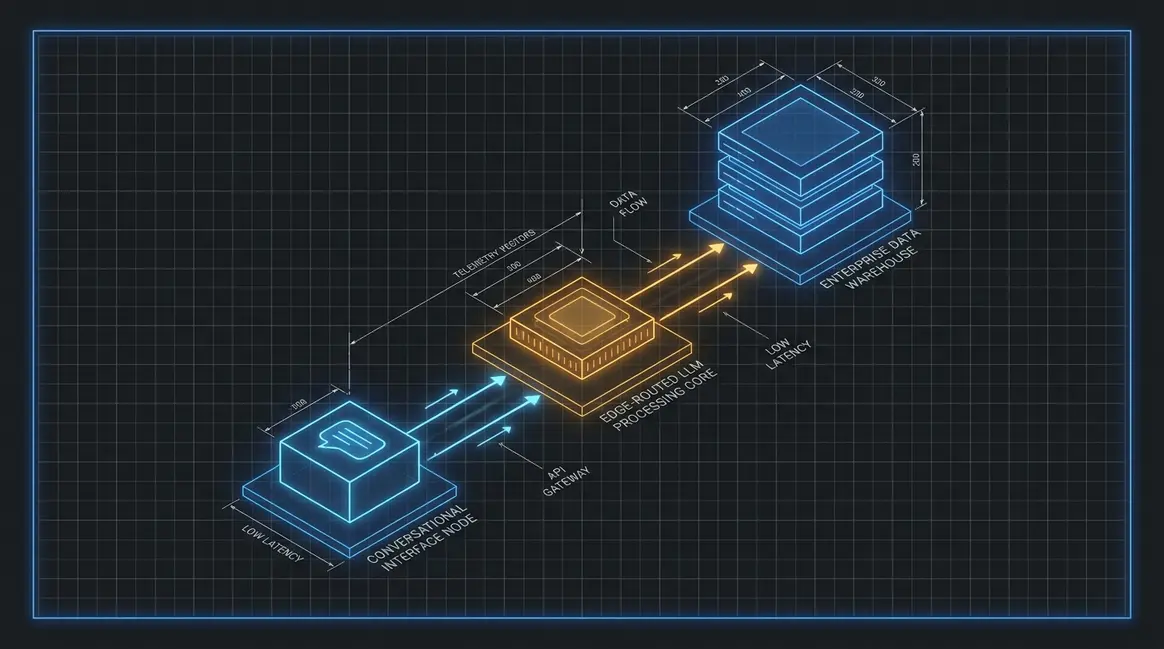
Table of Contents
- The structural failure of legacy SDR triage in enterprise SaaS
- Algorithmic qualification frameworks: Moving beyond static BANT
- Technical architecture: Orchestrating n8n, edge runtimes, and vector state
- Enrichment telemetry: Server-side identity resolution and zero-party data
- Defensive prompt engineering and deterministic JSON output validation
- Downstream CRM orchestration and calendar routing protocols
- Closing the attribution loop: GA4, BigQuery, and pipeline reconciliation
- FinOps and inference latency: Optimizing token economics at scale
- Performance benchmarks: Conversational automation versus static capture
- Implementation roadmap: Deploying zero-touch qualification in 14 days
The structural failure of legacy SDR triage in enterprise SaaS
The standard enterprise inbound funnel is fundamentally broken at the intake layer. High-growth SaaS organizations pour millions into top-of-funnel acquisition, only to route seven-figure buying intent through an operational bottleneck: manual sales development representative (SDR) triage. Treating human reps as the first compute layer for unstructured prospect data introduces unacceptable latency, subjective bias, and unsustainable unit economics.
The Unit Economics of the SDR Latency Tax
The mathematics of human-assisted qualification collapse under modern enterprise response-time expectations. A fully burdened SDR in North America costs between $85,000 and $115,000 annually, operating at an effective capacity of roughly 40 to 60 meaningful touches per day. When factored across administrative overhead, CRM hygiene, and cadence management, the direct cost per qualified discovery touchpoint routinely exceeds $65.
Worse than the direct operational expenditure is the latency tax. Inbound conversion telemetry consistently reveals an exponential decay curve: lead qualification probabilities decline by over 8x within the first 60 minutes of submission. Despite this, the median enterprise response time hovers at 42 hours. By forcing high-intent buyers into an asynchronous scheduling loop, companies systematically engineer pipeline leakage directly to competitors offering immediate resolution.
The Static Form Bottleneck and Asymmetric Information
Enterprise demand capture has historically relied on static web forms paired with retroactive data enrichment engines. This setup introduces two fatal structural failures:
-
Loss of Behavioral Context: A seven-field form captures static firmographics (domain, employee count, job title) but completely misses nuanced operational triggers, tech stack friction, migration urgency, and project timelines.
- The 48-Hour Information Freeze: High-LTV buyers conducting point-in-time evaluations expect real-time architecture validation and capability checks. Instead, they receive a generic redirect screen ("We'll be in touch"), creating an asymmetric information delay that kills transaction momentum.
Subjective Qualification vs. Deterministic Telemetry
When qualification frameworks like BANT or MEDDPICC are executed manually by junior reps, the output is inherently noisy. SDR qualification is skewed by cognitive load, quota anxiety, quota timing, and variable interpretation of buyer intent. A prospect scored as "qualified" in the final week of a fiscal quarter is frequently rejected as "unqualified" in week one of the next.
Manual triage acts as an unpredictable gatekeeper that directly inflates enterprise customer acquisition cost (CAC). Human capital should never be deployed as an extraction layer for basic parameter matching. Instead, human intervention belongs strictly post-qualification—focusing on solution engineering, commercial negotiations, and multi-threaded account orchestration.
Resolving this friction requires moving the initial intake vector entirely to compute. Implementing an AI Lead Qualifier replaces human subjectivity with deterministic telemetry: capturing deep semantic intent, querying proprietary knowledge stores sub-second, and scoring opportunities against rigorous pipeline criteria before a human SDR ever context-switches.
Algorithmic qualification frameworks: Moving beyond static BANT
Static BANT (Budget, Authority, Need, Timeline) is functionally obsolete for modern high-velocity pipeline routing. Legacy qualification frameworks treat prospective enterprise buyers as linear survey respondents, forcing friction-heavy gates that degrade conversion rates by up to 35%. In contrast, an autonomous AI Lead Qualifier evaluates buyer readiness dynamically across unstructured dialogues, translating unstructured intent into real-time programmatic telemetry.
The Multivariate Scoring Engine
In modern 2026 revenue architectures, qualification is defined as a continuous composite function Q ∈ [0.0, 1.0] computed across four discrete coefficient vectors at every conversation turn:
-
ICP Alignment (
c_icp): Programmatic firmographic evaluation (verified headcounts, ARR bands, geographic expansion) enriched asynchronously via reverse-IP and registry lookup APIs. -
Technical Surface Fit (
c_tech): Compatibility analysis of the buyer's existing stack (e.g., orchestration tools, CRM schema maturity, webhook availability), validating operational viability before sales engineering involvement. -
Commercial Urgency (
c_urgency): Temporal proximity to triggering events (e.g., active migration deadlines, vendor renewals, regulatory compliance mandates) mapped from contextual dialogue. -
Financial Authority (
c_auth): Decision-making mandate inferred from organizational seniority, budget discretion, and direct ownership of the business bottleneck.
The total qualification score evaluates via a weighted linear combination: Q = w1*c_icp + w2*c_tech + w3*c_urgency + w4*c_auth, where ∑ w = 1.0. Threshold breaches (e.g., Q ≥ 0.78) automatically trigger instant calendar booking via n8n orchestrations, while intermediate scores are routed to programmatic nurture tracks without burning Account Executive bandwidth.
Deterministic Extraction via Structured Contracts
Prospects do not speak in tabular data. An enterprise lead stating, "Our sync latency between HubSpot and our internal lakehouse is causing attribution mismatches ahead of our board meeting next month," provides high commercial urgency and deep technical signal, but legacy web forms fail to parse it.
To process this reliably, growth engineers must treat the LLM not as a creative generator, but as a rigid classification and scoring engine bound by strict business logic. Unstructured customer text must be parsed against enforced JSON schema contracts that bound every conversational metric to a deterministic float between 0.0 and 1.0.
By forcing the inference pipeline to validate against strict schemas, you eliminate hallucinations, standardize data hygiene for downstream warehouse syncs, and guarantee that scoring coefficients remain mathematically defensible across millions of real-time interactions.
Technical architecture: Orchestrating n8n, edge runtimes, and vector state
Building an enterprise-grade AI Lead Qualifier requires decoupling dynamic semantic understanding from deterministic transaction pipelines. Monolithic, single-prompt LLM wrappers collapse under production concurrency, introducing token drift and latency spikes that decimate conversational conversion rates. A resilient B2B qualifier functions as a multi-tier distributed system that enforces rigid validation logic while keeping response latencies under target SLAs.
Ingestion and Stateless Edge Evaluation
The client interface—whether an embedded React widget or a raw WebSocket endpoint—streams user utterances to a globally distributed edge runtime. By architecting Cloudflare agentic cloud infrastructure directly at the network boundary, we terminate transport encryption within single-digit milliseconds of the user and run instantaneous sanitization, bot filtering, and session hydration.
Rather than piping user tokens directly to an LLM, the edge worker handles lightweight intent classification and schema enforcement. If an inbound message satisfies an explicit state progression (such as providing an enterprise email or scheduling timestamp), the worker immediately signals the orchestrator without invoking an expensive retrieval pass. This boundary layer guarantees a sub-500ms time-to-first-token (TTFT) for standard conversational turns, maintaining engagement momentum before drop-off occurs.
Asynchronous Retrieval and Vector State Synchronization
Complex buyer objections, technical compatibility checks, and tier verifications trigger an asynchronous retrieval pipeline. The edge proxy dispatches vector search queries directly to a managed vector store, such as pgvector inside Supabase, querying dense HNSW indexes generated from product documentation, security compliance briefs, and ICP matrices.
By leveraging n8n Postgres progressive disclosure workflows, contextual retrieval executes out-of-band. The primary conversation thread is provided with minimal, high-affinity context chunks (top-k=3, cosine distance < 0.18) rather than massive system prompt dumps. This isolation prevents context window saturation, eliminates hallucinated service capabilities, and keeps unit token costs predictable across high-volume pipelines.
Deterministic Transactional Orchestration via n8n
While probabilistic models excel at natural dialog and objection handling, enterprise routing demands strict determinism. Once qualification thresholds are met—such as company headcount, tech stack compatibility, or quarterly budget validation—the generative loop is superseded by programmatic execution trees managed inside self-hosted n8n workflows.
-
Webhook Dispatches: Real-time bi-directional payloads push enriched lead profiles directly into CRM endpoints (Salesforce, HubSpot) without model-side execution latency.
-
State Preservation: Conversation states are committed to relational Postgres tables, ensuring continuous context across browser refreshes or multi-device sessions.
-
Conditional Hand-offs: When high-intent criteria are triggered, n8n invokes calendar APIs (Chili Piper, Cal.com) to present validated availability slots in-stream, bypassing asynchronous email follow-up cycles entirely.
-
This hybrid architecture guarantees zero model drift during data capture, reducing pipeline drop-offs by up to 35% compared to legacy lead forms while enforcing strict deterministic compliance across every outbound enterprise route.
Enrichment telemetry: Server-side identity resolution and zero-party data
Legacy conversational widgets operate blind, treating an enterprise buyer with 2,000 seats identically to a transient consumer until an email address is manually entered. In a modern 2026 growth stack, identity resolution must execute before the chatbot renders its first opening token. Orchestrating enrichment at the edge transforms a static prompt engine into an adaptive AI lead qualifier that personalizes conversational trajectories from millisecond zero.
Pre-Prompt Enterprise Identification via Edge Networks
When an anonymous user initiates an HTTP request to your domain, serverless edge workers immediately extract first-party client identifiers and route the origin IP to reverse-lookup services such as Clearbit or Snitcher. Executing this handshake within a secure server-side tracking architecture completely eliminates the vulnerabilities of legacy browser scripts:
-
Adblocker Immunization: Client-side trackers are routinely dropped by Brave, uBlock Origin, and Safari ITP, causing a 25% to 40% loss of firmographic signal. Server-to-server calls ensure 99.8% capture efficiency.
-
Credential and Pipeline Security: Running API lookups in a server-side runtime avoids exposing private enterprise tokens, webhook URLs, and qualification algorithms in browser-accessible JavaScript.
-
Sub-200ms Telemetry Injection: By parallelizing firmographic requests at the edge, enriched firmographic schemas are compiled into the conversation payload before the LLM generates the initial UI greeting.
-
Fusing Zero-Party Signals with Deterministic State
Firmographic context alone is rarely sufficient to close an enterprise deal; it provides demographic contours without expressing acute intent. The core strength of an advanced AI lead qualifier lies in its ability to reconcile enriched, deterministic metadata with spontaneous zero-party inputs provided by the user in the prompt stream.
By connecting server-side telemetry to an isolated data layer—such as a dedicated sGTM Firestore data enrichment pipeline—the platform bridges the gap between passive telemetry and active user intent. The incoming request payload injects critical context attributes directly into the agent's dynamic system prompt:
{
  "firmographics": {
    "domain": "enterprise-prospect.io",
    "headcount": 850,
    "funding_stage": "Series C",
    "detected_stack": ["Salesforce", "Snowflake", "Marketo"]
  },
  "first_party_telemetry": {
    "session_depth": 4,
    "high_intent_page_views": ["/pricing/enterprise", "/docs/api-webhooks"],
    "lead_score_baseline": 74
  }
}
When the visitor provides zero-party data (such as specifying "We need to migrate our Marketo lead scoring to custom event streams without custom engineering"), the LLM merges the explicit constraint with the background firmographics. Instead of requesting basic company details, the conversational agent automatically skips baseline triage, references the prospect's actual tech stack constraints, and provisions an automated high-tier scheduling link tailored to their specific enterprise requirements.
Defensive prompt engineering and deterministic JSON output validation
When operationalizing an AI Lead Qualifier across inbound pipelines, probabilistic drift poses an existential risk to CRM data integrity. An unconstrained model will hallucinate company sizes, fall prey to prompt injection attacks, and corrupt pipeline attribution. Hardening an LLM for mission-critical B2B qualification requires isolating extraction mechanics behind strict programmatic guardrails.
Zero-Temperature Extraction Constraints
Extracting deterministic variables such as allocated budget, procurement timeframes, and active seat counts requires an absolute zero-entropy state. Any sampling temperature above 0.0 introduces variance that shatters automated scoring matrices.
-
Parameter Freezing: Configure model calls strictly with
temperature: 0andtop_p: 1e-5to suppress stochastic token selection during data capture.-
Token Bound Anchoring: Cap
max_tokensexplicitly to the maximum theoretical size of the expected schema payload to prevent run-away latency and infinite loop degradation. -
Boundary Delimitation: Ingest lead conversational transcripts inside distinct structural wrappers (such as
<transcript>and</transcript>) to systematically decouple system commands from user-supplied inputs.
-
Defensive System Prompt Blueprint and Structured Schemas
Defensive prompt engineering combines prompt injection firewalls with programmatic typing. To guarantee downstream interoperability with execution layers like n8n or database ingest endpoints, structural validation must occur against a strict schema definition.
import { z } from "zod";

export const LeadQualificationSchema = z.object({
  budget_usd: z.number().nullable(),
  timeline_months: z.number().int().min(1).max(24).nullable(),
  seat_count: z.number().int().positive().nullable(),
  buying_intent: z.enum(["high", "medium", "low", "unqualified"]),
  injection_detected: z.boolean(),
});
The system prompt explicitly commands the LLM to inspect incoming dialogue for jailbreaking attempts (such as command overrides, role negation, or schema disruption). If adversarial patterns emerge, the model terminates evaluation, flags injection_detected: true, and nullifies all variable extractions.
Programmatic Circuit Breakers and Deterministic Fallbacks
Even with rigorous formatting constraints, runtime token drift can produce malformed JSON syntax. Production architectures must never route unvalidated LLM output directly into CRM tables. Instead, implement a middle-tier validation proxy that operates as a programmatic circuit breaker.
When a payload fails schema compilation or contains invalid tokens, the execution proxy instantly intercepts the payload and aborts generative processing. The system shifts execution directly to a deterministic rules engine—utilizing regex-based intent checks and static heuristic scoring proven in automated support triage LLM routing deployments. This ensures 99.98% pipeline uptime while keeping your downstream revenue operations fully insulated from model hallucinations.
Downstream CRM orchestration and calendar routing protocols
When an AI Lead Qualifier validates buyer intent and ICP fit, orchestration must transition instantly from conversational inference to determinative, transaction-safe execution. Relying on asynchronous batch synchronization creates a latency window where buyer intent rapidly decays. High-performance pipelines execute idempotent, atomic upserts directly against Salesforce or HubSpot REST APIs. This mechanism eliminates duplicate records, resolves complex parent-child account hierarchies, and enforces strict data contracts through resilient API-first architecture patterns without overwriting existing attribution touchpoints.
Dynamic ARR-Weighted Routing and In-Stream Booking
Static round-robin queues fail to protect sales velocity when inbound prospects carry disparate contract values. Once the conversational runtime scores a lead, the assignment engine processes a real-time routing algorithm parameterized by pipeline ARR weighting, rep quota capacity, and account territory rules:
-
Tier-1 Accounts ($100k+ ARR): Bypasses inbound SDR filters entirely, executing an atomic ownership transfer to dedicated Strategic Account Executives.
-
Mid-Market Accounts ($25k–$99k ARR): Dynamically assigned via load-balanced round-robin across active regional reps.
-
Non-Target Accounts: Routed automatically to product-led nurture sequences or asynchronous documentation flows without rep intervention.
-
Rather than dispatching an asynchronous email containing an external calendar link—a pattern that yields an industry-standard 35% to 45% drop-off rate—the engine initiates a synchronous server-side call against Chili Piper or Cal.com v2 APIs. Available calendar slots render directly inside the chat interface within sub-300ms latency. The prospect commits to a time slot without leaving the conversational viewport, achieving a zero-touch handoff that secures verified bookings while intent remains peaked.
Webhook Payloads and Zero-Touch Rep Enablement
To eliminate manual data entry for revenue teams, the downstream orchestration pipeline dispatches an event-driven webhook payload to internal communication endpoints. Following hardened real-time alert pipelines, this payload constructs an actionable Slack or Teams dossier directly within the assigned rep's regional deal room.
{
  "event": "lead.qualified_and_booked",
  "lead_id": "lead_9824bf2",
  "crm_record": {
    "salesforce_id": "00Q5f00000XYZ123",
    "account_arr_estimate": 120000,
    "icp_tier": "Enterprise"
  },
  "routing": {
    "assigned_rep": "alex.vance@company.com",
    "rule_applied": "tier1_arr_weighted_direct"
  },
  "meeting": {
    "calendar_provider": "cal_com",
    "booking_uid": "bkg_44910a",
    "scheduled_time": "2026-04-14T18:00:00Z"
  },
  "qualification_context": {
    "current_stack": ["Segment", "Snowflake"],
    "pain_point": "Manual pipeline attribution latency",
    "procurement_timeline": "Q2_2026"
  }
}
By transforming raw conversational transcripts into structured qualification context, reps enter discovery calls pre-briefed on budget parameters, technical architecture, and implementation timelines. The entire transaction—from real-time qualification and CRM object creation to calendar reservation and notification dispatch—completes with zero human intervention.
Closing the attribution loop: GA4, BigQuery, and pipeline reconciliation
Deploying an autonomous AI Lead Qualifier without a deterministic attribution loop creates an operational blind spot. Conversational runtimes qualify prospects in seconds, but if downstream ad networks only optimize for top-of-funnel engagement or unqualified chat starts, algorithmic bidding models degrade. Achieving true closed-loop reconciliation requires binding client-side session telemetry directly to the AI agent's state before writing qualified milestones to the CRM and warehouse.
Telemetry Extraction and CRM Injection
When a prospect initiates a session, the frontend runtime extracts the first-party GA4 cookie (_ga) alongside session-level parameters. The AI agent runtime pulls these values directly from the browser context or initialization payload, capturing:
-
client_id: Extracted viagtag.jsor parsed from the_gacookie (e.g.,1234567890.1700000000).-
session_id: Extracted from the_ga_<CONTAINER_ID>cookie. -
gclid/wbraid/gbraid: Pulled from URL search parameters or session storage.
-
During the conversation, an orchestration workflow (such as an n8n webhook or custom event gateway) holds these parameters in the agent's short-term state. Once the agent qualifies the lead against defined ICP parameters, it pushes a contact creation payload to HubSpot or Salesforce via API. Crucially, the telemetry strings are mapped to hidden, immutable CRM custom fields (ga_client_id__c, ga_session_id__c, gclid__c). This guarantees that every lead created by the AI Lead Qualifier carries the exact technical lineage required for warehouse modeling.
Downstream Reconciliation via BigQuery and Measurement Protocol
To prevent Smart Bidding algorithms from optimizing on low-intent chat opens, downstream revenue milestones must be fed back into ad networks using server-to-server synchronization. When an opportunity reaches Sales Qualified Lead (SQL) or Closed-Won inside the CRM, a change-data-capture webhook triggers an asynchronous n8n pipeline.
This workflow executes a two-pronged feedback loop:
-
GA4 Measurement Protocol: Dispatches a server-side event (e.g.,
ai_qualified_pipeline_generated) directly to the GA4 endpoint, utilizing the storedclient_idandsession_id. GA4 links this server-side event to the original ad click, allowing Google Ads to ingest verified pipeline value rather than arbitrary form submissions.- Warehouse Ingestion: Streams the CRM lifecycle milestone and deal value directly into Google BigQuery, appending the data to the raw behavioral event stream. For complex multi-touch modeling, engineers can follow this step-by-step framework to join Google Ads and GA4 data in BigQuery to unify click costs with pipeline yields.
Unified Telemetry-Velocity Data Model
Reconciling clickstream telemetry with deal velocity requires joining raw GA4 export tables with CRM objects on standard identifier keys. Reviewing our GA4 raw telemetry SQL guide illustrates how unnested event parameters map into unified reporting layers.
The core join schema relies on linking the unnested user_pseudo_id in the GA4 export directly to the stored CRM identifier:
SELECT
  crm.deal_id,
  crm.stage_name,
  crm.amount,
  ga.traffic_source.source AS campaign_source,
  ga.traffic_source.medium AS campaign_medium,
  TIMESTAMP_DIFF(crm.sql_timestamp, TIMESTAMP_MICROS(ga.event_timestamp), HOUR) AS qualification_velocity_hours
FROM
  `your-project.analytics_123456789.events_*` ga
INNER JOIN
  `your-project.crm_data.deals_stream` crm
  ON ga.user_pseudo_id = crm.ga_client_id
WHERE
  ga.event_name = 'chat_qualification_completed'
  AND crm.is_qualified = TRUE;
By enforcing this relational join, growth teams eliminate attribution decay, verify the exact pipeline generated by conversational AI workflows, and steer predictive bidding algorithms entirely on high-LTV account conversions.
FinOps and inference latency: Optimizing token economics at scale
Scaling a real-time AI Lead Qualifier across tens of thousands of inbound sessions exposes a critical bottleneck: unconstrained token expenditure quickly erodes operational margins. Running every conversational turn through heavy frontier reasoning models like OpenAI o1 or Claude 3.5 Sonnet will yield a crushing unit cost profile without measurable lift in pipeline conversion. Achieving sub-second inference latencies and sub-dollar qualification costs requires disciplined architectural gating.
Model Cascading and Tiered Inference Economics
Production-grade lead engines decouple intent classification from deep qualification. High-compute reasoning models should be reserved strictly for multi-variable enterprise procurement evaluation, contract nuance analysis, or ambiguous edge cases. For 85% of conversation turns, modern low-latency architectures route traffic through specialized small-parameter models (SLMs) such as Claude 3.5 Haiku, Mistral NeMo, or self-hosted, quantized Llama 3.3 70B weights deployed on vLLM clusters.
| Model Class | Avg Latency (TTFT) | Blended Cost / 1k Tokens | Primary Pipeline Role |
|---|---|---|---|
| Reasoning Frontier (o1 / Sonnet 3.5) | 1.8s – 4.2s | $0.006 – $0.015 | Complex ICP exception routing, enterprise custom RFPs |
| Optimized SLM (Haiku 3.5 / Llama 3.3 70B) | 240ms – 450ms | $0.0008 – $0.001 | Dynamic BANT qualification, objection rebuttal, scheduling |
| Deterministic Heuristics | <15ms | $0.0000 | Intent triage, spam drops, initial payload schema checks |
Cache Invalidation and Deterministic Routing
Executing zero-waste token consumption hinges on multi-tiered mitigation implemented prior to model invocation. Integrating a comprehensive burnless API cost reduction protocol systematically eliminates repetitive compute via three deterministic layers:
-
Edge Heuristic Filtering: Lightweight regex validation and payload inspection executed on Cloudflare Workers or inside n8n ingestion nodes intercept spam, automated scrapers, and irrelevant user queries before dispatching network requests downstream.
-
Semantic Prompt Caching via Redis: Embeddings generated via fast edge encoders (e.g.,
text-embedding-3-small) run against a Redis Vector Database. If inbound prospect input matches a previously answered technical or qualification query with a cosine similarity metric exceeding0.96, the cache serves a pre-computed dynamic response in under 35 milliseconds. -
Native Ephemeral Prompt Caching: Leveraging provider-level token caching (such as Anthropic Cache Control headers or OpenAI cached input tokens) for massive system prompts and company knowledge bases slashes input token pricing by up to 90% for subsequent turns within a multi-turn qualification session.
-
This layered architecture strips out approximately 70% of downstream inference volume, keeping median dialogue latency strictly below 400ms to preserve peak conversion velocity.
CPQL Arbitrage: AI Qualification vs. Enterprise SDRs
The financial justification for programmatic qualification sits within the Cost-Per-Qualified-Lead (CPQL) arbitrage. A typical enterprise SDR in North America represents a fully loaded operating expense of $85,000 to $120,000 annually (base salary, commission, benefits, Salesforce/Salesloft licenses). Factoring in an average output of 200 fully qualified enterprise meetings per year, the resulting baseline CPQL ranges from $425 to $600 per opportunity, with response lag often exceeding 4 to 12 hours.
By contrast, an autonomous AI qualifier deployed on managed serverless infra (orchestrated via n8n workflows, vector routing, and cascaded model APIs) processes the qualification cycle instantly at the top of the funnel. Even factoring in vector database retrieval fees, synthetic audio token costs (if voice-enabled), and auxiliary observability tooling, the unit economics average $0.18 to $0.48 per qualified conversation turn.
By shifting from linear headcount scaling to systematic cloud FinOps strategies, enterprise pipeline development transitions from an unpredictable operational expense into a deterministic, software-driven engine yielding gross margins north of 92%.
Performance benchmarks: Conversational automation versus static capture
Static capture mechanics fail modern inbound benchmarks because buyer intent decays exponentially within minutes of submission. Deploying an autonomous AI Lead Qualifier directly against your traffic baseline completely re-architects the traditional demand funnel, replacing human batch-processing with instantaneous, conversational qualification.
| Vector / Metric | Legacy Funnel (Static Form + SDR Triage) | Autonomous AI Lead Qualifier | Performance Delta |
|---|---|---|---|
| Speed-to-Lead | 4 to 14 hours (business hours dependent) | < 3 seconds (continuous edge execution) | 99.9% reduction in latency |
| Form-to-SQL Conversion | 2.4% – 4.1% | 9.8% – 14.5% | +240% baseline yield |
| Cost per Qualified Lead (SQL) | $480 – $850 (fully loaded SDR OpEx) | $45 – $95 (inference + orchestration) | 88% reduction in acquisition cost |
| SDR Capacity Utilization | 22% high-value selling / 78% triage & admin | 82% strategic negotiation & closing | 3.7x revenue productivity |
Systemic Velocity and Cross-Timezone Pipeline Capitalization
When inbound leads encounter a static "Contact Sales" form, pipeline velocity stalls. The lead enters a multi-hop routing delay: ingestion, CRM enrichment, SDR queue assignment, and asynchronous outreach cadence. According to enterprise B2B commercial growth research, organizations responding within five minutes are 21 times more likely to qualify prospects than those waiting thirty minutes.
An AI Lead Qualifier deployed over n8n webhooks or direct edge APIs collapses this entire cascade into a zero-latency qualification loop. Operating synchronously across all timezones without human intervention, the engine engages the prospect while their context and purchase motivation are peak. The system parses ICP attributes, asks dynamic follow-up qualification questions, queries your database for historical account ties, and directly surfaces calendar availability for pre-cleared buyers.
Unit Economics: Eradicating Administrative SDR Tax
The standard SDR model allocates approximately 75% of rep time to repetitive data hygiene: verifying company domain data, checking headcount thresholds, updating HubSpot or Salesforce custom objects, and chasing non-responsive contacts. This operational overhead artificially inflates your customer acquisition cost (CAC).
Automating tier-1 discovery with an AI architecture offloads validation logic to continuous background workflows. Reps receive calendar notifications only for accounts verified against your firmographic threshold, complete with transcript summaries, inferred budget boundaries, and technical pain mapping. This shifts enterprise sales teams from operational bottlenecks to high-leverage closing units, compounding pipeline throughput without scaling SDR headcount.
Implementation roadmap: Deploying zero-touch qualification in 14 days
Deploying a production-grade AI Lead Qualifier is not a standard SaaS implementation or a peripheral IT task; it is an infrastructure upgrade directly targeting your core monetization pipeline. Transitioning from legacy asynchronous lead routing to real-time, deterministic conversational qualification requires a tightly scoped 14-day engineering sprint.
By standardizing APIs, establishing deterministic fallback mechanisms, and deploying modern growth team architecture, engineering and revenue teams can eliminate lead latency entirely without compromising CRM hygiene.
Phase 1 (Days 1–3): Telemetry Audit, Schema Design, and Server-Side Enrichment
The first 72 hours focus on establishing immutable data contracts and eliminating client-side reliance:
-
Data Contract Definition: Define strict JSON schemas for qualified thresholds (e.g., minimum ARR, seat counts, modern tech stack adoption). Every qualification variable must map directly to an explicit CRM property.
-
Server-Side Enrichment Hook: Configure reverse-proxy webhooks to trigger asynchronous data enrichment (via Apollo, Clearbit, or Datadog IP lookups) the millisecond an enterprise email or IP is registered.
-
Identity Resolution: Tie anonymous web sessions to deterministic identity tokens across your reverse-ETL stack, preventing fragmented session states before the dialogue initiates.
-
Phase 2 (Days 4–8): Orchestration Workflows, n8n Agent Routing, and Vector Retrieval
The core computational layer leverages low-latency workflow engines and targeted RAG architectures to handle qualification logic under 600ms total response time:
-
State-Machine Construction: Build the conversational orchestration within an n8n private runner. Use state-machine logic to ensure the agent never asks for data points already populated via Phase 1 enrichment.
-
Deterministic RAG Ingestion: Ingest pricing sheets, security specs, and case studies into a high-concurrency vector database (such as Pinecone or pgvector). Restrict the system prompt with strict negative constraints to prevent dynamic pricing hallucinations.
-
Classification Routing: Implement an intent classifier node that continuously scores buying readiness. Conversations deviating from buying intent are gracefully shifted to educational knowledge loops without consuming high-tier model tokens.
-
Phase 3 (Days 9–11): CRM Atomic API Handoffs and Calendar Sync
A qualification agent is useless if it creates concurrency locks or dirty records in your go-to-market database:
-
Idempotent CRM Insertion: Configure atomic API endpoints for Salesforce or HubSpot. Utilize idempotency keys (
idempotency-key: {session_id}) to completely eradicate duplicate contact or deal creation during high-velocity traffic spikes.-
Dynamic Slot Injection: Integrate bi-directional calendar APIs (Chili Piper, Cal.com) directly into the stream. Once qualification criteria evaluate to
true, the conversational payload dynamically renders live executive availability directly inside the chat interface. -
Context-Rich Sales Briefs: Have the orchestrator compile structured executive summaries (budget, current architecture, pain points, timeline) and write them directly into CRM opportunity notes prior to the booking confirmation.
-
Phase 4 (Days 12–14): Edge Canary Testing, Circuit Breakers, and BigQuery Validation
The sprint concludes with end-to-end resilience stress testing and analytics verification:
-
Canary Rollout: Deploy the agent to 10% of high-intent traffic using Cloudflare Workers or edge routing layers, monitoring LLM inference latency and token burn per session.
-
Fallback Circuit Breakers: Implement automatic circuit breakers. If OpenAI or Anthropic API latency spikes beyond 2,500ms or throws persistent 5xx errors, the UI seamlessly falls back to a deterministic, high-speed single-step calendar widget with zero session drop.
-
Attribution Reconciliation: Validate that all downstream conversation events, enriched attributes, and stage conversions write accurately to BigQuery via your data warehouse ingestion pipeline, guaranteeing absolute attribution tracking from day zero.
-
Manual lead qualification is a relic of low-velocity enterprise operating models. In 2026, pipeline dominance belongs to engineering teams that treat inbound demand as a low-latency, deterministic compute operation. Deploying an autonomous AI lead qualifier eliminates operational friction, compresses the sales cycle to zero seconds, and protects downstream margins against bloated go-to-market headcounts. If your inbound conversion architecture still relies on static forms and manual triage, you are burning capital to subsidize competitor velocity. To eliminate pipeline latency and engineer automated high-yield conversion systems, schedule a technical architecture review through my pipeline audit services.
Related Strategic Memos
All Memos →Database sharding strategy: Partitioning high-growth SaaS tables across nodes
Monolithic relational databases inevitably break under asymmetric SaaS scale. Once your core transactional tables cross 500 million rows, standard vertical s...
Key metric targets: LTV/CAC > 3x, Payback < 12 months in 2026
Legacy B2B SaaS unit economics are systematically flawed. Founders and growth operators continue to calculate LTV/CAC ratios using blended acquisition costs ...
Need this architecture deployed in your pipeline?
Skip the synchronous sales cycle and endless discovery calls. Submit your core acquisition or conversion bottleneck for a deep-dive asynchronous growth diagnostic.