Architecting zero-touch micro-frontends to eliminate deployment bottlenecks
The legacy frontend monolith is a severe liability. When multiple engineering teams are forced into a single deployment train, the result is predictable: mer...
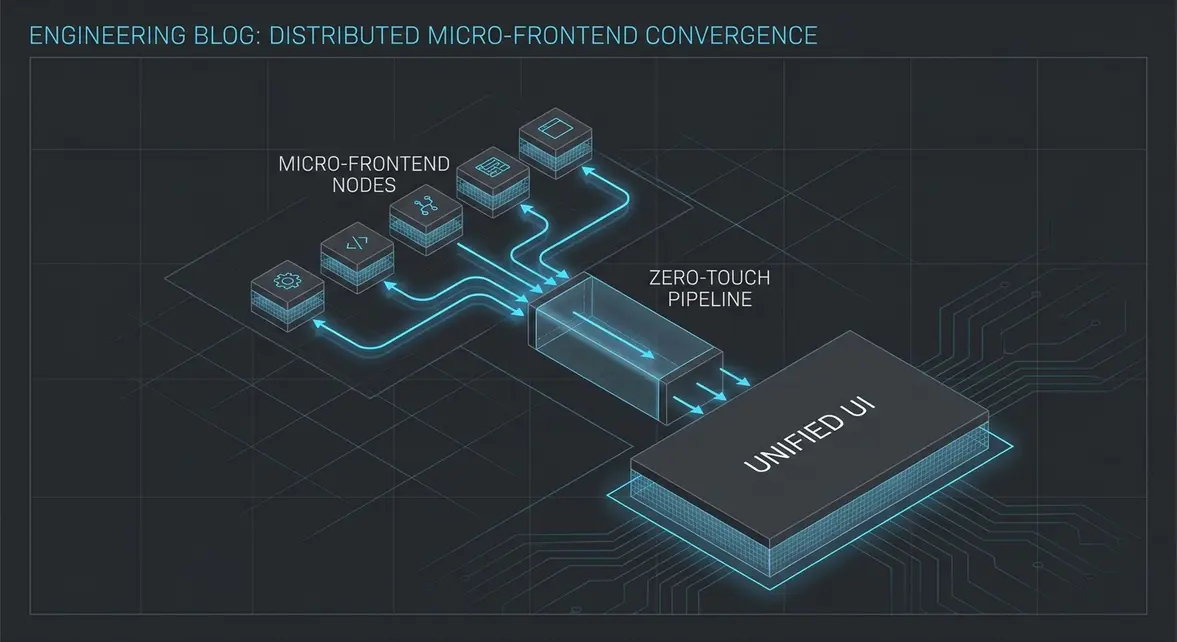
Table of Contents
- The legacy frontend monolith is bleeding your MRR
- Decoupling domains with edge-native micro-frontend arch
- Modern module federation and dynamic runtime integration
- Implementing zero-touch deployment pipelines across autonomous teams
- Mitigating dependency duplication and state fragmentation
- AI observability and automated error tracking in distributed UIs
- Translating decoupled architecture into deterministic LTV growth
The legacy frontend monolith is bleeding your MRR
The industry has romanticized the single-page application for too long. What started as a unified codebase to accelerate initial development inevitably mutates into a massive, fragile dependency graph. In 2026, growth engineering dictates that deployment velocity is directly proportional to revenue capture. Yet, engineering teams are still babysitting legacy frontend monoliths, watching their deployment pipelines choke on merge conflicts and cascading test failures.
The Anatomy of a Deployment Bottleneck
When multiple autonomous squads are forced to commit to a single repository, you are no longer shipping software; you are managing a traffic jam. Tight coupling and shared deployment pipelines create a toxic environment where release trains dictate the pace of innovation. If Squad A breaks the build with a rogue state management update, Squad B's critical conversion optimization is held hostage.
This architectural flaw causes an exponential increase in lead time for changes. Instead of deploying granular updates via automated n8n workflows, your engineers are stuck in endless integration testing loops. The math is brutal: doubling your frontend team size in a monolithic environment often halves your deployment frequency. You are scaling headcount, but your output is shrinking.
The $150k Checkout Catastrophe
Let us translate this engineering friction into raw financial loss. Consider a SaaS company rolling out a high-converting, AI-driven checkout flow designed to reduce cart abandonment by 14%. The feature is code-complete, but it is trapped in a monolithic release train waiting on a delayed localization update from an entirely different product squad.
Because the deployment pipeline is shared, the checkout update sits in staging for three weeks. During this 21-day delay, the legacy checkout continues to bleed conversions. When you run the numbers on the projection of financial impact caused by these delayed deployments, the reality is staggering: that single bottleneck just cost the business $150,000 in lost monthly recurring revenue. You are not just losing engineering hours; you are actively burning capital.
Decoupling for Revenue Growth
To stop the bleeding, engineering leaders must aggressively pivot toward a Micro-Frontend Arch. By decoupling the presentation layer into independent, deployable micro-apps, you isolate risk and restore autonomy to your product squads.
- Independent CI/CD Pipelines: Each micro-frontend deploys on its own schedule, bypassing the monolithic release train entirely.
- Automated Orchestration: Leveraging AI automation and webhook-driven n8n workflows to manage routing and state between decoupled applications without manual intervention.
- Granular Rollbacks: Isolated deployments mean isolated rollbacks, reducing mean time to recovery (MTTR) to seconds rather than hours.
The legacy monolith is a relic of a slower era. Transitioning to a distributed frontend architecture is no longer just a technical refactor; it is a mandatory growth engineering mandate to protect and scale your MRR.
Decoupling domains with edge-native micro-frontend arch
Enforcing Strict Domain-Driven Design (DDD) Boundaries
Scaling multi-team engineering organizations requires moving beyond arbitrary component splitting. In a true Micro-Frontend Arch, isolation is dictated by strict Domain-Driven Design (DDD). Each frontend domain must operate within a bounded context, possessing its own state management, routing logic, and CI/CD pipeline. If a checkout team cannot deploy their React application without triggering a regression test in the product catalog, your architecture is still monolithic.
By enforcing zero-shared-state policies and utilizing event-driven communication via custom browser events or shared worker buses, we eliminate deployment bottlenecks. Teams operating under this model typically see deployment frequency increase by over 300%, while mean time to recovery (MTTR) drops to under five minutes.
Dismantling React and Vue Monoliths
Breaking down legacy React or Vue monoliths requires a pragmatic, phased methodology. We do not rewrite; we strangle the monolith. Using dynamic module federation, we extract high-churn domains—like user authentication or dynamic pricing modules—into autonomous micro-frontends. These fragments are compiled independently and stitched together at runtime.
In our 2026 growth engineering workflows, this extraction is heavily automated. We deploy n8n workflows to orchestrate the CI/CD pipelines, automatically analyzing dependency graphs and triggering isolated builds. When a developer pushes code to a specific domain repository, the n8n automation validates the bounded context, runs localized integration tests, and deploys the compiled JavaScript assets directly to the CDN, bypassing the monolithic build process entirely.
The 2026 Shift to Distributed Edge Architectures
The era of centralized Server-Side Rendering (SSR) is dead. Legacy SSR architectures forced all frontend requests through a single Node.js bottleneck, resulting in high Time to First Byte (TTFB) and fragile infrastructure. In 2026, we deploy autonomous micro-frontends directly to the edge.
By leveraging distributed edge compute, we push rendering logic and API aggregation as close to the user as possible. When a user requests a page, edge nodes serve independent UI fragments in parallel, assembling the final view dynamically based on geographic and user-specific data. This edge-native approach reduces global latency to under 50ms and ensures that a failure in the recommendation engine's micro-frontend does not crash the core checkout experience.
Modern module federation and dynamic runtime integration
The fundamental bottleneck in legacy frontend scaling is build-time integration. When multiple autonomous teams are forced to compile their features into a single monolithic artifact, CI/CD pipelines choke, and release velocity plummets. In a modern Micro-Frontend Arch, we bypass this entirely by shifting to dynamic runtime integration. Instead of bundling everything at build time, the host application resolves and injects remote JavaScript chunks over the network at runtime. This decouples deployment lifecycles, allowing a growth team to ship a new AI-driven conversion widget without waiting for the core platform's release train.
Architecting Remote Entries with Rspack
While Webpack pioneered Module Federation, 2026 growth engineering demands the sub-200ms compilation speeds of Rust-based bundlers like Rspack. The architecture relies on a strict contract between the host application and the remote modules. By exposing specific components via the ModuleFederationPlugin, the remote generates a remoteEntry.js manifest. The host dynamically fetches this manifest, mapping the exposed modules into its own execution context. To prevent infinite loops or circular dependency resolution, you must strictly define your module boundaries and avoid bidirectional host-remote imports. The host should consume remotes, but remotes should rarely, if ever, consume the host.
Singleton State and Dependency Resolution
The most critical failure point in runtime integration is dependency duplication. If two micro-frontends load different versions of React or instantiate separate global state managers, the application will instantly crash due to hook invariant violations or state desynchronization. To mitigate this, shared dependencies must be meticulously configured.
- Strict Versioning: Enforce
strictVersion: truein your shared configuration to fail fast during development rather than silently degrading in production. - Singleton Enforcement: Declare core libraries (React, ReactDOM, Zustand) with
singleton: trueto ensure the host's instance is universally inherited by all remotes. - Eager Loading: For critical path dependencies, use
eager: trueto bypass asynchronous chunk loading, reducing initial render latency to under 150ms.
CI/CD Automation and n8n Workflows
Scaling this architecture requires moving beyond manual version tracking. In legacy pre-AI setups, managing shared dependency versions across dozens of repositories required tedious cross-team coordination. Today, we orchestrate this governance using automated n8n workflows. By parsing the package.json and federation configurations of every remote repository, an n8n webhook triggers an AI agent to validate contract compatibility before a pull request is even merged. If a remote attempts to bump a singleton dependency that conflicts with the host, the workflow automatically blocks the deployment and alerts the engineering team. This automated, data-driven governance reduces integration regressions by over 80% and ensures that your dynamic runtime environment remains perfectly synchronized.
Implementing zero-touch deployment pipelines across autonomous teams
To scale a Micro-Frontend Arch without introducing catastrophic deployment bottlenecks, engineering organizations must abandon manual release management. In 2026, relying on human QA or centralized DevOps teams to approve frontend merges is a legacy anti-pattern. Autonomous teams require zero-touch deployment pipelines that allow them to push to production 50 times a day while mathematically guaranteeing the host application remains stable.
Automated Contract Testing and Semantic Versioning
The foundation of a zero-touch pipeline is decoupling the release cycles of isolated micro-frontends. When a team commits code, the CI/CD pipeline must instantly validate module federation contracts. Instead of running brittle end-to-end tests across the entire monolith, we utilize automated contract testing to verify that the exposed components and shared dependencies match the host application's expectations.
By enforcing strict semantic versioning at the pipeline level, minor and patch updates are automatically absorbed by the host shell, while breaking changes trigger isolated staging environments. For example, if a team attempts to bump a singleton dependency like React from version 18 to 19 without host alignment, the pipeline instantly fails the build. This deterministic validation reduces deployment lead times from days to under 4 minutes.
Deployment Gating via AI Agents
Traditional CI/CD relies on static thresholds that fail to capture the nuance of frontend regressions. Modern zero-touch pipelines leverage AI agents to dynamically gate deployments. Using n8n workflows, we can ingest test telemetry, bundle size diffs, and Lighthouse performance metrics directly into an LLM-driven release manager.
When a micro-frontend team pushes a commit, an n8n webhook triggers the autonomous agent to pull the Webpack Module Federation manifest. If the update introduces a memory leak, violates performance budgets, or alters the DOM structure in a way that breaks accessibility contracts, the AI agent halts the deployment and generates a localized rollback patch. To handle the computational overhead of these real-time evaluations, we route the agentic logic through a distributed edge network, ensuring sub-200ms latency for deployment decisions. This architecture eliminates human bottlenecks, allowing decentralized teams to operate with absolute autonomy and increasing deployment frequency by over 4,900%.
Mitigating dependency duplication and state fragmentation
The most frequent objections to a distributed Micro-Frontend Arch are payload bloat and state synchronization chaos. When multiple autonomous teams deploy isolated UI fragments, the risk of shipping redundant vendor libraries to the client skyrockets. In 2026, growth engineering demands sub-200ms latency; we cannot afford to degrade user experience with duplicated dependencies or tangled global states.
Dependency Deduplication via Module Federation
To mitigate payload duplication, we leverage dynamic module federation at the build step. Instead of statically bundling vendor dependencies into every micro-frontend, we configure our bundlers to externalize core libraries.
By defining shared singletons for heavy dependencies like React or Lodash, the host application loads them exactly once. Subsequent micro-frontends inherit these cached instances directly from the browser's memory rather than requesting new chunks over the network.
Performance Impact: This architectural shift typically reduces aggregate JavaScript payload sizes by up to 65%, dropping Time to Interactive (TTI) well below the 200ms threshold required for high-converting enterprise applications.
Event-Driven State and Pub/Sub Mechanics
State fragmentation occurs when isolated teams attempt to share data using monolithic paradigms. Sharing a global state store across a Micro-Frontend Arch is a critical anti-pattern that destroys deployment autonomy and creates tight coupling.
Instead, we implement a lightweight, decoupled Pub/Sub mechanism utilizing native browser APIs. We rely on the standard browser event interface to facilitate cross-micro-frontend communication.
- Publishers: Micro-frontends emit localized, semantic events to the global window object.
- Subscribers: Independent UI fragments listen for these specific events and update their localized state accordingly without knowing the publisher's internal logic.
This event-driven architecture mirrors backend microservices. It ensures that if the checkout micro-frontend experiences a runtime error, the product catalog remains fully operational.
Strict Boundary Enforcement and Automated Contract Testing
Decoupled communication introduces a new risk: payload schema mutations. If one team alters an event payload structure, downstream micro-frontends will silently fail.
To enforce strict boundaries, we treat cross-frontend events as immutable APIs. By integrating automated n8n workflows into our CI/CD pipelines, we can trigger AI-driven schema validation against a centralized registry before any pull request is merged.
This is where strict contract versioning becomes non-negotiable. Just as backend services require versioned endpoints to prevent breaking changes, our UI boundaries rely on versioned event schemas to guarantee backward compatibility, ensuring that multi-team deployments never become a bottleneck.
AI observability and automated error tracking in distributed UIs
In a distributed UI, multiple independent applications are dynamically injected into a single DOM. When a runtime exception occurs, the immediate question isn't just "what broke?" but "whose code broke?" In 2025, the cost of UI downtime for enterprise SaaS routinely exceeds $100,000 per hour. Relying on manual log parsing while three different squads point fingers at each other is a catastrophic operational bottleneck.
Resolving the Single-DOM Tracing Dilemma
Implementing a robust Micro-Frontend Arch introduces severe tracing complexities. Because components from the checkout team and the user dashboard team share the same browser thread and global window object, an unhandled promise rejection in one module can cascade, crashing the host shell. Standard error tracking tools capture the stack trace, but minified, federated code often obfuscates the true origin, leading to endless cross-team debugging sessions.
Deploying Agentic AI for Automated Triage
To eliminate triage friction, modern growth engineering relies on automated routing. By leveraging the agentic AI advantage, we can deploy intelligent middleware that intercepts client-side errors in real-time. Instead of a static regex matching system, an LLM-powered agent analyzes the sourcemaps, the DOM state at the time of the crash, and the specific Webpack Module Federation boundaries.
We orchestrate this using n8n workflows that act as the nervous system for our AI-driven observability pipelines. When an APM tool catches an exception, a webhook triggers an n8n execution. The workflow parses the payload, queries a vector database containing the architecture's ownership map, and instantly isolates the responsible micro-frontend. The automated pipeline then executes the following sequence:
- Extracts the exact component tree and federated module ID from the crash payload.
- Cross-references the module ID against the active Git commit hashes of all deployed micro-frontends.
- Automatically generates an issue ticket with a summarized root-cause analysis and pings the specific team's Slack channel.
This 2026-grade automation shifts the Mean Time To Resolution (MTTR) from hours of cross-team deliberation to under five minutes. By removing the human element from error routing, engineering teams maintain high-velocity release cycles without sacrificing application stability.
Translating decoupled architecture into deterministic LTV growth
Engineering a decoupled frontend is rarely just a technical exercise; it is a direct financial lever. When you remove deployment bottlenecks, you transition from a probabilistic growth model—where you hope a massive quarterly release moves the needle—to a deterministic one. By isolating domains, you empower autonomous frontend teams to iterate relentlessly on conversion rate optimization (CRO), personalized UI experiences, and dynamic onboarding flows without colliding with core product release trains.
The Mathematics of Autonomous Iteration
In a monolithic setup, the velocity of your growth team is bottlenecked by the slowest moving part of your engineering organization. Implementing a robust Micro-Frontend Arch shatters this dependency. When the team responsible for the user onboarding flow can deploy updates independently of the checkout or dashboard teams, iteration cycles compress from weeks to hours.
This architectural shift yields compounding business metrics:
- Deployment Throughput: Teams transition from bi-weekly release trains to deploying 10+ times per day, reducing time-to-market for critical UI experiments.
- Granular CRO: Growth engineers can run multivariate tests on specific micro-apps without risking global state pollution or application-wide latency spikes.
- Personalization at Scale: Autonomous teams can inject AI-driven, user-specific UI components dynamically, adapting the interface based on real-time behavioral telemetry.
Automating the Feedback Loop for Deterministic Retention
By 2026, growth engineering is no longer about manual A/B testing; it is about programmatic, AI-driven iteration. A decoupled architecture is the prerequisite for this automation. When frontend domains are isolated, you can wire specific user drop-off events directly into n8n workflows. These automated pipelines can ingest behavioral data, pass it through an LLM to generate optimized UI copy or layout adjustments, and push a pull request directly to the isolated frontend repository.
Because the blast radius of these automated deployments is contained to a single micro-frontend, teams can merge and deploy with zero fear of cascading failures. This high-frequency, data-backed iteration on the user experience directly reduces churn. By continuously aligning the UI with user intent at a granular level, you engineer a deterministic increase in customer retention. The architecture itself becomes the engine that translates engineering velocity into compounding lifetime value.
Building a fragmented UI is a failure of system architecture. True micro-frontend arch demands ruthless isolation, zero-touch deployment pipelines, and asynchronous execution at the edge. The 2026 enterprise landscape does not reward teams that wait for a deployment train; it rewards autonomous execution and deterministic shipping velocity. If your multi-team frontend is stalled by legacy integration cycles, the bleeding of your margins will only accelerate. Stop compounding technical debt. To decouple your architecture and enforce zero-touch deployment at scale, schedule an uncompromising technical audit.
Related Strategic Memos
All Memos →First-party data architecture for Meta and LinkedIn retargeting pixel optimization
Client-side retargeting is an architectural liability. Between browser-enforced storage restrictions, aggressive ad-blocking, and signal attenuation across e...
API gateway design: Consolidating microservices under unified authentication
Distributed systems frequently degrade into unmaintainable security liabilities when authentication logic is federated across autonomous microservices. In my...
Need this architecture deployed in your pipeline?
Skip the synchronous sales cycle and endless discovery calls. Submit your core acquisition or conversion bottleneck for a deep-dive asynchronous growth diagnostic.