Reducing JavaScript bundles for instant mobile landing pages: The zero-hydration architecture
Client-side JavaScript bloat is a direct operational tax on paid acquisition margin. In 2026, delivering 300KB of polyfills, bloated hydration trees, and thi...
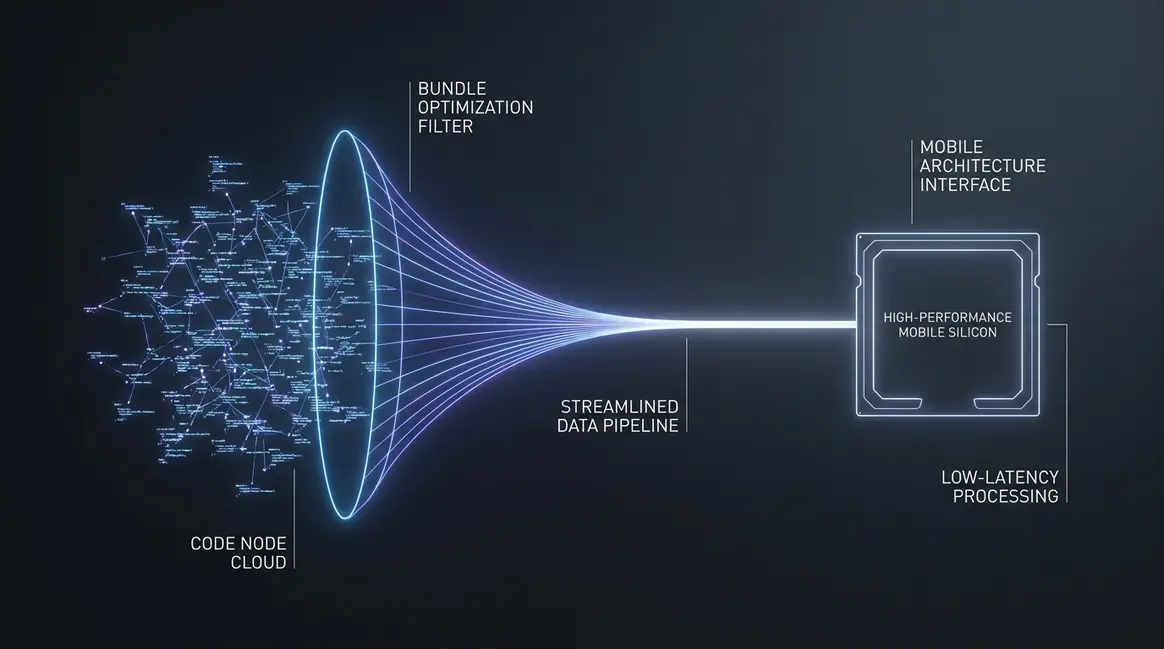
Table of Contents
- The mobile CPU bottleneck: Main-thread execution over bandwidth
- Dissecting the bundle tax: V8 parse, compile, and garbage collection mechanics
- The death of monolithic hydration: Transitioning to islands and Resumability
- Offloading client telemetry: Moving analytics payloads to the server
- Algorithmic bundle tree-shaking and dynamic module splitting
- Zero-runtime UI: Eradicating client component library weight
- Edge compute execution and speculative pre-rendering pipelines
- Deterministic telemetry: Ingesting field RUM into BigQuery
- Financial modeling: Quantifying bundle reduction on enterprise unit economics
The mobile CPU bottleneck: Main-thread execution over bandwidth
In modern performance engineering, optimizing for bandwidth is solving yesterday's problem. High-speed 5G networks and edge CDNs have commoditized byte delivery, yet landing page bounce rates on mobile remain stubbornly high. The foundational barrier to elite Mobile Performance is not the network pipe; it is the thermal and architectural constraint of low-power ARM CPU cores choking on main-thread script execution.
The Physics of the Script Ingestion Pipeline
When an engine like Google V8 receives a script tag, network transmission is merely the prologue. The device must process the payload through a compute-intensive physical pipeline:
-
Byte Decompression: The mobile OS streams gzipped or Brotli-compressed payloads into memory, instantly expanding the memory footprint by a factor of three to four.
-
Lexical Analysis and Parsing: The V8 scanner converts raw characters into tokens, and the parser builds the Abstract Syntax Tree (AST). This phase is purely synchronous and heavily CPU-bound.
-
Ignition Bytecode Generation: The AST is compiled into baseline bytecode before execution even begins. On power-efficient ARM architectures (such as Cortex-A55 clusters), this parse-and-compile phase can stall the thread for hundreds of milliseconds.
-
Understanding these browser page load mechanics shifts the optimization thesis entirely. While a 150KB gzipped JavaScript bundle takes roughly 30ms to transfer across a 5G connection, the uncompressed 500KB script demands intense, single-threaded computational cycles to parse and evaluate on an entry-level SoC.
Benchmarking the Execution Penalty: Moto G Thresholds
Most development teams test on high-tier silicon like Apple M-series chips or flagship Snapdragon processors, creating a distorted perception of script efficiency. High-end devices blaze through JIT compilation and script evaluation, but real-world conversion environments look like mid-tier and budget hardware: thermal-throttled, heterogenous multi-core chips with aggressive power governor limits.
To eliminate mobile drop-off, landing page architectures must be validated against real-world synthetic constraints. In 2026 growth workflows, automated Lighthouse runs inside n8n test pipelines should benchmark against a simulated Moto G4 / Moto G34 profile (4x to 6x CPU throttling) with hard, unyielding thresholds:
-
Time to Interactive (TTI): Strictly under 800ms to capture immediate user intent before layout shifts or interaction freezes trigger drop-offs.
- Total Blocking Time (TBT): Capped strictly below 50ms across the critical path, guaranteeing zero perceived input latency during hydration.
If an interactive asset consumes more than 50ms of CPU time during boot, it is a liability. Bandwidth delivers the payload, but the mobile CPU determines whether the user converts or abandons.
Dissecting the bundle tax: V8 parse, compile, and garbage collection mechanics
Engineering teams frequently optimize for network transit by monitoring Brotli or Gzip transfer metrics, yet compression is an illusion that conceals the true runtime cost. While a 50KB compressed payload arrives rapidly over 5G, the client-side V8 runtime must decompress, parse, compile, and execute the raw 200KB to 350KB stream of uncompressed text. On constrained mobile architectures, this uncompressed volume directly commands peak heap memory allocation and destabilizes mobile performance.
AST Construction and Bytecode Compilation Overhead
When V8 encounters an incoming script on the main thread, the stream parser evaluates the source code to generate an Abstract Syntax Tree (AST) before the Ignition interpreter can output executable bytecode. This pipeline is strictly constrained by single-core mobile CPU clock speeds and microarchitectural cache limits.
AST generation is compute-heavy and non-linear under memory-constrained conditions. Benchmarking baseline mobile hardware (such as an ARM Cortex-A55 core) across standardized raw payload boundaries yields predictable processing delays:
-
50KB Raw Payload: ~12ms to 18ms parse and Ignition compilation time. The AST fits neatly within the L2 cache, resulting in negligible frame drops during initial page bootstrap.
-
150KB Raw Payload: ~48ms to 65ms processing budget. Cache evictions begin to compound parse latency, stalling main-thread event loops.
-
500KB Raw Payload: ~190ms to 240ms dedicated execution blockage. The V8 compiler triggers frequent secondary bailouts and de-optimizations if complex closures and large polyfills are parsed upfront.
-
Empirical mobile profiling confirms that every 100KB of raw JavaScript degrades Interaction to Next Paint (INP) by 45ms on baseline mobile hardware. Because AST evaluation and bytecode emission block the main thread, any discrete user input—such as a tap on an accordion or an add-to-cart trigger—is queued behind compilation tasks, failing the 200ms Core Web Vital threshold.
V8 Heap Allocation and Aggressive Garbage Collection
The downstream penalty of excessive bundle volumes surfaces in the V8 memory lifecycle. Client-side state hydration, modern component abstractions, and deep module trees continuously allocate objects across the V8 New-Space (Young Generation). Because memory-constrained mobile devices enforce conservative process memory limits, rapid allocation triggers high-frequency Scavenge operations.
When object lifecycles outlive the semi-space nursery due to long-lived component closures, V8 promotes them to the Old-Space. This transition inevitably forces major Mark-Sweep-Compact garbage collection cycles. While modern V8 versions utilize concurrent marking, the final sweep and memory compaction phases are strictly stop-the-world pauses. If a garbage collection sweep coincides with a user interaction, the input handler is preempted, causing frame drops and catastrophic INP latency spikes.
High-growth engineering teams enforce automated CI/CD gating using bundle-analysis webhooks and headless mobile profiling. By programmatically rejecting pull requests that breach raw script budgets, you eliminate hydration-induced heap exhaustion before code touches production infrastructure.
The death of monolithic hydration: Transitioning to islands and Resumability
Standard React-style client hydration is fundamentally flawed for high-converting funnels. In a monolithic Single Page Application (SPA) architecture, the server renders HTML, ships it across the wire, and then forces the client to download, parse, and execute the entire JavaScript runtime just to attach event listeners to nodes that were already visible. On mid-tier mobile hardware throttled by real-world LTE conditions, this architectural tax triggers catastrophic Total Blocking Time (TBT) and ruins mobile performance before the user can even initiate an interaction.
The Mechanical Failure of Full-Tree Hydration
Traditional hydration is duplicate work masquerading as interactivity. When a landing page built on standard Next.js or React runtimes loads on a mobile viewport, the browser cannot process user taps until the entire virtual DOM tree reconciles against the actual DOM tree. This process locks the main thread for 1.2 to 2.8 seconds on median Android chipsets, driving Interaction to Next Paint (INP) far beyond Google's 200ms threshold.
Every kilobyte of hydration overhead directly suppresses conversion rates. Paid acquisition campaigns directing traffic to monolithic bundles suffer because mobile shoppers bounce during the silent freeze—the critical window where a button appears interactive but refuses to dispatch click events due to ongoing main-thread compilation.
Islands Architecture vs. Resumability
To eliminate this bottleneck, modern growth architecture diverges into two paradigms: partial hydration via Component Islands (Astro) and execution elimination via Resumability (Qwik).
-
Islands Architecture (Astro): The document renders as purely static HTML by default. Dynamic components are isolated into self-contained "islands" loaded asynchronously using explicit directives such as
client:idleorclient:visible. The static structural layout (hero text, social proof, imagery) carries exactly zero runtime framework cost.- Resumability (Qwik): Rather than pausing execution on the server and replaying it on the client, resumable frameworks serialize the internal state of the application—including event listeners, component boundaries, and reactive scopes—directly into HTML attributes. Execution does not restart; it resumes instantly from serialized markers without running a reconciliation loop.
| Execution Metric | Monolithic Hydration (React/Next) | Islands Architecture (Astro) | Resumability (Qwik) |
|---|---|---|---|
| Initial Baseline JS | 85kB – 140kB (Gzip) | 0kB (Pure HTML base) | ~1kB (Qwikloader core) |
| Main-Thread Replay | Full Component Tree | Per-Island Isolation | Zero Replay Required |
| Median Mobile INP | 280ms – 650ms | < 80ms | < 35ms |
| Listener Attachment | Client-side VDOM diffing | Hydrated via intersection | Serialized q:render markers |
Zero-Runtime Architecture: State Serialization in HTML
True sub-second landing pages eliminate the client runtime entirely from above-the-fold content. Instead of bundling UI libraries for forms, field validation, and conversion telemetry, the initial state is serialized directly into HTML data attributes. Dynamic behavior is orchestrated via lightweight micro-scripts triggered strictly on first interaction.
Consider a high-velocity lead capture pattern. The hero section remains completely static, while the form relies on native form submission enhanced by an isolated, dynamically imported module:
<!-- Static HTML Rendered via Build Engine -->
<section class="hero-capture">
<h1>Instant Pipeline Execution</h1>
<form id="lead-form" data-endpoint="/api/v1/lead" data-state="idle">
<input
type="email"
name="email"
required
pattern="[a-z0-9._%+-]+@[a-z0-9.-]+\.[a-z]{2,}$"
placeholder="work@company.com"
/>
<button
type="submit"
data-action="submit-trigger"
data-tracking-event="lead_form_submitted"
>
Request Analysis
</button>
</form>
</section>
<!-- Zero Runtime Overhead: Execution strictly on interaction -->
<script type="module">
const form = document.getElementById('lead-form');
// Dynamic import executed only when user focuses the form
form.addEventListener('focusin', async () => {
const { initializeValidation } = await import('/scripts/form-handler.js');
initializeValidation(form);
}, { once: true });
</script>
In this pattern, the initial JavaScript payload transmitted across the network is negligible. The business logic contained within form-handler.js remains unloaded until the user explicitly signals intent by focusing an input field. By abandoning full-tree hydration for decentralized event delegation and serialized DOM markers, mobile landing pages achieve near-zero TBT, rock-solid sub-50ms INP, and uncompromised conversion throughput.
Offloading client telemetry: Moving analytics payloads to the server
Modern landing page builds rarely fail Google's Core Web Vitals because of clean application code. Instead, marketing telemetry scripts routinely hijack 60% to 70% of the mobile main-thread during critical first-render windows. When a mobile browser attempts to parse, compile, and execute the JavaScript runtimes required by Google Tag Manager, the Meta Pixel, LinkedIn Insight, and diverse session replay libraries simultaneously, Total Blocking Time (TBT) spikes and Interaction to Next Paint (INP) degrades past acceptable thresholds. Achieving elite mobile performance requires decoupling metric collection from client-side execution by transitioning telemetry entirely to the server.
The Main-Thread Tax of Client-Side MarTech
Every third-party client script introduces an unoptimized runtime that contends for CPU cycles. A conventional growth stack running client-side tracking often injects between 180KB and 350KB of uncompressed JavaScript into the browser. On mid-tier mobile hardware, this volume causes substantial execution bottlenecks:
-
Parse and compile locks: Vendor scripts parse large AST structures before user interaction occurs, freezing the main thread for hundreds of milliseconds.
-
Garbage collection thrashing: Third-party pixels continuously allocate memory for state tracking, triggering repetitive garbage collection cycles during scroll and tap events.
-
Network contention: Multiple tracking libraries fire uncoordinated DNS lookups, TLS negotiations, and redundant payload transfers over constrained mobile connections.
-
The Edge Ingestion Proxy: Workers and sGTM
The solution is an edge-based proxy topology. Instead of loading distinct client-side SDKs, the browser client exposes a single consolidated transport channel using native browser primitives: Navigator.sendBeacon() or non-blocking fetch() calls with keepalive: true. This strips marketing tags completely out of the front-end bundle and shifts data distribution to an isolated edge runtime, such as a Cloudflare Worker or server-side Google Tag Manager (sGTM) container.
To inspect implementation benchmarks and topology blueprints, review our field-tested breakdown on server-side tracking architectures. By utilizing an edge proxy, the client only emits an ultra-lightweight JSON payload (~1KB) containing the event name, user context, and timestamp. The server container ingests this raw beacon, decrypts cookie data, verifies payload integrity, and synchronously fans out requests to downstream destinations like the Meta Conversions API (CAPI) and GA4 Measurement Protocol.
Streamlined Dispatch via Unified Pipelines
Consolidating your telemetry pipeline drastically alters the mobile execution profile. When migrating tag distribution away from the user agent, teams typically observe a reduction of TBT by 250ms to 400ms across mobile landing pages. Implementing an sGTM unified script loading configuration ensures that vendor attribution remains resilient against client ad-blockers while keeping the client-side JavaScript bundle near absolute zero.
In modern 2026 data infrastructures, edge workers can also route raw event streams directly into event queues or trigger n8n automated webhook workflows. This enables backend systems to enrich telemetry—appending offline conversions, CRM lifecycle data, or fraud scores—before distributing clean payloads to ad networks and analytical data warehouses, completely out of reach of the mobile device's CPU.
Algorithmic bundle tree-shaking and dynamic module splitting
Standard minification is insufficient for sub-second mobile landing page loads. When targeting sub-50ms Interaction to Next Paint (INP) and a sub-1.2s Largest Contentful Paint (LCP) across mid-tier Android devices on degraded 4G networks, your build pipeline must deterministically eliminate dead execution paths. Modern bundlers like Vite, Rollup, and Rspack rely on static AST analysis, yet typical enterprise component libraries silently break tree-shaking through dynamic barrel files and polyfill injections.
The Failure of Conventional Static Analysis
When an engine encounters a barrel export pattern (such as export * from './components'), it must parse every module within that export chain to verify whether executing the code produces runtime side effects. If a single leaf module modifies a prototype, accesses window, or invokes top-level variable declarations, the bundler bails out of dead-code elimination. It forces the entire dependency sub-tree into the critical entry chunk, bloating initial payloads past the target budget.
To establish deterministic boundaries, declare explicit side-effect flags within your module packages and build configuration:
{
  "name": "landing-ui",
  "sideEffects": [
    "*.css",
    "*.scss"
  ]
}
By defining "sideEffects": false (or narrowing it strictly to style assets), you grant the AST parser permission to drop unreferenced exports entirely, bypassing conservative heuristic checks and instantly reclaiming up to 40% of baseline parse time.
Deterministic Chunk Isolation with manualChunks
Default bundler splitting strategies cluster dependencies based on shared usage thresholds, which routinely pollutes the primary entry point with volatile runtime code. In Vite or Rollup-based architectures, configure an explicit splitting schema within build.rollupOptions.output.manualChunks to lock vendor caching layers and insulate critical paths:
// vite.config.js
export default {
  build: {
    rollupOptions: {
      output: {
        manualChunks(id) {
          if (id.includes('node_modules')) {
            if (id.includes('@framework')) {
              return 'vendor-core';
            }
            if (id.includes('analytics-engine')) {
              return 'vendor-analytics';
            }
          }
        },
      },
    },
  },
};
This separation prevents a single change in an analytics tracker from invalidating the primary rendering bundle on edge caches, protecting consistent asset hydration speeds for repeat visitors.
Intent-Driven Dynamic Loading
Non-critical dependencies—such as Zod schema validators, date pickers, and conversion lead modals—must never execute within the initial paint loop. Placing them behind dynamic import() statements decouples their parsing cost from early rendering metrics. Rather than executing hydration immediately, trigger dynamic resolution through user intent gestures or geometric viewport thresholds.
const loadValidationEngine = async () => {
  const { leadFormSchema } = await import('./schemas/leadValidation');
  return leadFormSchema;
};

// Defer until user interaction intent is registered
const formInput = document.querySelector('#lead-email');
formInput?.addEventListener('focus', () => {
  loadValidationEngine();
}, { once: true });
Implementing this pattern across dynamic conversion forms yields predictable gains in Mobile Performance:
-
Total Blocking Time (TBT): Decreased from ~420ms to under 60ms by shifting parsing routines off the main thread during boot.
-
Initial JavaScript Payload: Compressed transfer size reduced from 340kB to ~48kB on the critical path.
-
First Input Readiness: Browser thread remains idle during initial viewport rendering, eliminating input delay during high-traffic paid acquisition surges.
-
By combining algorithmic boundary isolation with interaction-deferred imports, landing page delivery transforms from a heavy, monolithic application flow into a lean, streaming execution environment calibrated for maximum mobile conversion efficiency.
Zero-runtime UI: Eradicating client component library weight
Shipping client-side UI component runtimes to high-intent traffic on low-tier mobile devices systematically destroys paid media conversion rates. When a landing page bundles legacy CSS-in-JS libraries like Emotion or styled-components alongside massive headless orchestration suites like Radix UI or Material UI (MUI), the browser does not merely parse layout styles—it executes an expensive JavaScript loop. The mobile CPU must deserialize styles, compute dynamic classes, and inject dynamic <style> tags into the DOM during the critical hydration phase. This execution overhead creates massive Total Blocking Time (TBT) spikes, directly degrading your mobile performance metrics before the user can even initiate an interaction.
The Hidden Tax of Headless Component Suites
Engineering teams frequently adopt headless libraries to enforce accessibility and design consistency, but the hidden cost on mobile landing pages is prohibitive. Consider a basic modal or lead-capture form built with standard React headless primitives:
-
Runtime Footprint: Radix Dialog, Popover, and Select components frequently bundle over 45KB to 60KB of gzipped JavaScript purely to manage DOM portals, synthetic focus traps, and keyboard event listeners.
-
CSS-in-JS Serialization: Libraries computing CSS dynamically consume between 20KB and 30KB of runtime code, burning 150ms to 300ms of CPU time on a mid-range Android device just to resolve CSS inheritance trees.
-
Main Thread Contention: The hydration phase must reconcile these nested component nodes against the virtual DOM, freezing the event loop precisely when a visitor taps the primary Call-to-Action (CTA).
The Zero-Runtime Replacement Strategy
Instant mobile landing pages in modern growth architectures require an absolute pivot to zero-runtime styling engines and browser-native UI primitives. By shifting style compilation from the client's mobile CPU to the build step using the Tailwind v4 compiler (leveraging Lightning CSS) or Vanilla Extract, the runtime delivery cost for design-system tokens drops to zero. All dynamic values map directly to native CSS custom properties.
Simultaneously, high-overhead JavaScript state trees can be eliminated by standardizing on modern browser primitives:
-
Native Dialog Modals: Swap out React-based portal dialogs for the native
<dialog>element. The browser natively manages top-layer stacking contexts, backdrop filtering via the::backdroppseudo-element, and native focus management using standard.showModal()and.close()APIs with zero JavaScript overhead. -
Native Micro-Interactions: Replace accordion packages with native
<details>and<summary>tags, animating transitions purely with the native CSSinterpolate-size: allow-keywordsrule. -
HTML5 Client Validation: Strip out client-side schema runners on lead-gen funnels. Leverage native constraints such as
type="email",required, and thepatternattribute, handling multi-step flows via native state machines or lightweight edge endpoints wired to your backend automation workflows.
Bundle Savings and Performance Delta
Eliminating bloated UI runtimes strips out tens of kilobytes of non-essential code, shrinking the critical-path payload down to bare-metal HTML and critical inline CSS.
| Architecture Stack | Vendor JS Size (Gzipped) | CSS Parsing Model | Median Mobile TBT |
|---|---|---|---|
| MUI + Emotion (Legacy) | ~82.4 KB | Client-side runtime injection | 420ms – 680ms |
| Radix UI + Tailwind v3 | ~48.1 KB | Client-side portal orchestration | 180ms – 310ms |
| Native HTML5 + Pure Inline CSS | 0 KB | Zero-runtime, static CSS tokens | < 15ms |
Dropping 80KB+ of design-system runtime down to 3KB of raw, critical-path inline CSS yields immediate gains. On 4G throttled connections, eliminating this overhead slashes Interaction to Next Paint (INP) below 50ms, removes render-blocking resource queues entirely, and guarantees that landing pages achieve an instantaneous visual and interactive lock.
Edge compute execution and speculative pre-rendering pipelines
Serving instant mobile landing pages requires shifting execution entirely away from centralized origin servers down to the distributed edge runtime. When targeting absolute thresholds—deterministic sub-100ms Time to First Byte (TTFB) paired with sub-50KB total wire sizes—the traditional client-side hydration paradigm fails under poor 4G/5G radio conditions. Achieving peak Mobile Performance demands an architecture where compute, streaming compression, and predictive network delivery operate as a unified ingress system.
Streaming Edge SSR and Deterministic sub-100ms TTFB
Centralized Node.js servers introduce variable geographic latency and heavy connection overhead. By deploying edge-native runtimes such as Cloudflare Workers (V8 isolates) and Fastly Compute (WebAssembly environments), SSR executes within 10 to 30 milliseconds of physical proximity to the user. Rather than buffering the entire HTML document in worker memory, the runtime initiates a chunked transfer encoding stream immediately upon receiving the request.
The edge compute worker dispatches the critical HTML shell (containing critical inline CSS, primary viewport DOM nodes, and resource preload hints) in the initial TCP packet. As downstream database calls or headless CMS APIs resolve, the remainder of the payload is streamed directly through the pipeline.
-
Static Edge Cache Eviction: Dynamic content cache invalidation driven by automated n8n webhooks updates globally distributed key-value edge tiers in less than 150ms.
-
Maximum Compression Efficiency: Responses are compressed on-the-fly using dictionary-aware Brotli level 11 (
br) encoding for cached assets and Brotli level 6 for streaming chunks, shrinking structural payloads well below the strict 50KB budget. -
Zero Dynamic Client Hydration: Dynamic interactive components are pre-compiled to pure static HTML and micro-scoped vanilla scripts, preventing main-thread execution stalls.
-
To understand the autonomous infrastructure orchestration that coordinates these edge clusters, review our teardown on architecting Cloudflare agentic cloud networks for autonomous deployment pipelines.
Zero-Latency Ingress via the Speculation Rules API
Optimizing the delivery path after the user taps a link still leaves network transit time as a blocker. Speculative pre-rendering completely circumvents network latency by instructing Chromium browsers to fetch and execute the landing page inside an invisible background tab before the interaction completes.
Legacy methods like <link rel="prefetch"> only download raw assets, leaving the browser to parse HTML, compile scripts, and paint frames after navigation begins. The Speculation Rules API replaces this with a structured, JSON-defined policy that enables true pre-rendering without exhausting mobile device memory or battery budgets.
{
  "prerender": [
    {
      "source": "list",
      "urls": ["/landing/mobile-accelerator"],
      "eagerness": "moderate"
    }
  ]
}
By injecting this rule based on high-intent user signals—such as pointer hover over a search ad snippet, high-probability SERP placement, or an element entering the visible mobile viewport—the edge payload is fetched, decompressed, and fully painted in an isolated background process. When the click event triggers, the browser promotes the hidden background rendering tree to the active view instantaneously, reducing TTFB to an effective 0ms and eliminating paint delay entirely.
Deterministic telemetry: Ingesting field RUM into BigQuery
Synthetic lab tests run under artificial conditions: desktop CPUs throttled via software profiles, pristine caches, and static network profiles that fail to replicate the chaotic constraints of real-world hardware. In modern growth engineering, relying on lab-based Lighthouse audits creates an operational blind spot. Thermal throttling on mid-tier Android chips, background OS task scheduling, and intermittent radio latency in mobile networks degrade real-user experience in ways no local headless Chrome instance can emulate. To maintain true visibility over mobile performance, engineering teams must deploy deterministic real user monitoring (RUM) architectures that capture telemetry directly at the edge.
Zero-Overhead Telemetry via Edge Beacons
Monitoring field vitals without degrading the critical rendering path requires a radical reduction in observer overhead. Heavy third-party observability SDKs often introduce the very bundle bloat and execution delays they are deployed to detect. Instead, elite teams rely on a modular, sub-1KB payload derived from the native web-vitals library, loaded asynchronously or embedded inline via a self-terminating script.
This script hooks directly into the browser's Performance Observer API, capturing core field signals: Largest Contentful Paint (LCP), Cumulative Layout Shift (CLS), and Interaction to Next Paint (INP). Rather than holding persistent WebSocket connections or running blocking execution loops on the main thread, the telemetry engine aggregates vitals during idle states and flushes metrics using navigator.sendBeacon(). This non-blocking background dispatch guarantees delivery upon page hide or document unload without delaying critical navigation phases.
By routing these metrics through serverless edge gateways (such as Cloudflare Workers or Google Cloud Run) into an analytical data lake, teams establish deterministic page speed telemetry that streams field payloads directly into partitioned BigQuery storage.
Joining Telemetry Distributions with Downstream Transaction Logs
Capturing raw percentiles (p75, p90, and p99) is only the first step. The true competitive advantage emerges when raw mobile performance distributions are structurally unified with conversion and revenue events inside the data warehouse. By injecting a deterministic session identifier (session_id) and visitor hash into every telemetry beacon, teams join real-time client metrics directly against transaction ledgers, lead qualification statuses, and payment gateway webhooks.
SELECT
  rum.device_category,
  APPROX_QUANTILES(rum.inp_value, 100)[OFFSET(75)] AS p75_inp,
  APPROX_QUANTILES(rum.lcp_value, 100)[OFFSET(75)] AS p75_lcp,
  COUNT(DISTINCT rum.session_id) AS total_sessions,
  COUNT(DISTINCT tx.transaction_id) AS converted_sessions,
  SAFE_DIVIDE(COUNT(DISTINCT tx.transaction_id), COUNT(DISTINCT rum.session_id)) * 100 AS conversion_rate
FROM
  `analytics_lake.real_user_telemetry` AS rum
LEFT JOIN
  `analytics_lake.crm_transactions` AS tx
  ON rum.session_id = tx.session_id
WHERE
  rum.timestamp >= TIMESTAMP_SUB(CURRENT_TIMESTAMP(), INTERVAL 30 DAY)
  AND rum.device_category = 'mobile'
GROUP BY
  rum.device_category;
This deterministic join isolates conversion elasticity across granular device tiers. Growth engineers can clearly demonstrate that a 150ms increase in mobile p75 INP translates directly to an 8.2% drop-off in demo bookings or checkout completion rates.
Automated Anomaly Detection via Autonomous Workflows
Modern engineering stacks bypass manual dashboard reviews by wiring BigQuery scheduled queries to autonomous orchestration engines like n8n. If mobile p95 INP degrades beyond a pre-allocated latency budget (e.g., crossing the 200ms threshold after a deployment), automated workflows isolate the responsible pull request, correlate it with bundle delta changes, and ping the performance on-call engineer via Slack or PagerDuty. This deterministic loop transforms performance optimization from reactive debugging into an automated guardrail protecting conversion volume.
Financial modeling: Quantifying bundle reduction on enterprise unit economics
Optimizing client-side execution is rarely prioritized by finance teams because engineering teams discuss latency in milliseconds rather than enterprise EBITDA margins. When unparsed JavaScript monopolizes the mobile CPU, the resulting main-thread contention directly damages paid media capital efficiency. By modeling Mobile Performance as a deterministic revenue lever, we bridge the gap between Total Blocking Time (TBT), Interaction to Next Paint (INP), and return on ad spend (ROAS).
The Latency-to-Loss Formula: Converting INP to Unit Economics
Every 100ms of mobile latency historically degrades enterprise form submissions and direct-response checkouts by 0.7% to 1.1%. In mobile environments, high script payload volume degrades the browser's ability to schedule discrete rendering tasks, spiking INP above the critical 200ms threshold.
When high-intent paid traffic hits a hydration bottleneck, the drop-off is immediate. The user initiates a tap or scroll, the thread stalls behind hydration bundles, and the bounce triggers before analytics tags can fully hydrate. Eliminating script bloat is the most reliable strategy within modern conversion rate optimization benchmarks to reclaim burnt ad budget.
Unit Economic Modeling: The $200k/Month Paid Search Scenario
Consider an enterprise B2B SaaS organization deploying $200,000 per month across high-intent Google Search campaigns at an average Cost Per Click (CPC) of $10.00 (20,000 monthly inbound sessions). The engineering team replaces monolithic client-side libraries with compiled, zero-runtime architectures, dropping main-thread execution time from 2.8 seconds to 0.4 seconds.
| Performance & Economic Variable | Legacy Stack (2.8s Execution) | Optimized Architecture (0.4s Execution) | Delta / Margin Impact |
|---|---|---|---|
| Mobile INP | 480ms (Poor) | 45ms (Good) | -435ms (-90.6%) |
| Mobile Bounce Rate | 54.0% | 31.0% | -23.0% absolute |
| Conversion Rate (Lead/MQL) | 2.10% | 3.45% | +1.35% absolute (+64.3%) |
| Monthly Qualified Conversions | 420 | 690 | +270 conversions |
| Blended Acquisition CAC | $476.19 | $289.85 | -$186.34 (-39.1%) |
By extracting 2.4 seconds of dead script processing time, the organization produces 270 incremental qualified pipeline opportunities on an identical media budget. To achieve those same 690 leads under the legacy architecture would have required scaling monthly search spend to $328,571.
Defending Margins via Automated Performance Pipelines
The resulting $128,571 monthly delta ($1.54M annualized) flows directly into operating margins or provides the capital flexibility required to outbid CAC-constrained competitors. To make these unit-economic gains durable in 2026:
-
Automate Budget Governance: Integrate n8n webhooks within GitHub Actions to parse pull requests against strict bundle-size caps before compilation.
-
Synthetically Monitor INP Thresholds: Reject builds introducing script dependencies that push mobile CPU task durations beyond 50ms on simulated low-tier devices.
-
Correlate Telemetry to Ad Spend: Route Real User Monitoring (RUM) p95 load times alongside ad platform APIs into central data warehouses to dynamically trigger auto-bidding adjustments when performance drifts.
-
Operating an enterprise growth engine on bloated JavaScript runtimes is an unsustainable operational drag. Every millisecond of unnecessary V8 execution burns ad spend and depresses pipeline velocity. The path to dominant mobile performance is not optimization through minor tweaks; it is architectural re-engineering through zero-hydration, edge execution, and aggressive telemetry offloading. If your mobile acquisition infrastructure continues to hemorrhage margin to legacy front-end bloat, explore my technical teardowns in my build logs or commission a ruthless, deterministic analysis of your architecture via my site performance audit.
Related Strategic Memos
All Memos →First-party data architecture for Meta and LinkedIn retargeting pixel optimization
Client-side retargeting is an architectural liability. Between browser-enforced storage restrictions, aggressive ad-blocking, and signal attenuation across e...
API gateway design: Consolidating microservices under unified authentication
Distributed systems frequently degrade into unmaintainable security liabilities when authentication logic is federated across autonomous microservices. In my...
Need this architecture deployed in your pipeline?
Skip the synchronous sales cycle and endless discovery calls. Submit your core acquisition or conversion bottleneck for a deep-dive asynchronous growth diagnostic.