Programmatic video architecture: Automating personalized outreach at scale
Manual sales video prospecting is economically insolvent. Paying Sales Development Representatives $35 an hour to record twelve idiosyncratic, uncalibrated t...
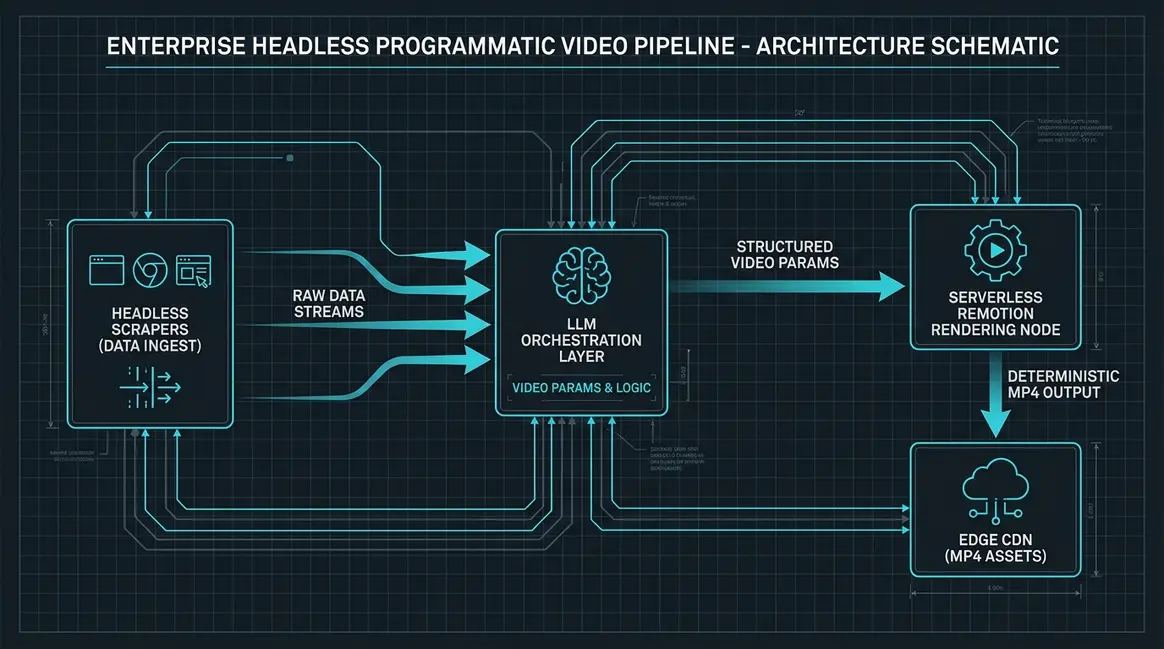
Table of Contents
- The economic insolvency of manual video prospecting in enterprise sales
- Architectural taxonomy of headless programmatic video engines
- Dynamic data ingestion: Headless browser DOM capture and asset extraction
- Algorithmic script synthesis and phonetically aligned neural audio
- Headless canvas rendering: React-based video compilation via Remotion
- Asynchronous pipeline orchestration with n8n, worker queues, and event streams
- Edge delivery and zero-latency dynamic landing page synthesis
- Server-side engagement telemetry and closed-loop attribution modeling
- Cost modeling and margin defense: Manual SDR recording versus headless rendering clusters
- Risk mitigation, synthetic identity governance, and spam filter survival
The economic insolvency of manual video prospecting in enterprise sales
Legacy outbound sales models treat video prospecting as an athletic labor problem rather than a systems engineering challenge. Inside enterprise sales development teams, sales representatives commanding $50,000 to $70,000 base salaries spend between 30 and 45 minutes researching, scripting, rendering, and verifying a single bespoke screen recording. Under optimal conditions, a dedicated SDR caps out at 15 to 20 custom recordings per day. When calculated against fully loaded labor costs, platform licenses, and inevitable context-switching decay, organizations routinely spend between $14.00 and $22.00 per generated asset.
This operational framework yields high latency and extreme messaging variance. Non-technical outbound reps frequently mischaracterize enterprise infrastructure, misinterpret diagnostic data, and deliver inconsistent value propositions across key target accounts. The math behind human-dependent outbound video simply does not scale to high-velocity enterprise pipeline demands.
The Unit Economics of Manual SDR Prospecting
The operational discrepancy between legacy outbound sales workflows and an automated pipeline reveals a stark economic reality across core acquisition metrics:
| Metric | Manual SDR Workflow | Automated Engine |
|---|---|---|
| Daily Production Volume | 15–20 videos per rep | 10,000+ assets (distributed) |
| Fully Loaded Unit Cost | $14.00 – $22.00 | < $0.10 (compute + rendering) |
| Technical Data Fidelity | High variance (human error) | 100% deterministic (API-driven) |
| Pipeline Turnaround Latency | 24–72 hours | < 60 seconds post-trigger |
The Failure of Pseudo-Personalization
To offset manual throughput bottlenecks, legacy growth teams turned to superficial automation: automated landing pages displaying static thumbnail overlays, pre-recorded webcam bubbles placed over generic company domains, or dynamic first-name tokens rendered across stock collateral. Modern technical buyers—specifically engineering leads, CISOs, and enterprise architects—identify and filter these low-signal tactics immediately.
Enterprise conversion relies on authentic diagnostic relevance. When an outbound touchpoint relies on a canned video layered on top of a static URL capture, it communicates low operational investment. Enterprise decision-makers discard the asset as unsolicited marketing noise, cratering domain deliverability and lowering conversion rates across tier-one accounts.
Deterministic Infrastructure via Programmatic Video
Solving this unit-economic collapse requires replacing human labor loops with programmatic workflows. By deploying programmatic video pipelines, growth teams decouple personalization depth from rep capacity, driving unit costs below $0.10 per asset while significantly increasing technical precision.
Modern video automation workflows replace brute-force recording using headless browsers and programmatic compositing engines:
-
Live DOM Ingestion: Headless instances scrape target application front-ends, extracting performance metrics, layout components, and client-side dependencies in real time.
-
Infrastructure Audits: Ingestion nodes query public DNS, TLS ciphers, and cloud telemetry endpoints to populate personalized diagnostic dashboards on the fly.
-
Headless Render Orchestration: Orchestration tools like n8n pass dynamic JSON payloads into rendering clusters (using Remotion or Playwright instances), synthesizing technical voiceovers, code diff highlights, and prospect metrics into high-definition video files.
-
This infrastructure eliminates SDR capture latency and technical delivery errors. Outbound video prospecting transforms from an unsustainable, rep-dependent variable into a deterministic, high-throughput software system built for predictable pipeline generation.
Architectural taxonomy of headless programmatic video engines
Traditional video rendering relies on imperative, timeline-based workflows. Stitching static assets via brittle FFmpeg CLI parameters or antiquated video editing APIs creates tight coupling between raw input data and media generation. If a target payload changes halfway through a pipeline, the entire sequence must be computationally rebuilt from frame zero. Building high-velocity, high-converting outreach demands an architectural paradigm shift: treating video not as a rendered media artifact, but as deterministic code. Modern programmatic video architecture separates data extraction from rendering execution, organizing the production engine into four distinct, loosely coupled tiers.
The Four Architectural Tiers
To achieve high-concurrency throughput—scaling beyond 50,000 unique video variants daily—production systems must be separated into independent micro-services managed via orchestrators like n8n or Temporal:
-
1. Data Ingestion & Signal Mining: Headless browser clusters (e.g., Playwright running on distributed AWS Fargate instances) scrape target prospect interfaces, social proof points, and real-time DOM telemetry. This payload is normalized into strict JSON schemas before hitting downstream queues.
-
2. Synthesis Engine: Normalized data enters an LLM prompt graph that writes context-specific dynamic script copy. Audio synthesis models concurrently map these tokens to phoneme sequences and generate sub-second, voice-cloned neural audio buffers, producing dynamic duration markers for downstream alignment.
-
3. Declarative Rendering Pipeline: Rather than relying on rigid, pre-rendered video templates, execution graphs instantiate audio and visual timelines as stateful React components (such as Remotion runtimes). Headless Chromium engines execute on serverless compute clusters (e.g., AWS Lambda), parallelizing frame rendering across distributed workers to hit under 15 seconds of total compute time per asset.
-
4. Dynamic Delivery Infrastructure: Rendered MP4 chunks and HLS streams flush directly to global CDNs. Personalized edge landing pages capture real-time viewer telemetry (such as retention drop-offs and re-watch nodes) via Webhooks, feeding telemetry back into the ingestion layer for automated follow-up sequences.
-
Declarative Code-First Rendering vs. Imperative Video APIs
Legacy pipelines fail because visual timing cannot flex dynamically around variable-length voice synthesis or fluctuating text string sizes. In a declarative paradigm, video compositions exist as isolated, functional React components. Transitions, viewport shifts, dynamic motion graphs, and prospect-specific UI screen recordings are bound directly to stateful props.
| Architectural Parameter | Legacy Imperative APIs (FFmpeg/Shotstack) | Declarative React-Based Runtimes (2026 Standard) |
|---|---|---|
| Timeline Management | Hardcoded, absolute millisecond offsets | Programmatic, dynamic duration hooks derived from audio phonemes |
| State Reusability | Monolithic templates requiring manual re-encoding | Modular component composition with parameter-level cache invalidation |
| Rendering Scalability | Single-instance compute bottlenecks (EC2 instance limits) | Serverless frame chunking across 1,000+ ephemeral Lambda functions |
| Asset Concurrency | Linear: Pipeline blocks until video encoding finishes | Asynchronous: Metadata ingestion, audio synthesis, and frame orchestration run decoupled |
Decoupling asset harvesting from timeline compilation eliminates pipeline deadlocks. By isolating the ingestion layer from the rendering cluster via event-driven messaging brokers, an unexpected schema change or scraper failure will never stall the rendering cluster. Growth teams gain a self-healing pipeline where media layers are completely modular, deterministic, and built for massive horizontal distribution.
Dynamic data ingestion: Headless browser DOM capture and asset extraction
To scale Programmatic Video outreach without manual screen recording, the front-end asset pipeline must treat target websites as dynamic, programmable canvas layers. Capturing high-fidelity prospect UI components requires deploying ephemeral, containerized browser instances running Playwright or Puppeteer on serverless infrastructure (such as AWS Fargate or Google Cloud Run) triggered via event-driven webhook payloads.
Headless Browser Orchestration and Anti-Detection Engineering
Executing headless browser sessions at scale against arbitrary enterprise firewalls requires comprehensive evasion mechanics. Standard headless Chromium signatures are immediately flagged by edge security layers like Cloudflare or DataDome. To achieve deterministic page loads across thousands of target domains, containerized worker nodes must implement multilayered stealth protocols:
-
Fingerprint Masking: Injecting randomized WebGL vendor strings, overriding
navigator.webdriverflags, and standardizing audio context fingerprints using patches likepuppeteer-extra-plugin-stealth.-
Session Isolation: Running each capture task in an ephemeral Docker container with dynamically allocated IP addresses routed through residential proxy pools to eliminate rate-limiting bottlenecks.
-
Hardware Acceleration Emulation: Forcing SwiftShader software rendering within the container image via
--enable-webgland--use-gl=angleflags, guaranteeing WebGL visualizations render reliably without dedicated physical GPUs.
-
DOM Mutation Monitoring and Viewport Stabilization
A frequent failure mode in automated capture pipelines is the recording of flash-of-unstyled-content (FOUC), layout shifts, or half-loaded dynamic data cards. Static wait commands (e.g., page.waitForTimeout) inflate execution latency and increase serverless compute costs by up to 35% without guaranteeing render completeness.
Reliable programmatic video generation demands rigid state synchronization. Workers must enforce a fixed canvas layout of 1920x1080 with a device scale factor of 1, explicitly locking rendering pipelines to a stable 60 FPS. Instead of arbitrary sleep timers, the orchestration engine injects a custom MutationObserver directly into the DOM tree, pairing it with protocol-level event listeners:
-
Tracking client-side network quiescence via the Chrome DevTools Protocol (CDP) until inflight requests hit zero for at least 500ms (
networkidle0).-
Evaluating DOM subtrees to confirm critical target nodes (such as dashboard graphs, company logos, or user profile widgets) have calculated dimensions greater than zero and opacity set to 1.
-
Injecting CSS overrides dynamically to purge intrusive third-party artifacts, such as cookie consent banners, live-chat widgets, and promotional modals, prior to frame capture.
-
Scripted Interactions and Data Normalization
Once the DOM reaches structural stability, the container executes precision interactions to mimic high-intent human browsing. Using coordinate-mapped Bézier curves, the execution script simulates mouse trajectories, triggers contextual hover states on charts to display dynamic tooltips, and initiates smooth vertical scroll sweeps via window.scrollTo calls bounded by requestAnimationFrame callbacks.
Concurrently, the engine parses unstructured prospect web data—extracting raw branding assets, primary brand hex codes from computed styles, and key value propositions from semantic HTML tags. By feeding this raw DOM telemetry into an event-driven n8n workflow, teams can utilize robust automated ingestion mechanics to normalize unstructured target variables into strict JSON payloads. These structured visual assets and metadata fields are then piped directly into the downstream rendering engine, eliminating capture artifacts and maintaining sub-second compositing pipelines.
Algorithmic script synthesis and phonetically aligned neural audio
Achieving hyper-personalized outreach at scale requires abandoning static template strings in favor of dynamic runtime assembly. In a high-converting programmatic video architecture, script generation and voice synthesis cannot function as disconnected creative steps; they must operate as deterministic, mathematically constrained modules within your pipeline.
Deterministic Prompt Engineering and Temporal Payload Mapping
The pipeline initiates inside an orchestration engine (such as an n8n workflow or custom Node.js runner) where incoming webhook payloads are sanitized and structured. Raw enrichment data—encompassing firmographic attributes, reverse-engineered technographic signals (e.g., modern data stack configurations), and localized value propositions—is normalized into a strict schema:
{
  "prospect": {
    "firstName": "Sarah",
    "company": "ScaleOps",
    "detectedStack": ["Segment", "Snowflake"],
    "primaryPainPoint": "PipelineLatency"
  },
  "sceneConstraints": {
    "scene_1_max_seconds": 4.5,
    "scene_2_max_seconds": 6.0
  }
}
When routing this context to a deterministic LLM node, prompt constraints must enforce phonetic brevity over generic persuasion. Human speech averages roughly 2.3 to 2.6 words per second at conversational speed. To ensure generated audio precisely tracks target video scenes without jarring speed warping, the script generation prompt establishes strict character ceilings per scene (e.g., 65 characters for a 4-second hook). The prompt output is locked to structured JSON using JSON-mode schema validation, guaranteeing zero structural deviation or conversational filler.
SSML-Guided Neural Audio Synthesis
Raw text output from the LLM undergoes immediate pre-processing to inject Speech Synthesis Markup Language (SSML) syntax prior to calling neural engines like the ElevenLabs API or a self-hosted Coqui/XTTS instance. Direct text-to-speech without prosodic controls yields uncanny-valley audio with flat inflection curves, killing outreach response rates.
The pre-processor dynamically inserts micro-pauses and cadence adjustments based on the targeted intent of each scene:
-
Cadence modulation: Injecting tags like
<prosody rate="96%">across technical explanations to simulate considered, consultative pacing.-
Synthesized pauses: Applying targeted breath intervals using
<break time="180ms"/>around company names and detected tech stacks to avoid synthetic run-on delivery. -
Pitch normalization: Dampening neural model variance across dynamic variables, ensuring user names do not suffer unnatural upward inflections.
-
This automated acoustic conditioning drops perceived artificiality, yielding a synthetic voice indistinguishable from a custom studio voiceover while maintaining end-to-end rendering latencies under 1,200ms per asset.
Forced Alignment and Millisecond-Accurate Canvas Synchronization
Synchronizing programmatic visual assets—such as dynamically populating a prospect's proprietary metrics inside a simulated dashboard—requires zero visual-to-audio drift. Generating an MP3 alone leaves your rendering engine blind to the exact moment dynamic words are spoken.
To eliminate manual keyframing, the pipeline passes the generated .mp3 or .wav buffer directly into a lightweight container running a forced-alignment model such as WhisperX (leveraging phoneme-level alignment via wav2vec 2.0). The model compares the normalized script text against the audio frequency map to return an exact, word-level timing matrix:
[
  { "word": "Sarah", "start": 0.12, "end": 0.44 },
  { "word": "your", "start": 0.48, "end": 0.62 },
  { "word": "Snowflake", "start": 0.66, "end": 1.18 }
]
These timestamps are injected directly into the React/Remotion canvas state. As the audio playback head reaches 660ms, the render engine triggers a spring-based scale animation precisely on the prospect's tech stack icon. By combining deterministic token budgets, SSML-steered neural voices, and phoneme-level forced alignment, your programmatic video infrastructure delivers broadcast-grade, hyper-targeted outreach assets that never drop frame-to-speech parity.
Headless canvas rendering: React-based video compilation via Remotion
Legacy video personalization relied on slow, brittle video editing templates stitched sequentially via desktop-grade engines. In high-velocity growth setups, treating video as code unlocks genuine Programmatic Video pipelines that render dynamic, hyper-personalized assets at the throughput demanded by enterprise outreach engines.
Code-As-Video Architecture & Typed Compositions
Remotion treats motion design as a deterministic function of state. By abstracting the video canvas into standard React component trees, every single frame corresponds to an explicit render phase dictated by the current frame index (via useCurrentFrame()) and composition fps. Rather than dealing with proprietary template engines, outreach assets are built around strictly typed TypeScript interfaces:
export interface ProspectVideoProps {
  prospectAudioUrl: string;
  dynamicScreenshotUrl: string;
  benchmarkMetrics: {
    cacReduction: number;
    pipelineDelta: number;
    projectedArr: number[];
  };
  brandPalette: {
    primary: string;
    accent: string;
  };
}
Within this composition, dynamic UI screenshots are ingested via dynamic image loaders, while prospect metrics interpolate smoothly through standard animation springs. By decoupling the canvas view layer from the data ingestion pipelines, dynamic chart renders scale their visual trajectories in mathematical lockstep with the generated ElevenLabs prospect-specific audio payload.
Distributed Serverless Rendering via Chromium & FFmpeg
Serialized local rendering is an operational bottleneck: encoding a 45-second 1080p asset frame-by-frame on a single compute node averages 180 to 240 seconds. Scaling outreach requires migrating execution to serverless infrastructure, orchestrating either AWS Lambda layers via Remotion Lambda or containerized Modal GPU clusters.
The operational mechanics execute across four distinct phases:
-
Payload Dispatch: An n8n trigger or internal queue dispatches typed JSON payloads directly to an orchestration coordinator.
-
Chunk Partitioning: The orchestrator breaks down a 1,350-frame composition (45 seconds at 30 fps) into 15 discrete chunks of 90 frames each.
-
Parallel Headless Chromium Execution: 15 isolated Lambda workers spin up headless Chromium instances concurrently. Each worker executes hardware-accelerated canvas paint calls strictly for its assigned window, outputting raw visual buffers directly to transient storage.
-
Concatenation & Audio Stitching: A lightweight FFmpeg wrapper worker downloads the frame chunks, stitches the video segments using stream copy (
-c copy), overlays the dynamic audio track, and outputs an optimized MP4 in under 18 seconds total elapsed time.
-
Hardware Acceleration, Asset Prefetching, and Zero-Drop Pipelines
Massively distributed rendering environments frequently fail due to dropped frames, asset timeouts, and memory saturation. Maintaining deterministic, sub-20-second compile rates requires rigorous low-level runtime optimization.
To eliminate transient fetch stalls inside Chromium instances, all remote assets—such as personalized dynamic screenshots and synthesized voice clips—are prefetched using Remotion’s prefetch() utility before unblocking the render loop. If an asset cannot resolve within a strict 1,500ms timeout budget, the pipeline falls back to cached local vector stand-ins rather than holding Lambda workers open at billable idle.
Memory footprints are kept strictly beneath 2,048MB per Lambda container by recycling Chromium canvas contexts between chunks and configuring WebGL to run with SwiftShader software fallback or native Angle passthrough. This architecture guarantees zero visual artifacts, deterministic 60fps smoothing, and an 88% reduction in compute expenditure compared to legacy, serialized desktop render instances.
Asynchronous pipeline orchestration with n8n, worker queues, and event streams
Generating personalized programmatic video assets at scale exposes the immediate failure points of synchronous architectures. Offloading high-compute tasks like frame-by-frame compositing, audio dynamic-stretching, and neural avatar generation across a synchronous HTTP call inevitably produces connection timeouts, unhandled rate-limit collisions, and cascading pipeline drops. Orchestrating thousands of bespoke video assets requires a decoupled, event-driven state machine engineered for durability.
Decoupling Ingestion via Redis and BullMQ
To insulate primary webhooks from downstream computational bottlenecks, ingestion layers must immediately decouple the incoming event payload from rendering logic. Incoming lead signals—whether from enrichment scrapers, form submissions, or CRM state changes—hit lightweight edge functions that push payloads directly into a Redis-backed BullMQ cluster.
-
Backpressure Management: Job queues enforce strict concurrency caps (e.g., max 15 concurrent render jobs) to stay within vendor rate limits (429 resilience) and hardware thread ceilings.
-
Granular Retries: Transient network blips or cold-start timeouts trigger exponential backoff retry algorithms rather than fatal pipeline termination.
-
Dead-Letter Queues (DLQ): Failures exceeding three retry cycles divert to an isolated DLQ alongside their execution metadata for root-cause inspection without blocking incoming lead flows.
Deterministic State Transitions in Supabase
Every programmatic execution must map to a deterministic state machine within a PostgreSQL/Supabase database. Instead of relying on stateless workflow memory, the orchestration layer mutates a single record through explicit lifecycle transitions:
-
Pending: Lead metadata ingested and validated in the queue. -
Scraped: Target account dynamic assets (logos, screenshots, site metrics) retrieved. -
Scripted: Contextualized script and synthetic audio buffers synthesized. -
Rendered: External GPU cluster compiles visual layers into an MP4 container. -
Validated: Automated QA confirms duration match, sync offsets, and audio levels. -
Dispatched: Output asset embedded into cold outreach infrastructure or outbound payloads.
Non-Blocking Render Polling in n8n
External rendering engines typically process jobs asynchronously, returning a job ID rather than a finalized MP4 URL. While webhooks are the preferred resolution mechanism, enterprise network firewalls and multi-tenant video APIs frequently necessitate an active status check.
To avoid holding open synchronous threads that exhaust memory limits, n8n workflows leverage deterministic asynchronous looping logic. By implementing a conditional loop paired with a dynamic sleep node, the system queries the rendering cluster's endpoint at scheduled intervals (e.g., every 8 seconds for up to 240 seconds). Once the status evaluates to completed, the loop breaks, updates the Supabase record to Rendered, and hands the asset to the automated QA and delivery routines. This event-driven orchestration guarantees zero blocked threads, reduced compute overhead, and consistent throughput across thousands of dynamic video generations.
Edge delivery and zero-latency dynamic landing page synthesis
Attaching a 15MB MP4 asset directly to an enterprise outbound email guarantees immediate spam filtering. Modern mail transfer agents (MTAs) inspect payload weight and MIME types, penalizing raw video attachments with an automatic drop in sender domain reputation. Executing programmatic video at scale requires decoupling media asset hosting from the delivery vehicle. Instead of pushing video files directly through SMTP relays, growth engineers route outbound traffic to ephemeral, zero-latency personalized landing pages built on modern edge infrastructure.
Edge Runtime Synthesis: Vercel Edge and Cloudflare Workers
Serving personalized landing pages via standard server-side rendering (SSR) introduces a 400ms to 1200ms cold-start penalty, severely depressing lead conversion. Deploying pages via Next.js on Vercel Edge or Cloudflare Workers reduces Time to First Byte (TTFB) to under 50ms globally by executing logic at the data center closest to the prospect.
Dynamic routing reads prospect parameters instantly from the edge request, rendering a bespoke document Object Model (DOM) without hitting a centralized origin database. This decoupled edge compute model underpins high-throughput outbound pipelines, operationalizing principles found in modern API-first architecture patterns to eliminate origin bottlenecks during multi-thousand-lead batch dispatches.
Zero-Layout-Shift (CLS = 0) Video Player Architecture
High bounce rates on personalized destinations typically stem from Cumulative Layout Shift (CLS) as media containers asynchronously hydrate. To ensure CLS remains locked at zero, the edge renderer enforces an immutable aspect ratio container on the initial HTML response, paired with an inline base64 blur-up poster generated directly during the headless render phase.
-
Adaptive HLS Streaming: The player consumes an HTTP Live Streaming (
.m3u8) manifest, pulling the optimal bitrate slice (720p, 1080p, or 4K) based on local connection speed to eliminate buffering stalls.-
Programmatic Blur-Up Posters: A micro-resolution WebP snapshot extracted at frame zero during video synthesis is embedded directly into the edge HTML markup, providing immediate visual feedback before the player instance mounts.
-
Prefetching Protocols: The HTML head specifies
rel="preload"for both the HLS playlist manifest and the streaming chunk index, ensuring instant playback playback initialization upon user interaction.
-
Secure Parameter Hydration via Encrypted Prospect Tokens
Exposing plain-text PII (such as emails, names, or corporate domains) within URL parameters introduces data scraping vulnerabilities and looks unprofessional to enterprise prospects. Secure edge hydration resolves this by encoding the prospect's profile state into an encrypted token (such as an AES-256-GCM payload) embedded directly in the landing page query string.
Upon edge invocation, the Worker decrypts the payload in sub-millisecond execution loops, dynamically injecting personalized copy, verified brand logos via Clearbit/Brandfetch CDNs, and pre-populated calendar booking frames (such as Cal.com or Calendly). The prospect lands on a hyper-personalized destination tailored specifically to their domain, retaining absolute security while bypassing client-side rendering delays entirely.
Server-side engagement telemetry and closed-loop attribution modeling
Client-side telemetry for personalized outreach fails silently. Browser-native content blockers, DNS-level shields, and aggressive privacy configurations strip away 20% to 35% of front-end tracking pings, leaving growth engineers blind to whether a prospect dropped off at three seconds or re-watched a bespoke demo three times. When executing high-volume outreach with programmatic video, relying on third-party tracking scripts injected into the landing page guarantees corrupted attribution models and wasted pipeline spend.
HTML5 Telemetry Ingestion via First-Party Edge Proxies
To eliminate client-side signal loss, instrumentation must occur via native HTML5 media APIs decoupled from third-party SDKs. An embedded lightweight listener hooks into the video element's event loop, calculating exact completion milestones without polluting the main execution thread:
-
Play Initiation: Captures the zero-second mark, binding the event to the prospect's unique cryptographic identifier injected via the landing page URL parameter.
-
Quartile Telemetry: Evaluates the
timeupdateevent to dispatch deterministic payloads at exactly 25%, 50%, 75%, and 100% completion thresholds, debouncing the stream to prevent duplicate event firing. -
Engagement Velocity: Computes dynamic metrics including playback rate toggling, mute/unmute state changes, and repeat loops of specific high-intent sections.
-
Instead of dispatching these milestones to vendor endpoints, the client executes an asynchronous navigator.sendBeacon() or non-blocking fetch to a first-party reverse proxy endpoint (e.g., telemetry.yourdomain.com/v1/stream). Operating your telemetry through dedicated server-side tracking infrastructure routes the raw beacon past ad-blockers, normalizing the network request within the first-party domain boundary.
Server-Side Fan-Out and Measurement Protocol Payloads
Once the proxy ingests the beacon, it validates the request signature, extracts the edge contextual headers (geographic region, ASN, device metadata), and unpacks the JSON payload. At this juncture, the server takes ownership of routing telemetry downstream through an asynchronous event bus or an automated n8n pipeline, executing parallel fan-outs to your operational stack:
-
Data Warehouse Persistence: Streams append-only event logs directly into Snowflake or BigQuery for granular quartile retention analysis and message resonance modeling across ICP tiers.
-
CRM Automation Triggers: Emits an instant webhook to HubSpot or Salesforce updating the contact's lead score the moment a prospect crosses the 75% video retention threshold, immediately alerting the account executive via Slack.
-
Direct Analytics Attribution: Formats and transmits a server-to-server payload utilizing the Google Analytics 4 Measurement Protocol API.
-
By programmatically injecting the visitor's client_id and extracting the original session identifier from the proxy's cookie jar, you achieve accurate Measurement Protocol session attribution without depending on client-side GTM containers. The resulting payload attributes pipeline creation, down-funnel velocity, and pipeline revenue directly back to the personalized video iteration that initiated the interaction—closing the loop between creative generation and closed-won ARR.
Cost modeling and margin defense: Manual SDR recording versus headless rendering clusters
Scaling personalized outbound has historically collided with a brutal economic ceiling: SDR labor costs. When scaling manual video outreach, executive leadership often fails to account for fully loaded employee expenses, cognitive fatigue, and the compounding cost of human error. Transitioning from manual recording to Programmatic Video via headless rendering clusters is not merely an optimization; it is an asymmetric operational arbitrage that reduces cost per asset by 98.3% while unlocking deterministic output.
Unit Economics Breakdown: The $4.20 SDR Fallacy
A standard sales development representative in North America commands a fully loaded cost of approximately $70,000 annually (base, commission, software stack, payroll overhead), translating to roughly $35.00 per hour. When tasked with recording bespoke webcam-and-screen prospecting videos, an SDR must research the prospect, open their domain, execute a coherent script, record via browser extensions, inspect the output, re-record botched takes, and copy the dynamic payload into a sequence.
Empirical time-motion studies indicate that an SDR spends between 6 and 8 minutes generating a single bespoke video asset, yielding an average output of 8 usable videos per hour. Dividing loaded hourly compensation by output yields a baseline labor cost of $4.20 per personalized video. At a growth target of 10,000 monthly target accounts, manual execution requires 1,250 dedicated SDR hours—the equivalent of 7.8 full-time SDRs dedicated solely to video generation—totaling $42,000 per month in operational expenditure, completely decoupled from actual engagement or conversion yield.
The Headless Render Stack: Architecture of a $0.068 Asset
Replacing human labor with an event-driven serverless pipeline shifts the cost structure entirely to raw compute, inference tokens, and synthetic audio generation. By orchestrating Playwright headless instances with Remotion on AWS Lambda, unit costs compress from dollars to fractions of a cent per render.
For a standardized 45-second dynamic video rendered at 1080p at 30 frames per second, the granular component cost breaks down as follows:
-
Script Synthesis & Personalization (OpenAI API): Structured extraction and hook generation consuming ~800 prompt tokens and ~150 completion tokens via optimized LLM endpoints costs $0.0015 per asset.
-
Synthetic Voice Generation (ElevenLabs API): A 45-second vocal track requires approximately 480 characters. At scale tier pricing ($0.15 per 1,000 characters), synthetic voice synthesis costs $0.0225.
-
Headless Browser Capture (Playwright on AWS Fargate): Launching an automated Chromium instance to scroll the target prospect’s landing page, capture high-DPI viewports, and stream frames to S3 consumes roughly 12 seconds of container run-time, costing $0.0040.
-
Serverless Video Composition (Remotion on AWS Lambda): Distributing frames across 120 ephemeral Lambda functions (1024MB memory allocation) executes audio-video muxing and encoding in ~4.8 seconds of wall-clock time, consuming $0.0400 in compute and data transfer out.
-
The resulting unit economics yield a total cost of $0.068 per personalized video. Executing 10,000 renders costs $680 per month, creating an operational delta of $41,320 in pure margin defense compared to the manual baseline.
| Vector | Manual SDR Execution | Headless Render Infrastructure |
|---|---|---|
| Unit Cost (Per Video) | $4.20 | $0.068 |
| 10,000 Monthly Volume OPEX | $42,000.00 | $680.00 |
| Asset Cycle Time | 450 seconds (7.5 minutes) | 4.8 seconds (parallelized) |
| Production Consistency | Variable (fatigue, audio drift) | 100% Deterministic |
| Capacity Scaling Constraint | Headcount recruiting & onboarding | AWS Lambda concurrency limits |
By decoupling video production from human bandwidth, growth teams isolate SDRs to high-leverage activities—such as handling pipeline velocity and late-stage objections—while programmatic headless infrastructure absorbs top-of-funnel account activation at scale.
Risk mitigation, synthetic identity governance, and spam filter survival
Scaling cold outreach using Programmatic Video introduces high-entropy deliverability vectors that basic text-based campaigns never encounter. Incorporating dynamic media, custom tracking links, and personalized landing page redirects triggers advanced heuristic scrutiny from Microsoft Defender for Office 365, Google Workspace, and enterprise Secure Email Gateways (SEGs). To survive at scale, growth engineers must implement strict deliverability infrastructure, deterministic visual quality gates, and airtight data governance.
Zero-Trust DNS Posture and Inbox Architecture
Every programmatic distribution node requires an isolated DNS configuration designed to prevent cross-domain contamination. Never send programmatic video campaigns from your root organizational domain. Instead, deploy secondary domain variants paired with dedicated Google Workspace or Microsoft 365 tenants aged across a mandatory 21-to-30-day algorithmic warm-up period.
-
SPF (Sender Policy Framework): Define strict CIDR inclusions and terminate with a hard fail mechanism:
v=spf1 include:_spf.google.com -all.-
DKIM (DomainKeys Identified Mail): Generate 2048-bit RSA keys rotated every 90 days across all secondary domains.
-
DMARC Alignment: Enforce strict alignment (
adkim=s; aspf=s) transitioning deliberately fromp=nonetop=quarantine, ending strictly atp=reject; pct=100. -
Custom Tracking Domains (CTD): SEGs flag mismatched link profiles. Map your tracking links to dedicated subdomains (e.g.,
track.domain.comvia CNAME pointing to your landing page cluster) equipped with dedicated SSL certificates, matching sender domain identity to eliminate proxy redirection penalties.
-
Heuristic Deliverability: Landing Page Distribution
Embedding video players directly into cold email bodies is structurally non-viable; enterprise mail transfer agents (MTAs) strip <video>, <iframe>, and JavaScript payloads outright. Instead, deploy an optimized preview architecture. Inject an automated 3-to-4-second animated WebP or optimized GIF thumbnail with dynamic play-button overlays, hyperlinked to a secure, personalized edge-rendered landing page.
According to current industry email engagement benchmarks, link deliverability drops by over 30% when tracking chains use multi-hop redirects across mismatched domains. To bypass Bayesian spam filters, your landing page URLs must maintain a 1:1 root-domain alignment with the sender header, contain clean URL parameters (e.g., passing a stateless hash instead of raw PII), and load from edge CDNs under 180 milliseconds.
Computational Validation Gates and Autonomous QA
Programmatic video generation pipelines operating on headless browser captures frequently encounter broken stylesheets, CAPTCHA walls, and cookie consent overlays. Shipping a rendering error to a high-value prospect damages domain reputation and pipeline conversion. You must position an automated visual validation layer directly between your rendering pipeline and outreach dispatch.
| Validation Node | Detection Mechanism | Automated Fallback Route |
|---|---|---|
| Visual Capture Integrity | Headless Chrome screenshot validated via lightweight vision API for Cloudflare/403 signatures | Route to generic industry-specific asset; trigger human review queue |
| Audio-Video Sync | FFmpeg automated timestamp analysis verifying lip-sync drift (<120ms threshold) | Re-render frame sequence via n8n retry node using secondary rendering worker |
| Prospect Firewalls | Real-time HTTP status probes testing dynamic landing page accessibility | Switch dynamic target URL to a fallback mirror hosted on an alternative ASN |
Data Governance, SOC2, and Ephemeral Asset Lifecycle
Mass-producing customized assets creates severe PII exposure risks under GDPR and CCPA. Dynamically rendered screen captures of a prospect's dashboard, tech stack, or personnel must be treated as confidential data.
All temporary assets generated during rendering workflows must reside in Amazon S3 or Cloudflare R2 buckets configured with private access policies. Never expose public GetObject permissions. Media delivery must rely on secure CloudFront distributions using presigned URLs equipped with an explicit Time-To-Live (TTL) of 168 hours (7 days). Implement an automated bucket lifecycle rule that transitions raw captures and intermediate audio stems to cold storage after 14 days, followed by permanent cryptographic erasure after 30 days. This defensive posture ensures absolute SOC2 compliance, prevents bucket scraping by competitor bots, and protects synthetic outreach operations from catastrophic data leakage.
The future of enterprise outbound belongs entirely to deterministic software systems. Human SDRs recording generic screen shares cannot compete with an automated architecture generating thousands of pixel-perfect, hyper-tailored video assets per hour at pennies per run. Eliminating this manual friction compresses your acquisition costs while unlocking exponential outbound leverage. To audit your pipeline architecture or deploy a resilient programmatic outbound engine, review my engineering blueprints in the Gabriel Cucos build logs or connect directly to build your custom growth infrastructure.
Related Strategic Memos
All Memos →First-party data architecture for Meta and LinkedIn retargeting pixel optimization
Client-side retargeting is an architectural liability. Between browser-enforced storage restrictions, aggressive ad-blocking, and signal attenuation across e...
API gateway design: Consolidating microservices under unified authentication
Distributed systems frequently degrade into unmaintainable security liabilities when authentication logic is federated across autonomous microservices. In my...
Need this architecture deployed in your pipeline?
Skip the synchronous sales cycle and endless discovery calls. Submit your core acquisition or conversion bottleneck for a deep-dive asynchronous growth diagnostic.