Streamlining SOC2 compliance for B2B SaaS: The zero-touch continuous audit framework
Point-in-time compliance is an engineering failure. Treating SOC2 compliance as an annual screenshot-gathering exercise executed by overpaid consultants para...
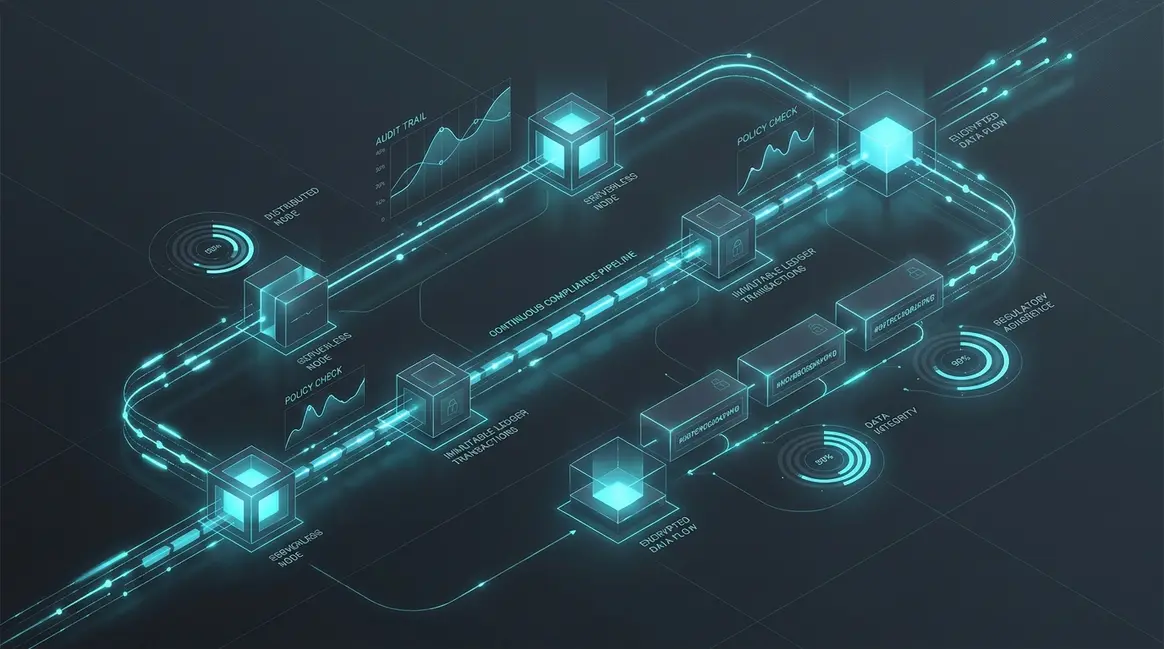
Table of Contents
- The structural failure of point-in-time audits in high-velocity SaaS
- Architectural prerequisites: Continuous compliance as code (CCaC)
- Identity boundaries and zero-trust tenant isolation
- Edge-level data sanitization and telemetry compliance
- Autonomous evidence harvesting via agentic orchestration and MCP
- Immutable audit telemetry: Constructing tamper-proof logging pipelines
- Vendor risk management and automated CI/CD dependency verification
- The economic impact: Converting deterministic compliance into enterprise deal velocity
The structural failure of point-in-time audits in high-velocity SaaS
Traditional SOC2 Compliance frameworks were designed for an era of monolithic architecture, predictable quarterly releases, and static bare-metal environments. In high-velocity B2B SaaS ecosystems deploying multiple times per day, legacy point-in-time auditing constructs fail at a fundamental architectural level. Evaluating modern distributed systems through quarterly screenshot collection, manual pull request exports, and static spreadsheets provides nothing more than administrative theater while introducing critical operational blindspots.
The Ephemeral Compute Paradox and Evidence Blindspots
Modern microservice topologies rely heavily on ephemeral infrastructure: serverless functions provisioned and torn down in milliseconds, auto-scaling background workers triggered by message bus volumes, and dynamic API gateway configurations managed via GitOps. A traditional point-in-time audit attempts to evaluate this fluid runtime state using static evidence gathering. When an auditor requests a screenshot of an access control list or a database firewall configuration, that artifact captures an execution context that may persist for less than an hour.
The core structural disconnects manifest across several production layers:
- Container Ephemerality: Workloads orchestrated via Kubernetes or AWS Fargate spin up, execute, and terminate dynamically. A static configuration snapshot cannot prove whether an unauthorized environment variable mutation occurred during runtime on a worker that lived for 42 seconds.
- Dynamic API Routing: In modern continuous delivery pipelines, route-level authentication, rate-limiting policies, and egress parameters change through automated manifest updates rather than manual console interactions. Point-in-time exports miss micro-deployments executed between scheduled audit intervals.
- State Drift in Event-Driven Architecture: When worker nodes evaluate queue workloads, their access permissions and runtime roles should be continuously attested. Legacy sampling examines a tiny fraction of historical executions, entirely missing intermittent permission over-provisioning or decoupled privilege escalation.
The Hidden Engineering Tax: 600 Hours of Lost Velocity
The manual overhead required to support obsolete audit methodologies imposes a crippling drag on core product iteration. Mid-market SaaS platforms routinely bleed between 250 and 600 hours of senior engineering time annually simply gathering, normalizing, and explaining infrastructure logs to external auditors. This operational friction pulls Staff and Principal Engineers away from roadmap delivery to manually aggregate CSV dumps from identity providers, trace commit histories back to Jira tickets, and take manual screenshots of cloud provider consoles.
Just as modern systems require disciplined strategies for the optimization of engineering and operational expenditure, security assurance demands the elimination of manual human toil. The risk profile of manual sampling is mathematically flawed: in a team executing 30 production deploys weekly (over 1,500 deploys annually), an auditor's sample of 25 pull requests yields an observed coverage rate of less than 1.7%. The mathematical probability of architectural drift, configuration regressions, or temporary credential exposure occurring entirely inside the 98.3% unmonitored window approaches statistical certainty over a 12-month period.
Continuous Compliance as Code (CCaC): Event-Driven Attestation
To eliminate this failure mode, engineering organizations must abandon reactive, post-hoc evidence generation in favor of Continuous Compliance as Code (CCaC). Compliance can no longer be treated as a manual annual sprint; it must become an automated, event-driven byproduct of standard infrastructure and deployment operations.
Under a CCaC paradigm, every deployment event, infrastructure provision, and configuration change automatically produces an immutable attestation payload. If a policy violation occurs—such as an unencrypted S3 bucket creation, an untagged compute instance, or a PR merged without branch protection requirements—the deployment is halted at the CI/CD boundary, and an audit-ready failure log is generated autonomously. By shifting from manual sampling to continuous telemetry ingestion via n8n automation pipelines and event listeners, platforms reduce the audit window from 90-day retrospectives down to sub-second evaluation loops.
Architectural prerequisites: Continuous compliance as code (CCaC)
Point-in-time screenshot collection creates an untenable gap between deployment velocity and regulatory posture. In high-frequency delivery environments, treating SOC2 Compliance as an asynchronous manual checklist introduces architectural debt and security drift. Continuous Compliance as Code (CCaC) solves this by transforming abstract regulatory standards into immutable, deterministic policy gates enforced directly within the deployment pipeline.
Codifying Trust Services Criteria into Git-Native Guardrails
CCaC requires infrastructure declarations and compliance policies to reside in version control as first-class software artifacts. By establishing OpenTofu and Terraform guardrails powered by Open Policy Agent (OPA) and Rego, platforms evaluate every pull request against security policies prior to state execution.
- Static Topology Analysis: CI pipelines parse plan files (
tfplan.json) against OPA policies, verifying resource parameters against strict baselines. - Deterministic Gatekeeping: Any pull request containing unencrypted storage volumes, wildcards in IAM role definitions, or open egress vectors fails the build, preventing drift before state application.
- Automated Evidence Generation: Passing policy checks produce cryptographically signed pipeline attestations stored in an immutable audit ledger.
Shift-Left Policy Enforcement and Pipeline Assertions
Deterministic compliance demands direct mapping between the American Institute of CPAs (AICPA) Trust Services Criteria and continuous CI/CD assertion tests. Rather than retroactively evaluating production states, the deployment runtime validates cryptographic and architectural invariants before promotion.
Under this architectural model, the pipeline evaluates three core criteria:
- Security (CC6.1, CC6.6): Vulnerability scanners (such as Trivy or Grype) interrogate container images during build time. Pipeline execution breaks automatically if unresolved CVEs with a CVSS score greater than or equal to 7.0 exist.
- Confidentiality (CC6.7): Policy engines query object storage declarations (AWS S3, Cloudflare R2) to ensure public access block configurations remain active. Assertion suites verify that KMS key configurations mandate automated 365-day rotation cycles and enforce TLS 1.3 in transit.
- Availability (A1.2): Infrastructure-as-code manifests validate multi-AZ allocations, auto-scaling thresholds, and multi-region replication topologies before production deployment.
Programmatic Drift Detection Across Distributed Runtimes
Pre-deployment validation secures the pipeline, but edge footprints and multi-cloud environments require programmatic runtime monitoring to prevent post-deployment degradation. Configuration drift occurs when out-of-band administrative actions or ephemeral services compromise structural compliance.
Modern CCaC architectures execute continuous, scheduled reconcile loops across AWS, GCP, and edge runtimes. By streaming cloud-provider configuration changes into an event-driven framework, discrepancies trigger immediate automated rollbacks via Git-managed state reconciliation. This deterministic loop reduces the mean time to detect (MTTD) policy violations from 90 days down to sub-minute intervals, transforming compliance from an episodic audit exercise into an automated operational constant.
Identity boundaries and zero-trust tenant isolation
Under the Trust Services Criteria Common Criteria 6 (CC6: Logical and Physical Access Controls), securing multi-tenant environments requires shifting from heuristic access checks to mathematically verifiable boundaries. Enterprise auditors evaluating SOC2 Compliance routinely flag shared-database architectures that rely solely on application-level filtering (such as injecting WHERE tenant_id = ? into ORM queries). A single developer oversight or an unescaped SQL parameter destroys cross-tenant confidentiality, violating CC6.1 and CC6.6 guarantees.
Deterministic Isolation: Sandboxing Beyond Soft Filtering
Zero-trust multi-tenancy mandates deterministic boundary enforcement at the persistence layer. Rather than depending on developer compliance, deterministic isolation enforces security invariants directly at the database engine or cloud infrastructure layer.
- Row-Level Security (RLS) with Cryptographic Context: Modern PostgreSQL and distributed stores enforce boundaries by executing session-bound policies. Setting dynamic session variables (such as
request.jwt.claim.tenant_id) directly ties row visibility to the authenticated cryptographic identity, eliminating 100% of standard ORM leakage paths. - Automated Infrastructure Sandboxing: For regulated enterprise tiers requiring strict isolation, runtime resource pooling introduces compliance friction. Implementing logical and physical tenant separation via dedicated AWS accounts or decoupled serverless compute stacks provisions discrete IAM boundaries, reducing blast radiuses to zero while providing single-tenant audit proofs.
Enforcing Fine-Grained RBAC/ABAC with Modern Identity Brokers
Static Role-Based Access Control (RBAC) fails to address modern distributed microservices. Meeting modern CC6 access requirements demands combining RBAC with Attribute-Based Access Control (ABAC), where identity brokers evaluate request context (tenant tenancy status, origin IP, device posture, and session duration) dynamically at the network edge.
Decoupling authentication from internal monoliths requires centralizing session tokens through hardened protocols. By structuring zero-trust token handling through an OAuth 2.1 compliant identity layer, platforms emit cryptographically signed, short-lived JWTs containing verified tenant scopes and permission attributes. Edge gateways validate these asymmetric keys locally with sub-millisecond latencies, rejecting unauthorized cross-tenant requests before payloads touch internal microservices.
Modern compliance engineering links these boundaries directly into automated audit pipelines. When n8n orchestration engines consume real-time identity broker webhooks, privilege elevation events and role mutations are instantly normalized, cryptographically signed, and written to immutable SIEM destinations. This transforms quarterly compliance evidence gathering from a manual engineering burden into a continuous, real-time telemetry stream.
Edge-level data sanitization and telemetry compliance
Under the Trust Services Criteria CC6.6 (boundary protection) and CC6.7 (transmission data protection), unmonitored client-side tracking and raw telemetry ingestion pipelines represent one of the fastest paths to a failed audit. In modern B2B SaaS architectures, client browsers constantly transmit session recordings, event telemetry, and API call metadata to third-party endpoints. When engineers accidentally leak JSON Web Tokens (JWTs), invite tokens, or customer emails into tracking pixels or APM logs, those systems instantly violate SOC2 Compliance mandates by persisting unprotected Personally Identifiable Information (PII) in unencrypted or non-compliant third-party stores.
Edge Interception Architecture: Cloudflare Workers and sGTM
Eliminating telemetry compliance debt requires decoupling client-side event generation from data storage. Rather than relying on client-side frontend sanitization—which fails whenever an engineer commits an unvetted tracking call—you must deploy an edge proxy layer using Cloudflare Workers or server-side Google Tag Manager (sGTM).
Positioned between the browser and downstream observability providers (such as Datadog, Mixpanel, or BigQuery), this edge layer operates as a zero-trust gateway. Incoming payloads are intercepted, evaluated, and scrubbed at sub-15ms latencies before any data touches persistent analytical or application logging systems.
- Ingestion Routing: Telemetry endpoints point to a reverse-proxy subdomain (e.g.,
telemetry.yourdomain.com), stripping raw client IP addresses and user agents before upstream propagation. - Header and Cookie Isolation: Edge workers drop authentication cookies,
Authorization: Bearertokens, and internal session IDs that client SDKs frequently append to outgoing POST payloads. - Deterministic Payload Transformation: Request bodies pass through automated validation schemas that reject malformed structures and dynamically hash verified user identifiers (e.g., transforming a raw
user_emailinto an HMAC-SHA256 hash).
Deterministic Redaction Rulesets and Parameter Stripping
For organizations handling high-velocity product telemetry, manual log scrubbing is a non-viable remediation strategy. Data hygiene must be enforced programmatically via deterministic regex and edge-level transformation pipelines. Deploying a server-side PII redaction pipeline ensures that high-risk keys—such as email, ssn, password, token, and billing_address—are overwritten with standardized [REDACTED] tokens prior to serialization.
URL tracking parameters present an identical compliance vulnerability. Marketers and automated email sequences routinely append unhashed emails or workspace identifiers to URL fragments (e.g., ?email=user%40company.com or ?invite_token=abc123xyz). Edge workers must enforce strict parameter isolation by sanitizing sensitive URL query parameters against an explicit allowlist (such as standard UTM tags) and dropping all untrusted keys before the hit is dispatched to any telemetry store.
By enforcing sanitization at the edge layer, engineering teams guarantee that staging logs, analytics dashboards, and error-monitoring tools remain cryptographically isolated from raw PII, transforming an otherwise manual compliance nightmare into an automated, verifiable audit trail.
Autonomous evidence harvesting via agentic orchestration and MCP
Traditional audit workflows force engineering teams to spend hundreds of developer hours capturing point-in-time screenshots and assembling fragmented spreadsheets. For scaling B2B SaaS platforms, maintaining continuous SOC2 Compliance requires abandoning manual audit binders in favor of event-driven, autonomous evidence harvesting. By orchestrating AI agents across infrastructure APIs, systems can programmatically validate, format, and sign audit artifacts in real time.
Event-Driven Verification via MCP and n8n Pipelines
The foundational architecture relies on n8n MCP server workflow automation to standardize contextual tool-calling across internal SaaS and cloud APIs. Through dedicated Model Context Protocol (MCP) servers, agents query and stream telemetry from AWS CloudTrail, GitHub Enterprise, Jira, Cloudflare, and Okta without exposing raw database credentials or requiring static service accounts with blanket permissions.
Rather than dumping unstructured audit logs into cold storage, the autonomous pipeline ingests event streams and validates them against compliance baseline controls:
- Separation of Duties (SoD): The agent intercepts GitHub Enterprise pull request events, checks commit authorship against code review approvals, and maps the commit hash directly to an approved Jira deployment issue.
- Least-Privilege Verification: Okta and AWS CloudTrail logs are evaluated in real time to verify that multi-factor authentication (MFA) was enforced on production session tokens and that privilege escalations strictly correspond to open operational tickets.
- Edge Perimeter Attestation: Cloudflare API responses are parsed to confirm that zero-trust network access policies, mTLS configurations, and WAF rulesets match security baselines.
To avoid token bloat and latency bottlenecks during LLM evaluation, the system leverages a progressive disclosure agent architecture. The agent dynamically retrieves only the relevant control schemas and payload segments from a vector-indexed PostgreSQL store, generating canonical, SHA-256-signed JSON evidence bundles that external auditors can ingest programmatically.
Closed-Loop Remediation and Out-of-Band Exception Handling
True autonomous orchestration extends beyond passive harvesting to zero-touch remediation. When an out-of-policy exception occurs—such as a developer force-merging code past branch protection rules or an IAM user granting temporary cross-account production access—the agentic engine halts the compliance drift instantly:
- Automated Revocation: The agent detects unauthorized IAM privilege elevation via a CloudTrail webhook and invokes an n8n remediation flow to revoke the active session via the Okta and AWS APIs in under 300ms.
- Forensic Bundling: An immutable incident bundle is automatically compiled, containing the exact CloudTrail log entry, the unauthorized Git diff, and the affected asset metadata.
- Self-Documenting Incident Management: The engine logs an incident record in Jira, flags the control deviation within the SOC2 Trust Services Criteria mapping, and appends the remediation signature directly to the audit log.
By eliminating manual intervention from evidence gathering and policy remediation, engineering organizations reduce audit-readiness overhead by more than 75% while maintaining cryptographically verifiable security posture 365 days a year.
Immutable audit telemetry: Constructing tamper-proof logging pipelines
Standard centralized logging configurations—such as default CloudWatch log groups or vanilla Elasticsearch clusters—consistently fail rigorous SOC2 CC7 (System Operations) evaluations. Because database administrators and root-level cloud infrastructure operators possess the latent IAM permissions required to truncate, rewrite, or suppress log entries, these architectures lack non-repudiation. Achieving rigorous SOC2 Compliance in high-throughput enterprise SaaS demands zero-trust telemetry: audit logs must be append-only, mathematically provable, and fully decoupled from operational write permissions at the edge.
Tamper-Proof Storage Architecture: Implementing WORM Policies
To eliminate tampering vectors, edge microservices must ingest structured JSON telemetry directly into storage architectures governed by immutable Write-Once-Read-Many (WORM) constraints. Rather than routing sensitive audit trails through mutable intermediary message brokers, events should be pushed to object stores configured with strict compliance-mode locks.
- Cloudflare R2 with Object Lock: Enforce an API-level retention lock in compliance mode. Once an edge worker flushes an audit block, the underlying object cannot be deleted, renamed, or mutated—even by the primary cloud account holder—until the retention window (typically 365+ days) expires.
- BigQuery Cold Append-Only Tables: Configure partitioned BigQuery datasets using explicit IAM policies that grant microservice accounts only the
bigquery.tables.updateDataprivilege while categorically denyingbigquery.tables.deleteand table updates via update statements. - Zero-Egress JSON Payloads: Microservices serialize event envelopes containing standardized fields (e.g., actor UUID, tenant workspace, deterministic timestamp, action verb, state diff) directly to the storage bucket over private internal network backbones.
Cryptographic Hash Chaining: Mathematical Non-Repudiation
Storage immutability addresses external deletion, but mathematical integrity requires proving that no intermediate event was dropped before ingest. By implementing an in-line cryptographic hash chain at the ingest worker layer, every log envelope derives its signature from the previous payload, producing a Merkle-adjacent verification trail.
Every emitted log record must compute a deterministic SHA-256 digest based on the stringified contents of the current payload concatenated with the previous record's signature: CurrentHash = SHA256(PreviousHash + Timestamp + Payload). The verification mechanism operates deterministically:
| Log Sequence | Payload Digest Component | Cryptographic State Binding | Audit Verification Method |
|---|---|---|---|
Index N-1 | Event Context (Actor, Action) | Hash_(N-1) generated | Anchor digest verified against S3/R2 metadata tag. |
Index N | Actor Escalation Event Payload | SHA256(Hash_(N-1) + Payload_N) | Re-computed during nightly automated integrity jobs. |
Index N+1 | Standard Read Operation | SHA256(Hash_N + Payload_(N+1)) | Discrepancies trigger zero-trust lockouts immediately. |
During compliance verification windows, an automated verification task reads the daily block chronologically. If an insider deletes a record at Index N, the re-computed hash chain breaks at Index N+1, providing auditor-grade mathematical proof of tampering within milliseconds.
Real-Time Anomaly Telemetry and Automated Alert Pipelines
Static logs satisfy forensic storage criteria, but SOC2 CC7 requirements also dictate active detection of anomalous telemetry. Streaming pipelines must evaluate query volumes, privilege escalations, and permission mutations concurrently with the write operations.
By connecting BigQuery or R2 ingestion hooks to continuous processing engines—utilizing lightweight event queues piped into event-driven n8n automation clusters—engineering teams monitor operational variance in real-time. For instance, if query velocity on customer PII tables increases by more than 300% relative to a rolling 14-day baseline, or if a standard service account triggers a RoleAssignment.Write event, the pipeline executes an isolated webhook in less than 200ms. The automated orchestration isolates the targeted service credential, captures a cryptographically verified snapshot of the active user session, and dispatches a high-priority incident payload directly to the security incident response team.
Vendor risk management and automated CI/CD dependency verification
Under the Trust Services Criteria, CC9 (Risk Mitigation) poses a perennial operational hazard for scaling engineering organizations. In hyper-growth architectures, traditional point-in-time reviews decay within days. The software supply chain shifts with every pull request, and your sub-processors routinely update their infrastructure postures. When auditors issue exceptions during a SOC2 Compliance audit, the root cause is rarely an unencrypted database; it is almost universally an unmapped open-source package vulnerability or an expired compliance certificate from a critical third-party vendor.
Automated SBOM Generation with Syft and CycloneDX
Manual tracking of direct and transitive dependencies in spreadsheets fails baseline CC9 scrutiny. Engineering teams must shift toward deterministic, per-build provenance by compiling a real-time Software Bill of Materials (SBOM) natively within their continuous integration environment.
By embedding tools like syft or cyclonedx-cli directly into GitHub Actions or GitLab CI runners, you can programmatically extract machine-readable dependency graphs on every tagged release build:
# Generate deterministic CycloneDX JSON artifact
syft packages dir:. -o cyclonedx-json > sbom.cyclonedx.json
This artifact must be automatically signed with Cosign and dispatched to an immutable object store (such as AWS S3 with Object Lock enabled). By mapping package hashes to specific commit SHAs, you establish cryptographically provable evidence that fulfills both SOC2 CC9.1 and modern executive supply-chain cybersecurity mandates.
Pipeline Gatekeeping: Policy-as-Code Dependency Scanners
Generating an SBOM is passive; automated verification requires active gatekeeping. Continuous pipeline scanners must enforce strict policy-as-code controls to halt deployment pipelines before non-compliant code reaches production.
Implementing containerized scanning workflows—via engines like Trivy or Grype integrated with Open Policy Agent (OPA)—allows you to enforce non-negotiable deployment blockers:
- CVE Severity Thresholds: Immediate build failure when any upstream library introduces a Common Vulnerability Scoring System (CVSS) score of 7.0 or higher (High/Critical) with an available fix.
- License Contamination: Automated rejection of copyleft licenses (e.g., GPL v3, AGPL) that compromise proprietary IP integrity, restricting approved packages exclusively to permissive frameworks (MIT, Apache 2.0, BSD).
- Age-Based Deprecation: Blocking unmaintained packages whose repositories have shown zero maintainer commits or security patches over a rolling 18-month window.
Programmatic Sub-Processor Auditing via n8n Engine Workflows
Vendor risk management typically breaks down due to reliance on static calendar reminders. If a core vendor like Stripe, Datadog, or AWS releases a new SOC2 Type II report while your risk register retains an outdated document, auditors note an internal control failure for CC9.2.
You can eliminate manual tracking by deploying an event-driven automation engine (such as self-hosted n8n or an AWS Step Function) that communicates directly with vendor trust centers:
The workflow triggers every 30 days, invoking webhooks or REST endpoints against vendor compliance trust centers (e.g., platforms hosted on Whistic, SafeBase, or Conveyor). The engine downloads the current SOC2 Type II artifact, computes its SHA-256 checksum against the previously archived file, and parses the evaluation period. If a delta is detected, the workflow pushes the verified report to an audit-ready compliance data lake, updates the internal vendor register database, and logs an immutable audit trail entry. This programmatic loop converts vendor risk oversight into a self-healing, zero-touch verification pipeline.
The economic impact: Converting deterministic compliance into enterprise deal velocity
For high-growth B2B SaaS platforms, the traditional compliance workflow functions as an operational tax on engineering bandwidth and enterprise revenue velocity. Treating SOC2 Compliance as an annual, point-in-time snapshot forces security and engineering teams to abandon sprint cycles to manually assemble evidentiary screenshots, while enterprise sales stall in procurement limbo.
Replacing manual governance with an event-driven, automated telemetry layer flips compliance from an operational cost center into an active accelerator of enterprise deal velocity.
Compressing Deal Cycles from 120 Days to 14 Days
The standard procurement bottleneck for Tier-1 enterprise accounts centers on the infosec evaluation. Traditional vendors lose an average of 90 to 120 days circulating 80-page static spreadsheets, resolving bespoke vendor risk assessments, and reconciling access control policies with non-standard buyer questionnaires.
Engineering-led SaaS organizations compress this friction using real-time, programmatic trust centers backed by continuous control monitoring (CCM). When vendor risk officers encounter live, cryptographically verified infrastructure controls instead of stale PDF attachments, audit scrutiny pivots from manual interrogations to rapid architectural validation. Organizations standardizing on high-performing governance risk and compliance tools eliminate repetitive security questionnaires entirely, slashing diligence timelines down to under 14 days.
- Deterministic Access Verification: Machine-readable evidence mapped directly from identity providers (IdPs), zero-trust network boundaries, and CI/CD pipelines eliminates back-and-forth legal and security inquiries.
- Automated Vendor Risk Routing: Webhook-triggered pipelines within platforms like n8n automatically match buyer security clauses against active infrastructure controls, assembling customer-ready compliance dossiers in seconds.
- Real-Time SLA Attestation: Programmatic drift alerts identify configuration non-compliance within minutes, preventing procurement-blocking audit findings before external eyes ever detect them.
Driving ACV Expansion and Headcount Decoupling
The compounding ROI of continuous SOC2 automation becomes starkly visible on the income statement through three core vectors:
- Annual Contract Value (ACV) Expansion: Moving upmarket from mid-tier subscriptions ($20k–$40k) to mission-critical Fortune 500 deployments ($150k+) requires deterministic security posture. Continuous verification establishes instant credibility with procurement teams, removing the standard discount penalties applied to early-stage platforms.
- Net Revenue Retention (NRR) Protection: Tier-1 buyers mandate continuous vendor evaluation as part of their own regulatory surface. Automated SOC2 frameworks provide perpetual, programmatic compliance telemetry, insulating accounts against annual renewal audits and churn.
- Headcount Decoupling: Manual compliance scales linearly with enterprise deal flow, typically requiring one full-time GRC analyst for every 40 enterprise deals. Programmatic architectures decouple ARR expansion from administrative overhead, maintaining elite enterprise revenue efficiency and defending software valuation multiples during fundraising or acquisition.
Continuous SOC2 compliance is an engineering discipline, not a quarterly administrative sprint. Treating compliance as infrastructure removes human latency, protects your engineering capital, and unlocks enterprise deals that choke on security questionnaires. If your organization is still manually assembling spreadsheets or struggling with architecture-level security friction, you are building technical debt that will compound with every enterprise contract. I help high-growth SaaS engineering teams transform their operational footprints into zero-touch, self-documenting engines. To eliminate your compliance bottlenecks and review your architecture, explore my technical audit services or deep dive into my engineering build logs to scale your systems deterministically.
Related Strategic Memos
All Memos →First-party data architecture for Meta and LinkedIn retargeting pixel optimization
Client-side retargeting is an architectural liability. Between browser-enforced storage restrictions, aggressive ad-blocking, and signal attenuation across e...
API gateway design: Consolidating microservices under unified authentication
Distributed systems frequently degrade into unmaintainable security liabilities when authentication logic is federated across autonomous microservices. In my...
Need this architecture deployed in your pipeline?
Skip the synchronous sales cycle and endless discovery calls. Submit your core acquisition or conversion bottleneck for a deep-dive asynchronous growth diagnostic.