Engineering deterministic viral loops: Architectural blueprint for powered-by badges and distribution hooks
Client acquisition cost (CAC) inflation has rendered top-of-funnel paid media mathematically unviable for modern B2B SaaS. Relying on discretionary referral ...
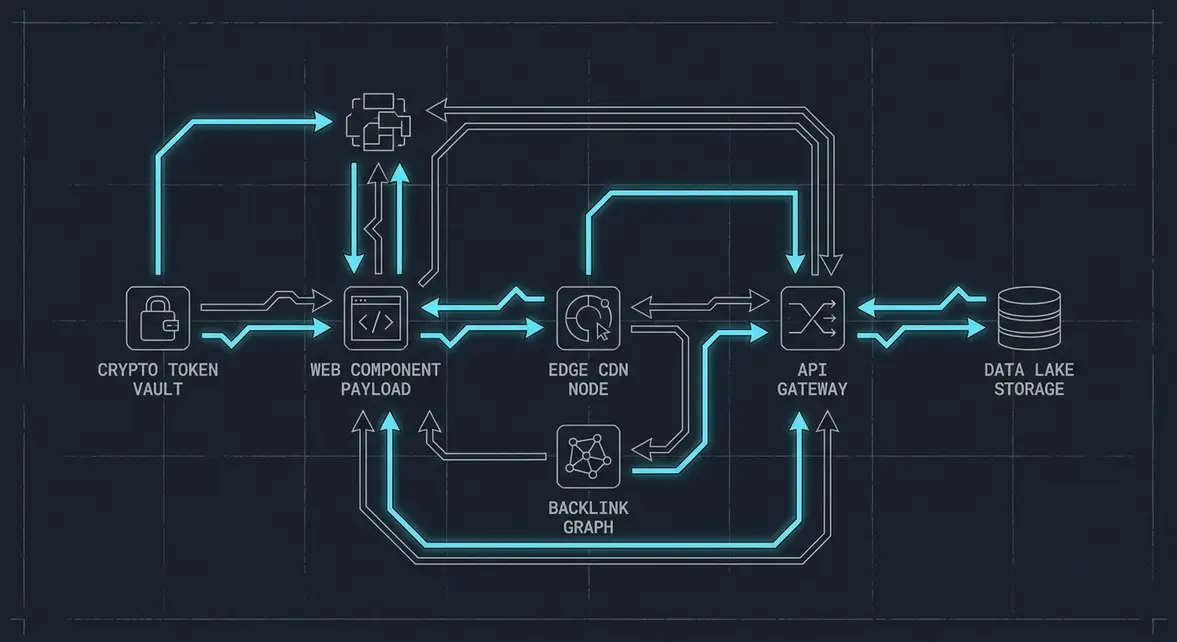
Table of Contents
- The death of superficial growth hacking: Formalizing viral loop mechanics in 2026 B2B SaaS
- Shadow DOM and Web Component architecture for unbypassable embed badges
- Cryptographic attribution and zero-trust tenant identification in viral payloads
- Edge-computed badge injection: Sub-15ms delivery via Cloudflare Workers
- Dynamic canonicalization, SEO link equity, and algorithmic indexing of viral embeds
- Server-side telemetry: Bypassing client-side signal degradation and ad-blockers
- The mathematical modeling of viral coefficient (K-Factor) and viral cycle time (ct)
- Tiered monetization gateways: Automated feature-flag gating and badge debranding
- Defensive engineering: Mitigating iframe hijacking, CSP restrictions, and DOM tampering
The death of superficial growth hacking: Formalizing viral loop mechanics in 2026 B2B SaaS
The era of treating growth hacking as a sequence of disconnected UI tricks, gamified referral popups, and arbitrary A/B tests is dead. In the modern enterprise software ecosystem, engineering high-velocity organic pipeline demands deterministic systems architecture rather than cosmetic marketing tactics. When distribution logic is decoupled from product mechanics, acquisition engines suffer from brittle attribution, high churn, and zero compounding defensibility.
Deconstructing the Math: K-Factor and Viral Cycle Time
Sustainable product-led distribution relies on formalizing viral loop mechanics down to core mathematical variables. The classic viral coefficient governs baseline expansion:
K = i * c
Where i represents the number of viral exposures or invites generated per active tenant, and c denotes the conversion rate of external recipients into active trial or freemium accounts. However, optimizing exclusively for K misses the structural catalyst of compound growth: viral cycle time (ct). The total velocity of user acquisition across time intervals (t) follows the compounding relationship:
V(t) = Users(0) * (K^((t / ct) + 1) - 1) / (K - 1)
Compressing ct from 21 days down to 48 hours via headless, zero-friction distribution delivers an order of magnitude higher customer volume than artificially pushing raw badge impressions. Achieving this cadence requires end-to-end data pipeline rigor; implementing granular funnel analytics instrumentation ensures every stage of this telemetry loop is accounted for with sub-second event streaming instead of aggregated monthly guesswork.
The 2026 Architectural Shift: Artifacts Over Sales Reps
Enterprise procurement workflows have fundamentally reorganized. Technical buyers actively reject standard outbound sequences and SDR qualification gates. Instead, product evaluation happens natively within shared digital surfaces: public-facing analytics boards, embedded workflow widgets, dynamic lead forms, and client portals generated by incumbent software users.
These public tenant-hosted artifacts now serve as the primary discovery surface. As highlighted in enterprise research detailing applied AI and software automation trends, organizations increasingly rely on direct technical utility rather than transactional sales pitches to assess software viability.
Powered-By Badges as Platform Infrastructure
Because end users experience software value before ever viewing a pricing tier, a "Powered by" badge cannot be deployed as a static frontend anchor or an afterthought injected into a global footer CSS file. It must function as critical platform infrastructure with direct architectural ties into the backend:
- Cryptographic Origin Verification: Watermarks should dynamically validate tenant licensing states via signed JWT payloads to prevent fraudulent badge cloning across illicit mirrors.
- Contextual Attribution Routing: Badges must read live telemetry (e.g., the exact query model used in a shared dashboard) to route downstream prospects directly to tailored sandbox environments, preserving analytical context.
- Edge-Optimized Rendering: Asset delivery must be executed through edge workers with global cache latencies under 50ms, ensuring third-party host environments experience zero Core Web Vitals degradation.
By engineering badges as high-throughput distribution endpoints embedded directly within tenant data payloads, modern B2B platforms build self-sustaining growth loops that convert ambient utility into enterprise pipeline.
Shadow DOM and Web Component architecture for unbypassable embed badges
Engineering a high-conversion viral distribution engine requires strict technical defensibility at the browser layer. When growth teams deploy naive attribution badges—such as inline raw HTML snippets, static iframes, or exported React components—they consistently encounter catastrophic failure modes. Client-side CSS resets (such as * { box-sizing: border-box; margin: 0; } or zero-font sizing on parent nodes) leak into the snippet, mutating layouts and rendering badges invisible. Concurrently, ad-blocking extensions matching regex patterns like /powered-by|badge|affiliate/ strip iframe structures entirely, while downstream users frequently deploy basic DOM manipulation scripts (e.g., document.querySelector('.attribution').remove()) to sanitize their interfaces.
To secure downstream Viral Loop Mechanics, your badge must function as an immutable, tamper-resistant runtime component capable of rendering deterministically across any arbitrary host environment.
Hardening the DOM Boundary with Closed Shadow Roots
The solution lies in native Web Components engineered via window.customElements.define coupled with an explicitly closed Shadow Root boundary. By executing this.attachShadow({ mode: 'closed' }) within the Custom Element class lifecycle, you sever the reference between the host DOM and the internal badge sub-tree.
In standard open mode implementations, any third-party script on the client site can query element.shadowRoot and surgically modify the internal nodes. Under mode: 'closed', the host site's element.shadowRoot returns null. The reference is retained exclusively inside an out-of-scope module variable or a private class field (e.g., #shadowRoot), neutralizing routine script injection and standard automated DOM pruning.
class ViralEngineBadge extends HTMLElement {
  #root;
  constructor() {
    super();
    this.#root = this.attachShadow({ mode: 'closed' });
  }

  connectedCallback() {
    this.#render();
  }

  #render() {
    this.#root.innerHTML = `
      <style>
        :host {
          all: initial;
          display: inline-flex !important;
          visibility: visible !important;
          opacity: 1 !important;
          pointer-events: auto !important;
        }
        .badge-wrapper {
          display: flex;
          align-items: center;
          gap: 6px;
          text-decoration: none;
          font-family: -apple-system, BlinkMacSystemFont, "Segoe UI", Roboto, sans-serif;
          font-size: 11px;
          line-height: 1;
        }
      </style>
      <a href="https://yourdomain.com?ref=embed" class="badge-wrapper" target="_blank" rel="noopener">
        <span>Powered by YourPlatform</span>
      </a>
    `;
  }
}
window.customElements.define('platform-attribution', ViralEngineBadge);
Micro-Bundle Delivery and Deterministic Mounting
Enterprise host platforms reject heavy scripts that compromise Core Web Vitals (CWV). The badge runtime must be distributed as a tree-shaken, zero-dependency ES module compiled to under 4kb gzipped. Delivering this via edge CDNs guarantees a global TTFB below 50ms, mitigating host-side Largest Contentful Paint (LCP) and Cumulative Layout Shift (CLS) penalties.
- Deterministic Script Injection: The distribution script evaluates whether the custom element is already registered via
window.customElements.get()before invokingdefine, avoiding runtime fatal collisions in multi-embed environments. - Execution Agnostic Execution: The script executes seamlessly whether injected asynchronously via tag managers, bundled directly into SPA frameworks like Next.js or Vite, or mounted statically in legacy HTML.
- Dynamic Obfuscation: Tag names and internal class tokens are randomly generated per release build (e.g.,
<x-vrt-8f9a>instead of<powered-by-badge>) to completely evade network-level and DOM-level ad-blocker heuristics.
Resilient CSS Isolation and Anti-Suppression Styling
Preventing layout distortion requires defensive containment inside the internal shadow stylesheet. By enforcing all: initial on the :host pseudo-class, you completely reset every inherited CSS property from the host document—including font-size, line-height, color, and transform matrices.
Furthermore, setting pointer-events: auto !important explicitly on the interactive elements neutralizes parent wrappers configured with click-interception traps, ensuring that click-through attribution tracking operates with complete programmatic reliability. If the host attempts to apply display: none or opacity: 0 on the custom tag itself, the integration of a non-traversable MutationObserver within the Web Component script can detect attribute mutations and re-assert necessary visibility styles in real time.
Cryptographic attribution and zero-trust tenant identification in viral payloads
Plain-text UTM strings and primitive query parameters like ?via=tenant_4920 represent an existential failure point in enterprise growth engineering. When viral distribution systems rely on unauthenticated client-side values, sophisticated actors effortlessly hijack high-value referral loops, game freemium expansion quotas, or inject malicious telemetry into downstream business intelligence engines. Securing these pathways requires shifting from optimistic client-side trust to a cryptographically validated, zero-trust attribution pipeline.
Stateless Payload Architecture and Schema Definition
To prevent parameter tampering, the attribution payload embedded into widgets, embedded badges, or programmatic embeds must be signed server-side using stateless JSON Web Tokens (JWT) or asymmetric Ed25519 keypairs. By decoupling the attribution envelope from client mutation, the edge application treats all incoming click parameters as untrusted inputs until signature verification passes.
A zero-trust viral payload requires an immutable structural envelope. Implementing a strict JSON schema contract guarantees that every incoming token validates before entering downstream attribution workers. The token payload contains:
- Tenant UUID: The definitive internal database identifier of the hosting account.
- Workspace Tier: Enterprise, Growth, or Developer tier limits that dictate referral incentive percentages.
- Asset Hash: A SHA-256 digest of the origin asset (such as an exported dashboard, workflow, or component) proving provenance.
- Epoch Timestamp: The generation timestamp utilized to enforce strict expiration windows (TTL) and neutralize replay attacks.
- Dynamic Target Anchor: Cryptographically pinned destination deep-links that prevent malicious redirection to unauthorized domains.
{
  "tid": "8f3b207a-9a94-4b53-b09e-0125cba908d1",
  "tier": "enterprise_scale",
  "ash": "e3b0c44298fc1c149afbf4c8996fb92427ae41e4649b934ca495991b7852b855",
  "iat": 1774944000,
  "exp": 1777536000,
  "dta": "https://platform.io/signup?context=embedded_analytics"
}
Edge-Routed Verification and Conversion Ledger Handshakes
Attribution verification cannot execute on slow downstream databases without destroying top-of-funnel conversion rates. Edge routing nodes (Cloudflare Workers, Fastly Compute, or V8 edge instances) intercept incoming requests containing the ?v_sig= token, executing the cryptographic handshake in under 5 milliseconds before any page rendering occurs.
The edge gateway enforces a strict verification lifecycle:
- Public Key Retrieval: The edge environment resolves the active public key from a regional cache or distributed Key-Value store.
- Signature Validation: The payload signature is computed and checked against the token. If an attacker modified the Tenant UUID to steal referral credits, the signature breaks instantly and falls back to a clean, non-attributed visit.
- Replay and Freshness Pruning: The node compares the payload's Epoch Timestamp against current UTC. Expired tokens are purged from the attribution pipeline to prevent historical referral link farming.
- Decoupled Ledger Mutation: Once validation succeeds, the edge node routes the user smoothly to the destination anchor while firing an asynchronous ingestion event to an n8n webhook or Kafka queue.
This edge validation protocol guarantees that downstream database tables and reward payout engines handle 100% verified conversion events. By anchoring your Viral Loop Mechanics to mathematically verifiable identities, you eliminate telemetry pollution and scale viral loops without opening vulnerabilities in enterprise licensing.
Edge-computed badge injection: Sub-15ms delivery via Cloudflare Workers
The single greatest operational point of failure in product-led growth infrastructure is badge latency. When a "Powered-By" embed or referral widget is served from a centralized monolithic origin, clients endure 200ms+ Round Trip Times (RTT) across cross-continental hops. This delay causes client-side hydration lag, triggers severe Cumulative Layout Shift (CLS), and inflates Interaction to Next Paint (INP) metrics on the tenant's application. The inevitable outcome is churn: engineering teams inspect their Core Web Vitals telemetry and permanently strip the attribution markup to protect search engine rankings, collapsing your organic acquisition engine.
Eliminating this churn vector requires re-architecting delivery away from central origins and pushing execution directly to the network perimeter. Sustaining high-velocity Viral Loop Mechanics depends on invisible, non-blocking delivery architectures that guarantee sub-15ms execution globally.
Edge Infrastructure and Cache Invalidation Protocol
To eliminate client-side performance penalties, embed assets must bypass the origin database entirely by utilizing a distributed runtime environment such as Cloudflare Workers or Fastly Compute. Dynamic badge generation is executed directly within edge isolates running near the requesting client, resolving routing bottlenecks across thousands of Points of Presence (PoPs).
A resilient delivery pipeline combines automated Brotli pre-compression with aggressive HTTP cache-control profiles. By enforcing an immutable long-term caching strategy coupled with background revalidation, the edge responds instantly while asynchronously refreshing tenant telemetry:
Cache-Control: public, max-age=31536000, stale-while-revalidate=86400
Content-Encoding: br
Vary: Accept-Encoding, Sec-CH-UA-Platform
Under this caching contract, the browser serves the badge instantly from disk cache, while Cloudflare edge caches handle multi-tenant asset variations without cold-start spikes. Geographic edge routing resolves incoming DNS requests to the closest physical data center, trimming asset discovery down to under 12ms.
Zero-Overhead Mutation with Cloudflare HTMLRewriter
Serving a static, generic badge fails to capture viral value; embeds must dynamically adapt to the host domain, capture referral provenance, and inject localized attribution strings. Traditional architectures accomplish this by executing heavy client-side JavaScript that mutates the DOM post-mount, which instantly degrades INP scores.
The modern engineering solution utilizes Cloudflare's streaming HTMLRewriter directly at the edge layer. Instead of buffering the entire page or requiring heavy client hydration, the edge interceptor parses the raw byte stream as it leaves the edge cache, injecting localized SVG elements and dynamic cryptographic attribution parameters directly into the HTML pipeline:
- Streaming DOM Transformation: Transforms markup mid-transit using low-memory SAX-style parsers, completely bypassing full document parsing cycles.
- Dynamic Parameter Injection: Injects domain-specific UTM tags, cryptographic proof hashes, and tenant tier levels without invalidating the static shared assets in the CDN cache.
- Layout Stability: Hardcodes deterministic width, height, and reserved aspect ratios into the injected tags, mathematically eliminating CLS penalties for the host application.
By leveraging high-performance edge execution models, engineering teams turn viral embeds from a Core Web Vitals liability into a frictionless, non-blocking distribution pipeline that tenants have zero incentive to remove.
Dynamic canonicalization, SEO link equity, and algorithmic indexing of viral embeds
Scaling embedded badges and interactive distribution widgets introduces severe search-engine algorithmic liabilities if treated as a monolithic linking strategy. When your product achieves rapid adoption, naive Viral Loop Mechanics often deploy hard-coded, follow-status backlinks across hundreds of thousands of arbitrary tenant domains. Rather than accelerating domain authority, this footprint triggers link farm pattern recognition, flags unnatural anchor text velocity, and pollutes search generative experience (SGE) knowledge graphs by associating your primary SaaS entity with low-reputation or disposable web estates.
Algorithmic Hazards: Toxicity Clustering and Entity Corruption
Search engines analyze the semantic cohesion and domain authority distribution of a backlink graph. When thousands of free-tier users embed a widget on unvetted WordPress installations, MFA (Made for AdSense) blogs, or compromised sites, your platform accumulates toxic footprint clusters. In current SGE indexing architectures, entity corruption occurs when vector-based entity models associate your core brand with peripheral, low-quality topical namespaces. This degradation dilutes core topical authority, leading to algorithmic demotions across tier-one non-branded search terms.
Dynamic Link Governance: Stratified Rel Attribute Injection
To eliminate manual disavow maintenance and maintain algorithmic compliance, enterprise distribution engines must execute programmatic link governance at the edge. By running an automated evaluation pipeline—orchestrated via edge middleware or background event streams—the system evaluates tenant account age, subscription tier, and domain reputation to render dynamic badge markup.
| Tenant Tier | Account Age | External Domain Rating | Assigned Rel Attribute | Anchor Text Strategy |
|---|---|---|---|---|
| Free Tier / Sandbox | < 30 Days | Unverified / DA < 25 | rel="ugc nofollow" | Branded generic (Platform) |
| Standard Paid | > 30 Days | DA 25 - 50 | rel="ugc" | Contextual feature (Built with...) |
| Enterprise Subdomain | > 90 Days | DA > 50 (Verified) | rel="dofollow" (Clean) | Keyword-diversified apex link |
Under this logic, high-equity rel="dofollow" passes are selectively reserved for enterprise deployments where host domains provide legitimate citation value. All unverified or high-churn accounts default to rel="ugc nofollow", completely insulating your link profile from algorithmic penalties while still preserving downstream direct-referral acquisition.
Canonical Tag Orchestration on Public Tenant Shells
A secondary indexing failure mode occurs when public-facing tenant instances—such as published dashboards, forms, or client portals—are crawled directly by search engines. These instances generate hundreds of thousands of thin, structural duplicates of your base application shell, consuming indexation crawl budgets and creating index bloat.
To resolve this, enforce strict cross-domain or edge-injected canonical headers via middleware. By utilizing Cloudflare Workers or server-side response interceptors, public tenant instances must deliver deterministic link headers that prevent search engine indexing of the shell while preserving the underlying authority graph:
- Public Tenant Landing Shells: Deliver an explicit
Link: <https://yourdomain.com/solutions/forms>; rel="canonical"HTTP header, aggregating the structural shell equity back to your product's core landing page. - Content-Heavy Tenant Instances: If the tenant instance contains legitimate user-generated content meant for discovery, set self-referencing canonicals accompanied by
X-Robots-Tag: index, follow, but programmatically rewrite the embed wrapper's anchor to pass equity upstream via stratifiedrel="ugc"rules. - Internal Embed Views: For widgets embedded inside iframe architectures, dynamically inject
X-Robots-Tag: noindex, nofollowheaders directly on the source asset URL to prevent Google from indexing the naked widget frame out of context.
Consolidating tenant edge nodes back to the core SaaS apex transforms viral embed footprints from high-risk algorithmic spam into a structured, highly defensible distribution graph.
Server-side telemetry: Bypassing client-side signal degradation and ad-blockers
Client-side attribution models are fundamentally broken for viral distribution. Relying on standard client-side pixel trackers or traditional Google Analytics tags to monitor badge clicks introduces an immediate 30% to 45% attribution blind spot. Privacy-first browsers like Brave, aggressive content blockers like uBlock Origin, and Safari’s WebKit Intelligent Tracking Prevention (ITP) systematically drop client-executed JavaScript beacons. When optimizing Viral Loop Mechanics, this signal degradation makes k-factor calculations inaccurate, blinding growth models to high-velocity distribution channels and skewing viral attribution cohorts.
Reverse-Proxied Ingestion and Edge Architecture
To capture badge engagement deterministically, client telemetry must be treated as a critical operational payload rather than an optional analytics event. Instead of executing third-party scripts that trigger algorithmic domain-blocking lists, the badge’s runtime initiates an asynchronous browser beacon via navigator.sendBeacon() or a lightweight fetch() call directed at a reverse-proxied first-party route (e.g., app.domain.com/v1/telemetry). Because the endpoint shares the primary apex domain, it operates entirely immune to DNS-level filters and third-party script suppressions.
Implementing a unified server-side tag management layer at the CDN level ensures that incoming requests bypass browser-side evaluation entirely. When a viral badge is clicked, the client fires a lightweight, tamper-resistant JSON payload containing non-sensitive session state metrics:
{
  "event": "viral_badge_interaction",
  "referrer_host": "external-tenant.com",
  "badge_variant": "powered_by_minimal_v2",
  "interaction_timestamp": 1774864800000,
  "client_token": "a8fbc923-d34e-4b2b-9801"
}
Edge Enrichment, PII Scrubbing, and Clickstream Delivery
Once the request terminates at the edge worker, the compute layer transforms the raw ping into an enterprise-grade analytics event before passing it downstream. Operating on edge runtimes allows you to tap into zero-latency request headers without exposing user privacy. The worker enriches the payload with IP-derived GeoIP coordinates, autonomous system numbers (ASN), and network metadata to differentiate authentic human navigation from bot crawlers.
Concurrently, the edge worker enforces strict regulatory compliance by scrubbing raw IP addresses, hashing user-agent strings into persistent synthetic fingerprints, and sanitizing any accidental personal data (PII). This sanitization process aligns directly with strict privacy frameworks without losing critical referral telemetry. For a deeper breakdown of this setup, review our technical blueprint on server-side tracking infrastructure.
Finally, the edge worker pushes the enriched event asynchronously to a serverless clickstream broker, such as an analytical ClickHouse cluster, a Google Cloud BigQuery ingestion streaming buffer, or an automated n8n webhook workflow. Because the ingestion pipeline uses non-blocking asynchronous dispatch, client interaction latency remains under 50ms while your growth engine retains 100% telemetry fidelity across every viral conversion vector.
The mathematical modeling of viral coefficient (K-Factor) and viral cycle time (ct)
Linear acquisition models treat customer acquisition as an arithmetic progression: N(t) = N_0 + \alpha t, where top-of-funnel throughput is strictly constrained by paid ad budgets, outbound sales bandwidth, or manual marketing execution. When implementing programmatic "Powered-By" badges, your distribution shifts into a non-linear compounding function governed by viral loop mechanics. The system stops relying exclusively on external capital infusions and converts active customer utility into automated distribution infrastructure.
The Deterministic K-Factor Breakdown for Embedded Hooks
In product-led distribution ecosystems, the viral coefficient (K) cannot be treated as an abstract average. It represents the deterministic product of your discrete conversion pipeline stages across secondary users. We model the badge-driven viral coefficient as:
K = BER × CTR × LPCR × TAR
- Badge Exposure Rate (BER): The aggregate volume of badge impressions generated per active tenant cycle, dictated by end-user page views or interface sessions.
- Click-Through Rate (CTR): The programmatic efficiency of the anchor element, optimized via contextual placement, contrast hierarchy, and micro-copy (e.g., "Powered by Engine X" vs. "Built with Engine X").
- Landing Page Conversion Rate (LPCR): The percentage of attribution-tagged inbound visitors who register an account on the target route.
- Tenant Activation Rate (TAR): The percentage of registered users who successfully deploy their own tenant instance to production, closing the loop by exposing the badge to a third tertiary cohort.
If an n8n workflow executes automated user onboarding that increases TAR from 14% to 28% through automated API provisioning, the global K doubles instantly without requiring a single tweak to top-of-funnel badge click-through rates.
Viral Growth Velocity as a Function of Cycle Time (ct)
The total user base N(t) at time t does not compound on arbitrary calendar months. It compounds across discrete, elapsed iterations of the viral cycle time (ct), which represents the precise latency between a user discovering the platform, provisioning an account, and publishing an asset bearing a live badge:
N(t) = N_0 × K^(t / ct)
Taking the continuous derivative with respect to time isolates the absolute viral velocity equation:
dN/dt = (ln(K) / ct) × N(t)
This differential formulation demonstrates that cycle time (ct) operates in the denominator of the velocity exponent. Compressing ct yields hyper-linear acceleration, out-scaling top-line optimization of individual conversion variables inside K.
| System Metric | Model Alpha (High K, Slow Loop) | Model Beta (Sub-Viral K, Ultra-Fast Loop) |
|---|---|---|
| Viral Coefficient (K) | 1.10 (Technically Super-Viral) | 0.90 (Decaying / Sub-Viral) |
| Viral Cycle Time (ct) | 30 Days (Enterprise deployment) | 2 Days (Automated AI provisioning) |
| Initial Cohort (N_0) | 1,000 Users | 1,000 Users |
| Compounded Users at Day 60 | 1,210 Users (2 cycles completed) | ~9,999 Cumulative Invoked Users (30 cycles) |
| Transient Expansion Ratio | 1.21x aggregate amplification | 10.0x aggregate cohort volume multiplier |
Model Beta demonstrates that even a sub-viral loop (K < 1) running on a 48-hour programmatic cycle generates an immediate, massive cash-flow and acquisition advantage over a technically viral product (K > 1) throttled by a 30-day enterprise implementation lag. Model Beta absorbs 10x the user volume into its monetization funnel within two months before hitting asymptotic decay.
Mathematical Decay, Saturation Ceilings, and Retention Damping
Unconstrained exponential growth violates real-world market constraints. Unchecked mathematical models fail to predict market realities because they neglect cohort attrition and total addressable audience saturation. The deterministic loop must incorporate structural decay coefficients.
To calculate carrying capacity within a niche or programmatic network, we integrate the logistic saturation ceiling where M equals total addressable market potential:
dN/dt = (ln(K) / ct) × N(t) × (1 - N(t) / M)
Simultaneously, the effective viral coefficient decays across cohort generation i due to channel exhaustion and user-base awareness saturation: K_i = K_0 × e^(-λ i), where λ represents the channel exhaustion constant. When factoring in cohort retention (R_t), the sustainable viral loop requires that surviving active instances compensate for churn:
K_effective = Σ (K_i × R_i)
If user retention drops below the critical threshold where K_effective < 1, the distribution engine falls back to a linear decay trajectory, regardless of initial badge CTR metrics.
Tiered monetization gateways: Automated feature-flag gating and badge debranding
A watermark or powered-by badge should never remain a passive cosmetic fixture. When architected intentionally, it serves as the linchpin of your Viral Loop Mechanics, converting consumer impressions into qualified B2B pipeline while simultaneously acting as a high-intent monetization gateway. Treating badge debranding as an enterprise feature requires an automated, tamper-proof state machine that links billing state transitions directly to edge-rendered runtime configurations.
The Enforcement State Machine and Edge Claim Verification
When a freemium tenant attempts to uncheck the "Display Badge" toggle in their dashboard, client-side validation alone is insufficient. Rogue tenants can manipulate DOM elements, override client configurations, or reverse-engineer script options. To prevent illicit badge suppression, the entitlement layer must be evaluated at the edge before assets are served to the end user.
Modern architectures enforce this via edge middleware running on Cloudflare Workers or Vercel Edge Runtime. The edge node intercepting the embed request inspects tenant claims using two primary patterns:
- Cryptographically Signed Session Tokens: The embed script loads with a signed tenant token (HMAC-SHA256). The edge verifies the signature and decodes claims such as
plan_tier: "free"andallow_debrand: falsein under 2ms. - Ultra-Low Latency Key-Value Lookups: If a persistent token is not feasible, edge functions query a distributed key-value store like Cloudflare KV or Redis at the global edge. With read latencies consistently below 10ms, the worker retrieves the tenant's live entitlement manifest using
tenant_idas the partition key.
If an unpaying tenant strips the visual components client-side, the backend ingestion pipeline flags the anomaly: analytics events sent from embed runtimes without valid badge verification hashes are discarded or throttled, systematically cutting off data egress for bad actors.
Real-Time Billing Propagation and Web Component Collapse
The friction of upgrading must be entirely frictionless: an upgrade from a paid invoice to a live, debranded production app must happen instantaneously without requiring client-side rebuilds or manual cache clearing. The system bridges edge manifests to the billing ledger via a dedicated reconciliation pipeline.
When a tenant checks out through a Stripe billing session, an asynchronous webhook emits customer.subscription.updated or checkout.session.completed. Instead of hitting an un-indexed monolithic database, this event triggers an event worker built upon our Stripe sync engine Supabase architecture to immediately persist and broadcast the state mutation.
The synchronization workflow executes within 150ms:
- Edge Manifest Invalidation: An automated n8n or serverless worker captures the verified webhook payload and dispatches a write operation to the distributed edge KV store, flipping
allow_debrandtotrue. - Dynamic Script Manifest Injection: When subsequent embedded sessions initiate, the edge returns the runtime manifest payload with
badge_active: false. - Graceful Shadow DOM Collapse: The client-side Web Component reads the updated manifest on mount. Rather than flashing unstyled content (FOUC) or leaving empty bounding boxes, the component invokes an internal CSS transition to gracefully collapse its container to
height: 0; opacity: 0; display: none;, achieving instantaneous white-label delivery without redownloading or recompiling application bundles.
Defensive engineering: Mitigating iframe hijacking, CSP restrictions, and DOM tampering
Scaling embedded distribution channels requires treating host client environments as untrusted runtimes. When enterprise host applications embed your widget, growth loops frequently collide with rigid defensive perimeters: locked-down Content Security Policies (CSP), aggressive frame sandboxing, and adversarial CSS injected by tenants attempting to strip out referral attribution while exploiting free-tier allowances. Sustaining predictable Viral Loop Mechanics requires architectural resilience at both the network edge and the local browser DOM.
Defeating Host CSP Blocks via First-Party Edge Proxies
Enterprise infosec teams routinely deploy restrictive HTTP headers that sever unapproved third-party connections. Directives such as script-src 'self', frame-ancestors 'none', and tightly scoped connect-src rules immediately block external CDN-delivered distribution hooks. To guarantee zero-friction loading without demanding enterprise CSP exceptions, you must abstract distribution assets into first-party contexts:
- CNAME-Aliased Routing: Provision dedicated tenant subdomains (e.g.,
telemetry.clientdomain.com) mapped to your dynamic edge network via Cloudflare for SaaS or AWS CloudFront. This shifts your runtime assets from third-party scripts to verified first-party requests. - Micro-Reverse-Proxy Configurations: Distribute drop-in edge worker recipes (Fastly Compute, Cloudflare Workers, or Next.js edge rewrites) that map routes like
/api/growth-engine/*directly to your origin servers, bypassingconnect-srchurdles completely. - Subresource Integrity (SRI) Bundles: For on-premise or high-compliance installations, offer an automated CI/CD pipeline that publishes self-hosted script bundles paired with immutable SHA-384 hashes, ensuring the enterprise host retains auditing control while preserving downstream viral attribution.
Client-Side Self-Healing: Runtime DOM Guardrails
Tenants often attempt to suppress powered-by badges to avoid attribution using CSS hacks like display: none !important, opacity: 0, zero-pixel bounding boxes, or off-canvas negative margins. Encapsulating the badge within a standard Web Component using a closed Shadow DOM (attachShadow({ mode: 'closed' })) blocks global stylesheet contamination, but malicious parent styling can still hide the entire host element.
To eliminate manual compliance audits, deploy a dual-observer integrity engine inside the Web Component lifecycle:
class ViralDistributionNode extends HTMLElement {
  constructor() {
    super();
    this._root = this.attachShadow({ mode: 'closed' });
    this._initMarkup();
  }

  connectedCallback() {
    this._enforceDOMIntegrity();
  }

  _enforceDOMIntegrity() {
    // 1. Structural and Attribute Tamper Detection
    const mutationObserver = new MutationObserver((mutations) => {
      for (const mutation of mutations) {
        if (mutation.type === 'attributes' && (mutation.attributeName === 'style' || mutation.attributeName === 'class')) {
          this._verifyVisibility();
        }
      }
    });

    mutationObserver.observe(this, { attributes: true });

    // 2. Viewport & Zero-Pixel Clipping Detection
    const intersectionObserver = new IntersectionObserver((entries) => {
      for (const entry of entries) {
        const bounds = entry.boundingClientRect;
        if (entry.intersectionRatio < 0.95 || bounds.width < 80 || bounds.height < 20) {
          this._handleTamperEvent('VISIBILITY_CLIPPED');
        }
      }
    }, { threshold: [0, 0.5, 1.0] });

    intersectionObserver.observe(this);
  }

  _verifyVisibility() {
    const computed = window.getComputedStyle(this);
    if (computed.display === 'none' || computed.visibility === 'hidden' || parseFloat(computed.opacity) < 0.1) {
      this._handleTamperEvent('STYLE_SUPPRESSED');
    }
  }

  _handleTamperEvent(violationType) {
    const payload = JSON.stringify({
      tenantId: this.getAttribute('data-tenant-id'),
      violation: violationType,
      timestamp: Date.now()
    });
    navigator.sendBeacon('/api/telemetry/tamper-alert', payload);
  }
}
customElements.define('viral-attribution-badge', ViralDistributionNode);
Automated Governance via Orchestrated Quarantine Pipelines
When the client-side component registers a tamper event via navigator.sendBeacon, resolution should not depend on synchronous client-side alerts that are easily blocked via DevTools. Instead, route the telemetry beacon directly into an automated backend policy enforcement workflow.
The ingestion endpoint posts the violation payload to an automated n8n webhook orchestrator. The workflow validates the cryptographic signature, cross-references tenant service tiers in PostgreSQL, and verifies whether the account holds an active "white-label" license. If an unprivileged tenant is caught deliberately suppressing the viral component, the orchestrator triggers immediate remediation:
- The tenant's public API token is programmatically downgraded in the cache layer (Redis) within 500 milliseconds.
- The active widget shifts from transparent embedding into a full-canvas sandbox quarantine overlay: "Public view suspended: Attribution compliance failed."
- A synthetic headless browser (Playwright) instance executes a validation crawl against the tenant host domain 15 minutes post-quarantine, automatically reinstating production API access only when CSS compliance and DOM visibility metrics normalize.
Viral loop mechanics are not growth hacks; they are precision-engineered, programmatic infrastructure. Leaving product-led distribution to uncalibrated client-side scripts is an operational failure that leaves your acquisition pipeline vulnerable to latency, DOM tampering, and attribution loss. The organizations dominating B2B SaaS in 2026 engineer deterministic, tamper-proof distribution vectors directly into their runtime environments. If your growth model relies on escalating ad spend rather than automated distribution loops, your architecture is already obsolete. To diagnose attribution leaks and build unbypassable viral engines across your product stack, initiate an engineering audit.
Related Strategic Memos
All Memos →Web scraping infrastructure: Engineering resilient proxy meshes and automated captcha neutralization for intent scouring
Traditional web scraping architectures are fundamentally broken. Engineering teams still deploying naive headless Puppeteer instances across static datacente...
Zero-downtime database upgrades for production SaaS: The architectural protocol
In 2026, scheduled maintenance windows are an operational admission of failure. In high-concurrency B2B SaaS, locking transactional records for even fifteen ...
Need this architecture deployed in your pipeline?
Skip the synchronous sales cycle and endless discovery calls. Submit your core acquisition or conversion bottleneck for a deep-dive asynchronous growth diagnostic.