Growth team architecture: Structuring engineering and marketing into autonomous pod units
Traditional B2B SaaS organizational design is fundamentally broken. When engineering operates inside isolated two-week sprint rituals and marketing runs disc...
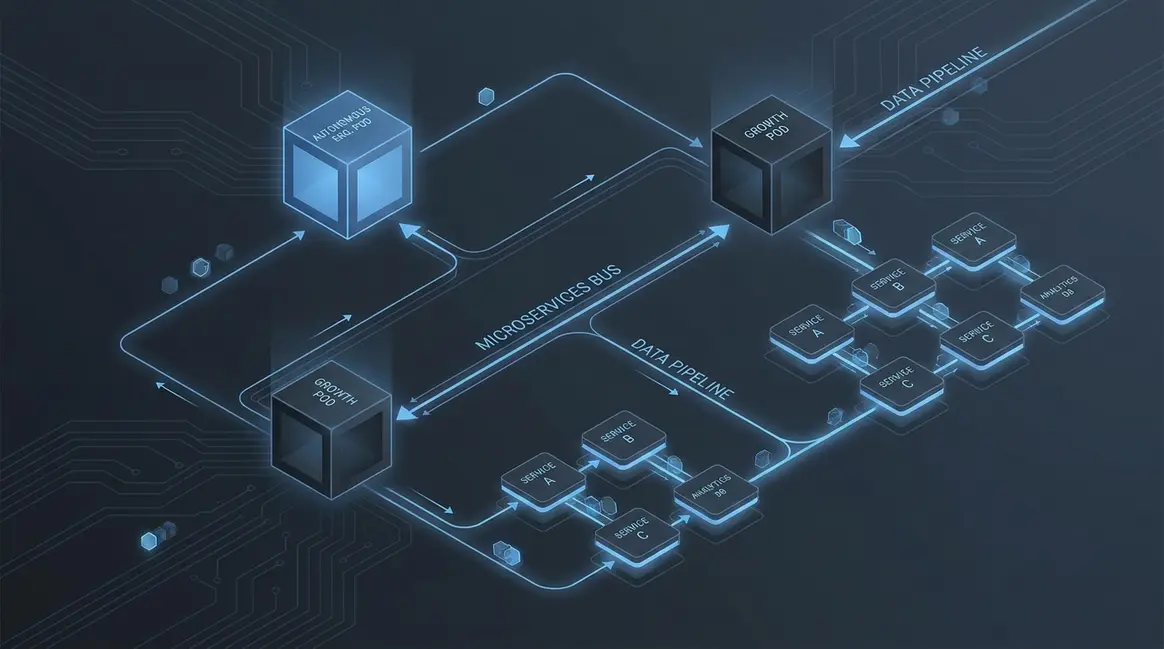
Table of Contents
- The structural failure of functional silos in modern B2B SaaS
- Deconstructing the growth pod: Mathematical topologies for cross-functional throughput
- The API-first contract: Decoupling marketing velocity from core product codebases
- Composable frontends: Implementing microfrontends for autonomous acquisition surfaces
- Unified telemetry architecture: Eliminating attribution drift between product and acquisition
- Agentic automation pipelines: Integrating n8n and MCP servers for zero-touch growth execution
- Governance, guardrails, and algorithmic resource allocation
- The 90-day migration blueprint: Transitioning from monolithic departments to pod units
The structural failure of functional silos in modern B2B SaaS
In traditional enterprise B2B SaaS organizations, segregating engineering and marketing into isolated, horizontal departments is the fastest way to throttle revenue velocity. This legacy structure creates an operational bottleneck: every cross-functional initiative must clear inter-departmental ticket queues, asynchronous requirements gathering, and prioritization friction. Transitioning away from these departmental silos is not merely a managerial preference; as outlined in research on next-generation operating models, removing structural handoffs is essential to eliminating latency and reducing deployment cycle times across digital touchpoints.
The Incentive Asymmetry and the 21-Day Sprint Drag
The root problem of horizontal functional alignment is an irreconcilable divergence in Key Performance Indicators (KPIs):
-
Engineering teams are incentivized to optimize for code maintainability, zero-defect releases, system uptime, and technical debt reduction.
- Growth and marketing teams are incentivized to optimize for pipeline velocity, experimentation volume, conversion rate lift, and immediate customer acquisition.
When these groups operate in silos, a simple growth initiative—such as modifying an onboarding form step, building an interactive ROI calculator, or emitting granular telemetry to a modern data stack—becomes an external request. Marketers submit a ticket to a core product engineering backlog, where it sits behind customer-facing feature roadmaps and refactoring sprints. In enterprise B2B SaaS, this sprint dead-time averages between 14 to 21 days. By the time an engineer reviews the PR, the market window or testing hypothesis has lost context, and the financial waste of idle marketing spend compounds daily.
A resilient Growth Team Architecture resolves this structural impasse by embedding full-stack software engineers directly into the acquisition and activation cycles, eliminating queue latency entirely.
Shadow IT, DOM Bloat, and Core Web Vitals Collapse
When engineering backlogs reject marketing tickets, growth operators do not stop experimenting; they bypass technical oversight. This operational friction inevitably spawns "Shadow IT."
Lacking direct access to the codebase, demand-generation teams inject unvetted third-party client-side tag managers, split-testing scripts, customer data platform (CDP) libraries, and behavioral session-recording SDKs directly into production containers. Because these scripts load outside the continuous integration and continuous deployment (CI/CD) pipeline, they introduce severe architectural side effects:
-
Main-Thread Blocking: Unoptimized JavaScript bundles monopolize the browser's execution thread, inflating Total Blocking Time (TBT) and triggering degraded Interaction to Next Paint (INP) scores.
-
Asynchronous Layout Instability: Visual elements injected post-DOM construction cause unpredictable reflows and severe Cumulative Layout Shift (CLS).
-
Network Contention: Multiple external SDKs fire competing HTTP calls, saturating bandwidth and delaying critical page asset delivery.
-
The downstream effect is paradoxical: growth teams deploy tracking and experimentation tools to increase revenue, but the resulting browser page load mechanics and conversion rates suffer severe degradation. Organic search rankings drop due to failed Core Web Vitals thresholds, while bounce rates surge on high-intent landing pages before the prospect ever interacts with the CTA.
Deconstructing the growth pod: Mathematical topologies for cross-functional throughput
Traditional engineering squads are structurally optimized for feature delivery, architectural integrity, and linear roadmap execution. However, treating conversion funnels and expansion loops as software tickets within a standard sprint cadence introduces terminal friction. To scale enterprise experimentation, modern Growth Team Architecture abandons functional silos in favor of autonomous, mathematically optimized pod topologies designed around system throughput rather than story point burn-down.
Structural Topology and Staffing Ratios
A resilient Growth Pod operates as an embedded algorithmic engine. Rather than pulling cross-functional favors or queuing Jira tickets across disjointed departments, the unit contains every core dependency required to formulate, instrument, ship, and analyze an experiment. The optimal pod configuration scales across a 4-FTE footprint:
-
1 Lead Growth Engineer: Acts as the technical anchor, directing edge routing, experimentation SDKs, and reverse-ETL pipelines while ensuring code quality does not degrade into technical debt.
-
1 Full-Stack/Automation Engineer: Focuses on execution velocity, rapid front-end variant scaffolding, webhook orchestration, and event-driven automation via n8n and internal API workers.
-
1 Technical Marketer / Acquisition Specialist: Owns the quantitative hypothesis backlog, copy parameters, paid/organic channel triggers, and the continuous feedback loop between go-to-market mechanics and code.
-
0.5 Data / Telemetry Engineer: Provisions semantic layer definitions, maintains real-time clickstream schemas, and prevents telemetry drift across production databases and warehouse destinations.
-
0.5 Product Designer: Designs modular design-system components, variant states, and micro-interactions optimized for cognitive load reduction and rapid UI instantiation.
-
This topology departs fundamentally from standard scrum setups. In conventional squads, ownership centers on output: delivering tickets, completing epics, and closing pull requests. Inside an autonomous pod, engineering ownership pivots strictly toward quantifiable system metrics, including Activation Rate, Net Revenue Retention (NRR) expansion, and organic pipeline velocity.
Little's Law and Backlog Queuing Dynamics
The mathematical justification for the growth pod model lies in operations research and Queuing Theory, governed by Little's Law:
L = λ × W
Where L represents the Work In Progress (the total active experiments undergoing ideation, design, and deployment), λ is the system throughput (completed deployments per unit time), and W is the cycle time (the latency from hypothesis conception to statistical significance). Rearranging for cycle time yields W = L / λ.
In traditional enterprise silos, cross-departmental approval chains, compliance sign-offs, and disjointed sprint planning hyper-inflate WIP (L). A hypothesis must traverse marketing reviews, design syncs, core engineering backlog grooming, and manual QA cycles. As active WIP expands while throughput (λ) remains throttled by handoff friction, cycle latency (W) degrades exponentially—often extending iteration windows to 28 days or more.
By eliminating external approval gates, running automated regression suites, and constraining pod concurrency (setting strict WIP limits where L ≤ 3 simultaneous experiments per engineer), the cycle time collapses to under 48 hours. When cycle time decreases by an order of magnitude, the system's test capacity expands dynamically, compounding statistical wins over shorter fiscal cycles.
| Operational Metric | Functional Silo Model | Autonomous Growth Pod |
|---|---|---|
| Average WIP (L) | 18-25 concurrent tickets | 3-5 active experiments |
| Cycle Time (W) | 28 days (672 hours) | Under 48 hours |
| Weekly Throughput (λ) | 0.5-1 production deployments | 5-8 validated iterations |
| Core Success Metric | Story Points Completed | Pipeline & Conversion Delta |
The API-first contract: Decoupling marketing velocity from core product codebases
Scaling acquisition velocity without introducing existential risk to production systems requires an uncompromising separation of concerns. In legacy setups, growth teams routinely submit pull requests against core monolith repositories to deploy conversion experiments, modify onboarding steps, or hardcode tracking pixels. This coupling creates severe engineering friction: deployment gates stall marketing cadence, while brittle front-end changes risk destabilizing business-critical checkout flows. A mature Growth Team Architecture treats core production codebases as black-box platforms accessed exclusively through programmatic boundaries.
Headless Isolation and Schema-Driven Engines
To eliminate code-level dependencies between product engineering and growth pods, all user-facing acquisition surfaces must be decoupled via a headless paradigm. The operational standard relies on modern edge runtimes (such as Next.js on Vercel or Cloudflare Workers) querying microservices and headless CMS platforms purely through validated interfaces. Growth pods deploy and iterate on landing page engines where layout compositions, dynamic component mapping, and variant testing are determined at the edge rather than baked into core application deployments.
Adopting an rigorous API-first design establishes clean boundaries between consumer and provider. Under this framework, core application engineers maintain domain logic—such as user authentication, billing pipelines, and data persistence—and expose them as immutable, authenticated endpoints. Growth engineers consume these services to assemble experiment layers without ever obtaining write access to the core application repository.
Contract Governance with Dynamic Schema Payloads
Autonomous growth pods, automated n8n workflows, and AI generation agents require reliable structural guardrails to spin up high-converting pages dynamically. Using strict JSON Schema definitions enforces deterministic component rendering across all headless touchpoints. Every dynamic UI component—such as pricing matrix selectors, testimonial carousels, or lead capture forms—adheres to explicit data validation models before hydration.
Consider the payload boundary for a dynamically generated personalization funnel:
{
  "$schema": "https://json-schema.org/draft/2020-12/schema",
  "title": "GrowthFunnelPayload",
  "type": "object",
  "properties": {
    "experimentId": { "type": "string", "pattern": "^exp_[a-zA-Z0-9]{8}$" },
    "targetSegment": { "type": "string" },
    "components": {
      "type": "array",
      "items": {
        "type": "object",
        "properties": {
          "type": { "type": "string", "enum": ["HeroBanner", "PricingTable", "LeadForm"] },
          "props": { "type": "object" }
        },
        "required": ["type", "props"]
      }
    }
  },
  "required": ["experimentId", "targetSegment", "components"]
}
This contract governance delivers measurable architectural benefits:
-
Regression Immunity: Automated CI/CD pipelines reject any payload that violates schema contracts, preventing edge runtime crashes caused by malformed CMS inputs or agent hallucinations.
-
Sub-100ms Edge Latency: Static page generation (SSG) and incremental static regeneration (ISR) execute at the edge, reducing origin server roundtrips and keeping Time to Interactive (TTI) well under performance thresholds.
-
Autonomous Execution: Non-technical marketers and automated agents can assemble, customize, and publish hyper-targeted acquisition funnels in minutes without triggering core release cycles or requesting engineering reviews.
-
Composable frontends: Implementing microfrontends for autonomous acquisition surfaces
High-velocity growth teams cannot afford to be bottlenecked by monolithic release cycles. When every headline adjustment, conversion rate experiment, or localized landing page requires end-to-end regression testing across multi-tenant database layers and core banking or dashboard logic, cycle velocity stalls. Modern Growth Team Architecture solves this operational drag by treating acquisition surfaces as autonomous microfrontends decoupled from the core application at the edge.
Edge Routing and Deterministic Path Rewriting
Decoupling does not require fragmented domain setups (such as subdomains like app.domain.com vs. get.domain.com), which dilute root-domain SEO equity and complicate cross-subdomain tracking. Instead, edge layers—orchestrated via Cloudflare Workers or Vercel Edge Middleware—intercept inbound traffic and deterministically proxy requests based on URI prefixes.
-
Routing Matrix: High-funnel pages (
/compare/*,/features/*) route to an optimized static site generator (e.g., Next.js SSG or Astro) serving statically generated HTML from edge caches with a time-to-first-byte (TTFB) under 40ms.-
Acquisition Workflows: Interactive surfaces like
/signup-flowroute to a high-reactivity micro-app handling transient state, client-side validation, and telemetry ingestion before dispatching payloads to the onboarding APIs. -
Core Application: Authenticated paths (
/dashboard/*,/settings/*,/api/*) are proxied directly to the primary, mission-critical infrastructure, ensuring growth experiments never interact with protected production clusters.
-
Eliminating Monolithic Regression Testing and Pipeline Drag
The primary win of microfrontends inside an engineering-led growth pod is blast radius containment. In traditional setups, changing a dynamic input field on a public pricing calculator mandates running complete test suites spanning authentication guards, billing webhooks, and core tenant isolation protocols.
By enforcing clear deployment boundaries, the acquisition pod maintains an independent CI/CD pipeline. Growth engineers can ship changes to /signup-flow multiple times a day via autonomous Git workflows. To achieve this isolation without sacrificing performance, our teams implement decoupled deployment mechanics and asset optimization strategies that preserve sub-millisecond edge response times and eliminate shared runtime dependencies.
Because the acquisition microfrontend does not inherit the heavy bundle sizes, polyfills, or complex state management libraries of the internal dashboard, client-side bundle weight drops significantly (frequently reducing JavaScript payloads from 850KB to under 65KB). This performance delta directly drives Core Web Vitals into the 99th percentile while granting the acquisition pod complete autonomy to test, ship, and iterate.
Unified telemetry architecture: Eliminating attribution drift between product and acquisition
The standard telemetry model across high-growth startups is broken. Ad platforms routinely report 1,000 successful workspace signups, while your production database registers only 600 authenticated records. This 40% attribution variance is not statistical noise; it is an infrastructure failure caused by ad blockers, Safari's Intelligent Tracking Prevention (ITP) cutting client cookie lifespans to 24 hours, and dropped client-side tags. Within a modern Growth Team Architecture, engineering and marketing cannot rely on separate sources of truth. Eliminating this discrepancy requires eliminating client-side tracking scripts entirely and treating telemetry as production infrastructure.
Edge-Routed Ingestion and First-Party Identity Resolution
Relying on Google Tag Manager in the browser creates fragile data capture. To ensure complete alignment between acquisition and product engagement, the growth pod must implement an edge-routed event streaming model. Network requests are proxied through an edge worker (such as Cloudflare Workers or AWS CloudFront) hosted directly on the application's root domain.
This proxy acts as a secure identity resolution layer before forwarding clean event payloads downstream:
-
First-Party Identifier (FPID) Generation: The edge worker issues an HTTP-only, secure cookie with an expiration anchored directly to the root domain. This completely bypasses browser-level ephemeral storage constraints and cross-site tracking blocks.
-
Deterministic Identity Stitching: When an unauthenticated visitor interacts with an acquisition asset, their anonymous device ID and FPID are stamped on every hit. Upon registration, an edge-routed webhook joins this anonymous identifier to the product's internal
user_idandworkspace_id. -
Stateful Forwarding: The clean, enriched payload is synchronously split and dispatched to acquisition endpoints and primary data storage using a robust server-side tracking architecture.
-
Pod Ownership: Reconciling Ad Spend with Product Truth
In traditional setups, data engineering exists as a centralized, ticket-based service bureau that takes weeks to debug attribution leaks. Under an autonomous pod structure, the pod's dedicated data engineer owns the ingestion pipeline from edge receipt to final dimensional modeling.
Raw event streams are routed simultaneously into Supabase for real-time operational state tracking and into Google BigQuery for longitudinal attribution modeling. To close the conversion loop, automated orchestration pipelines via n8n query BigQuery hourly to extract real product events—such as completed team onboarding or initial API credit purchase—and dispatch high-fidelity Conversion API (CAPI) events back to ad networks.
By engineering automated workflows that join Google Ads and GA4 data in BigQuery with transactional tables, the growth pod removes platform self-reporting bias. Marketing targets are no longer set against speculative platform metrics, but tied directly to deterministic funnel analytics, ensuring every marketing dollar spent is accounted for in production revenue.
Agentic automation pipelines: Integrating n8n and MCP servers for zero-touch growth execution
Modern Growth Team Architecture in 2026 rejects the operational bottleneck of manually wiring growth experiments. Legacy growth pods spend up to 60% of their engineering sprint cycles on boilerplate tasks: scaffolding programmatic landing page variants, synchronizing webhook payloads across CRMs, and sanitizing enrichment pipelines. By decoupling raw execution from manual code deployment, growth pods transition from reactive task factories into autonomous agentic engines.
Bridging State and Logic: n8n and MCP Orchestration
The foundation of autonomous growth execution relies on marrying headless workflow automation with context-aware AI tooling. Traditional webhooks pass static JSON strings; agentic pipelines, however, require deep contextual visibility into internal datasets without risking data poisoning or prompt bloat. By implementing Model Context Protocol (MCP) servers directly on top of production-replica Postgres or Supabase instances, growth teams expose schema definitions, query execution interfaces, and operational guards to reasoning models.
In this architecture, n8n acts as the deterministic backbone. It triggers on schedule, database mutations, or inbound webhooks, routing tasks to local LLMs and agent swarms equipped with MCP endpoints. Rather than hardcoding SQL queries across dozens of microservices, the growth pipeline leverages an n8n MCP server LLM orchestration to dynamically inspect database states, evaluate cohort parameters, and execute multi-step enrichment runs. This approach integrates natively with a progressive disclosure database architecture, allowing the agent to retrieve only the exact column schemas and historical experiment metrics needed for the immediate programmatic variation, keeping latency below 450ms per execution.
The Zero-Touch PR and Validation Loop
Zero-touch growth execution eliminates manual copy-pasting across Content Management Systems (CMS) and GitHub repositories. Instead, it enforces a self-healing, automated verification lifecycle:
-
Asset Synthesis: When market signals or internal queue events fire, autonomous agents draft semantic page metadata, write optimized body copy, and assemble valid, nesting-compliant JSON-LD structured data.
-
Staging Deployment: The n8n engine consumes the agent's validated output, generates a new Git branch via the GitHub REST API, commits MDX templates, and spins up an ephemeral preview deployment (e.g., Vercel or Cloudflare Pages) within seconds.
-
Automated Smoke Testing: Headless audit workers run automated Core Web Vitals checks and schema syntax validations against the preview URL. If layout shifts occur or schemas fail validation, the pipeline passes the raw compiler errors back to the LLM agent for iterative correction.
-
Human-in-the-Loop Gatekeeping: Once verification passes, n8n pushes an interactive payload to a dedicated Slack growth engineering channel. The alert contains the preview URL, visual diff snapshots, and performance scores.
-
The growth engineer does not write boilerplate components, adjust copy, or construct metadata files. They simply click an interactive "Approve & Merge" button inside Slack, which fires an authenticated webhook to trigger the production deployment. This loop compresses experiment turnaround times from 72 hours down to under 4 minutes, establishing an unassailable operational advantage in competitive markets.
Governance, guardrails, and algorithmic resource allocation
The primary objection from enterprise engineering leadership against autonomous pods is predictable: speed corrodes quality. When growth teams chase rapid conversion wins, core maintainers brace for brittle DOM hacks, compromised bundle sizes, unvetted third-party tracking scripts, and technical debt that eventually metastasizes into the core repository. Solving this requires decoupling autonomy from anarchy. A resilient growth team architecture replaces manual oversight with programmatic, non-negotiable deployment gates.
Automated CI/CD Regression Gates and Compliance Enforcement
Growth pods operate on production-grade infrastructure, meaning their pull requests must clear the exact same zero-tolerance deployment pipelines as core platform services. Rather than relying on peer review to catch performance regressions, pipelines enforce programmatic blockades within CI/CD pipelines:
-
Core Web Vitals Regression Testing: Synthetic Lighthouse CI runners benchmark every PR against production baselines. Deployments fail automatically if Largest Contentful Paint (LCP) degrades by more than 100ms, Cumulative Layout Shift (CLS) exceeds 0.05, or Interaction to Next Paint (INP) crosses 200ms.
-
TypeScript and Build Integrity: Pod codebases operate in strict TypeScript mode with zero compiler exceptions permitted. Any un-typed payloads or loose variable assertions immediately halt the build.
-
Data Privacy and Security Scanning: Automated Static Application Security Testing (SAST) inspects event-tracking calls and client-side payloads. Pod pipelines must pass automated PII redaction checks to ensure that raw email strings, IPs, or authorization tokens never bypass hashing functions before transmission to marketing analytics lakes.
-
The 70/20/10 Algorithmic Resource Allocation Model
To prevent "growth rot"—the gradual collapse of sprint velocity caused by decaying experimental code—pod sprint capacity must be governed by an algorithmic resource budget rather than shifting backlog priorities. Engineering and marketing pod leads allocate bandwidth across three locked vectors:
-
70% for Revenue-Driving Experiments: Dedicated purely to hypothesis-driven execution, including funnel optimizations, dynamic onboarding paths, and localized pricing tiers.
-
20% for Experimentation Infrastructure: Invested in the growth engine itself—building modular component libraries, upgrading feature-flag orchestration, and optimizing n8n event webhook dispatchers.
-
10% for Technical Debt Cleanup: Reserved strictly for code hygiene. At the conclusion of every two-week cycle, engineers rip out losing variants, remove stale feature flags, and refactor winning experiments into core shared component modules.
-
This operational partition guarantees that pods execute at startup-level velocity without creating long-term liabilities for enterprise platform maintainers.
The 90-day migration blueprint: Transitioning from monolithic departments to pod units
Transitioning an organization from siloed functional departments into autonomous pods requires treating organizational topology like a distributed systems refactor. Implementing an effective Growth Team Architecture without destabilizing live revenue pipelines demands a structured, three-phase cutover that systematically removes dependencies between commercial strategy and core product engineering.
Phase 1 (Days 1–30): Surface Isolation and Telemetry Contracts
The transition begins by isolating a high-impact, bounded context within your revenue engine. Rather than overhauling the entire customer journey, target a single high-velocity surface—such as the self-serve PLG onboarding funnel or freemium sign-up flow.
-
Ring-Fence Dedicated Headcount: Pull two full-stack engineers, one growth marketer, and one data analyst out of the traditional sprint rotation. This cohort reports exclusively to a designated Growth Product Manager, insulating them from core product tech-debt tickets.
-
Establish Immutable Telemetry Contracts: Implement JSON Schema validation at the edge for all event tracking. By defining strict contracts for events like
trial_activatedorworkspace_invited, you eliminate data discrepancy between client-side analytics and production databases before running tests. -
Baseline Metric Calibration: Lock in baseline conversion rates, time-to-value (TTV) latency, and pipeline drop-off metrics for this single surface across a minimum 14-day trailing cycle.
-
Phase 2 (Days 31–60): Technical Decoupling and Edge Deployment
Autonomous pods fail when forced to deploy via monolithic release trains. Phase 2 decouples the target surface from the primary application repository to enable sub-hour production releases.
-
Deploy Microfrontend Architecture: Decouple the onboarding flow using Next.js sub-applications or Module Federation. The growth pod must own their front-end deployment target independently of the core application runtime.
-
Implement Server-Side Analytics: Shift client-side tracking scripts to a server-side ingestion proxy (via edge workers or tools like RudderStack). This bypasses ad-blockers, captures 100% of telemetry data, and drops client-side JavaScript execution overhead to preserve sub-200ms Core Web Vitals.
-
Build Async CI/CD Pipelines: Deploy isolated GitHub Actions workflows that run automated end-to-end (E2E) testing on isolated ephemeral preview environments, completely bypassed from legacy staging gates.
-
Phase 3 (Days 61–90): Automated Experimentation and Economic Calibration
The final phase permanently dismantles ticket-based handoffs between marketing and engineering, replacing Jira queues with code-defined, automated workflows.
-
Automate Experimentation Loops: Deploy n8n workflows integrated with feature-flagging SDKs (such as PostHog or LaunchDarkly). Marketing sets experiment parameters within a structured schema, triggering automated webhooks that spin up variant feature flags, auto-tag analytics cohorts, and alert the pod upon reaching statistical significance.
-
Deprecate Functional Handoffs: Abolish cross-departmental creative briefs. Pod engineers work directly alongside marketers inside shared edge branches, committing code and variant copy simultaneously.
-
Calibrate Pod Success Metrics: Shift the pod's evaluation away from engineering sprint velocity or marketing lead volume. The pod's sole performance index becomes gross ARR acceleration and CAC:LTV efficiency—mandating a targeted customer acquisition payback period compressed to under 8 months.
-
Departmental silos are an architectural failure mode that directly depresses gross margins. In modern B2B SaaS, velocity is not measured in commit counts or campaign impressions, but in the deterministic speed at which an operational hypothesis converts into verified enterprise pipeline. Decoupling growth into autonomous pod units eliminates the organizational drag holding your CAC hostage. If your current product-engineering interface is bottlenecking ARR growth, you must re-engineer the system. Book a comprehensive growth architecture audit to diagnose your operational latency and deploy high-throughput, agentic pod structures.
Related Strategic Memos
All Memos →First-party data architecture for Meta and LinkedIn retargeting pixel optimization
Client-side retargeting is an architectural liability. Between browser-enforced storage restrictions, aggressive ad-blocking, and signal attenuation across e...
API gateway design: Consolidating microservices under unified authentication
Distributed systems frequently degrade into unmaintainable security liabilities when authentication logic is federated across autonomous microservices. In my...
Need this architecture deployed in your pipeline?
Skip the synchronous sales cycle and endless discovery calls. Submit your core acquisition or conversion bottleneck for a deep-dive asynchronous growth diagnostic.