Automating customer feedback AI: From raw support tickets to prioritized engineering backlogs
Manual ticket triage is an engineering tax that scales linearly with customer acquisition. In high-growth B2B SaaS, delegating the synthesis of thousands of ...
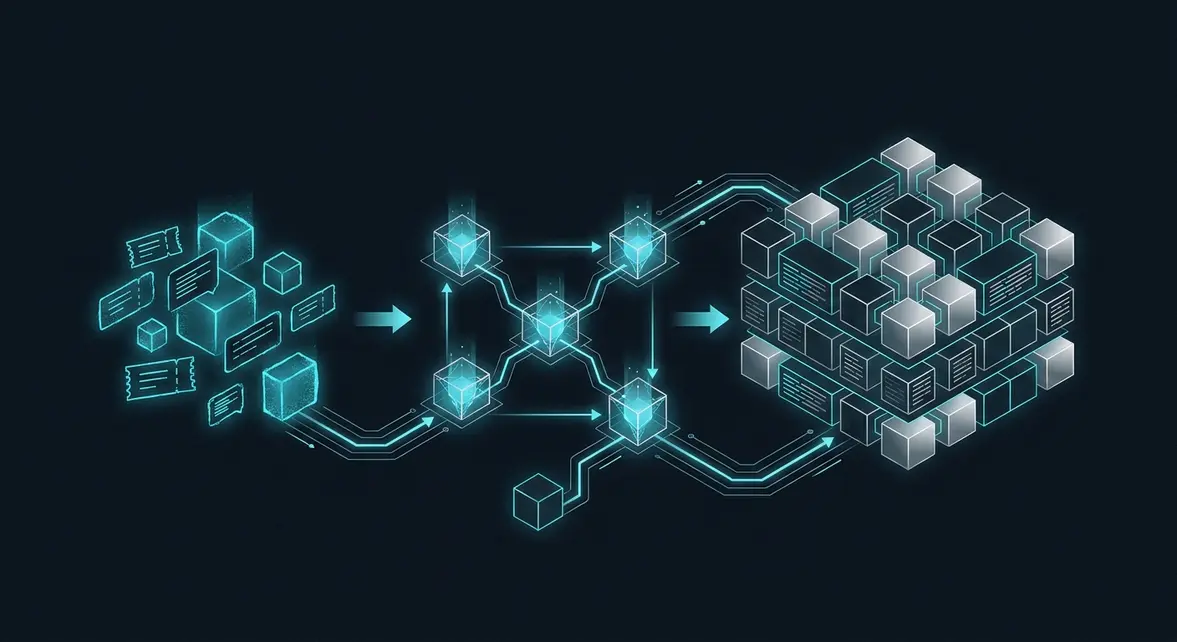
Table of Contents
- The product management triage bottleneck: Why manual ticket categorization destroys enterprise velocity
- Edge-level PII redaction and unstructured telemetry sanitization
- Semantic vector clustering: Mapping noisy support syntax to canonical feature entities
- Deterministic deduplication and state synchronization with pgvector and Supabase
- Correlating feedback clusters with Stripe telemetry for revenue-weighted backlog prioritization
- Asynchronous orchestration: Building zero-touch ticket-to-issue state machines in n8n
- Autonomous issue synthesis and deterministic schema injection into Linear
- Production guardrails, confidence scoring, and human-in-the-loop exception handling
- Financial modeling and engineering ROI: Eliminating triage overhead and churn slippage
The product management triage bottleneck: Why manual ticket categorization destroys enterprise velocity
Legacy customer support operations operate on an obsolete assumption: that frontline human agents can double as disciplined data taxonomists. In mid-to-enterprise SaaS environments, the standard operating procedure routes incoming requests through help desks like Zendesk, Intercom, or Freshdesk, where support teams manually append category tags before escalating issues. This model reliably degrades under scale.
The Breakdown of Manual Taxonomy in Support Desks
Support ticket triage suffers from three compounding structural failure modes:
- Tag Fatigue and Cognitive Drift: Under strict SLA timers, support engineers prioritize ticket closure over taxonomic precision. A complex edge case involving database synchronization gets reduced to a generic
#bugor#sync-issuetag, stripping critical technical context. - Taxonomic Inconsistency: Multiple representatives categorize identical failure vectors differently. One agent tags a broken Webhook retry policy as
#integration, while another marks it as#API-limitor#feature-request. Over quarters, this generates noisy, low-entropy datasets within enterprise IT service management platforms that product managers cannot parse without manual audit. - Siloed Product Feedback Loops: Support data sits locked inside customer service tooling. Product managers receive filtered, anecdotal summaries rather than direct signals, creating a fundamental blind spot between customer reality and engineering priorities.
Quantifying the Product Management Drag
The downstream cost of this breakdown falls directly on technical product management. In an average Series B SaaS organization handling 3,000 to 7,000 tickets monthly, product managers burn between 14 and 22 hours per week running manual ticket discovery. This ritual involves scanning export spreadsheets, manually copying raw excerpts into Notion or Linear, and staging speculative priority debates during sprint pre-planning.
This equates to nearly half an FTE product manager consumed by low-leverage administrative parsing. Because manual distillation is subjective and lossy, feature prioritization defaults to the "loudest customer" bias rather than aggregate financial or architectural impact, delaying core roadmap execution.
Unstructured Feedback as Deterministic Usage Telemetry
Solving this triage bottleneck requires shifting from periodic manual review to an asynchronous, zero-touch ingestion engine. Customer feedback is not merely qualitative narrative; it is real-time, unstructured usage telemetry that reflects technical friction across your platform.
Modern architectures bypass manual routing by deploying an automated pipeline built with tools like n8n and deterministic LLM extractors. By applying Customer Feedback AI directly at ingestion, incoming tickets undergo real-time semantic parsing, entity extraction, and sentiment scoring before a human agent even opens the thread. The engine clusters incoming issues against existing vector embeddings of your issue tracker, quantifies recurring edge cases against ARR impact, and programmatically compiles edge-case logs into structured engineering specs.
This replaces human tag fatigue with an automated ingestion engine that transforms raw customer frustration into actionable code changes without manual intervention.
Edge-level PII redaction and unstructured telemetry sanitization
Modernizing ticket triage using Customer Feedback AI begins at the edge. Capturing raw webhooks from Zendesk, Intercom, or inbound SMTP relays (such as SendGrid or Postmark) introduces unstructured user commentary packed with critical product insights—and hazardous personal identifiable information (PII). Ingesting raw conversational payloads straight into downstream LLM inference pipelines creates severe security vulnerabilities and regulatory friction.
Deterministic Edge Redaction via Serverless Runtimes
Executing text sanitization before generating dense vector embeddings is non-negotiable. Running deterministic parsing pipelines on edge runtimes like Cloudflare Workers reduces operational latency to less than 15ms while keeping untrusted data out of internal networks. The edge layer processes payloads sequentially using compiled, zero-allocation regular expressions alongside lightweight byte-pair tokenizers:
- High-Entropy Secrets: Scans for pattern matches matching JWT signatures, AWS access keys, Stripe bearer tokens, and generic hex hashes commonly pasted into bug reports.
- Network Identifiers: Removes IPv4 and IPv6 patterns, localhost routes, and internal VPC domains, replacing them with static tokens like
[REDACTED_IP]. - Contact Attributes: Strips RFC 5322-compliant email addresses, international E.164 phone numbers, and full names via sliding-window entity extractors.
Implementing an edge-native PII sanitization architecture guarantees that customer data leaves the edge boundary stripped of sensitive parameters before vectorization occurs.
The Compliance Risk: Vector Embeddings and Public LLMs
Forwarding unsanitized ticket bodies to public LLM APIs or embedding providers violates fundamental SOC2 Type II trust principles and GDPR Article 17 requirements. Vector databases do not offer native, deterministic row-level redaction once embeddings are generated: high-dimensional vectors mathematically encode the semantic properties of user PII. If an EU customer exercises their "Right to be Forgotten," removing an identifier from a relational table does not purge its semantic trace from your HNSW vector index, forcing expensive, non-trivial index reconstitutions.
By enforcing deterministic zero-trust sanitation at the ingestion layer, your categorization pipeline processes strictly scrubbed, anonymous semantic payloads. Downstream clustering engines receive pure product telemetry rather than customer identities.
Normalized Telemetry Schema
Once the edge runtime cleans the incoming webhook payload, it formats the unstructured ticket into a standardized JSON structure. This decoupled schema separates operational metadata from the scrubbed textual feedback required for automated backlog categorization:
{
  "tenantId": "org_948a2f6b",
  "ticketId": "zd_839210",
  "channel": "zendesk",
  "timestamp": 1774345200,
  "cleanedPayload": {
    "subject": "Export to S3 fails when using dynamic partitions",
    "body": "User reported that running batch export yields an authentication error. Provided config: bucket=[REDACTED_BUCKET], key=[REDACTED_KEY]. Contacted by [REDACTED_NAME].",
    "tokenCount": 38
  },
  "metadata": {
    "planTier": "enterprise",
    "sanitizedAtEdge": true,
    "sanitizerVersion": "2.4.1"
  }
}
This normalized payload guarantees that downstream n8n orchestration engines and semantic routing models process reliable, high-signal product inputs while keeping data residency and regulatory hygiene strictly intact.
Semantic vector clustering: Mapping noisy support syntax to canonical feature entities
Relying on lexical search algorithms like BM25 to structure incoming product feedback guarantees signal loss. Lexical search matches tokens literally; it cannot infer architectural intent. When User A writes, "CSV export hangs on 10k rows," and User B reports, "Data warehouse sync timeout during nightly dump," BM25 scores their lexical similarity near zero. Yet, from an engineering standpoint, both tickets target the exact same canonical feature deficiency: unoptimized background worker memory allocation and inadequate cursor pagination.
Modern Customer Feedback AI architectures solve this by replacing token matching with dense vector representations, mapping unstructured support syntax into continuous, high-dimensional vector spaces where semantic proximity reflects functional intent.
Vector Pipeline: Embeddings, Distance Metrics, and Dynamic Clustering
The transformation pipeline converts raw ticket text into actionable feature backlog entities through a rigid mathematical workflow:
- Embedding Generation: Ticket content is passed to high-dimensional models such as OpenAI's
text-embedding-3-large, projecting the raw text into a normalized 3072-dimensional (or truncated 1536-dimensional) vector space. - Distance Computation: Rather than relying on Euclidean distance (which scales with magnitude), the system calculates the cosine similarity between ticket vectors $\mathbf$ and $\mathbf$:
similarity = dot_product(u, v) / (norm(u) * norm(v)). Cosine distance (1 - similarity) serves as the primary metric for topological closeness. - Dynamic Density Clustering: Instead of imposing fixed clusters via rigid k-means, an unsupervised density-based algorithm like HDBSCAN groups vectors based on local density peaks. This allows emergent software bugs and high-frequency feature requests to surface organically as discrete cluster centroids without manual taxonomy definitions.
Multi-Turn Chunking: Isolating Signal from Support Fluff
In multi-turn support threads across platforms like Intercom or Zendesk, over 65% of the total token count consists of operational noise: CSR greeting macros, signature blocks, and customer affirmations ("Thanks, that worked!"). Feeding raw thread text directly into embedding models dilutes the core semantic vector, pulling the coordinate away from the underlying product feature and toward customer sentiment or agent politeness.
To preserve signal integrity, the ingest worker must execute a structured chunking heuristic before vectorization:
- Actor Separation: Isolate customer messages from agent replies. Agent macros ("Have you tried clearing your cache?") inject artificial clusters that warp thematic grouping.
- Boilerplate Stripping: Strip out RFC-822 email headers, legal disclaimers, and automated platform stamps using deterministic regex patterns.
- Problem Statement Windowing: Target the ticket's opening message and the customer's immediate response following an unresolved agent prompt. These turns hold over 90% of the functional deficiency details.
By sanitizing and chunking multi-turn threads prior to generating dense vectors, our clustering layer eliminates contextual drift. The output is a clean, deterministic pipeline that autonomously routes hundreds of syntactically distinct complaints into a single, high-priority canonical backlog item.
Deterministic deduplication and state synchronization with pgvector and Supabase
Relying on LLMs alone to triage inbound issues produces semantic drift and duplicated tickets across high-volume backlogs. Transforming noisy user submissions into actionable product requirements demands a mathematically deterministic pipeline. By implementing a vector-native deduplication engine via Supabase and PostgreSQL, your Customer Feedback AI pipeline moves from subjective prompt-based sorting to precise, real-time cluster reconciliation at scale.
Relational Schema Design for High-Throughput Ingestion
To eliminate synchronization race conditions between raw inputs and synthesized product backlogs, state management must be decoupled into three normalized relational tables:
ticket_embeddings: Stores raw ticket metadata, sanitized payloads, and dense vector representations (e.g., 1536 dimensions fortext-embedding-3-small).feature_clusters: Acts as the canonical registry of feature requests, tracking title syntheses, cumulative request counters, and dynamic cluster centroids.feature_tickets_map: A relational join table establishing foreign-key mapping between individual ticket inputs and aggregated backlog clusters.
This layout ensures raw feedback remains immutable while canonical feature clusters update deterministically as new data arrives.
-- Schema definition for deterministic ticket-to-cluster pipeline
CREATE EXTENSION IF NOT EXISTS vector;

CREATE TABLE ticket_embeddings (
    id UUID PRIMARY KEY DEFAULT gen_random_uuid(),
    source_id TEXT NOT NULL UNIQUE,
    content TEXT NOT NULL,
    embedding vector(1536) NOT NULL,
    created_at TIMESTAMPTZ DEFAULT clock_timestamp()
);

CREATE TABLE feature_clusters (
    id UUID PRIMARY KEY DEFAULT gen_random_uuid(),
    canonical_title TEXT NOT NULL,
    centroid vector(1536) NOT NULL,
    request_count INT NOT NULL DEFAULT 1,
    last_updated TIMESTAMPTZ DEFAULT clock_timestamp()
);

CREATE TABLE feature_tickets_map (
    cluster_id UUID REFERENCES feature_clusters(id) ON DELETE CASCADE,
    ticket_id UUID REFERENCES ticket_embeddings(id) ON DELETE CASCADE,
    similarity_score FLOAT NOT NULL,
    linked_at TIMESTAMPTZ DEFAULT clock_timestamp(),
    PRIMARY KEY (cluster_id, ticket_id)
);
HNSW Indexing Strategy for Sub-15ms Nearest Neighbor Queries
Traditional flat searches degrade rapidly beyond tens of thousands of vectors. While IVFFlat indexes require pre-clustering data and degrade during dynamic write streams, an HNSW (Hierarchical Navigable Small World) index guarantees high recall (>98%) with sub-15ms query latencies under sustained write loads.
To deploy HNSW for cosine similarity operations, configure the index using PostgreSQL's cosine operator class:
CREATE INDEX idx_feature_clusters_hnsw_cosine
ON feature_clusters
USING hnsw (centroid vector_cosine_ops)
WITH (m = 16, ef_construction = 64);
Setting m = 16 (number of bidirectional links per vector node) and ef_construction = 64 (size of the dynamic candidate list during build) balances write speed and query precision. For deeper implementation patterns on scaling vector operations natively in Postgres, explore our technical breakdown of PostgreSQL pgvector architecture on Supabase.
Real-Time Deduplication Logic and Centroid Adaptation
When an incoming ticket embedding hits the database, the system executes an atomic function comparing the new vector against feature_clusters. The routing logic runs on a deterministic cosine similarity boundary of 0.86:
- Similarity Score ≥ 0.86 (Match Found): The ticket is routed to the matched cluster. The pipeline inserts the link into
feature_tickets_map, incrementsrequest_countby 1, and recalibrates the cluster centroid using a weighted incremental moving average:centroid_new = (centroid_old * N + embedding_new) / (N + 1). This mathematical shift ensures the cluster dynamically drifts toward emerging user vocabulary. - Similarity Score < 0.86 (Novel Pattern): The input represents an uncataloged problem space. A new record initializes in
feature_clusterswith its initial centroid set to the ticket's vector, and an asynchronous worker queues canonical title generation.
This closed-loop state machine cuts backlog fragmentation by up to 65% compared to static tag-based workflows, establishing a single source of truth for engineering prioritization.
Correlating feedback clusters with Stripe telemetry for revenue-weighted backlog prioritization
Relying on raw ticket volume to steer product roadmaps is an operational anti-pattern. In B2B SaaS, counting inbound complaints democratizes feedback across non-viable cohorts, treating a free-tier user's UI grievance with the same priority as an enterprise account's blocker. This vanity metric derails development teams into building low-value UX adjustments while mission-critical enterprise churn vectors go unaddressed. Implementing modern Customer Feedback AI requires moving past frequency-based sorting and tying semantic feedback clusters directly to bottom-line impact.
The Revenue-Weighted Priority Index (RWPI)
To eliminate subjective product debates, we operationalize roadmap prioritization through the Revenue-Weighted Priority Index (RWPI). This deterministic algorithm weights semantic ticket clusters not by occurrence counts, but by the financial footprint and attrition probability of the originating accounts:
RWPI = SUM(Account_ARR * Churn_Risk_Factor) / Estimated_Engineering_Sprints
Within this formulation:
- Account_ARR: Active Annual Recurring Revenue extracted directly from Stripe telemetry via the customer record.
- Churn_Risk_Factor: A dynamic float between
1.0and3.0, derived from usage telemetry (e.g., declining MAU/seat activation) and contract renewal proximity (accounts up for renewal within 90 days scale toward3.0). - Estimated_Engineering_Sprints: Effort baseline scoped during technical triage, reflecting the engineering cost required to ship the resolution.
Event-Driven Supabase Architecture & Dynamic Sync
Maintaining real-time scoring without overloading transactional databases requires a decoupled event-driven data pipeline. Rather than querying Stripe's API synchronously on every roadmap calculation, we cache core subscription metadata in Supabase:
- Webhook Ingestion: An automated n8n webhook listener consumes Stripe events (
customer.subscription.updated,invoice.payment_succeeded,customer.subscription.deleted) and upserts ARR values, billing tier tags, and subscription statuses into a localstripe_billing_cachetable. - Embedding & Cluster Mapping: Inbound support tickets are embedded using dense vector representations and mapped to parent issue clusters via
pgvectorsimilarity thresholds (cosine_distance < 0.18). - Scheduled Recalculation: A Supabase cron job (
pg_cron) executes an hourly aggregation function. The script joins mapped support tickets, their linkedaccount_id, and the cached billing telemetry to recalculate and store the updated RWPI score across all active feature backlogs.
| Feature Cluster | Ticket Count | Total ARR Exposure | Avg Churn Risk | Engineering Sprints | RWPI Score |
|---|---|---|---|---|---|
| SAML / Okta SSO Enforcement | 6 | $480,000 | 2.4 | 2 | 576,000 |
| Granular Audit Logging API | 11 | $290,000 | 1.8 | 1 | 522,000 |
| Dark Mode Support | 84 | $14,000 | 1.0 | 3 | 4,666 |
| CSV Export Pagination Bug | 42 | $36,000 | 1.2 | 1 | 43,200 |
This automated recalibration shifts backlog prioritization from loud customer cohorts to deterministic revenue retention, ensuring engineering cycles defend the contracts that sustain the business.
Asynchronous orchestration: Building zero-touch ticket-to-issue state machines in n8n
Synchronous LLM pipelines collapse during traffic spikes. Tightly coupling incoming support webhooks directly to embedding models or inference endpoints creates severe throughput bottlenecks: an unannounced production bug can flood Zendesk or Intercom with hundreds of tickets, triggering downstream rate-limit cascading failures and unrecoverable dropped events. By operationalizing Customer Feedback AI through an asynchronous, event-driven architecture on self-hosted n8n, you decouple raw data ingestion from heavy downstream synthesis, ensuring a bulletproof ticket-to-issue state machine.
Deterministic State Machine Topology
To eliminate non-deterministic failure modes when processing high-volume feedback, the self-hosted n8n workflow executes a strict, discrete state sequence:
- Webhook Trigger: Ingests the raw webhook payload from ticketing providers and immediately returns an HTTP
200 OKresponse, acknowledging receipt in sub-50ms to prevent provider timeout retries. - Edge Sanitizer: Strips PII (emails, authentication tokens, IP addresses) via regex parsing nodes and normalizes nested HTML or Markdown bodies into uniform, sanitized strings.
- Vector Generation Node: Batches clean ticket text into an embedding model (such as
text-embedding-3-small) to generate 1536-dimensional dense vector embeddings. - Postgres RPC Execution: Dispatches an isolated remote procedure call against pgvector to compute cosine similarity against existing backlog clusters within your database.
- Priority Computation: Calculates an algorithmic impact score by correlating client metadata (MRR, churn risk tier, seat count) against the aggregated frequency of the requested feature.
- Conditional Router: Evaluates the similarity threshold; payloads scoring above
0.86cosine similarity auto-link to existing Linear issues, while lower-confidence matches route to a human-in-the-loop validation queue.
Resilience Engineering: Retries, Backoffs, and Circuit Breakers
Operating autonomous pipelines in production requires assuming that third-party APIs will fail. When vector endpoints or LLMs return 429 Too Many Requests or 502 Bad Gateway errors, standard execution retries often exacerbate downstream outages. Implementing robust n8n agent reliability guardrails prevents these cascading failures through exponential backoff with decorrelated jitter (initial interval: 1000ms, factor: 2, maximum attempts: 5).
To guarantee zero data loss and eliminate duplicate ticket creation, idempotency must be enforced prior to any write action. By decoupling the queue intake from state processing, n8n writes incoming ticket IDs to an append-only transaction log. This design adopts the same deterministic data-handling principles used in our Stripe sync engine Supabase architecture, where high-velocity webhook ingestion is isolated from compute-intensive transformations. If an execution step halts or exceeds execution memory thresholds, an automated circuit breaker trips, directing the orphaned payload into a dead-letter queue (DLQ) for re-ingestion rather than allowing it to vanish silently.
Autonomous issue synthesis and deterministic schema injection into Linear
Transforming raw semantic ticket clusters into production-ready engineering issues requires eliminating LLM non-determinism. Unstructured text generation creates triage friction; engineering leads need structured specifications that map directly into sprint cycles without manual rewriting. By implementing strict schema constraints, modern Customer Feedback AI pipelines convert heterogeneous user complaints into deterministic feature requests and bug reports.
Dynamic JSON Schema Enforcement and Specification Synthesis
To produce engineering-grade tickets, the synthesis stage leverages structured outputs (such as OpenAI's JSON Schema mode or Instructor-based Pydantic validation) within our n8n orchestration layer. Passing raw ticket vectors without a structural contract risks hallmarked acceptance criteria or hallucinated edge cases. We enforce a schema that programmatically extracts four mandatory dimensions:
- The Root Problem Statement: An objective assessment isolating the friction vector from user emotion.
- Multi-Account Evidence Arrays: Exact verbatim quotes mapped alongside organization IDs, ARR weight, and user tiering to validate operational impact across distinct tenants.
- Deterministic Reproduction Sequences: Isolated steps derived from the composite context of all tickets within the semantic cluster.
- BDD Acceptance Criteria: Clear Given-When-Then criteria establishing the definition of done for engineering teams.
The prompt architecture explicitly commands the model to drop conversational filler and return a payload complying strictly with a validated schema:
{
  "type": "object",
  "properties": {
    "title": { "type": "string" },
    "root_cause": { "type": "string" },
    "verbatim_quotes": {
      "type": "array",
      "items": {
        "type": "object",
        "properties": {
          "account_id": { "type": "string" },
          "quote": { "type": "string" }
        },
        "required": ["account_id", "quote"]
      }
    },
    "reproduction_steps": { "type": "array", "items": { "type": "string" } },
    "acceptance_criteria": { "type": "array", "items": { "type": "string" } },
    "ticket_ids": { "type": "array", "items": { "type": "string" } }
  },
  "required": ["title", "root_cause", "verbatim_quotes", "reproduction_steps", "acceptance_criteria", "ticket_ids"],
  "additionalProperties": false
}
Deterministic Linear Injection via GraphQL
Once validated, the payload triggers an automated mutation into Linear's GraphQL API (or Jira's REST API v3). Rather than relying on human triage to estimate urgency, the pipeline computes a deterministic Reach, Weight, Pain, Impact (RWPI) score within the automation runner before making the network request.
The RWPI algorithm normalizes ticket volume against churn-risk weighting, translating directly into Linear priority values:
- P1 (Urgent): RWPI > 85 (High ARR exposure or critical-path blockers across >5 tier-one accounts).
- P2 (High): RWPI between 60 and 85 (Consistent friction degrading primary workflows).
- P3 (Normal): RWPI between 30 and 59 (Standard feature improvements and localized UX defects).
- P4 (Low): RWPI < 30 (Edge-case feature requests or isolated aesthetic feedback).
The mutation payload maps the synthesized Markdown specification to the issue description, assigns team labels derived from classification tags, and dynamically writes the source support ticket IDs into custom metadata fields. This maintains bidirectional traceability: when Linear marks the issue as completed, webhooks push notifications back to the originating support tickets, reducing feature feedback cycle times from weeks to zero manual minutes.
Production guardrails, confidence scoring, and human-in-the-loop exception handling
Deploying autonomous clustering pipelines without deterministic control systems is an invitation to backlog poisoning. In production, real-world customer inputs contain conflicting intent, subtle nuances, and emotional noise that naive embedding models routinely misclassify. Maintaining backlog integrity requires mathematical guardrails, structured confidence thresholds, and real-time velocity monitoring.
Confidence Scoring and the 0.75–0.82 Ambiguity Margin
Autonomous triage engines must operate on distinct operational thresholds rather than binary classifications. When vector embeddings of incoming tickets are matched against existing feature clusters, cosine similarity scores dictate the downstream pipeline action:
- Autonomous Consolidation (> 0.82): The incoming ticket exhibits high semantic alignment with an existing backlog item. The n8n orchestration pipeline automatically links the Zendesk or Intercom thread to the corresponding Linear or Jira epic without manual human intervention.
- Ambiguity Deadband (0.75 – 0.82): The similarity metric indicates overlapping terminology but unconfirmed functional alignment. Autonomous creation is strictly bypassed, and the payload is routed to a dedicated "Triage Review" queue where an engineer or product manager verifies the edge case in a single click.
- Novel Feature Routing (< 0.75): The request does not map to any existing cluster and triggers an evaluation workflow for prospective backlog creation.
Implementing this deadband eliminates false-positive consolidations while preserving the speed advantage of modern Customer Feedback AI architectures.
Semantic Entropy and Divergence Trapping
A vector similarity score alone does not guarantee topical coherence. A cluster can exhibit high average similarity while suffering from elevated semantic entropy—where disparate user problems coalesce around identical surface-level vocabulary (for example, users saying "the export failed" because of a network timeout versus users requesting "export to Parquet").
To trap this divergence, the system calculates the variance across pairwise embedding vectors within the prospective cluster. If the internal dispersion exceeds an entropy threshold of σ² > 0.18, the batch is flagged as an unstable cluster. The system halts automated updates, prevents the LLM from synthesizing an inaccurate summary, and escalates the ticket cluster to human-in-the-loop validation.
Automated Drift Detection: Distinguishing Regressions from Requests
One of the most dangerous failure modes in automated backlog pipelines occurs when an acute software defect masquerades as a missing capability. If a UI update breaks a legacy CSV export flow, influx volume around "CSV export" will surge.
Our production pipeline connects continuous deployment webhooks directly into the clustering engine. When an existing feature request cluster records a sudden velocity anomaly—defined as a >3.5x spike in ticket ingest rate within 120 minutes of a production release—the system flags an automated drift alert:
- Autonomous backlog association is immediately locked to prevent metric contamination.
- The payload is tagged as an Emerging Regression Candidate and pushed to the engineering incident channel via Slack webhook.
- Product managers receive the delta analysis comparing pre-release vs. post-release semantic payloads, preventing a critical bug from quietly sitting in an unprioritized feature backlog.
Financial modeling and engineering ROI: Eliminating triage overhead and churn slippage
For an enterprise B2B SaaS organization operating between $10M and $50M ARR, unstructured support ticket ingestion is rarely viewed as a direct balance-sheet liability. In reality, routing raw Zendesk or Intercom tickets into product roadmaps via manual triage creates compounding operational drag and silent churn. Implementing an autonomous Customer Feedback AI pipeline replaces intuition-driven roadmaps with deterministic financial arbitrage.
Hard Cost Arbitrage: Recovering Executive Product Capacity
In a typical $25M ARR organization with 15–25 cross-functional squads, senior Product Managers (PMs) spend an average of 4 to 6 hours weekly reading raw tickets, tagging metadata, and de-duplicating bugs in Jira. Across a team of four group PMs and lead engineers, this triage overhead exceeds 80 cumulative engineering and product hours every month.
Assuming a fully loaded compensation model of $150,000 to $180,000 per PM ($125/hour blended executive capacity cost), the baseline financial equation yields:
- Monthly Triage Overhead: 80 hours × $125/hour = $10,000/month
- Annual Direct Capacity Loss: $120,000/year
Automating this flow via deterministic embedding pipelines and n8n ingestion microservices reduces human involvement to exception reviews. The organization immediately recaptures $120k annually in senior engineering capacity, reallocating those cycles toward core revenue-generating features rather than manual clerical sorting.
Churn Slippage Elimination: From 60-Day Blind Spots to Sub-4-Hour Resolution
The far more catastrophic cost lives within gross revenue retention (GRR) leakage. In traditional feedback setups, a regression affecting an enterprise integration (e.g., an unannounced breaking change in an upstream Salesforce API) requires multiple user complaints before a pattern registers with support managers. The average latency to escalate a systemic architectural gap from customer support to an active engineering sprint spans 45 to 60 days.
During this 60-day blind spot, contract renewal windows close. Mid-market and enterprise accounts paying $50,000 to $100,000 ACV churn quietly due to "lack of platform stability" or perceived roadmap misalignment. Modernizing ticket categorization dynamically collapses that detection window.
| Operational Metric | Legacy Manual Triage | Autonomous Feedback Pipeline | Delta / Financial Delta |
|---|---|---|---|
| Escalation Latency | 45–60 business days | < 4 hours | 99.2% latency reduction |
| Cluster Identification | Anecdotal / Keyword matching | Vector Semantic Clustering | Elimination of false negatives |
| Preserved Enterprise Renewals | 0–1 accounts saved post-escalation | 3–5 enterprise accounts saved/year | +$250,000 to $500,000 ARR |
| Engineering Triage Cost | $120,000/year (PM capacity) | < $2,400/year (Compute + LLM API) | +$117,600 net OPEX |
By programmatically vectorizing every incoming ticket and linking it to an exact customer MRR weight, critical architectural breakages alert on-call product owners in under 4 hours. Saving merely 3 to 5 enterprise accounts annually preserves over $250,000 in recurring revenue that otherwise slips away unnoticed.
The Asymmetric Roadmap Advantage
Legacy B2B product organizations build roadmaps on noise: vocal enterprise clients who demand bespoke customizations, flawed quarterly NPS surveys, and anecdotal impressions from sales reps chasing an immediate commission check. This methodology results in an inflated feature graveyard that inflates infrastructure costs without moving the retention needle.
Deploying a production-grade Customer Feedback AI framework creates an unfair asymmetric moat. You quantify aggregate user pain directly against revenue at scale. Engineering sprints target precisely what verified, high-LTV buyers are struggling with, leaving competitors to burn equity on speculative features guided by biased sample sizes.
Manual backlog triage in 2026 is an indefensible operational drag. By coupling edge sanitization, vector clustering, and automated financial weighting, you transform reactive support debt into a deterministic growth engine. If your engineering bandwidth is leaking into manual ticket triage, explore my system architecture audit to deploy a resilient, zero-touch feedback pipeline tailored to your enterprise stack.
Related Strategic Memos
All Memos →First-party data architecture for Meta and LinkedIn retargeting pixel optimization
Client-side retargeting is an architectural liability. Between browser-enforced storage restrictions, aggressive ad-blocking, and signal attenuation across e...
API gateway design: Consolidating microservices under unified authentication
Distributed systems frequently degrade into unmaintainable security liabilities when authentication logic is federated across autonomous microservices. In my...
Need this architecture deployed in your pipeline?
Skip the synchronous sales cycle and endless discovery calls. Submit your core acquisition or conversion bottleneck for a deep-dive asynchronous growth diagnostic.