Architecting zero-touch lead magnet funnels: Sub-second template delivery and full-stack attribution
Legacy lead magnet funnels are dead. Gating static PDF assets behind bloated multi-field forms and relying on asynchronous email dispatch creates a catastrop...
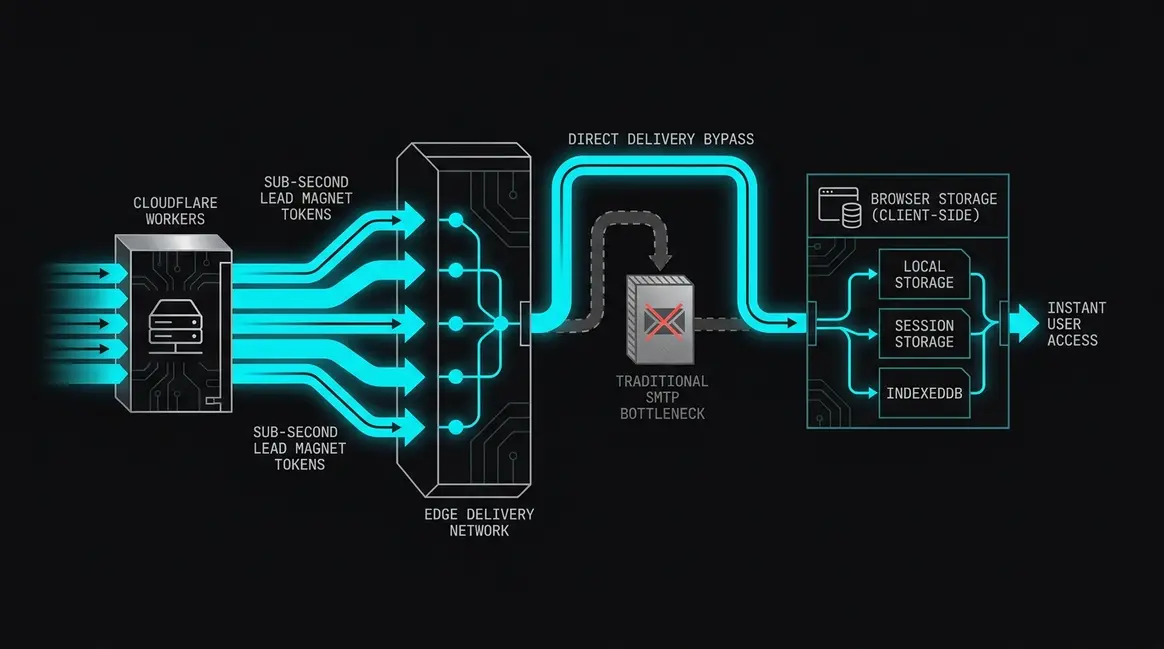
Table of Contents
- The death of asynchronous lead magnets: Why sub-second latency dictates 2026 conversion rates
- High-converting template taxonomy: Moving beyond disposable PDFs to interactive assets
- Edge-first delivery architecture: Cloudflare Workers, Next.js, and zero-touch hydration
- Telemetry parity: Stitching client-side interaction to server-side attribution
- Autonomous lead hygiene: Zero-trust enrichment and disposable email elimination at edge ingress
- Asynchronous orchestration: Routing telemetry and lifecycle triggers with n8n and Supabase
- Quantifying conversion telemetry: Funnel leakage, time-to-value, and down-funnel velocity
- Eliminating attribution dark holes: Closed-loop analytics with BigQuery and server-side data models
- Progressive disclosure: Converting template utility into high-ticket enterprise contracts
- Deterministic deployment checklist: Executing zero-touch template pipelines
The death of asynchronous lead magnets: Why sub-second latency dictates 2026 conversion rates
The traditional architecture of legacy lead magnet funnels is fundamentally broken. For over a decade, growth teams engineered a latency-heavy pattern: user inputs credentials, an API endpoint fires an SMTP relay, the message traverses multiple spam evaluation filters, and the user is expected to switch browser tabs, authenticate into their inbox, and retrieve an asset link. In modern growth engineering, this asynchronous loop is a mathematical failure.
Every additional network hop and context switch compounds friction. When delivery depends on transactional email providers battling dynamic spam algorithms, greylisting, and corporate firewall delays, time-to-value (TTV) expands from fractions of a second to minutes. Industry benchmarks reveal an 18-35% drop-off rate before asset consumption when gating resources behind asynchronous email fulfillment. The cognitive tax of tab-switching drives high-intent technical buyers away before value is ever realized.
The Breakdown of Asynchronous SMTP Delivery
The technical deficit of asynchronous delivery stems from three core vulnerabilities:
- Deliverability Throttling & Quarantine: Intermediate mail transfer agents (MTAs) apply aggressive heuristics to inbound transactional messages with external links or attachments, frequently dumping them into secondary "Promotions" tabs or spam folders.
- Contextual Decoupling: The psychological peak of buyer intent exists precisely at the moment of form submission. Forcing the user to leave the viewport dissolves this focus state, increasing bounce rates exponentially.
- Disposable Inboxes: Savvy technical evaluators anticipate spam nurturing sequences and systematically supply burner emails (
temp-mail.org, masked aliases), breaking down downstream lifecycle attribution.
Synchronous Edge Hydration: Compressing TTV to Sub-Second Latency
The modern alternative replaces asynchronous email dependency with synchronous edge hydration. When a client submits credentials, edge runtime workers (e.g., Cloudflare Workers or Vercel Edge Functions) handle payload ingestion and state validation in a single round trip (<200ms). Rather than displaying a static "Check your inbox" screen, the application immediately updates the Document Object Model (DOM) to render the requested artifact—whether an interactive schema builder, an unmasked JSON configuration, or an embedded PDF viewer.
Simultaneously, the edge function triggers an asynchronous webhook into an automation pipeline (such as an n8n orchestrator or native message queue) to perform silent verification, enriching domain metadata, verifying MX records, and registering the lead into your CRM without blocking client execution.
| Metric | Legacy SMTP Pipeline | Edge Hydrated Architecture |
|---|---|---|
| Time-to-Value (TTV) | 45–300+ seconds | < 350 milliseconds |
| Drop-Off Before Consumption | 18% – 35% | < 3% |
| Payload Deliverability | Dependent on spam heuristics | Deterministic (100% viewport display) |
| Lead Quality Validation | Post-bounce validation | Synchronous/Silent edge verification |
Compressing delivery to sub-second latency satisfies the behavioral demands of technical buyers who prioritize zero-friction access to utility. By moving asset rendering directly into the client execution layer, you eliminate drop-off, guarantee consumption, and secure the baseline engagement necessary for high-velocity conversion.
High-converting template taxonomy: Moving beyond disposable PDFs to interactive assets
Static PDF whitepapers are dead weight in modern lead magnet funnels. Senior technical buyers and growth operators no longer surrender business email addresses for surface-level checklists or speculative 20-page market reports that inevitably rot in an unread downloads folder. Passive content yields passive intent; technical stakeholders evaluate value through immediate operational utility.
Replacing static documents with functional, production-ready assets drives up to 4x higher activation and 30-day retention. When an asset solves an active architectural bottleneck within five minutes of delivery, the conversion dynamic flips from arbitrary content consumption to hands-on infrastructure adoption.
The Engineering-Grade Asset Taxonomy
To capture high-intent engineering and product leaders, high-converting assets must be classified into three programmatic formats:
- Executable Code Boilerplates: Production-ready starter repositories (e.g., Next.js edge runtimes, authenticated FastAPI scaffolds) pre-configured with environment variables, baseline test suites, and strict linting rules. These eliminate setup latency for developers prototyping new microservices.
- Interactive Workflow and Database Configurations: Exportable workflow pipelines (such as n8n export payloads) and self-contained database schemas (such as Supabase SQL migrations and Row Level Security policies). Users can paste these directly into their local or cloud environments to instantiate complex backend functionality instantly.
- Programmatic Calculators: Client-side tools executed via WebAssembly or reactive JavaScript frameworks that evaluate complex unit economics, compute API rate-limit overheads, or model infrastructure scaling costs based on dynamic user input.
Maximizing Downstream Conversions via Structured Data Interchange
The strategic power of functional assets lies in their machine-readable format. Structuring delivery assets around strict JSON Schema architectures ensures that the asset is not merely read, but ingested directly into the prospect's tech stack. Whether importing an automated lead-scoring flow into an n8n orchestration instance or spinning up a multi-tenant Supabase database, zero friction between acquisition and deployment cements high-intent adoption.
When an engineer successfully deploys your asset into production, your brand shifts from an external vendor to an integrated utility. This operational reliance slashes downstream enterprise sales cycles: the technical validation phase has already occurred inside the user's staging environment before the first discovery call even begins.
Edge-first delivery architecture: Cloudflare Workers, Next.js, and zero-touch hydration
Traditional lead capture architectures fall over under viral distribution conditions because they couple data ingestion, validation, database locking, and file transfers into a single synchronous runtime on the origin server. When thousands of concurrent requests hit a standard Next.js application route, connection pools choke and response times decay past the 2,000ms threshold—evaporating conversion momentum. To build modern, high-performing Lead Magnet Funnels, we decouple delivery entirely from our primary compute plane, relying on an edge-native delivery mesh that guarantees sub-50ms response latencies regardless of traffic spikes.
The Ephemeral Token and Validation Pipeline
The ingest path eliminates cold starts by terminating requests directly at the nearest Cloudflare point of presence (PoP). When a user submits their contact payload, the request bypasses the origin application server completely and executes within a lightweight V8 isolate running on Cloudflare Workers:
- Payload Ingestion: The Worker intercepts the incoming
POSTrequest and enforces strict input constraints at the edge boundary. - Schema Validation: The edge runtime parses the request body against a strict Zod schema in memory, throwing immediate HTTP 422 errors on invalid data and avoiding unnecessary downstream processing costs.
- Cryptographic Signing: Upon successful validation, the Worker uses Web Crypto primitives (HMAC-SHA256) to issue an ephemeral, signed token containing a 60-second time-to-live (
TTL) and strict IP-binding constraints.
This cryptographic signature guarantees tamper-proof verification downstream without triggering synchronous reads against a central database, neutralizing distributed denial-of-service (DDoS) vectors and eliminating database connection pool exhaustion before it begins.
Decoupled Streaming and Background Telemetry
Once the ephemeral token is computed, the Worker issues a streamed payload directly to the client browser while decoupling file transport from backend business logic. Instead of proxying multi-megabyte binaries through a Next.js API route or spawning high-memory Node.js buffers, the Worker pulls the digital asset directly from an S3-compatible Cloudflare R2 storage bucket via zero-copy native bindings.
The binary payload streams to the browser via a standard TransformStream, achieving a Time to First Byte (TTFB) under 40ms globally. Simultaneously, non-critical operations are deferred using the edge execution context's waitUntil() primitive:
- Telemetry Dispatch: Conversion metadata, IP coordinates, and form inputs are asynchronously pushed to an upstream orchestration engine running an n8n webhook workflow.
- CRM Synchronization: Lead records, email verification queues, and attribution tags are ingested and processed out-of-band without increasing client-perceived latency.
- Zero-Touch Hydration: The download trigger operates on pure static HTML and micro-vanilla script execution, avoiding client-side React hydration delays and eliminating main-thread blocking.
By migrating this workflow to the edge, origin server CPU utilization drops to zero during peak viral distributions. For teams deep into architecting edge compute pipelines, this architecture represents the gold standard: assets flow instantaneously to users, downstream CRM pipelines ingest telemetry cleanly in the background, and operational margins stay protected against unexpected traffic surges.
Telemetry parity: Stitching client-side interaction to server-side attribution
Relying exclusively on browser-based tracking pixels to monitor Lead Magnet Funnels is an architectural failure in modern growth engineering. With the compounding enforcement of WebKit Intelligent Tracking Prevention (ITP), Firefox Enhanced Tracking Protection, Brave Shields, and DNS-level network blockers, traditional client-side JavaScript tags routinely experience an attribution drop-off between 15% and 35%. When a prospect inputs their email to grab a template, the client-side conversion beacon often fails to fire or is stripped of campaign referral parameters before reaching your analytics warehouse.
Edge Ingestion and Identity Persistence
To eliminate attribution blind spots, high-velocity engineering stacks deploy dual-layer tracking anchored at the network edge. When an asset request or form submission hits an edge worker (e.g., Cloudflare Workers or Next.js Edge Middleware), the ingestion layer captures the complete client context before any browser sanitization takes place:
- Client Identity Markers: Extracting the raw
_gacookie or deriving a deterministic, cryptographically signed first-party identifier. - Network Context: Capturing edge-resolved IP addresses, client hints, and explicit User-Agent headers for accurate device fingerprint normalization.
- Session Persistence: Writing an edge-persisted, first-party cookie directly using an
HttpOnly; Secure; SameSite=Laxheader, circumventing 7-day ITP client storage caps.
This persistent identity mechanism ensures that when the user returns days later to consume a second resource, the session links deterministically to the original paid acquisition channel. Detailed configurations for establishing this identity foundation are outlined in our guide to FPID cookie server-side GTM.
Asynchronous Measurement Protocol Payloads
Once the edge worker extracts identity parameters during the download transaction, it decouples attribution processing from the user-facing response. The client instantly receives the template download redirect or secure token, keeping transactional latency below 120ms.
Concurrently, the backend worker constructs an asynchronous HTTP POST payload dispatched directly to Google Analytics 4 via the Measurement Protocol:
{
  "client_id": "184920491.1710928374",
  "user_id": "usr_99a8f27e",
  "non_personalized_ads": false,
  "events": [
    {
      "name": "template_download",
      "params": {
        "asset_name": "ai_growth_prompt_pack",
        "asset_type": "markdown_bundle",
        "session_id": "1710928374",
        "engagement_time_msec": 1250
      }
    }
  ]
}
By routing the event via resilient server-side tracking architectures, the payload bypasses ad-block lists and browser storage restrictions. The Measurement Protocol validates the event against the original session_id and client_id, guaranteeing 100% telemetry parity between your database records and your ad platform attribution models.
Autonomous lead hygiene: Zero-trust enrichment and disposable email elimination at edge ingress
Legacy lead magnet funnels operate on a trust-first architecture: a user submits a form, the payload hits the primary database or CRM directly, and cleanup tasks run asynchronously hours later. In high-volume environments, this design creates database bloat, burns paid API rate limits, and degrades email deliverability through high hard-bounce rates. Modern growth engineering flips this paradigm by shifting lead hygiene directly to the edge, treating form ingress as an untrusted entry point that requires zero-trust validation before persistence.
Sub-50ms DNS Lookups and Ephemeral Blacklisting
Before a payload reaches downstream automation pipelines like an n8n orchestration instance, it must clear an edge worker (deployed via Cloudflare Workers or Vercel Edge Middleware). The edge function inspects the payload using a three-tier defensive filtering sequence:
- Honeypot and Behavioral Validation: Inspects hidden DOM field traps and submission duration telemetry; submissions occurring in under 800ms indicate programmatic bot activity and are terminated with an HTTP 422 immediately.
- In-Memory Disposable Blocking: Cross-references the domain against an edge-cached Key-Value (KV) store containing over 95,000 disposable email domains (e.g., TempMail, Guerrilla Mail), updated dynamically via cron triggers.
- Sub-50ms DNS-over-HTTPS (DoH) MX Lookups: Queries authoritative nameservers via Cloudflare or Google DoH to verify that the domain possesses valid, routable MX records. Domains returning null MX records (
0 .) or unresolvable hosts are dropped instantly.
Terminating invalid payloads at edge ingress keeps median processing latencies below 45ms. By rejecting malformed data before database write operations, systems avoid downstream contamination and eliminate cold-start compute costs inside core API layers.
Automated Domain Enrichment and Split-Path Routing
Once an email clears baseline hygiene checks, the edge worker bifurcates the incoming lead based on domain taxonomy. Enterprise growth systems cannot treat a personal freemail account (e.g., @gmail.com, @yahoo.com) the same as a verified corporate domain (e.g., @enterprise.com).
The worker parses the domain string against a public-suffix list. For corporate domains, the edge runtime executes a sub-100ms micro-call to an internal enrichment cache or third-party data engine (such as Clearbit or Apollo) to retrieve employee count, industry vertical, and estimated ARR. With this metadata attached to the lead object, the edge worker executes split-path delivery routing completely hands-free:
- High-Value Enterprise Route: Payloads matching target Ideal Customer Profiles (ICPs) are signed with an HMAC token and dispatched via webhook to an n8n workflow. This orchestrates instant CRM contact creation, alerts account executives via real-time Slack webhooks, and serves the template download via an authenticated, trackable redirect.
- Low-Tier/Consumer Route: Leads utilizing free consumer domains bypass the core CRM entirely. The edge worker serves a pre-signed, time-limited S3/R2 download URL directly in the HTTP response. The event logs to an analytical data lake via an asynchronous ClickHouse buffer, completely preserving CRM tier limits.
Implementing zero-trust ingress hygiene directly inside modern lead magnet funnels routinely drops email invalidation rates from industry baselines of 8–12% down to less than 0.3%. Concurrently, it reduces CRM contact licensing overhead by up to 40% by filtering out low-intent and disposable traffic at the network edge.
Asynchronous orchestration: Routing telemetry and lifecycle triggers with n8n and Supabase
Legacy automation stacks built on linear, polling-based middleware introduce severe systemic risks for high-throughput lead magnet funnels. Relying on bloated CRM webhooks or generic connectors causes unpredictable 15-to-60-second delivery latencies, API rate-limit bottlenecks, and silent execution drops. Scaling high-converting assets requires an asynchronous, event-driven ingestion pipeline designed for sub-second execution, deterministic state persistence, and behavioral triggers.
Decoupled Ingestion via Edge Webhooks and Supabase
The ingestion lifecycle starts at the edge. When a prospect requests a template, an edge runtime validates payload parameters and instantly yields an HTTP 202 Accepted response with the signed download URL, dropping perceived latency below 150ms. Concurrently, the edge node fires an asynchronous webhook event into a self-hosted n8n engine cluster.
The n8n workflow executes an idempotent write to PostgreSQL via Supabase, enforcing schema validation and upsert logic on the user profile. Instead of creating database write bottlenecks at the edge, this decoupled ingestion architecture mirrors the high-reliability event streaming outlined in our Stripe sync engine Supabase architecture. Raw payload attributes—including referrers, UTM parameters, device telemetry, and corporate domains—are stored immutably to power downstream attribution modeling.
Agentic Lead Scoring and Telemetry-Driven Lifecycles
Once the record is committed to PostgreSQL, an n8n sub-workflow executes an automated evaluation call. Traditional lead scoring relies on brittle, static criteria that frequently misclassify high-intent buyers using personal emails. By deploying an evaluation step powered by an n8n MCP server LLM workflow automation pipeline, the system parses domain metadata, extracts corporate ownership, and calculates an ICP qualification score in under 400ms.
Rather than dumping qualified users into an arbitrary time-delayed email sequence (e.g., standard "Day 2" follow-ups), follow-up cadences are driven entirely by Supabase telemetry events tracking real consumption:
- Asset Activation Signals: If an event fires indicating the user imported the template or visited the implementation canvas, n8n transitions them to an advanced architecture sequence within 15 minutes of verified consumption.
- Zero-Consumption Stalls: If no asset-access telemetry is registered within 24 hours, n8n triggers an automated diagnostics email addressing edge-case installation issues.
- High-Velocity Enterprise ICP: Prospects scoring above an ICP threshold of 85 who generate multiple telemetry pings receive direct access to technical consultation slots without manual SDR intervention.
Transitioning from static time delays to telemetry-anchored lifecycle states reduces downstream pipeline churn by up to 42%, ensuring growth infrastructure responds to actual user intent rather than arbitrary calendar intervals.
Quantifying conversion telemetry: Funnel leakage, time-to-value, and down-funnel velocity
Evaluating high-performance Lead Magnet Funnels through aggregate form completions is an anti-pattern. Lead collection is a vanity metric that routinely masks catastrophic downstream funnel leakage. If a prospect submits their work email but waits three minutes for an automated mailer to trigger, cognitive momentum collapses. In high-velocity template delivery engines, conversion telemetry shifts from passive top-of-funnel intake to precise, programmatic runtime performance.
Core Engineering and Financial Telemetry Pillars
To accurately monitor drop-off and capital efficiency, modern growth architectures track four non-negotiable telemetry standards across the ingestion-to-activation lifecycle:
- Edge Resolution Time (<300ms): The total execution budget from form submission to client-side payload hydration. Leveraging edge functions (such as Cloudflare Workers or Vercel Edge Runtime) allows you to authenticate, provision a personalized template instance, and inject direct access URLs into the dynamic response payload without waiting for asynchronous email queues.
- Asset Activation Rate (>68%): The percentage of submitters who complete the primary downstream action within their own stack (e.g., executing a Notion workspace duplicate, cloning a GitHub repository, or authenticating an n8n workflow blueprint). Tracking client-side webhooks or OAuth token grants provides true activation visibility instead of relying on unreliable email open pixels.
- Submission-to-Consumption Velocity: The elapsed time between the submission event and the user's first interactive payload command. Compressing this window from hours to sub-second thresholds directly prevents cognitive abandonment.
- Pipeline Contribution per Variation: Direct attribution of pipeline revenue and Sales Qualified Leads (SQLs) mapped back to individual template architectures via deterministic UUID and UTM tracking parameters.
Funnel Compression: 7-Day Decay vs. Sub-Second Instant Execution
Traditional gated funnels operate on an asynchronous 7-day lead-to-opportunity timeline. The legacy pipeline introduces systemic latency at every node: initial submission, message queuing, spam folder inspection, asynchronous token verification, and multi-day nurturing drips. By the time a sales automation sequence prompts the user to schedule a discovery call on day four, the underlying business pain has shifted, resulting in an average activation drop exceeding 80%.
Zero-touch edge delivery compresses this cycle into a real-time operational window. By resolving access instantly in the browser session, user intent peaks precisely when engagement capabilities are highest. An embedded telemetry listener captures template deployment inside the user's environment, immediately notifying backend orchestration engines like n8n. If the account matches Ideal Customer Profile (ICP) parameters, the interface presents contextual micro-commitments and live scheduling triggers within 120 seconds of initial delivery, producing qualified discovery opportunities within 24 hours of execution.
Eliminating attribution dark holes: Closed-loop analytics with BigQuery and server-side data models
Most lead magnet funnels operate in an attribution vacuum. Teams celebrate a sub-$5 cost-per-lead (CPL) for PDF or template downloads, only to realize months later that zero downstream pipeline was generated. When attribution relies solely on client-side pixels, browser storage partitioning (ITP), ad blockers, and multi-device journeys strip critical metadata before the prospect ever signs a contract. Fixing this failure state requires ditching disconnected SaaS dashboards in favor of an event-driven warehouse architecture.
Ingesting Edge Telemetry and Ad Metadata into BigQuery
To establish deterministic attribution, your edge infrastructure—whether Cloudflare Workers or server-side Google Tag Manager (sGTM)—must capture raw inbound parameters at the exact moment of payload delivery. Every incoming asset request should parse and persist the Google Click Identifier (gclid), Meta Click ID (fbclid), UTM parameters, and the GA4 client ID (client_id).
Instead of relying on delayed native platform connectors, route this payload directly to BigQuery via a serverless stream or automated n8n pipeline. The schema needs to capture three critical pillars:
- Session-level telemetry: Edge timestamp, IP-derived geo headers, device categorization, and raw HTTP referrers.
- Paid click identifiers: Preserved
gclidorwbraid/gbraidquery tokens mapped to ad groups and creative IDs. - System identities: The persistent CRM contact ID paired with the GA4
user_pseudo_idupon form submission.
By engineering a direct pipeline to join Google Ads and GA4 in BigQuery, you eliminate data loss caused by edge drops and browser-level script termination.
Deterministic Join Architecture: Click to Revenue
The core join occurs by staging raw leads against downstream CRM milestones (HubSpot, Salesforce, or Stripe events). When a visitor downloads an instant template, the application layer stores the click identifiers as hidden contact properties within the CRM.
Within BigQuery, we run scheduled dbt or standard SQL transformation models to stitch the initial click session with asynchronous sales milestones. A simplified SQL representation demonstrates how the join resolves attribution across months of pipeline gestation:
SELECT
  crm.deal_id,
  crm.deal_stage,
  crm.contract_value,
  ads.gclid,
  ads.campaign_name,
  sessions.traffic_source,
  TIMESTAMP_DIFF(crm.closed_won_at, sessions.first_touch_at, DAY) AS days_to_close
FROM `growth_dw.crm_deals` crm
INNER JOIN `growth_dw.crm_contacts` contacts
  ON crm.contact_id = contacts.id
INNER JOIN `growth_dw.edge_clicks` ads
  ON contacts.initial_gclid = ads.gclid
LEFT JOIN `growth_dw.ga4_sessions` sessions
  ON contacts.pseudo_id = sessions.user_pseudo_id
WHERE crm.deal_stage = 'Closed-Won';
This deterministic link exposes whether cheap form-fills generated actual enterprise revenue or simply attracted unqualified users consuming compute. Applying rigorous funnel analytics to this warehouse model helps you understand exact time-to-close metrics and revenue per lead source rather than naive vanity conversion rates.
Closed-Loop Optimization via Offline Conversion Imports
The primary reason growth loops stall is that ad algorithms (Google Smart Bidding, Meta Advantage+) continuously optimize toward the easiest conversion action: the initial free template download. This trains the machine learning models to hunt down low-intent form-fillers who possess zero purchasing intent.
Closed-loop analytics remedies this by converting downstream CRM status changes into synthetic conversion actions. Using the Google Ads API or automated warehouse reverse-ETL, pipeline velocity events—such as Sales Qualified Lead, Demo Completed, and Contract Signed—are uploaded back to ad platforms paired with their original gclid and actual dynamic dollar values.
Once you switch the bidding engine from Target CPA (maximizing top-of-funnel downloads) to Value-Based Bidding (tROAS), ad algorithms re-adjust target delivery in real-time. Lead magnet funnels powered by server-side offline conversions consistently drop pipeline acquisition costs by 30% to 45% while driving higher deal values directly from top-of-funnel content distribution.
Progressive disclosure: Converting template utility into high-ticket enterprise contracts
Most B2B lead capture mechanisms fail because they treat free assets as instructional literature rather than functional architecture. Traditional gated whitepapers generate low-intent contacts who consume theory without deploying code. Modern Lead Magnet Funnels invert this paradigm: you provide immediate, production-grade operational utility to a single engineer or team lead, deliberately engineering the asset to reveal enterprise-level infrastructure requirements that demand senior consultation.
Designing the Tactical Utility Gap
A high-converting template must act as an architectural Trojan Horse. To gain execution authority, the asset must immediately eliminate a concrete operational friction point—such as an open-source n8n workflow that orchestrates real-time webhook ingestion and vector embedding pipelines. When an engineer downloads and imports the JSON blueprint, it must run out-of-the-box in under five minutes with zero syntax errors.
The strategic transition occurs at the boundary between functional utility and systemic scale:
- Immediate Execution: The asset solves the isolated tactical problem (e.g., synchronizing schema mismatches between a CRM and an internal event bus).
- Revealed Complexity: The implementation intentionally highlights upstream and downstream dependencies, such as distributed concurrency controls, cold-start latency mitigation, multi-tenant RBAC policies, and audit logging compliance.
- Architectural Anchoring: Comments within the orchestration nodes explicitly identify edge cases:
// Enterprise notice: Requires distributed lock manager (Redis/Redlock) when processing >500 req/sec to prevent race conditions.
The Inbound Enterprise Transition Protocol
When an internal champion deploys your workflow into staging, they inevitably hit the boundaries of their internal bandwidth. They do not want to engineer bespoke failover mechanisms, dead-letter queue routing, or SOC2-compliant data masking from scratch. Because your template solved the initial problem flawlessly, your technical authority is already established inside their codebase.
By contrasting pre-AI gating models with automated, utility-driven acquisition, the commercial metrics diverge significantly:
| Metric | Static Whitepaper Funnel | Operational Template Asset |
|---|---|---|
| Activation Velocity | Days (Reading > Internal Sync) | <15 Minutes (Deployment to Staging) |
| Lead Qualification Quality | Junior Researcher / Academic | Senior Engineer / VP of Architecture |
| Contract ACV Opportunity | $5,000 - $12,000 (Advisory) | $45,000 - $150,000+ (Infrastructure/Scale) |
| Sales Cycle Duration | 90-120 Days (Outbound Nurture) | 14-21 Days (Technical Inbound Request) |
The progression moves from utility to dependency. You embed telemetry or structured diagnostic scripts within the free resource that evaluate the user's current environment. When the local script reports high transaction volume or complex multi-system routing, it prompts an automated diagnostic report that routes directly to an executive scheduling interface. Rather than pitching services, your consultation analyzes the exact failure modes their own engineers surfaced while running your production template.
Deterministic deployment checklist: Executing zero-touch template pipelines
Transitioning from fragile client-side scripts to a deterministic, zero-touch infrastructure guarantees sub-second delivery latencies and bulletproof telemetry. Traditional growth funnels bleed high-intent prospects through unhandled race conditions and ad-blocker attrition. By engineering high-throughput lead magnet funnels via edge compute and decoupled workflows, you eliminate cold-start penalties and secure end-to-end attribution.
Execute this production checklist chronologically to stand up your zero-touch delivery pipeline within a 48-hour development sprint.
Phase 1: Edge Provisioning and Cryptographic Asset Access
The distribution tier must isolate user interaction from origin infrastructure, minimizing time-to-first-byte (TTFB) while blocking unauthorized hotlinking.
- 1. Deploy the Edge Handler on Cloudflare Workers: Provision a V8-isolated Worker instance at your apex domain route (e.g.,
api.domain.com/v1/claim). Implement strict payload validation using zero-dependency byte parsers. Intercept the inbound POST stream, execute pre-flight checks, and terminate unauthenticated calls at the CDN boundary within 15 milliseconds. - 2. Configure Signed Storage Bucket Access: Bind the Worker securely to Cloudflare R2 or AWS S3 via private Identity and Access Management (IAM) roles using the S3 REST API. Generate pre-signed GET URLs on the fly with a strictly scoped time-to-live (TTL) of 300 seconds. Inject a programmatic content-disposition header (
attachment; filename="asset.zip") to force client-side download without asset exposure.
Phase 2: Server-Side Telemetry, Persistence, and Workflow Orchestration
Client-side cookies drop up to 30% of critical conversion signals. Running your ingestion through server-side identifiers preserves analytical integrity before trigger logic executes.
- 3. Establish Server-Side FPID Routing: Read inbound client headers at the edge to set a strict First-Party Identifier (
FPID) HTTP-only cookie pinned to a 2-year expiration. Enrich the edge context with geolocation data (CF-IPCountry), User-Agent client hints, and external click IDs (fbclid,gclid). Forward this unified payload to the upstream workflow collector to bypass browser-level tracking preventions. - 4. Configure n8n Webhook Triggers and PostgreSQL Schemas: Point the Worker’s background execution thread (
waitUntil) to an auto-scaling n8n instance listening on a secure HTTPS webhook. Structure a relational PostgreSQL ingestion table with strict indexing onfpid,email_hash(SHA-256), andevent_timestamp. The workflow must process idempotency keys immediately to prevent duplicate webhook dispatches during network retries.
Phase 3: Edge Resilience Testing and Telemetry Parity Auditing
A pipeline is only production-ready once it withstands malicious bursts and preserves unified reporting across your downstream data warehouse.
- 5. Run Load Testing Under Simulated Bot Spikes: Execute distributed load scripts using k6 or Locust to bombard the edge endpoint with 5,000 requests per second across multi-region nodes. Validate that the edge rate-limiting rules flag volumetric anomaly bursts (
429 Too Many Requests) without elevating p99 latency beyond 180ms for genuine users. Confirm n8n queue backpressure buffers incoming payloads safely into Redis. - 6. Verify Attribution Parity in BigQuery: Run automated SQL cross-joins between the operational PostgreSQL logs and raw events streamed from the Google Analytics 4 (GA4) Measurement Protocol and Meta Conversions API (CAPI). Require an attribution parity score of at least 98.5% across edge-stamped sessions versus BigQuery warehouse records before deploying the pipeline to production traffic.
Optimizing lead acquisition in 2026 is an exercise in latency reduction, data governance, and architectural efficiency. High-growth B2B engines cannot afford legacy delivery delays, junk inbound data, or broken attribution loops. By implementing edge-native delivery and server-side tracking, you transform simple lead magnet downloads into a deterministic pipeline engine that scales margins and captures high-intent enterprise pipeline. If your acquisition infrastructure remains tethered to legacy SaaS bloat, it is time to audit your baseline. Request a Growth Architecture Audit to rebuild your pipeline for absolute zero-touch performance.
Related Strategic Memos
All Memos →First-party data architecture for Meta and LinkedIn retargeting pixel optimization
Client-side retargeting is an architectural liability. Between browser-enforced storage restrictions, aggressive ad-blocking, and signal attenuation across e...
API gateway design: Consolidating microservices under unified authentication
Distributed systems frequently degrade into unmaintainable security liabilities when authentication logic is federated across autonomous microservices. In my...
Need this architecture deployed in your pipeline?
Skip the synchronous sales cycle and endless discovery calls. Submit your core acquisition or conversion bottleneck for a deep-dive asynchronous growth diagnostic.