Feature-gating frameworks that accelerate enterprise upsell
Traditional SaaS pricing tiering is broken. Hardcoding feature gates inside your primary application code creates technical debt, decouples monetization from...
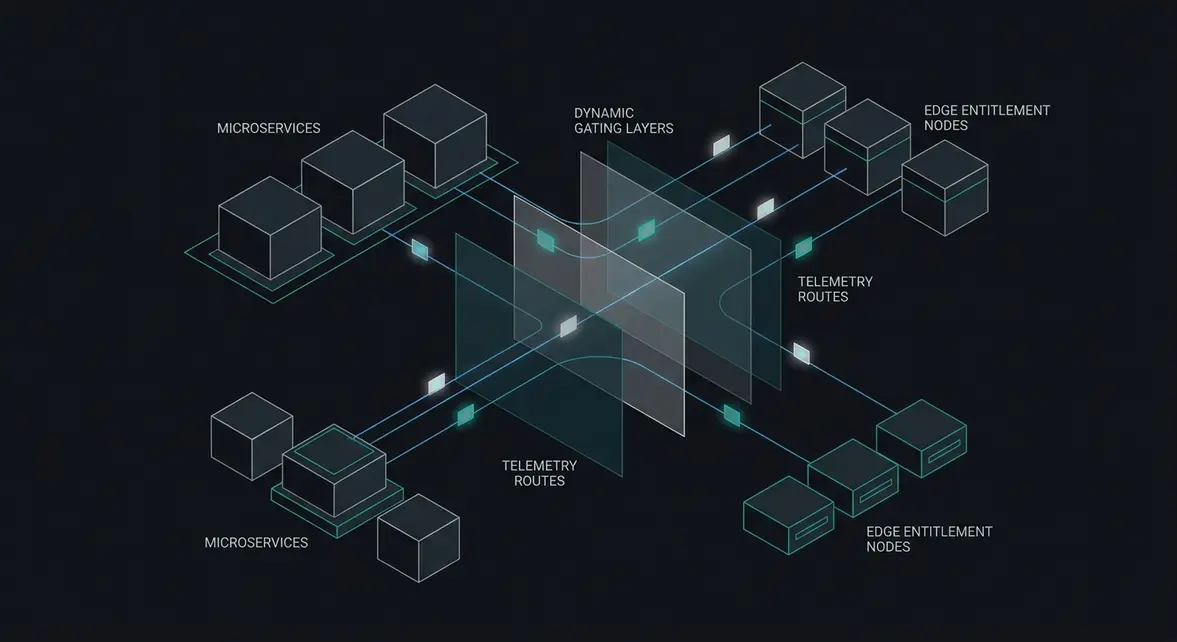
Table of Contents
- The structural failure of hardcoded entitlement checks
- Deconstructing SaaS pricing tiering: From static seats to consumption-gated primitives
- Deterministic entitlement engines: Decoupling billing logic from application code
- Edge-native gating with distributed state synchronization
- Database schema patterns for dynamic tenant entitlements
- Zero-touch enterprise upsell triggers via telemetry aggregation
- Autonomous sales workflows: Orchestrating AI agents and billing pipelines
- Graceful degradation and soft limits: Eliminating enterprise churn at the gate
- Deterministic integration testing for monetization infrastructure
The structural failure of hardcoded entitlement checks
Embedding boolean flags like isEnterprise or hasFeatureX directly into application code remains one of the most destructive architectural anti-patterns in modern software. While treating monetization as an afterthought of if/else statements offers short-term implementation speed, it permanently corrupts core business logic. As your commercial strategy evolves, hardcoded logic fragments your SaaS pricing tiering, binding commercial flexibility directly to the technical debt of your codebase.
The Velocity Tax of Deploy-Dependent Gating
When entitlement boundaries live in application repositories, altering product packaging demands a full continuous integration and deployment (CI/CD) cycle. Moving a workflow trigger from a "Growth" tier to an "Enterprise" tier ceases to be an instantaneous business decision; it becomes a sprint ticket requiring pull requests, staging QA, and coordinated production deployments. Benchmarks across scaling software organizations demonstrate a 23% reduction in engineering velocity directly caused by coupling billing and packaging changes to feature releases.
This coupling becomes exponentially worse across distributed environments. If your systems utilize a decoupled microfrontend architecture or decentralized microservices, hardcoded logic guarantees silent authorization drift. One isolated service inevitably runs an outdated entitlement schema, exposing premium features to churned accounts while mistakenly locking out legitimate enterprise contracts.
Silent Authorization Drift and Audit Vulnerabilities
Hardcoded checks frequently manifest as cosmetic client-side gating—conditionally rendering a React component or disabling a DOM element based on a user metadata token. This frontend-only bypass pattern introduces catastrophic security vulnerabilities:
- API-Level Security Exposure: Hiding a button in the UI does nothing to secure the underlying endpoint. Sophisticated enterprise prospects running preliminary penetration tests routinely uncover unprotected GraphQL mutations or REST endpoints that execute enterprise workflows without server-side verification, terminating procurement discussions on the spot.
- Endpoint-Level State Fragmentation: Evaluating usage counters and rate limits ad hoc at the individual API route level without centralized state synchronization leads to race conditions. Without an event-driven control plane—such as an automated sync engine orchestrated via real-time ingestion pipelines or n8n webhooks—concurrent requests effortlessly bypass usage quotas.
- Compliance and Audit Failures: Enterprise security questionnaires and SOC 2 Type II compliance audits require deterministic access governance. When entitlement logic is scattered across dozens of controllers rather than managed via a single source of truth, establishing an auditable chain of authorization becomes functionally impossible.
Hardcoded entitlements fail because they treat authorization as static code rather than dynamic, high-throughput state. Decoupling entitlement checks from execution logic is the only pathway to scale enterprise upsells without engineering drag.
Deconstructing SaaS pricing tiering: From static seats to consumption-gated primitives
The enterprise monetization model has undergone a seismic inversion. For over a decade, B2B software relied on static per-seat licensing—a framework that penalizes organizational efficiency and collapses under the weight of AI-driven automation. When autonomous workers and headless integrations execute workloads previously handled by large teams, charging per seat actively depresses Annual Contract Value (ACV). Sustaining Net Revenue Retention (NRR) benchmarks above 130% requires modern architectures to decouple monetizable units from human headcount, shifting toward consumption-entitlement topologies that gate underlying platform primitives.
The Tri-Dimensional Entitlement Topology
Executing an effective SaaS pricing tiering framework requires abandoning binary "paywalling" in favor of multi-dimensional limit enforcement evaluated at runtime. High-velocity enterprises must architect continuous policy validation across three specific runtime surfaces:
- Binary Capability Gates: Static, enterprise-readiness security protocols (such as SAML 2.0/SCIM provisioning, automated RBAC, and SIEM audit log streaming via webhook pipes). These features do not scale linearly with compute; they validate governance posture and justify base enterprise contract floors.
- Volumetric Rate Gates: High-throughput throughput meters managing ingestion volume, including transactional API requests per second (RPS), total webhook dispatches, and raw event streaming limits. Gating here throttles abusive multi-tenant noisiness while metering platform utility.
- Computational Resource Gates: Deep infrastructure consumption metrics tied directly to compute cost, including raw LLM token throughput, vector database vector search queries, and distributed background worker concurrency ceilings.
ACV Leakage and the Expansion Velocity Formula
Traditional rigid tiers leak revenue at the margins. When a customer exceeds an arbitrary operational threshold, the conventional response is an immediate, blocking HTTP 429 Too Many Requests or an administrative UI lockout. This model introduces severe enterprise friction, incentivizing engineering leads to optimize usage downward or migrate workloads rather than expand their spend.
Maximizing revenue capture requires replacing hard ceilings with low-latency dynamic entitlement evaluation paired with automated expansion triggers. System architects can quantify this dynamic through the Expansion Velocity formula:
Expansion Rate = (Consumption Telemetry / Gating Latency) * Enterprise Conversion Efficiency
In this equation, Consumption Telemetry represents real-time event ingestion density; Gating Latency measures the duration required for edge middleware (such as Cloudflare Workers or Envoy sidecars) to reconcile usage against tenant limits (targeting sub-10ms execution); and Enterprise Conversion Efficiency defines the probability that a soft-limit ceiling event triggers an automated contract escalation via programmatic webhooks to billing orchestration workflows (such as n8n pipelines updating Stripe Billing or Metronome primitives). By treating limit thresholds as real-time upsell signals rather than terminal drop-offs, platforms secure continuous baseline expansion without stalling production workloads.
Deterministic entitlement engines: Decoupling billing logic from application code
Querying external billing providers like Stripe or Chargebee directly within the application execution path is an architectural anti-pattern. Upstream billing APIs are designed for eventual consistency, ledger durability, and complex financial reconciliation—not sub-10ms runtime gatekeeping. Routing user requests through a third-party billing gateway introduces 200ms to 800ms of unwanted latency, converts a third-party outage into an internal platform outage, and severely constrains high-frequency enterprise workflows.
To enforce robust SaaS Pricing Tiering without compromising system throughput, entitlement verification must exist as an autonomous, zero-latency micro-engine that sits entirely inside your private network boundary.
In-Memory Cache Layer and Event-Driven Synchronization
A deterministic entitlement service decouples financial invoicing from feature authorization by separating the transactional source of record from the runtime evaluation path. The architecture relies on a two-tier storage paradigm:
- Relational Source of Truth: An authoritative datastore (e.g., PostgreSQL) houses workspace subscriptions, custom enterprise contractual add-ons, feature flags, and tenant limits. Changes originate here via signed internal billing mutations.
- In-Memory Evaluation Plane: A distributed, read-optimized cache layer running on Redis or Valkey clusters maintains serialized, pre-computed tenant capabilities. Read latencies remain sub-2ms under sustained load.
- Asynchronous Synchronization: Subscription state updates propagate out-of-band. Enterprise billing events, n8n orchestration workflows, and webhook consumers update the relational state and invalidate the memory layer via pub/sub channels without locking the application runtime.
The Entitlement Broker Contract and Schema Enforcement
The contract between the application gateway and the entitlement broker must remain strictly functional: identical inputs must yield identical authorization decisions with zero side effects. The entitlement check must never mutate state, trigger telemetry-side writes, or execute rate-limiting adjustments inline.
Communication between the service boundary and the micro-engine requires explicit runtime validation. Using strict JSON Schema definitions, both requests and evaluation responses are verified before hitting memory:
{
  "$schema": "https://json-schema.org/draft/2020-12/schema",
  "title": "EntitlementQuery",
  "type": "object",
  "required": ["tenant_id", "feature_key", "context"],
  "properties": {
    "tenant_id": { "type": "string", "format": "uuid" },
    "feature_key": { "type": "string", "pattern": "^[a-z0-9_\\-\\.:]+$" },
    "context": {
      "type": "object",
      "properties": {
        "actor_role": { "type": "string" },
        "environment": { "type": "string", "enum": ["production", "staging"] }
      },
      "required": ["actor_role"]
    }
  },
  "additionalProperties": false
}
The response payload delivers an immutable, cryptographically predictable grant:
{
  "tenant_id": "9b1deb4d-3b7d-4bad-9bdd-2b0d7b3dcb6d",
  "feature_key": "enterprise_sso",
  "access_granted": true,
  "quota_limit": null,
  "evaluation_signature": "sha256:d8e8fca2dc0f896fd7cb4cb0031ba249"
}
By enforcing zero-side-effect evaluations and isolating metering increments to asynchronous event buses (such as Apache Kafka or Redis Streams), the core application layer validates access rules across complex enterprise contracts in microseconds, insulating user experience from billing system volatility.
Edge-native gating with distributed state synchronization
Traditional monolithic architectures enforce entitlement checks at the application or database layer, introducing severe latency penalties and architectural vulnerabilities. Routing every inbound API call to a centralized PostgreSQL or Redis cluster to verify subscription status adds 40ms to 120ms of round-trip overhead per request. In high-throughput enterprise ecosystems, this latency degrades user experience and artificially inflates infrastructure costs.
Modern growth engineering shifts this boundary to the edge. By executing feature checks directly within edge runtimes like Cloudflare Workers, Fastly Compute, or V8 isolates, entitlement verification occurs geographically proximate to the caller. This keeps read latencies consistently below 5ms while decoupling core database performance from global traffic volume.
Sub-Millisecond Read Topology and Edge Key-Value Stores
Achieving sub-5ms entitlement reads requires flattening complex multi-tenant permissions into binary or lightweight structural primitives stored in distributed edge stores, such as Cloudflare Workers KV or Fastly KV. Instead of evaluating relational permissions on the fly, the edge runtime evaluates a pre-compiled JSON entitlement payload cached in runtime memory or local edge storage:
{
  "tenant_id": "org_enterprise_982",
  "tier": "enterprise_plus",
  "features": {
    "audit_export": true,
    "ai_seats": 250,
    "realtime_sync": true
  },
  "rate_limits": {
    "rpm": 50000
  }
}
When an inbound enterprise request hits the gateway, the edge worker extracts the tenant identifier from the signed JWT or API token, retrieves the cached bitmap, and evaluates access in-memory. Central databases remain untouched during nominal operation, allowing systems to absorb hundreds of thousands of concurrent requests without compute degradation.
Distributed State Synchronization via CDC and Webhooks
The principal engineering challenge of edge-native gating is cache invalidation. Enterprise customers expect tier upgrades or seat expansions to take effect instantaneously. A polling strategy is too slow, while full cache purges create cold-start stampedes.
The optimal pattern implements Change Data Capture (CDC) combined with event-driven webhooks. When a contract upgrade alters the SaaS Pricing Tiering topology in the primary transactional database, an automated pipeline—orchestrated via event streaming or an n8n webhook consumer—broadcasts an atomic update directly to edge key-value stores globally. For detailed execution strategies on building stateful, low-latency edge systems, review our blueprint on architecting edge-first agentic infrastructure.
- Propagation Speed: Global state propagation settles across edge points of presence (PoPs) within 60 to 300 milliseconds.
- Fail-Safe Fallbacks: Stale-while-revalidate policies ensure that temporary edge store network partitions fall back to local worker memory rather than hard-failing enterprise workloads.
Denial-of-Wallet Mitigation and Upstream Insulation
Exposing complex application logic to unverified requests introduces catastrophic denial-of-wallet risks, particularly for architectures triggering expensive downstream AI models, vector lookups, or third-party metered APIs. If an unauthorized tenant issues rapid-fire API requests, upstream compute charges accumulate even if the origin application ultimately returns a 403 Forbidden.
Edge-native gating solves this by dropping unentitled requests at the edge boundary. Traffic exceeding enterprise rate tiers or attempting to access gated endpoints is terminated at the edge with immediate HTTP 402 (Payment Required) or 429 (Too Many Requests) responses, burning zero origin CPU cycles and shielding backend cloud infrastructure from deliberate or accidental resource exhaustion.
Database schema patterns for dynamic tenant entitlements
Monetization velocity stalls the moment product teams hardcode tier checks or build bespoke branches for enterprise deals. Implementing scalable SaaS Pricing Tiering requires an immutable, relational foundation in PostgreSQL that models complex entitlements, handles negotiated enterprise exceptions, and evaluates authorization queries in sub-5ms runtimes.
Relational Schema Blueprint: From Plans to Tenant Overrides
To eliminate code forks and decouple billing logic from application runtimes, model feature gating across five core relational tables: tenants, plans, features, plan_features, and tenant_overrides.
-- Core feature registry
CREATE TABLE features (
    id VARCHAR(64) PRIMARY KEY, -- e.g., 'sso_saml', 'audit_logs', 'seat_limit'
    feature_type VARCHAR(16) NOT NULL CHECK (feature_type IN ('boolean', 'metered', 'tiered')),
    default_value JSONB NOT NULL DEFAULT 'false'::jsonb,
    created_at TIMESTAMPTZ NOT NULL DEFAULT NOW()
);

-- Pricing tiers
CREATE TABLE plans (
    id VARCHAR(64) PRIMARY KEY, -- e.g., 'free', 'growth', 'enterprise'
    name TEXT NOT NULL,
    version INT NOT NULL DEFAULT 1,
    is_active BOOLEAN NOT NULL DEFAULT true
);

-- Plan-level default entitlements
CREATE TABLE plan_features (
    plan_id VARCHAR(64) REFERENCES plans(id) ON DELETE CASCADE,
    feature_id VARCHAR(64) REFERENCES features(id) ON DELETE CASCADE,
    value JSONB NOT NULL, -- e.g., 'true' or '{"limit": 50}'
    PRIMARY KEY (plan_id, feature_id)
);

-- Tenant records bound to active plans
CREATE TABLE tenants (
    id UUID PRIMARY KEY DEFAULT gen_random_uuid(),
    name TEXT NOT NULL,
    plan_id VARCHAR(64) REFERENCES plans(id),
    stripe_subscription_id TEXT UNIQUE,
    status VARCHAR(32) NOT NULL DEFAULT 'active',
    updated_at TIMESTAMPTZ NOT NULL DEFAULT NOW()
);

-- Custom enterprise contract overrides
CREATE TABLE tenant_overrides (
    tenant_id UUID REFERENCES tenants(id) ON DELETE CASCADE,
    feature_id VARCHAR(64) REFERENCES features(id) ON DELETE CASCADE,
    value JSONB NOT NULL,
    expires_at TIMESTAMPTZ,
    reason TEXT,
    PRIMARY KEY (tenant_id, feature_id)
);
Architectures leveraging an account-per-tenant serverless SaaS strategy isolate security domains while consuming this exact centralized catalog for policy evaluations.
Normalization vs. Denormalized JSONB: The Real-Time Evaluation Trade-Off
Evaluating raw normalized joins across five tables on every authorized API call introduces unnecessary database round-trips and connection pool exhaustion at scale. While normalization guarantees referential integrity during catalog modifications, run-time evaluation demands instant resolution.
- Normalized Relational Reads: Executing a
COALESCE(tenant_overrides.value, plan_features.value, features.default_value)via standard joins guarantees data purity across historical changes. However, query latency averages 8ms to 18ms under concurrent production loads. - Denormalized JSONB Snapshots: Storing a compiled
entitlementsJSONB document directly on thetenantsrow reduces entitlement verification down to a single index lookup (sub-1ms latency). Updates are triggered asynchronously through database triggers or event-driven workers whenever an override or plan reassignment occurs.
Managing Custom Enterprise Overrides Without Code Branches
Enterprise sales cycles frequently demand bespoke exceptions—such as doubling rate limits or granting early access to beta features—prior to an official contract expansion. Storing these parameters in tenant_overrides eliminates conditional feature branch logic (if tenant_id == 'x') entirely.
Application logic evaluates entitlements by querying resolved states through a deterministic hierarchy:
SELECT
    f.id AS feature_id,
    COALESCE(
        CASE
            WHEN tor.expires_at IS NULL OR tor.expires_at > NOW() THEN tor.value
            ELSE NULL
        END,
        pf.value,
        f.default_value
    ) AS effective_value
FROM features f
LEFT JOIN plans p ON p.id = (SELECT plan_id FROM tenants WHERE id = $1)
LEFT JOIN plan_features pf ON pf.plan_id = p.id AND pf.feature_id = f.id
LEFT JOIN tenant_overrides tor ON tor.tenant_id = $1 AND tor.feature_id = f.id
WHERE f.id = $2;
Deterministic Ingestion: Mirroring Payment Webhooks with Idempotency
To keep the relational entitlements layer synchronized with third-party billing providers (e.g., Stripe, Lago, or Orb) without split-brain anomalies, event ingestion must be strictly idempotent. Out-of-order webhook delivery otherwise risks overwriting newer subscription downgrades with stale renewal payloads.
Ingestion handlers execute within an isolated transaction that writes incoming event IDs to an idempotency_log table using an ON CONFLICT DO NOTHING gate. By pairing deterministic event sequences with a resilient Stripe sync engine Supabase architecture, asynchronous subscription state changes update the underlying tenants.plan_id and recompute denormalized JSONB snapshots atomically in under 120ms.
Zero-touch enterprise upsell triggers via telemetry aggregation
Modern monetization infrastructure renders static paywalls obsolete. When configuring a SaaS pricing tiering architecture designed for net revenue retention (NRR), the gateway between self-serve tiers and high-ticket enterprise contracts must be dynamic. Instead of relying on manual quarterly business reviews or punitive hard blocks that break customer workflows, high-performing growth stacks deploy an automated telemetry aggregation pipeline that treats product usage anomalies as deterministic sales triggers.
Ingestion Architecture and Consumption Thresholds
The pipeline begins with high-throughput event collectors capturing resource utilization at the application layer. By deploying low-latency server-side tracking pipelines via Kafka or AWS Kinesis, every API invocation, compute cycle, or seat allocation is aggregated into stateful sliding windows. These streams track burn trajectory rather than static snapshots:
- Early Warning Trigger (85% Quota): Emits an asynchronous notification to compute velocity models, comparing burn rate against days remaining in the billing cycle.
- Critical Threshold Trigger (95% Quota): Dispatches an automated, hyper-contextual in-app notification offering friction-free tier upgrades or auto-scaling enterprise capacity before hard limit caps disrupt live workflows.
Behavioral Pattern Detection and Org-Level Expansion
Enterprise contracts are rarely won by capacity exhaustion alone; they close when organizational sprawl creates security and governance friction. Real-time stream processing models analyze continuous usage telemetry to flag enterprise-grade behavioral indicators across distributed user clusters:
- Domain Heterogeneity: Multiple user sign-ups originating from corporate subsidiaries or disparate email domains (such as regional business units or newly acquired entities) linking to the same core workspace.
- Velocity Spikes: Sudden acceleration in ingestion volume exceeding standard deviation baselines by more than 300% within a rolling 48-hour window.
- Feature Entitlement Probing: Repeated non-admin attempts to configure SAML/SSO, export enterprise audit logs, or adjust custom role-based access control (RBAC) matrix settings.
Asynchronous Broker Routing and Zero-Touch Dispatch
Once consumption patterns match an enterprise expansion archetype, events route through message brokers such as RabbitMQ or Google Cloud Pub/Sub into orchestration engines like n8n or Temporal. These workers correlate the raw usage signal with account contract records and pipe the enriched telemetry into funnel analytics platforms to map expansion velocity.
The execution executes end-to-end without engineering overhead: automated playbooks notify internal account executives via high-priority Slack/CRM alerts enriched with technical usage context, while simultaneously provisioning the buyer's procurement team with customized, single-click enterprise upgrade proposals. By engaging stakeholders during the 85% to 95% saturation corridor rather than at the 100% hard limit, engineering teams eliminate friction, protect end-user productivity, and accelerate contract expansion cycles by up to 45%.
Autonomous sales workflows: Orchestrating AI agents and billing pipelines
Traditional expansion motions rely on human Account Executives manually parsing product usage alerts inside a bloated CRM. By the time a sales rep reviews an overage flag and drafts an upsell proposal, the buyer's expansion intent has decayed. In high-velocity growth architectures, SaaS pricing tiering must operate as a deterministic state machine: usage telemetry breaches a hard boundary, an automated event fires, and programmatic billing modifications occur dynamically.
Gate-Breach Ingestion and Asynchronous Synthesis
The loop initiates the moment a tenant exceeds an entitlement quota—such as running 105% of allocated seat capacity or exhausting API rate limits. Instead of failing the user experience with hard stops, the billing proxy emits a signed webhook event to an asynchronous ingestion queue.
Dedicated worker nodes pull the payload and aggregate the tenant’s historical footprint. By pulling telemetry from ClickHouse or Snowflake, the pipeline computes customer-specific realization data—quantifying hours saved, compute optimized, or downstream revenue generated. This data feeds into headless execution layers where you can deploy an n8n MCP server LLM workflow to synthesize contextual ROI decks and enterprise transition terms without human intervention.
Programmatic Proposal Generation and Billing State Mutation
Once the model computes the optimal contract structure based on past consumption trajectories, the pipeline executes a multi-point dispatch to system backends:
- Contract Generation: The agent compiles a custom MSA addendum through headless document APIs (e.g., DocuSign or PandaDoc), pre-populating negotiated volume discounts and custom SLA tiers.
- Billing Pipeline Synchronization: An idempotent API call dispatches to Stripe Billing or Lago, staging a pending subscription update with prorated usage credits and updated tier gates.
- In-App Decision Surfacing: The tenant workspace admin receives an in-app prompt offering immediate one-click authorization for the custom enterprise tier, eliminating asynchronous email friction.
Zero-Touch Contract Execution and Instant Provisioning
When the tenant admin approves the terms via cryptographic in-app signature, the orchestrator completes the transaction cycle:
| Workflow Stage | Legacy Manual Motion | Autonomous Agent Pipeline |
|---|---|---|
| Breach-to-Quote Latency | 3 to 7 business days | < 45 seconds |
| Contract Compilation | Manual quote generation in CPQ | Dynamic LLM synthesis via MCP |
| Provisioning Execution | Manual seat add / manual CS ticket | Automated webhook to feature flag service |
| Pipeline Cost | High human OPEX ($10k+ CAC) | Near-zero compute overhead ($0.04 per run) |
The webhook payload updates your feature flag service (such as LaunchDarkly or an internal Redis key-value store) to immediately lift usage gates. The enterprise tier provisions instantly, locking in high-margin expansion ARR while eliminating the sales commission overhead typical of legacy enterprise sales cycles.
Graceful degradation and soft limits: Eliminating enterprise churn at the gate
Hard quota enforcement at the API gateway or application layer represents an architectural anti-pattern in enterprise SaaS. Abruptly returning an unmitigated 429 Too Many Requests or 402 Payment Required disrupts production pipelines, triggers urgent escalations to executive sponsors, and directly impairs net revenue retention (NRR). In modern SaaS pricing tiering, technical growth teams decouple threshold gating from service termination by implementing deterministic soft limits paired with dynamic rate-shaping.
Destructive Hard-Stops vs. Deterministic Soft-Limiting
A binary access cutoff penalizes rapid expansion. When an enterprise tenant breaches their provisioned consumption ceiling—whether API invocations, event ingestion volume, or active compute seats—a hard-stop causes downstream system failures. This operational friction inflates customer acquisition payback periods by overloading high-tier support pipelines and triggering contractual SLA penalties.
Conversely, deterministic soft-limiting routes boundary conditions into three parallel execution paths:
- Elastic Overage Ingestion: Ingestion pipelines continue processing payload streams while buffering events into secondary, rate-regulated queues.
- In-App Contextual UX Triggers: Real-time consumption telemetry updates the UI layer with predictive exhaustion banners and inline checkout modals before business logic halts.
- Automated Value-Based Notifications: Background automation workflows (executed via headless engines such as n8n) notify account executives and tenant admins with consumption velocity forecasts rather than failure alerts.
Mathematical Modeling for Value-Based Grace Periods
To prevent unauthorized platform exploitation while insulating strategic accounts from disruption, determine the optimal grace window ($G_t$) dynamically. Instead of assigning a static 48-hour buffer across all tiers, configure your entitlement engine using historical tenant lifetime value (LTV), trailing velocity ($v$), and payment reliability index ($R$):
G_t = G_base * (1 + ln(LTV / ARR_tier)) * (1 / (1 + e^(k * (v - 1)))) * R
Where:
G_baserepresents the standard tier baseline (e.g., 72 hours).LTV / ARR_tiermeasures the account's historical enterprise equity relative to minimum tier entry requirements.vindicates the consumption velocity ratio over the trailing 7 days (ActualUsage / ContractedLimit), normalized by growth factork.Ris a bounded coefficient[0.1, 1.0]reflecting historical invoice settlement latency.
Automated Rate-Shaping and Intelligent Upsell Triggers
When an enterprise enters the dynamic grace window G_t, edge proxies apply adaptive throttling (Token Bucket or Leaky Bucket variations) to the non-critical endpoints rather than terminating sessions. Query intensive analytics or batch export endpoints degrade to lower concurrent thread allocations, preserving transactional ingestion guarantees.
Simultaneously, the gateway dispatches a webhook payload to an event-driven n8n workflow. The engine analyzes usage telemetry, evaluates contract renewal dates via CRM integrations, and provisions an automated overage proposal via Slack or email. By shifting enforcement from infrastructure rejection to predictable commercial expansion, soft limits transform potential enterprise churn into automated net-new ARR expansion.
Deterministic integration testing for monetization infrastructure
Treating monetization infrastructure as an afterthought is the fastest way to leak revenue and shatter enterprise SLA guarantees. When gating rules govern six-figure contracts, an erroneous authorization check is indistinguishable from an application crash. Engineering teams must treat their entitlement enforcement engine with the same operational rigor reserved for cryptographic protocols and identity providers. Validating your SaaS Pricing Tiering requires automated, deterministic CI/CD pipelines that reject builds at the pull-request stage if an entitlement matrix yields even a single false positive or negative.
CI/CD Pipeline Architecture for Entitlement Engines
A deterministic testing framework relies on ephemeral staging environments populated with synthetic tenant topologies. In modern growth stacks, each pull request automatically spins up an isolated test runner backed by containerized billing adapters and a mock entitlement engine (such as an open-source OpenFGA or custom evaluation daemon). This isolates the gating layer from live external endpoints like Stripe, Lago, or Stigg, eliminating flaky network timeouts while enforcing deterministic state verification.
- Synthetic State Seeding: Every test run provisions isolated tenant fixtures across Free, Growth, and Enterprise tiers, preloaded with explicit historical telemetry.
- Sub-Millisecond Evaluation Thresholds: Entitlement check latency is gated at
<15msunder synthetic concurrency loads (simulating 5,000 requests/sec) to verify policy-lookup performance before deployment. - Automated AI Reconciliation Harnesses: Headless n8n workflows ingest test execution artifacts, comparing post-test state snapshots against expected billing ledger tables to flag silent permission drifts.
Simulating Lifecycle Transitions and Webhook Chaos
Static unit tests fail to catch edge cases caused by temporal drift, asynchronous payment gateways, or network partitions. Robust integration test suites actively inject chaos into billing lifecycles, asserting that tenant access adjusts instantly without manual intervention.
Automated test suites must execute state machines through rigorous transactional paths:
- Mid-Cycle Prorations and Tier Upgrades: Validate that moving from a seats-only model to a hybrid usage-plus-base tier immediately provisions enterprise entitlements, recalculates quotas in-memory, and writes accurate delta ledger lines without double-charging base fees.
- Immediate vs. End-of-Cycle Downgrades: Verify that when an Enterprise account downgrades, hard resource caps (e.g., SSO enforcement, audit log retention, data export pipelines) remain active until
current_period_end, switching to restricted mode exactly at epoch expiration. - Out-of-Order Webhook Drops: Intentionally drop, delay, or replay Stripe/Paddle webhooks (such as
invoice.payment_failedarriving beforecustomer.subscription.updated). The entitlement resolution layer must rely on idempotent, deterministic state machines rather than raw event ordering, guaranteeing enterprise accounts are never prematurely locked out.
Unit Testing Multi-Dimensional Entitlement Matrices
Enterprise accounts rarely map to standard subscription tiers; custom master services agreements (MSAs) introduce bespoke feature flags, volume-discounted seat pools, and SLA-bound add-ons. Entitlement resolution must therefore be structured as a pure, side-effect-free evaluation function: evaluateEntitlement(tenantState, featureKey, context) => ResolutionResult.
By framing policy checks as pure functions, your CI pipeline can execute thousands of permutation tests across custom overrides, legacy tier deprecations, and geographical compliance flags within seconds. Zero-regression guarantees require running your full historical catalog of enterprise contract exceptions through the matrix, ensuring that a refactor to self-serve pricing never accidentally strips a dedicated IP or high-throughput API allocation from a legacy enterprise client.
Legacy SaaS pricing tiering relies on static friction; modern growth engineering relies on dynamic momentum. By decoupling monetization logic from your core codebase and executing deterministic, edge-evaluated feature gating, you transform arbitrary paywalls into an automated revenue expansion engine. In 2026, engineering leadership must treat monetization architecture as a core product system rather than a sales afterthought. If your enterprise expansion is constrained by manual provisioning and static tiering, review my technical audit services to architect a scalable monetization infrastructure.
Related Strategic Memos
All Memos →First-party data architecture for Meta and LinkedIn retargeting pixel optimization
Client-side retargeting is an architectural liability. Between browser-enforced storage restrictions, aggressive ad-blocking, and signal attenuation across e...
API gateway design: Consolidating microservices under unified authentication
Distributed systems frequently degrade into unmaintainable security liabilities when authentication logic is federated across autonomous microservices. In my...
Need this architecture deployed in your pipeline?
Skip the synchronous sales cycle and endless discovery calls. Submit your core acquisition or conversion bottleneck for a deep-dive asynchronous growth diagnostic.