Automating technical SEO audits: The zero-touch continuous crawling and Core Web Vitals engine
Manual technical SEO audits are an obsolete ritual of legacy digital agencies. Generating a monthly 90-page PDF report through desktop-tethered crawlers is a...
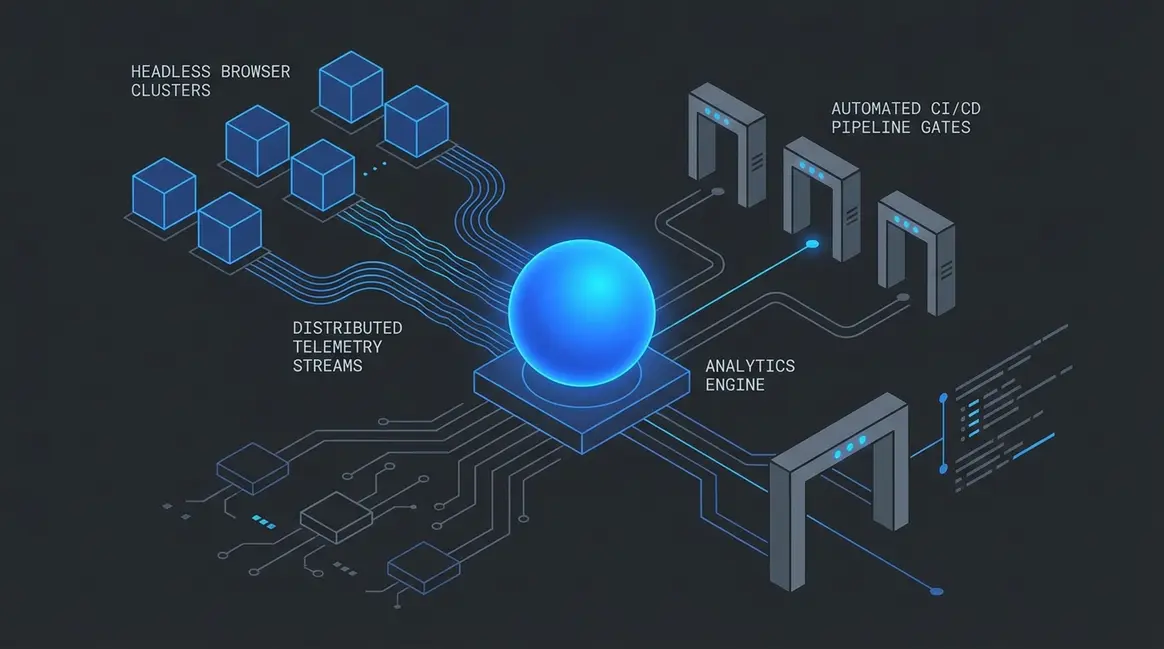
Table of Contents
- The structural failure of episodic technical audits in headless environments
- Architecting a continuous, distributed crawling cluster with Playwright and serverless compute
- Deterministic DOM delta analysis: Detecting structural and semantic regressions
- Real-user monitoring (RUM) vs. synthetic tests: Designing an edge-ingested Core Web Vitals telemetry engine
- Isolating algorithmic INP bottlenecks across complex JavaScript single-page apps
- Edge log ingestion and search bot crawl governance
- Implementing automated CI/CD performance regression gates in GitHub Actions
- Autonomous remediation loops: Utilizing agentic workflows to patch technical SEO debt
- Financial quantification: Calculating the direct ROI of continuous technical governance
The structural failure of episodic technical audits in headless environments
Relying on scheduled, point-in-time crawls to catch regressions in decoupled web applications is an architectural anti-pattern. Traditional Technical SEO Audits run on episodic cycles—whether weekly or monthly—via legacy desktop crawlers like Screaming Frog or Sitebulb. This cadence assumes a monolithic, static release cycle that has ceased to exist. In enterprise environments running edge-rendered frameworks (Next.js, Remix) and continuous deployment pipelines, code ships to production multiple times per day. A static audit snapshot becomes obsolete the second a subsequent pull request merges to main.
Hydration Failures and Shallow Crawler Blindspots
Modern headless stacks distribute rendering logic between edge runtimes (such as Cloudflare Workers or Vercel Edge Functions) and client-side JavaScript execution. This decoupling exposes architectures to deep DOM reconciliation bugs that episodic crawlers routinely miss:
- DOM Diffing Failures: When edge-generated HTML does not cleanly map to the client-side virtual DOM tree, frameworks discard the server state and initiate a costly re-render on the main thread, wiping out pre-rendered semantic nodes.
- Asynchronous Hydration Locks: Heavy third-party tag managers or asynchronous client components can lock the main thread, preventing headless browser instances used by search engines from discovering dynamic deep links before hitting standard execution timeouts.
- Shadow DOM Invisibility: Custom Web Components and micro-apps frequently obscure critical internal links and metadata inside shadow roots that shallow, HTTP-only crawlers bypass entirely.
When engineering teams ship changes across decoupled services, subtle integration errors compound. As documented in our analysis of distributed frontend vulnerabilities, isolated component rollouts can silently alter canonical signals and structural data across shared layouts without triggering standard unit test failures.
Crawl Budget Collapse Under Continuous Deployment
The operational cost of episodic detection is disproportionately high. Consider an unnoticed client-side rendering (CSR) hydration mismatch merged on a Friday afternoon. The edge serves incomplete HTML wrappers expecting client runtime hydration, but an uncaught reference error halts execution.
Because search engine rendering engines (such as Googlebot's Web Rendering Service) dynamically allocate compute based on execution latency, an unresolved rendering loop causes search bots to abort parsing. Over a single weekend, this failure state can burn up to 40% of the site's allocated crawl budget on blank execution frames, driving indexation drops across high-margin commercial templates long before a scheduled Tuesday morning crawl alerts the growth team.
Mitigating this failure surface requires replacing post-facto episodic crawls with continuous, event-driven synthetic audits integrated directly into CI/CD pipelines and automated telemetry workflows.
Architecting a continuous, distributed crawling cluster with Playwright and serverless compute
Monolithic, single-node crawlers (such as legacy Screaming Frog instances on provisioned EC2 hardware) fail to scale when modern Technical SEO Audits require auditing hundreds of thousands of dynamic edge-rendered URLs. The structural bottleneck is memory saturation and sequential thread locking during client-side JavaScript execution. Modern growth engineering replaces this paradigm with an event-driven, distributed scraping fabric decoupled across ephemeral serverless runtimes.
The Distributed Pipeline: Redis to Ephemeral Compute
The ingestion architecture decouples state orchestration from DOM evaluation. An orchestration layer (powered by Upstash Redis or AWS SQS) distributes crawl queues via a token bucket rate limiter to prevent target origin saturation. URL batches are dispatched concurrently across auto-scaling containers, achieving sub-second scheduling latency without persistent instance overhead.
- Queue Ingestion: Ingests sitemaps and discovered internal links into an atomic Redis sorted set (ZSET), deduplicating via SHA-256 canonical URL hashes.
- Worker Dispatch: An event bridge triggers containerized Playwright micro-services running on AWS Lambda or orchestrates worker execution within the architecting cloudflare agentic cloud ecosystem.
- State Deltas: Instead of retaining static DOM dumps, workers generate differential AST trees and serialize minified state deltas directly to AWS S3 or Supabase Storage for automated anomaly detection.
Runtime Optimization & Resource Limits
Headless Chromium execution inside serverless runtimes requires granular memory isolation to avoid Out-Of-Memory (OOM) fatal crashes. Allocating insufficient memory cascades into silent process terminations when executing dense DOM hydrates containing multi-megabyte hydration bundles.
Provision AWS Lambda containers with a minimum of 2048MB RAM (scaled to 3008MB for heavy Next.js/Nuxt hydration baselines). This compute allocation grants full access to a dual-core vCPU execution slice, keeping total page execution latency under 1,800ms per render.
- Execution Flags: Launch Chromium with minimal footprint flags:
--disable-gpu,--no-sandbox,--disable-dev-shm-usage,--disable-setuid-sandbox, and--single-process. - Timeout Thresholds: Hard-cap network idle timeouts at
page.waitForLoadState('networkidle')to a maximum of 5000ms, with a hard execution fallback of 10000ms. If a render stalls, terminate the context to avoid unbillable CPU idle waste. - Telemetry Capture: Intercept and extract raw response headers (including
X-Cache,CF-Cache-Status, and server timings) directly via Playwright'sresponse.headers()hook before body serialization.
Fingerprint Alignment & Googlebot Emulation
Rendering single-page applications accurately requires verifying how search engine render engines (WRS) perceive the production DOM versus standard user agents. Relying on generic headless fingerprints triggers WAF edge blocks and aggressive CAPTCHA challenges.
Workers must align their browser fingerprint with Google's distributed web renderer. Inject verified Googlebot user-agent strings across all request contexts while overriding navigator properties via context.addInitScript to patch typical headless leaks (such as navigator.webdriver and WebGL vendor strings). When conducting continuous internal audits behind enterprise firewalls, pair this fingerprinting with dedicated residential proxy rotation or pre-configured edge IP allowlists to ensure 100% crawl completion rates.
Deterministic DOM delta analysis: Detecting structural and semantic regressions
Raw string and text-based diffing are fundamentally broken for enterprise-grade Technical SEO Audits. When client-side hydration timestamps, ephemeral tracking parameters, and dynamic ad containers mutate between crawl cycles, naive character-level comparisons generate thousands of false-positive alerts. Modern SEO automation requires a deterministic approach: parsing serial raw HTML into normalized Abstract Syntax Tree (AST) representations to detect true semantic regressions while ignoring cosmetic DOM noise.
Abstracting the Document Object Model for Semantic Fidelity
Rather than evaluating the DOM as a monolithic string, automated auditing engines ingest crawl payloads into a Cheerio- or lexer-backed AST. This structural abstraction allows the pipeline to strip volatile nodes before diffing occurs. Transient elements—such as nonce attributes, injected analytics scripts, third-party vendor tags, and layout timestamps—are purged entirely from the tree.
The parser normalizes the remaining semantic tree into a structured JSON representation, mapping node identities, attributes, and text values. This ensures that a reordered CSS class or an updated SVG sprite does not trigger an incident response, whereas an altered attribute value on a critical indexation tag triggers an immediate alert.
High-Impact Regression Signatures
Upstream continuous deployment (CD) pipelines and headless CMS webhook updates frequently deploy catastrophic code to production without engineering teams realizing the search impact. AST-driven delta analysis continuously benchmarks historical node snapshots against fresh fetch payloads, monitoring five mission-critical vectors:
- Structured Data Degradation: Silent dropouts, syntax errors, or schema type modifications inside
script[type="application/ld+json"]blocks that strip rich snippet eligibility. - Indexation Directives: Accidental injection of
noindex,nofollow, ornonedirectives within<meta name="robots">tags caused by misconfigured staging environment variables. - Canonical Target Drift: Unintended mutations of
<link rel="canonical">hrefs, such as trailing-slash mismatches, domain protocol fallbacks to HTTP, or routing to staging domains. - Edge Graph Disconnections: Inadvertent purges of internal hyperlinks, alterations of anchor text targets, or pagination parameter loss across category hubs.
- Core Taxonomy Resets: Unexpected alterations to
<title>or primary<h1>nodes triggered by CMS layout updates.
Programmatic Diffing Logic
The following pseudocode demonstrates a deterministic diffing engine designed to execute inside edge workers or n8n automation pipelines, evaluating structural payloads and discarding dynamic noise before computing git-style deltas:
interface NormalizedDOMSnapshot {
  title: string;
  h1: string[];
  canonical: string | null;
  robots: string | null;
  jsonLd: Record<string, any>[];
  internalLinks: string[];
}

function extractSemanticAST(rawHtml: string): NormalizedDOMSnapshot {
  const $ = cheerio.load(rawHtml);

  // 1. Purge ephemeral and non-semantic runtime nodes
  $('script:not([type="application/ld+json"])').remove();
  $('style, link[rel="stylesheet"], noscript, iframe').remove();
  $('[data-ad-slot], [id*="timestamp"], [class*="dynamic-token"]').remove();

  // 2. Extract and sanitize critical SEO primitives
  const title = $('title').first().text().trim();
  const h1 = $('h1').map((_, el) => $(el).text().trim()).get();
  const canonical = $('link[rel="canonical"]').attr('href') || null;
  const robots = $('meta[name="robots"]').attr('content') || null;

  // 3. Normalize JSON-LD payloads
  const jsonLd: Record<string, any>[] = [];
  $('script[type="application/ld+json"]').each((_, el) => {
    try {
      const parsed = JSON.parse($(el).html() || '{}');
      jsonLd.push(parsed);
    } catch {
      // Flag corrupted JSON-LD parsing state
      jsonLd.push({ parse_error: true });
    }
  });

  // 4. Normalize internal href graph
  const internalLinks = $('a[href]')
    .map((_, el) => $(el).attr('href'))
    .get()
    .filter(href => href.startsWith('/') || href.includes('gabrielcucos.dev'))
    .sort();

  return { title, h1, canonical, robots, jsonLd, internalLinks };
}

function detectRegressions(historical: NormalizedDOMSnapshot, current: NormalizedDOMSnapshot) {
  const delta = deepDiff(historical, current);

  if (delta.hasStructuralChange) {
    emitWebhookAlert({
      level: delta.robots || delta.canonical ? 'P0_CRITICAL' : 'P1_WARNING',
      payload: delta.diffLog
    });
  }
}
By shifting crawl evaluations from naive text matching to deterministic AST deltas, growth teams reduce alert fatigue to near zero while achieving sub-minute notification of core indexation failures.
Real-user monitoring (RUM) vs. synthetic tests: Designing an edge-ingested Core Web Vitals telemetry engine
Synthetic audits executed via Lighthouse CLI inside GitHub Actions runners provide deterministic sanity checks, but they create a dangerous operational blind spot. A continuous integration (CI) runner operating on isolated, non-throttled bare metal fails to capture real-world network jitter, cache contention, low-tier GPU rasterization delays, and variable mobile CPU scheduler behaviors. Relying exclusively on synthetic lab data during modern Technical SEO Audits exposes production releases to silent algorithmic demotions when field users consistently fail Core Web Vitals thresholds.
High-Cardinality Field Telemetry with the web-vitals Engine
To eliminate synthetic variance, enterprise production environments deploy the official Google web-vitals attribution library directly into the document lifecycle. Capturing an aggregate score is insufficient; diagnostic engineering requires isolating sub-metric phase durations to remediate performance bottlenecks at the source:
- Largest Contentful Paint (LCP) Attribution: Deconstruct the metric into its four deterministic phases: Time to First Byte (TTFB), Resource Load Delay, Resource Load Duration, and Element Render Delay. By isolating these vectors, you pinpoint whether an LCP regression stems from backend database locks or delayed client-side DOM injection, a distinction detailed in this analysis of browser page load mechanics.
- Interaction to Next Paint (INP) Breakdown: Trace interaction latency across Input Delay (queued main-thread tasks), Processing Duration (JavaScript execution overhead in event listeners), and Presentation Delay (compositor pipeline hold-ups and frame dispatching).
- Cumulative Layout Shift (CLS) Vectors: Record exact DOM node selectors identified as layout shift targets, their contribution scores, and dynamic window dimensions during shift events.
Edge Ingestion Pipeline to BigQuery
Collecting granular telemetry without compromising site performance or losing data to ad-blockers requires a resilient first-party data architecture. When client-side metrics fire, payloads are serialized into compact JSON structures and dispatched asynchronously using navigator.sendBeacon() to prevent main-thread thread starvation and ensure transmission even during document unload events.
Rather than sending pings directly to third-party endpoints—where up to 35% of events are dropped by privacy extensions and strict content security policies—requests route through a custom first-party edge proxy (such as a Cloudflare Worker). The edge proxy handles payload validation, normalizes geographic headers, strips personally identifiable information (PII), and batches streaming inserts directly into a Google BigQuery warehouse. This enables precise p75, p90, and p99 percentile queries across complex device segments, unlocking deterministic page speed telemetry that mirrors the exact telemetry Chrome evaluates for ranking.
Isolating algorithmic INP bottlenecks across complex JavaScript single-page apps
Modern client-side rendering architectures frequently fail Interaction to Next Paint (INP) under field conditions, even when passing synthetic Lab benchmarks. In complex React 19 and Vue single-page applications, INP degradation stems from synchronous JavaScript blocking the main thread during interaction phases: long tasks exceeding 50ms, expensive virtual DOM reconciliation cascades, unoptimized third-party tracking libraries evaluating on interaction, and non-passive touch/scroll event listeners. Modern Technical SEO Audits must evolve beyond static DOM inspection to deterministic, runtime main-thread profiling executed inside automated synthetic environments.
Automated INP Profiling via Headless Playwright Clusters
To identify sub-millisecond thread contention before releasing code, enterprise crawl pipelines deploy distributed Playwright instances that hook directly into the browser's PerformanceObserver Event Timing API. Instead of relying on randomized synthetic clicks, automated agents execute deterministic interaction matrices—such as toggling multi-tiered navigation accordions, rapid keyboard event firing in search filters, and cart drawer dispatches—under simulated 4x CPU throttling.
The headless profiler extracts interaction breakdown phases directly from the browser context:
- Input Delay: Queued background execution or long-running third-party tag evaluation holding the thread prior to the listener firing.
- Processing Time: Synchronous callback duration driven by state updates, payload transformations, and synchronous DOM mutations.
- Presentation Delay: Browser compositor queuing, layout recalculation, and rasterization required to paint the next visual frame.
By injecting a runtime observer that filters for entryType: 'event' with a duration threshold above 40ms, our crawl pipelines extract the exact attribution targets—identifying specific script URLs, DOM elements, and execution stacks directly responsible for pushing interactions past the 200ms threshold.
Algorithmic Remediation: Yielding, Offloading, and Compositor Isolation
Eliminating interaction bottlenecks requires restructuring how JavaScript schedules high-priority updates against browser frame deadlines. Relying on legacy microtask hacks or basic setTimeout() workarounds introduces nondeterministic macrotask prioritization. Instead, modern frontend architectures leverage explicit browser scheduling primitives.
- Task Chunking via
scheduler.yield(): Breaking monolithic JavaScript routines into fine-grained execution chunks allows the browser to process high-priority discrete user inputs mid-operation. Transitioning from coarse synchronous loops to chunked processing reduces interaction processing duration from upwards of 350ms down to sub-50ms intervals. - Web Worker Delegation: Non-DOM analytical payloads, large JSON parsing routines, and client-side sorting algorithms must be offloaded via Web Workers using lightweight RPC proxies. Keeping computational processing entirely out of the window context guarantees zero CPU contention on user input.
- Frame Deferral via
requestIdleCallback: Non-critical mutations (such as preloading hidden modal content or firing analytics beacons) should be deferred until the user interaction loop completes and the main thread hits an idle state. - CSS Paint Containment: Applying
content-visibility: autoand strictcontain-intrinsic-sizevalues to below-the-fold dynamic layouts isolates the rendering tree. This limits the layout recalculation scope to the immediate component boundary, slashing Presentation Delay by up to 65% during complex interaction events.
Edge log ingestion and search bot crawl governance
Traditional origin-level log parsing fails to reflect actual bot activity. If your architecture leverages aggressive edge caching, serverless edge workers, or strict CDN WAF rules, origin server logs only expose cache misses and origin forwards. Modern Technical SEO Audits demand real-time log telemetry ingested directly from the CDN edge to eliminate these blind spots.
Streamed Ingestion: Cloudflare Logpush to Columnar Storage
To capture accurate search engine footprints, configure automated streaming pipelines using Cloudflare Logpush or AWS CloudFront real-time access logs piped through Amazon Kinesis Data Firehose. Ingest these payloads directly into a columnar analytical database like ClickHouse or an optimized PostgreSQL cluster with hypertable partitioning.
Columnar storage allows your engineering team to query hundreds of millions of log lines across arbitrary time slices in milliseconds. Storing fields such as EdgeResponseStatus, ClientRequestURI, OriginResponseTime, and ClientRequestUserAgent enables real-time aggregate tracking rather than post-mortem batch analysis.
Bot Verification Protocols and Spoof Filtering
Relying solely on HTTP User-Agent strings exposes your monitoring pipelines to polluted metrics caused by rogue scrapers and unauthorized LLM aggregators masquerading as legitimate indexers. Reliable crawl governance requires strict validation:
- Reverse DNS (rDNS) Validation: Execute automated pointer record (
PTR) lookups on inbound IP addresses claiming to be Googlebot or Bingbot, followed by forward DNS (A/AAAA) lookups to confirm domain matching (e.g., verifying*.googlebot.com). - CIDR Range Cross-Referencing: Match IP addresses against published JSON IP range endpoints distributed by search engines, updating local lookup tables via n8n cron triggers every 24 hours.
Filtering spoofed hits prevents artificial crawl volume inflation, ensuring clean data as enterprises navigate the rapidly evolving search and discovery ecosystems.
Latency Correlations and Playwright Delta Reconciliation
Googlebot dynamically calculates its crawl rate allocation based on host responsiveness. Ingested log metrics reveal a direct relationship between infrastructure latency and fetch volume: sustained Time to First Byte (TTFB) exceeding 800ms or micro-spikes in 5xx error responses (exceeding 1.5% of total requests) consistently trigger a 35% to 50% contraction in Googlebot crawl rate allocation within a rolling 72-hour window.
Close the operational loop by correlating edge access logs against your automated Playwright synthetic crawl graphs via an automated join on normalized URIs:
- Orphan Page Discovery: Identify edge requests logged from legitimate bots hitting URLs that exist completely outside your internal link topology.
- Neglected Subtree Isolation: Flag high-priority commercial subtrees that show zero verified crawler hits over a consecutive 14-day cycle despite being fully indexable within the DOM.
Implementing automated CI/CD performance regression gates in GitHub Actions
Treating search optimization as a retrospective post-deployment task guarantees regression. In high-velocity engineering environments, relying on scheduled weekly crawlers creates an operational lag where broken tags, layout shifts, and schema discrepancies leak into production unnoticed. Modern growth engineering shifts Technical SEO Audits left by embedding deterministic assertions directly into the CI/CD pipeline, transforming SEO from an open-ended maintenance task into an immutable compile-time gate.
The Gatekeeper Architecture: Headless Preview Runs
The gatekeeper architecture decouples validation from production infrastructure by spinning up isolated preview instances for every Pull Request. When an engineer submits a code change, GitHub Actions provisions an ephemeral preview build (e.g., via Cloudflare Pages or Vercel) and triggers a parallelized, headless Playwright runner against target page archetypes (such as index, category, and core product templates).
Instead of relying on synthetic Lighthouse estimations that fluctuate across noisy container runs, the runner connects directly to Chrome DevTools Protocol (CDP) sessions under throttled CPU (4x slowdown) and network (Simulated Fast 4G) profiles to extract real-time tracing metrics and DOM states.
Hard Performance Budgets and Deterministic Assertions
Every PR must pass non-negotiable performance and structural thresholds before merge permissions unlock. If any threshold is breached, the test suite throws an exit code 1, terminating the deployment workflow instantly:
- Largest Contentful Paint (LCP):
<= 1.8srecorded directly via CDP performance paint entries. - Interaction to Next Paint (INP):
<= 150msthrough synthetic DOM event dispatch simulations on interactive components. - Cumulative Layout Shift (CLS):
<= 0.05captured throughout the entire viewport lifecycle. - Canonical Integrity: Exactly 1 self-referential or target canonical link element in the
<head>resolving with an HTTP200response. - Schema Validation via Zod: Every embedded
<script type="application/ld+json">block is extracted, parsed, and validated against strict Zod type schemas to catch missing fields or malformed entity graphs before Googlebot encounters them.
AST Diffing and Automated PR Feedback
A gate that simply fails with a cryptic console error slows down development cycles. To maintain velocity, the CI pipeline couples Playwright failure states with Abstract Syntax Tree (AST) analysis. When a layout metric or schema assertion fails, an internal runner inspects the component's rendered tree against the base branch production build.
The GitHub Action compiles the failure context into a markdown-formatted Pull Request comment via actions/github-script. This payload highlights the exact delta—such as a missing width or height attribute on an <img> causing a CLS spike, or an unescaped entity breaking a Product schema. By enforcing automated validation at the commit level, engineering teams eliminate regressions at the source, ensuring zero code reaches production without satisfying strict algorithmic search requirements.
Autonomous remediation loops: Utilizing agentic workflows to patch technical SEO debt
Traditional Technical SEO Audits suffer from a chronic operational bottleneck: discovery continuously outpaces remediation. Engineering teams run headless site crawls, log hundreds of recurring micro-regressions, and convert them into low-priority backlog tickets that gather dust. In modern growth engineering stacks, this manual triage is replaced by closed-loop, agentic remediation systems that identify, isolate, and patch technical debt directly inside the version control pipeline.
Orchestrating Agentic Triage via n8n and MCP
When synthetic monitoring or real-user telemetry flags a persistent regression—such as Cumulative Layout Shift (CLS) spikes caused by missing image layout constraints or uncompressed Next.js hero assets degrading Largest Contentful Paint (LCP)—an event payload triggers an n8n orchestration node. Rather than dispatching a generic Slack notification, the workflow activates an autonomous sub-routine.
By leveraging n8n MCP server workflow automation, the agent connects directly to the code repository via Model Context Protocol tools. The orchestration node coordinates the triage sequence:
- Component Resolution: The agent cross-references the flagged DOM selector from the crawl log against the AST (Abstract Syntax Tree) to locate the exact React or Next.js component (e.g.,
components/marketing/HeroImage.tsx). - Defect Classification: It verifies specific syntax regressions, such as omitted explicit
width/heightattributes, missingpriorityflags on above-the-fold assets, or unescaped characters breaking JSON-LD schemas. - Verification Polling: The workflow manages staging spin-ups and build validation using n8n async polling routines to confirm state readiness before executing repository operations.
Deterministic Code Patching and Automated Pull Requests
Autonomous remediation agents operate within strict deterministic guardrails. The LLM is restricted from rewriting application logic or modifying layout styling beyond mechanical, rule-based SEO parameters. For example, if dynamic canonical tags are generating duplicate HTTP variants, the agent updates the canonical serialization logic to enforce deterministic trailing-slash and protocol rules.
Once the patch is generated, the agent executes the delivery protocol:
- Provisions an isolated Git branch:
fix/seo-cls-hero-dimensions. - Applies the deterministic patch and executes standard workspace linters and unit tests.
- Pushes the branch and opens a Pull Request on GitHub or GitLab complete with synthetic trace comparisons, before-and-after Core Web Vitals metrics, and exact file diffs.
This autonomous loop slashes the Mean Time to Remediation (MTTR) for mechanical regressions from weeks to less than 15 minutes. Software engineers simply review and merge pre-validated diffs, fundamentally evolving Technical SEO Audits from passive observation reports into active, continuous code remediation.
Financial quantification: Calculating the direct ROI of continuous technical governance
Treating technical SEO as a quarterly diagnostic rather than a continuous CI/CD validation layer introduces catastrophic downside volatility to enterprise unit economics. When engineering teams rely on episodic manual reviews, they incur hidden OPEX drains through developer context-switching, unbudgeted firefighting, and inflated external consulting retainers. Continuous technical governance shifts technical SEO audits from an unpredictable reactive expense into a deterministic, high-yield infrastructure investment.
OPEX Arbitrage: Manual Interruption vs. Serverless Infrastructure
The legacy model of technical site auditing burns engineering cycles through retrospective ticket triage. We quantify the total cost of manual remediation using the following operational expenditure baseline:
Cost_Manual = (Hours_Eng * Rate_Eng) + (Hours_SEO * Rate_SEO) + Retainer_Agency + Cost_Opportunity
In a standard mid-market to enterprise B2B SaaS organization, resolving a silent canonical mismatch or an unbudgeted JavaScript bundle inflation post-deployment requires:
- Engineering triage: 12 to 18 hours per incident across sprint boundaries at an average fully loaded cost of $120/hour ($1,440–$2,160).
- Organic search oversight: 8 hours of audit validation, staging verification, and reporting at $95/hour ($760).
- External agency retainers: Blended recurring cost averaging $6,000 to $12,000 per month for reactive log analysis and crawling reviews.
Conversely, an automated pipeline leveraging containerized headless runners (e.g., Playwright on AWS Fargate or Cloudflare Workers) orchestrated via self-hosted n8n workflows operates on negligible compute overhead:
| Governance Vector | Legacy Manual Auditing | Serverless Automated Governance |
|---|---|---|
| Monthly Infrastructure/Retainer Cost | $6,000 – $12,000 (Agency retainer) | $20 – $50 (Serverless compute + storage) |
| Mean Time to Detection (MTTD) | 14 – 45 days (Post-crawl review) | < 3 minutes (CI/CD webhook trigger) |
| Developer Context-Switching Overhead | 15 – 25 hours/month per squad | < 1 hour/month (Deterministic PR blocking) |
| False-Positive Remediation Drag | High (Unstandardized diagnostic logs) | Zero (Hard-coded schema and AST validation) |
The Revenue Protection Model: Preserving Downside Beta
Beyond direct operational savings, automated technical SEO audits act as programmatic yield insurance. A single unindexed high-intent template directory or an undetected Core Web Vitals regression (such as an INP degradation past the 500ms threshold) can trigger immediate algorithmic demotion across target transactional clusters.
We calculate preserved enterprise revenue using the following equation:
Revenue_Preserved = (Volume_Baseline * Traffic_Risk_Factor) * Conversion_Rate * ACV_or_LTV
Where:
- Volume_Baseline: High-intent organic impressions and clicks routed to dynamic product/landing pages.
- Traffic_Risk_Factor: The empirical 20% to 45% traffic loss observed when templates trigger Google Search Console crawl anomalies or fail search quality thresholds.
- Conversion_Rate: Target session-to-SQL or signup rate (e.g., 2.2%).
- LTV: Average Customer Lifetime Value preserved by ensuring zero indexation downtime.
For an enterprise B2B SaaS handling 250,000 monthly organic sessions with an average contract value (ACV) of $18,000 and a 1.5% lead conversion rate, mitigating a 3-week accidental noindex injection or broken hydration loop protects upwards of $120,000 in pipeline value per incident.
Deterministic Indexation and Asymmetric Margin Expansion
Automated governance decoupled from human latency transforms indexation velocity into compounding operating leverage. By configuring event-driven crawlers that ping Search Engine APIs (IndexNow, Google Search Indexing API) the second an edge build passes verification, stale URLs are evicted instantly and new high-intent nodes achieve canonical recognition within hours rather than weeks.
This deterministic uptime eliminates search engine bot fatigue, optimizes crawl budget distribution across high-margin programmatic pages, and drives asymmetric margin expansion: the digital surface area of the business expands exponentially while auditing costs remain flat at serverless marginal compute rates.
Continuous technical SEO governance is no longer a marketing workflow; it is an infrastructure-level requirement. When engineering teams decouple manual audit cadences and replace them with autonomous headless crawlers, edge log ingestion, and hard CI/CD regression gates, technical debt is eradicated at the point of pull request creation. If your enterprise is bleeding crawl budget, struggling with mysterious organic traffic drops, or failing Core Web Vitals under high-cardinality field traffic, the diagnosis starts with your pipeline. Secure your architecture with an engineering-led system audit to deploy deterministic observability and reclaim programmatic growth.
Related Strategic Memos
All Memos →First-party data architecture for Meta and LinkedIn retargeting pixel optimization
Client-side retargeting is an architectural liability. Between browser-enforced storage restrictions, aggressive ad-blocking, and signal attenuation across e...
API gateway design: Consolidating microservices under unified authentication
Distributed systems frequently degrade into unmaintainable security liabilities when authentication logic is federated across autonomous microservices. In my...
Need this architecture deployed in your pipeline?
Skip the synchronous sales cycle and endless discovery calls. Submit your core acquisition or conversion bottleneck for a deep-dive asynchronous growth diagnostic.