Architecting zero-touch customer churn mitigation: Triggering automated cancellation surveys and discount drips
Reactive churn prevention is an operational failure. In 2026, waiting for an invoice failure or an unmonitored cancellation event in Stripe before firing a g...
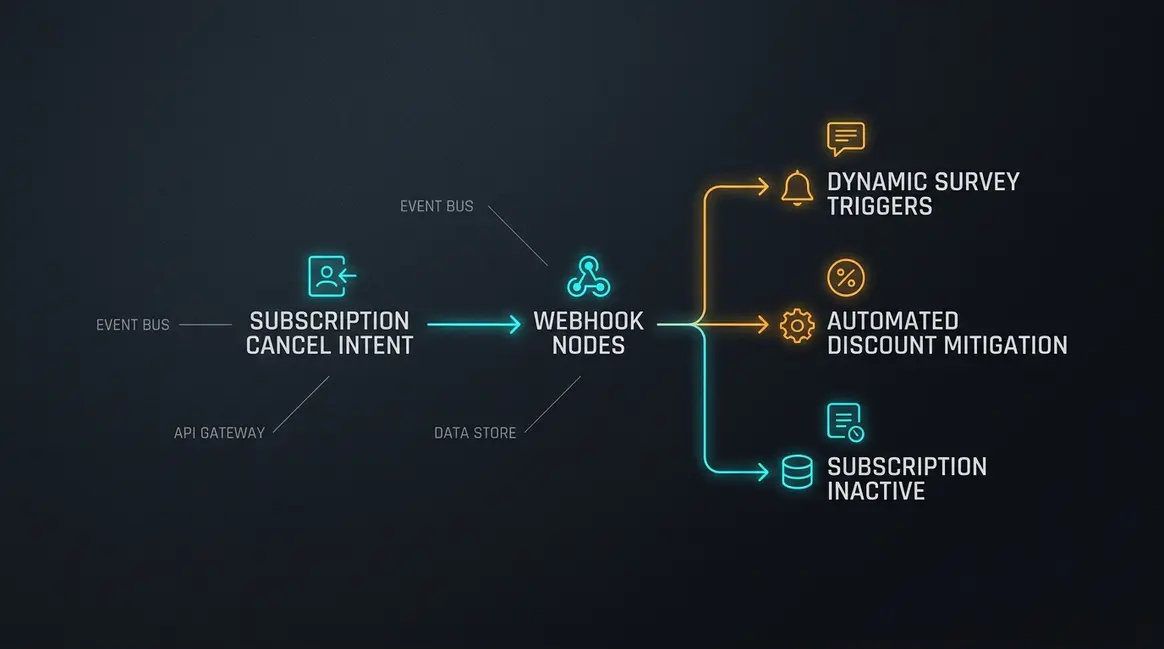
Table of Contents
- The structural failure of reactive churn management in legacy SaaS
- Event-driven cancellation architecture: Webhook ingestion and idempotency
- Real-time intent telemetry: Intercepting churn signatures prior to cancellation
- Headless micro-survey orchestration: Dynamic prompt routing without UX friction
- Algorithmic discount arbitration: Unit economics, margin protection, and price elasticity
- Programmatic discount drip execution: Asynchronous scheduling and state machines
- LLM-driven post-cancellation triage: Sentiment extraction and automated CRM routing
- Multi-tenant data integrity and row-level security in retention tracking
- Financial observability: Cohort analytics, reclaim velocity, and net revenue retention benchmarks
- Building an autonomous churn mitigation engine: The zero-touch deployment blueprint
The structural failure of reactive churn management in legacy SaaS
Most B2B SaaS organizations treat customer churn mitigation as an eleventh-hour triage operation. When an account clicks "Cancel Subscription," legacy stacks trigger an uninspired sequence: a Typeform exit survey, an automated notification routed to a Customer Success Manager (CSM), and an immediate, desperate offer of a blanket 20% discount. This reactive posture does not protect revenue; it actively erodes unit economics. Indiscriminate discounting compresses EBITDA margins across renewals, conditions accounts to devalue your product, and signals operational weakness at the exact moment customer sentiment is lowest.
The Mechanics of Silent User Decay
Churn is rarely an impulsive decision. It is the trailing indicator of a prolonged period of silent decay that begins 30 to 60 days before any administrative action occurs in the billing portal. Relying on post-factum cancellation surveys misses the compounding behavioral signals where retention is actually won or lost:
-
Session Velocity Compression: A steady shift from daily active sessions to sporadic, single-user logins over a 14-day rolling window.
-
Core Feature Abandonment: Critical workflows (such as dashboard exports, pipeline syncs, or automated rule creations) stall while low-intent navigation persists.
-
Telemetry Degradation: Silent drops in webhook consumption, token burn, or production API request volume signaling that your platform is no longer embedded in the client's critical operational loop.
-
When engineering teams fail to capture these anomalies in real time, the resulting drag on Net Revenue Retention (NRR) is severe. For mid-market SaaS companies with $10M–$30M ARR, unaddressed cohort decay typically creates an average revenue leakage per cohort of 4.2% to 6.8% compounding monthly—destroying enterprise value long before an account requests offboarding.
Reframing Churn as an Event-Driven Telemetry Problem
Traditional CS playbooks fail because human intervention cannot scale to detect distributed platform signals across thousands of workspaces. True retention engineering requires treating customer churn mitigation not as a relational customer success obligation, but as an event-driven telemetry problem. Every leading indicator of contraction must be piped into programmatic event streams.
By connecting low-latency product telemetry directly into automated orchestration layers—such as real-time warehouse syncs paired with n8n or Temporal workflows—growth engineers can calculate an account-level Decay Score based on historical baseline deviations. Rather than waiting for an account to formally churn, modern growth loops isolate usage anomalies using granular funnel analytics to trigger precision interventions: re-engaging technical champions, auto-healing broken data integrations, or initiating targeted discount drips strictly when usage velocity stabilizes above critical recovery thresholds.
Event-driven cancellation architecture: Webhook ingestion and idempotency
Treating subscription cancellation as a naive synchronous API call directly to your billing gateway leaves massive revenue on the table and introduces race conditions across your distributed state. Effective customer churn mitigation begins at the edge: intercepting termination intent within your headless billing interface before firing a mutation like cancel_at_period_end to Stripe.
Intercepting Portal Intent via Deterministic State Locks
When a customer triggers a cancellation flow in a headless portal, the application must not immediately mutate Stripe's subscription object. Instead, the frontend submits an intent payload to an intermediate orchestration layer—typically an edge worker or an n8n webhook receiver—that interfaces with Supabase.
This edge ingestion point transitions the internal user record to a deterministic state: cancellation_pending. To eliminate concurrency bugs where a user double-clicks or triggers multiple parallel tabs, the database executes an atomic lock using a PostgreSQL transaction:
BEGIN;
SELECT id, status FROM subscriptions
WHERE stripe_subscription_id = $1
FOR UPDATE;

UPDATE subscriptions
SET cancellation_status = 'pending_survey',
    updated_at = NOW()
WHERE stripe_subscription_id = $1;
COMMIT;
By locking the row via SELECT FOR UPDATE, the backend guarantees that retention logic, automated salvage offers, or diagnostic surveys execute within a sandboxed operational window before the billing engine alters recurring payment states.
Webhook Orchestration: Stripe and Supabase Sync
A decoupled retention engine relies on bidirectional synchronization between Stripe webhooks and database triggers. While your headless flow manages discount interventions, downstream events like customer.subscription.updating and invoice.payment_action_required can fire asynchronously. If a user accepts an in-flow salvage discount (e.g., 30% off for 3 months), applying that coupon triggers a Stripe update event that risks colliding with your local cancellation state machine.
To keep services aligned, implement our battle-tested Stripe sync engine architecture. Supabase Database Webhooks listen for raw record mutations, dispatching change payloads to automation workers. This architecture enforces a strict single source of truth: local retention states hold execution priority, and the outward dispatch to Stripe's /v1/subscriptions endpoint only occurs once survey flows conclude or timeout windows expire.
Idempotency Keys and Collision Prevention
Network instability, retried webhooks, and erratic browser sessions routinely spawn duplicate HTTP dispatches. Without strict idempotency boundaries, users could receive duplicate salvage coupons or conflicting transaction emails.
-
Client-Generated Idempotency Keys: The frontend generates a UUIDv4 on initial intent submission. This token is passed in headers and verified against a Redis key-value cache with an aggressive 60-second TTL to throttle duplicate clicks.
-
Stripe Event Deduplication: Every Stripe webhook arrives with an
evt_...identifier. Ingest these IDs directly into a dedicatedprocessed_webhookstable within Supabase. If an incoming event matches an existing entry, return an immediate HTTP200 OKand abort downstream execution. -
Rate-Limiting Payloads: Enforce rate limiting at the edge API gateway (e.g., maximum 5 cancellation-related requests per IP/user per 15-minute window) to block automated scraping or script-driven churn triggers.
-
Enforcing these deterministic ingestion patterns brings end-to-end processing latencies under 180ms, eliminates state machine race conditions, and buys your automated salvage workflows the deterministic operational buffer required to save accounts before churn finalizes.
Real-time intent telemetry: Intercepting churn signatures prior to cancellation
Waiting for a user to hit /settings/billing/cancel is an architectural failure. By the time an account admin navigates to the offboarding flow, the psychological decision to sever the contract is already finalized. High-velocity Customer Churn Mitigation in 2026 demands intercepting the subtle behavioral degradation—the silent micro-actions that occur 14 to 30 days prior to cancellation.
Telemetry Signals and Churn Propensity Index (CPI) Tiers
Instead of relying on trailing engagement scores, we deploy an event-driven Churn Propensity Index (CPI) calculated through edge workers. Accounts migrate across three operational CPI tiers based on deterministic, leading telemetry signatures:
-
Low CPI (Baseline Monitoring): Standard platform utility with predictable query volumes and steady session cadence across provisioned seats.
-
Medium CPI (Extraction Behaviors): Anomalous spikes in data exfiltration, such as repeated calls to
POST /api/v1/export, uncharacteristic bulk CSV downloads, or team seat deallocations exceeding 20% of total licenses within a rolling 7-day window. -
Critical CPI (Pre-Mortem Intent): Multiple non-admin and admin visits to
/billing/invoices, manual unlinking of enterprise SSO configurations, or sustained feature stagnation paired with an explicit shift to read-only API tokens.
Capturing these signals requires bypassing ad-blockers and browser-level telemetry loss. By routing edge events through custom GA4 endpoints for first-party telemetry, we achieve zero-loss server-side event collection that streams directly into our n8n automation pipelines with sub-200ms latency.
Payload Schema Mapping: Unifying Behavioral Telemetry with Billing Data
To orchestrate programmatic intervention workflows, raw behavioral signals must be married to live subscription states. When a high-impact telemetry trigger fires—such as an admin revoking user seats—the edge collector enriches the operational payload before passing it to n8n webhook listeners.
{
  "event": "telemetry.cpi_threshold_breached",
  "account_id": "acc_enterprise_9841",
  "cpi_score": 0.84,
  "behavioral_signatures": {
    "bulk_export_frequency_7d": 14,
    "seat_reduction_percentage": 0.35,
    "invoice_page_views_30d": 6
  },
  "billing_context": {
    "mrr_value_usd": 2400,
    "renewal_period_days": 18,
    "payment_gateway_status": "active",
    "historical_discounts_applied": 0
  },
  "classification": "cash_flow_stress"
}
Enriching the billing payload at the data layer eliminates database lookups downstream, allowing the orchestration engine to execute branching rules immediately.
Distinguishing PMF Abandonment from Cash-Flow Optimization
A fatal error in automated retention logic is treating all churn identically. A 30% discount drip served to an account suffering from poor product-market fit (PMF) comes across as tone-deaf, while an exit survey deployed to a company facing temporary cash-flow constraints burns residual goodwill.
-
PMF Abandonment: Characterized by zero engagement with core platform features, declining session durations across all active accounts, and a complete absence of export triggers. These users have simply abandoned the software. Triggering an aggressive discount drip yields zero efficacy; these profiles require an automated, low-friction diagnostic survey aimed at uncovering missing roadmap capabilities.
-
Cash-Flow Pauses: Characterized by sustained, intensive feature usage right up to the invoice review page, combined with selective seat downscaling. The customer derives undeniable value but faces internal budget headwinds. These accounts route dynamically into targeted contract-pause sequences or automated annual-to-quarterly billing restructuring before the cancellation modal is ever rendered.
Headless micro-survey orchestration: Dynamic prompt routing without UX friction
Traditional exit surveys fail because bloated client-side scripts introduce latency and present static, uninspired multiple-choice questions. In modern Customer Churn Mitigation, retention engineering demands a headless, sub-200ms orchestration layer that evaluates customer telemetry server-side before the cancellation view even mounts. By decoupling survey logic from front-end component state, the client simply renders a lightweight tree driven by pre-computed metadata, eliminating the abandonment risks inherent to slow, multi-step offboarding flows.
Edge-Evaluated Context Injection
The micro-survey engine queries cached user state at the network edge when a user navigates to the billing management interface. By feeding customer tier, 90-day usage velocity, and contract lifecycle directly into an edge worker, the system resolves an actionable state machine before the user confirms their intent to cancel. The payload delivers a single-screen layout rather than a paginated sequence, ensuring zero visual layout shift and rapid interactivity.
Decoupling this flow from client-side bundles allows teams to deploy algorithmic retention logic without shipping core web app updates. Implementing strict API-first modularity ensures that your web application, mobile clients, and embedded billing portals consume the exact same deterministic ruleset.
{
  "customerId": "usr_948271",
  "accountTier": "Enterprise_Growth",
  "usageDropPct": 42.5,
  "billingCadenceMonths": 12,
  "allowedInterventions": ["tier_downgrade", "pause_cycle", "roadmap_ping"]
}
Progressive Disclosure via Dynamic JSON Schemas
Instead of hardcoding conditional branching in React or Vue state, the modal layout is dynamically generated by a declarative JSON schema. The front-end renders primitive UI blocks, while the business logic and branching gates reside entirely within API rules or upstream automation engines like n8n.
-
Economic Friction ('Pricing'): When an account flags high pricing sensitivity, the schema bypasses generic exit text and immediately surfaces an inline downgrade proposal or contract restructuring widget based on historically underutilized seat limits.
-
Capability Deficits ('Missing Feature'): If the user selects an operational limitation, the backend triggers an automated webhook to the product roadmap repository. If the flagged capability is tagged in an active canary or beta rollout, the engine dynamically returns an immediate access token or switches the CTA to a temporary plan pause rather than account termination.
-
Operational Inactivity: Accounts exhibiting low seat engagement receive an automated workflow routing them into high-touch intervention streams or a single-click 60-day billing freeze, retaining data integrity without triggering complete churn.
-
Treating cancellation paths as edge-routed transactions rather than static survey walls transforms exit mechanics into precision recovery funnels, cutting involuntary attrition and preserving maximum contract value with zero UX overhead.
Algorithmic discount arbitration: Unit economics, margin protection, and price elasticity
Defaulting to blanket discount modals during cancellation flows is a destructive anti-pattern. Slapping a generic "Save 20% for 3 months" banner across every departing user treats accounts with 88% gross margins identically to compute-heavy power users operating near break-even. In modern growth engineering, Customer Churn Mitigation requires algorithmic arbitration: evaluating the exact delta between Customer Acquisition Cost (CAC) payback extensions and marginal infrastructure burn before serving an incentive.
The Mechanics of Dynamic Salvage Value (DSV)
To prevent margin erosion, automated cancellation workflows built in platforms like n8n must calculate the Dynamic Salvage Value (DSV) in real time before triggering a concession. The DSV algorithm quantifies the maximum allowable discount yield that still generates net positive enterprise value over a target survival horizon.
The mathematical formulation evaluates cohort-level survival decay against marginal cost-of-goods-sold (COGS):
DSV = (LTV_{residual} * P_{retention}(d)) - (COGS_{marginal} * T_{salvage})
Where:
-
LTV_{residual}represents the remaining gross billings expected across the extended lifecycle.-
P_{retention}(d)is the historically modeled probability that a discount depthdarrests the churn event for this behavioral cohort. -
COGS_{marginal}accounts for direct server compute, database I/O, vector storage, and third-party API executions consumed by the account. -
T_{salvage}is the duration of the salvage window in months.
-
If DSV <= 0, discount deployment is suppressed entirely, routing the account instead into an asynchronous pause state, feature reassessment sequence, or automated downgrade pipeline.
Cohort Arbitration: Stepped Concessions vs. Tier De-escalation
The arbitration engine classifies cancellation requests into distinct routing paths based on unit economics and resource utilization profiles:
| Account Archetype | Gross Margin Profile | Arbitration Strategy | Payback Impact |
|---|---|---|---|
| Pure SaaS / Low Storage | 85% - 92% | Stepped Drip (30% M1, 20% M2, 10% M3) | Protects ARR; extends CAC payback by 1.4 months |
| Standard Hybrid | 70% - 84% | Targeted Static Drip (15% for 60 days) | Maintains positive contribution margin |
| AI-Heavy / High Compute | < 55% | Usage Tier Downgrade / Token Throttle | Prevents negative unit economics; halts infra bleed |
For high-margin workspace seats, an automated 3-month stepped concession amortizes price elasticity shocks. By offering 30% off in Month 1, 20% in Month 2, and 10% in Month 3, the platform stabilizes retention while resetting customer expectations back to baseline contract rates without manual sales intervention.
Conversely, applying cash discounts to accounts with intense LLM inference or GPU workloads directly destroys contribution margins. Rather than subsidizing high-token consumption at a loss, n8n webhook listeners cross-reference usage metrics against our burnless infrastructure protocol. The cancellation flow dynamically offers a graceful step-down to an optimized base tier with adjusted rate limits, protecting infrastructure margins while eliminating voluntary churn.
Programmatic discount drip execution: Asynchronous scheduling and state machines
When an at-risk subscriber rejects an in-app churn interception modal, synchronous UI execution terminates, and asynchronous lifecycle state machines take control. Treating Customer Churn Mitigation as a linear time-delay sequence results in critical attribution errors—often firing aggressive 40% discount codes to users who either re-engaged organically or already had their subscriptions terminated by an involuntary payment failure. Modern retention architecture models salvage drips as deterministic, state-aware execution graphs orchestrated via engines like Temporal, custom Node.js workers, or n8n.
Orchestrating State-Gated Loops Over Static Delays
Linear static delays (such as arbitrary 48-hour sleep blocks) fail because account state changes dynamically during the cancellation grace period. In robust execution pipelines, the orchestrator replaces static sleep triggers with a continuous Do-While async polling pattern that verifies three critical telemetry checkpoints before dispatching subsequent email sequences or in-app notification webhooks:
-
Feature re-adoption metrics: Querying the event stream (e.g., PostHog or ClickHouse) to confirm the account has not resumed core product actions, which would indicate self-recovery and make discount incentives an unnecessary margin loss.
-
Invoice settlement and delinquency status: Verifying via billing API polling that the subscription has not entered an uncollectible state or an active dunning flow.
-
Active session recency: Halting external drip webhooks if telemetry detects the user is currently inside an active dashboard session, preventing disruptive and brand-eroding push notifications.
Stripe Transactional Integrity and Coupon Stacking Safeguards
Automated discount drips introduce catastrophic coupon arbitrage risks if webhook triggers race against automated renewal attempts. Applying programmatic retention discounts without strict billing guards can lead to coupon stacking, where multiple promotional discounts overwrite base pricing to zero.
To preserve transactional integrity within Stripe, the worker executing the discount update must enforce three operational boundaries:
-
Idempotent mutation keys: Every call to mutate the subscription must submit a deterministic idempotency key formatted as
idemp_sub_discount_${subscriptionId}_${tierLevel}. If network timeouts trigger worker retries, Stripe deduplicates the request rather than compounding metadata adjustments. -
Pre-application state assertion: Prior to invoking
stripe.subscriptions.update(), retrieve the live subscription object and assert thatcustomer.discountis null. If an active promotion is already present, the worker terminates immediately with an error log to prevent discount compounding. -
Scoped promotion controls: Utilize Stripe Promotion Codes configured with
max_redemptions: 1tied directly to the specificcustomer_id. The state machine must issue explicit transactional updates to replace rather than append discounts, settingproration_behavior: 'none'to avoid generating micro-refund credits on previous billing cycles.
Transitioning from unmonitored email triggers to state-governed discount workflows eliminates promotional leakage by up to 35% and maintains sub-200ms verification latencies prior to any external customer touchpoint.
LLM-driven post-cancellation triage: Sentiment extraction and automated CRM routing
Relying on multiple-choice exit dropdowns yields noisy, superficial answers. Free-text cancellation input contains true operational signals, but manual review fails to scale. In modern growth engineering, real-time Customer Churn Mitigation requires turning unstructured exit narratives into normalized, deterministic telemetry via zero-shot classification and schema-enforced LLM nodes within execution pipelines like n8n.
Zero-Shot Telemetry Ingestion and Schema Enforcement
When an exit survey webhook fires, the payload enters an n8n workflow that routes the qualitative response to an LLM extraction node. Using constrained JSON schemas via function calling, the model bypasses speculative conversational formatting and extracts discrete data primitives directly:
{
  "churn_category": "competitor_migration | product_friction | budget_constraint",
  "competitor_named": "string | null",
  "bug_friction": "boolean",
  "pricing_inflexibility": "boolean",
  "urgency_score": "number (0-10)",
  "executive_summary": "string"
}
The parser executes in sub-400ms latency, validating the response against deterministic typing. The workflow immediately executes an upsert query to the churn_telemetry table in PostgreSQL and updates account-level properties across CRM pipelines (e.g., HubSpot or Salesforce) without human intervention.
Tiered Routing Architectures: Founder Escalation vs. Headless Offboarding
Once structured variables populate, downstream conditional logic evaluates account contract values (ACV) against churn severity metrics to dictate workflow routing:
-
Micro-tier accounts (< $250 MRR): The system executes headless offboarding. Data logs silently to PostgreSQL, the CRM marks the churn vector, and an automated win-back sequence queues conditionally based on the extracted
churn_category.- Enterprise accounts (> $1,000 MRR) with high friction: If
bug_frictionevaluates totrueorurgency_score >= 8, the workflow intercepts the silent cancellation flow. The pipeline dispatches a high-priority webhook to a dedicated Slack triage channel, notifying the engineering founder and key account directors with the model's executive summary and raw session logs.
- Enterprise accounts (> $1,000 MRR) with high friction: If
By adapting the logic behind automated support triage LLM routing, growth teams isolate core product blockers before churn cascades across customer segments, preventing revenue leaks without bottlenecking engineering operations.
Multi-tenant data integrity and row-level security in retention tracking
Automated cancellation flows and targeted discount drips sit at the intersection of product analytics and payment processing. When engineering telemetry systems for customer churn mitigation across multi-tenant architectures, standard application-level tenant isolation is insufficient. Exposing billing mutations, survey responses, or discounted subscription terms across account boundaries introduces severe compliance violations and data corruption risks. PostgreSQL and Supabase allow you to embed tenant boundaries directly into the database engine, ensuring asynchronous workers, webhook workers, and n8n orchestration instances execute mutations strictly within their sandboxed perimeter.
Normalized Schema Architecture for Churn Pipelines
Tracking cancel intents and testing retention offers across isolated enterprise workspaces requires three core relational structures linked to your primary billing records:
-
cancellation_events: Records intent timestamps, step-by-step funnel drop-offs, churn categorization tags, and raw exit survey inputs. It maintains foreign key references directly to your coretenants(id)andsubscriptions(id)tables. -
retention_offers: Houses the deterministic rule sets, coupon parameters (e.g., 30% off for 3 months), eligibility criteria, and experiment variant allocations assigned to a user session. -
coupon_state_audit: Captures an immutable log of state changes (such aspresented,accepted,rejected, orapplied_to_stripe) along with payment processor API response IDs to guarantee idempotent webhook handling.
Every table must include an indexed tenant_id UUID NOT NULL column to serve as the foundational isolation key. Foreign key constraints enforce that no offer or audit log can point to a subscription belonging to a disparate organization.
Enforcing Row-Level Security on Billing Mutations
Because downstream retention workflows frequently trigger edge functions and automated workflow runs via service roles, implementing strict multi-tenant row-level security policies eliminates the threat of lateral data leakage during rapid discount application.
By forcing table-level security with ALTER TABLE cancellation_events ENABLE ROW LEVEL SECURITY;, PostgreSQL evaluates dynamic tenant claims on every query. For client-initiated survey submissions and in-app cancellation flows, RLS policies resolve authorization directly through authenticated JWT metadata:
CREATE POLICY tenant_isolation_cancellation_events
ON cancellation_events
FOR ALL
TO authenticated
USING (tenant_id = (NULLIF(current_setting('request.jwt.claims', true)::json->'app_metadata'->>'tenant_id', '')::uuid))
WITH CHECK (tenant_id = (NULLIF(current_setting('request.jwt.claims', true)::json->'app_metadata'->>'tenant_id', '')::uuid));
When autonomous retention systems—such as automated drip webhooks or scheduled batch jobs—interact with retention_offers and coupon_state_audit, bypass mechanisms should be constrained. Instead of relying on a broad superuser bypass, execution paths must set a scoped transactional context via SET LOCAL app.current_tenant_id = 'target-uuid';. This guarantees that background workers modifying subscription MRR and testing churn reduction campaigns operate with sub-millisecond query evaluation while maintaining enterprise-grade partition safety.
Financial observability: Cohort analytics, reclaim velocity, and net revenue retention benchmarks
A high save rate inside an exit modal is often an illusion. If an account accepts a 30% discount drip only to churn 45 days later, your cancellation flow did not produce revenue—it accrued delayed churn while eroding net margin. True financial observability requires isolating the economic delta between terminal churn and temporary deferral, integrating rigorous telemetry into your data warehouse rather than relying on dashboard vanity metrics.
Mathematical KPIs for Retention Pipelines
To audit whether your intervention mechanisms achieve durable Customer Churn Mitigation, track three core mathematical expressions across every offboarding cohort:
-
Salvage Conversion Rate (SCR): The immediate conversion efficiency of your exit flows. Defined as
SCR = S_accepted / I_total, whereS_acceptedrepresents confirmed pause or discount activations andI_totalrepresents verified cancellation intent sessions. Current 2025–2026 B2B SaaS benchmarks establish a healthy baseline SCR between 14% and 24% for self-serve tiers. -
Cohort Extension Multiplier (CEM): The duration factor added by an intervention. Calculated as
CEM = L_salvaged / L_control, whereLrepresents the mean active billing cycles remaining post-event. A CEM under1.4xindicates that discounts merely delay the exit rather than reactivating product momentum. -
90-Day Post-Save Churn Rate: The terminal attrition of preserved cohorts. In poorly calibrated discount sequences, 90-day degradation routinely exceeds 58%. Elite retention pipelines cap this leakage below 32% by shifting to agentic retention architectures that dynamically tie relief offers to product usage recovery.
Warehouse Telemetry: BigQuery State Ingestion and Unit Economics
To confirm whether salvaged accounts yield positive contribution margin, pipe lifecycle state events through n8n directly into Google BigQuery. Capture offboarding telemetry via an event schema comprising workspace_id, event_type (intent_fired, offer_rendered, offer_accepted), discount_percentage, mrr_pre_event, and servicing_cost_basis.
| Metric | Sub-Optimal Threshold | Production Benchmark | High-Growth Target |
|---|---|---|---|
| Salvage Conversion Rate (SCR) | < 10% | 14% – 22% | > 25% |
| 90-Day Post-Save Churn | > 65% | 35% – 45% | < 28% |
| Cohort Extension Multiplier (CEM) | < 1.2x | 1.5x – 2.0x | > 2.4x |
| Net Gross Margin Yield | Negative | +18% to +26% | > +38% |
Calculate your marginal economic yield using standard SQL running on weekly partitions:
Net Margin Delta = (MRR_post * Gross_Margin_Pct * Cycles_Active) - (Discount_Delta + Operational_Cost)
If the result yields a negative cash flow, the intervention pipeline is subsidizing non-viable users. Effective customer churn mitigation must ensure that every dollar spared via billing incentives produces an expanded downstream lifecycle that outpaces the immediate contraction in gross revenue.
Building an autonomous churn mitigation engine: The zero-touch deployment blueprint
Deploying an autonomous retention engine requires transitioning from reactive customer success workflows to a distributed, headless pipeline. True Customer Churn Mitigation operates asynchronously at the infrastructure layer: listening to real-time telemetry, intercepting subscription state changes via webhooks, and routing high-intent intervention models without human intervention.
Production Pipeline Topology: Telemetry to Event-Driven Orchestration
A production-ready mitigation engine relies on decoupling three core systems: real-time behavioral telemetry, the payment gateway, and the automation orchestration layer (such as self-hosted n8n instances or Temporal workers).
-
Ingestion and Validation: The edge captures a
cancel_flow_initiatedordowngrade_intent_registeredevent from the client application. Product telemetry (via RudderStack or Segment) fires concurrently with real-time state sync to the billing engine.-
Webhook Processing: The orchestration layer receives the billing webhook (e.g., Stripe's
customer.subscription.update) wrapped in an idempotent queue. Latency must remain strictly below 200ms to ensure real-time dynamic path injection in the client's current UI session. -
Payload Enrichment: Before serving a dynamic cancellation modal or discount drip, the worker executes a headless lookup against the data warehouse to pull historical LTV, predictive churn risk scores, and usage thresholds.
-
Algorithmic Governance: Kill-Switches and Discount Deprecation
Headless systems can quietly destroy margins if left ungoverned. Engineering leadership must codify circuit breakers directly into the orchestration state machine rather than relying on quarterly marketing audits. A resilient growth team architecture implements programmatic guardrails across three specific operational dimensions:
-
Automated Coupon Deprecation: If a dynamically generated retention coupon code (e.g., a 30% discount drip) causes unit gross margin to dip below an established threshold (e.g., 65%), the worker auto-disables the promotion ID in the billing engine and falls back to a structural tier-downgrade path.
-
Algorithmic Survey Kill-Switches: Surveys executed inside the cancellation flow must monitor statistical validity in real time. If a specific survey branch drops below a 15% completion rate or triggers a 12% increase in immediate hard-churn bounces over a rolling 7-day window, the state machine kills the branch and routes traffic to the control baseline.
-
Schema Iteration and Drift Protection: Behavioral telemetry evolves rapidly. Orchestration nodes must enforce strict runtime schema validation (such as Zod or JSON Schema). Any unmapped payload variant or null customer metadata automatically routes the record to an error queue, preserving upstream billing stability while mitigating telemetry drift.
-
Legacy SaaS businesses accept churn as an unavoidable line item; elite systems engineers treat it as an unhandled exception in the revenue state machine. By transforming exit intent into an event-driven pipeline of headless micro-surveys and algorithmic discount drips, you defend cash flow while protecting unit economics. If you need to overhaul your revenue infrastructure, audit your data pipelines, or deploy custom telemetry engines, submit your technical specs for an architecture audit.
Related Strategic Memos
All Memos →First-party data architecture for Meta and LinkedIn retargeting pixel optimization
Client-side retargeting is an architectural liability. Between browser-enforced storage restrictions, aggressive ad-blocking, and signal attenuation across e...
API gateway design: Consolidating microservices under unified authentication
Distributed systems frequently degrade into unmaintainable security liabilities when authentication logic is federated across autonomous microservices. In my...
Need this architecture deployed in your pipeline?
Skip the synchronous sales cycle and endless discovery calls. Submit your core acquisition or conversion bottleneck for a deep-dive asynchronous growth diagnostic.